
Maximize a 20x45x15 Garage Space or Equivalent Self-Storage: Capacity, Fitting Examples, and Smart Packing
By footprint, its 900 sq ft equals about 4.5 standard 10x20 units. Many facilities have ceilings of just 7.5 to 10 ft.
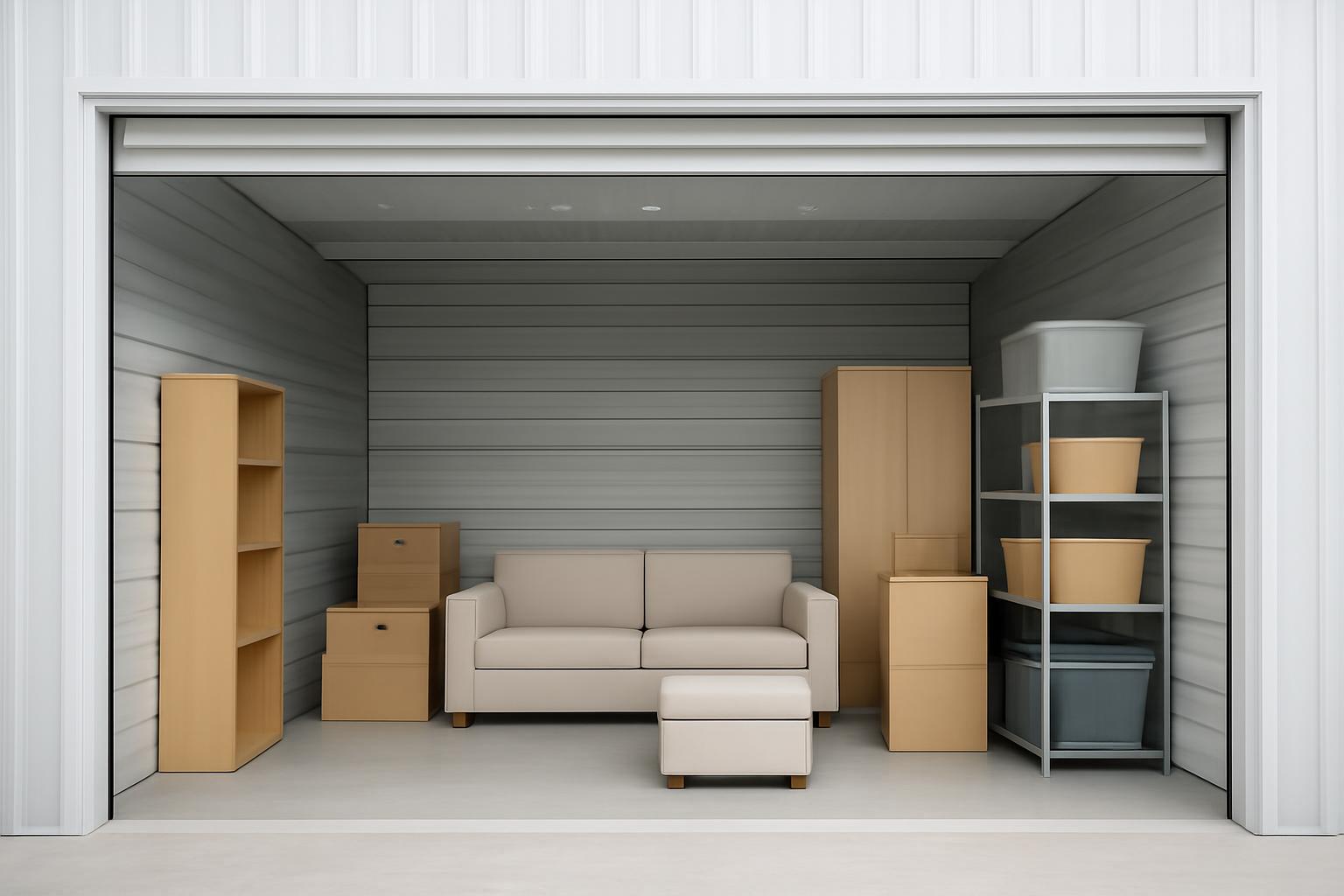
A 20 x 45 x 15 garage sounds simple, but people usually mean one of two things when they search it. Some are evaluating an actual structure size. Others are really asking a storage question: What does that amount of space mean in real life, and can large self-storage replace it?
This guide focuses on the second question. It treats a 20x45x15 garage as a storage envelope, then compares that envelope with the kinds of self-storage units and specialty vehicle bays that come closest in practice. That is the more useful lens for movers, homeowners, estate-cleanout families, remodelers, and RV owners who care less about building specs than about usable capacity, access, and damage prevention.
The key idea is that raw dimensions are only the start. A big shell can be inefficient if you fill it as one dense wall of stuff. A smaller rented setup can also disappoint if ceilings are low, aisles are missing, or your real problem is one tall vehicle rather than lots of boxes. So the right comparison is not just square footage. It is floor area, vertical clearance, access, and how often you need to retrieve things.
Dimensions and Capacity of a 20x45x15 Garage
At the simplest level, a 20-by-45 footprint gives you 900 square feet of floor area, and a 15-foot-tall rectangular envelope works out to about 13,500 cubic feet before you subtract anything for framing, door tracks, shelving, or maneuvering space. Seller listings do show that exact size as a real market configuration; for example, Pacific Metal Buildings lists a 20’x45’x15’ barn-style structure with a 900-square-foot main building in its 20x45x15 metal barn example.
That headline number is useful, but it needs to be separated into three different kinds of capacity:
| Measure | What it is | Why it matters |
|---|---|---|
| Floor area | 900 sq ft | Determines how much footprint you can spread across the floor |
| Gross rectangular volume | ~13,500 cu ft | Shows the theoretical airspace inside a 20x45x15 shell |
| Practical usable capacity | Less than gross | Real storage loses space to access lanes, turning room, shelving, door swing, and items that cannot stack safely |
That distinction matters because a large garage-like shell and a storage facility unit do not use space the same way. A tall private structure gives you more vertical freedom, while many conventional storage units have ceilings in the 7.5- to 10-foot range and require more disciplined packing. LockerHelp’s storage unit size guide also recommends leaving an access margin and notes that, in dense storage layouts, only about 60% of the floor area may be readily accessible at a given moment.
So what does a 20x45x15 garage actually feel like in use? It is large enough to stop being “extra room” and start behaving like a zoned space. Instead of one pile, you can realistically separate the area into a front access zone, side-wall storage, a furniture section, and a rear long-term section. That is often the biggest advantage over smaller units: not just that it holds more, but that it can hold bulky items without instantly becoming impossible to navigate.
A useful comparison point is the common 10x20 storage unit. LockerHelp estimates a 10x20 at roughly 1,500 cubic feet and says it can fit a mid-size car or the contents of a 2- to 3-bedroom home. By floor area, a 20x45 garage footprint is about 4.5 times larger than a 10x20. By raw cubic volume, a 20x45x15 shell is about 9 times larger than a 1,500-cubic-foot 10x20. Those are rough equivalencies, not direct replacements, because ceiling height, stacking safety, and access patterns are different.
Height is the other major differentiator. Fifteen feet is not just “nice to have.” It changes what kind of storage system is possible. Tall shelving, stacked bins, long handled tools on wall systems, hanging gear, and many RV-height use cases all become more realistic in a 15-foot shell than in a typical household storage unit. Average RV heights run roughly 10 to 14 feet depending on class, and Extra Space Storage lists Class A motorhomes at about 12 to 13 feet high and Class C rigs at about 10 to 12 feet high in its RV size guide.
If you are trying to decide whether this is “too big” for normal household needs, the better answer is that it is generous enough to store a substantial move and preserve layout discipline. In other words, the size does not remove the need for planning. It raises the ceiling on what good planning can accomplish.
What Household Items and Furniture Fit in 20x45x15 Space
For household storage, this is not a “few spare rooms” size. It is a serious whole-load footprint. Because a 10x20 is commonly treated as large enough for the contents of a 2- to 3-bedroom home, and a 20x45 footprint equals about 4.5 of those 10x20 floors, a 20x45x15 garage sits well into substantial-move territory even after you allow for aisles and imperfect stacking.
A realistic way to think about the fit is by zones rather than by item count. One workable household layout looks like this:
| Zone | Typical contents | Why it works |
|---|---|---|
| Front section | Items you may need weekly or monthly, labeled bins, tools, cleaning supplies | Fast access without unloading half the space |
| Middle section | Sofas, mattresses, dressers, tables, chairs, appliances | Bulky items stack poorly and should live where you can still work around them |
| Side walls | Shelving, long flat items, mirrors, bed rails, folded tables | Protects the aisle and uses vertical surfaces well |
| Rear section | Archived files, holiday items, long-term boxes, low-priority overflow | Best location for deep storage |
That approach matters because large spaces can waste volume surprisingly fast. A fully assembled bed frame, a dining table with legs attached, or boxes labeled only on top can turn a big footprint into a frustrating maze. Extra Space Storage’s packing and organization guide recommends disassembling furniture when possible, using clear plastic bins for visibility and stronger stacking, labeling clearly, placing frequently needed items near the front, keeping heavy items on the bottom, and leaving pathways for access.
Those guidelines are even more important in a large garage-like shell because the temptation is to assume you can “sort it out later.” Usually that means later you are walking around dead space created on day one. Better practice is to load in priority order:
- Long-term storage at the back
- Mid-priority furniture and boxed goods in the middle
- Access-sensitive items near the front
- Tall or flat items upright along the walls
- A main aisle left open from the start
The access margin deserves emphasis. If you expect to retrieve anything before final move-out, do not plan around 100% occupancy. LockerHelp’s sizing guidance says to leave an access margin and budget only about 60% of the floor area as readily accessible in a tightly packed layout. In a 20x45x15 space, that does not mean the rest is “wasted.” It means that access itself is part of the usable design.
Here is a practical example. Imagine a family storing the contents of a multi-room move:
- 3 bedroom sets, with frames broken down
- 2 sofas and a loveseat
- 1 dining table and chairs
- major loose furniture such as dressers, desks, side tables, and bookcases
- appliances such as a refrigerator, washer, or dryer if the move requires it
- a large number of boxed household goods, seasonal décor, and garage overflow
That kind of load is exactly where the 20x45 footprint helps. Not because every item stacks neatly to 15 feet, but because awkward pieces can sit in their own lane while boxes use the safer vertical capacity around them.
Protection choices matter as much as fit. Source guidance supports a few clear rules:
- break down furniture wherever possible
- use clear plastic bins instead of weak or aging cardboard when practical
- keep heavy items low and fragile items above
- use the empty cavities inside dressers, desks, or cabinets for soft goods or light boxed items
- start with a clean, dry storage area and check for leaks or cracks before loading
For soft goods and sensitive finishes, avoid creating moisture traps. LockerHelp’s prohibited-items guidance warns that leather can mold in humidity when plastic-wrapped, and wet items can become mold substrate quickly. So breathable covers are safer than sealing fabric or leather under non-breathing plastic for long storage.
What this section should leave you with is not a magic item count, but a better standard for judging fit: a 20x45x15 shell can handle a substantial household load, but it works best when you preserve shape, category, and access instead of treating the room as one giant pile.
Vehicle and RV Storage in a 20x45x15 Garage
Yes, many vehicles and many RVs can fit in a 20x45x15 garage on paper. The phrase “on paper” matters.
Extra Space Storage’s RV size guide lists average Class A motorhomes at about 26 to 45 feet long, 8 to 8.5 feet wide, and 12 to 13 feet high. Class C motorhomes average about 20 to 33 feet long, 8 to 8.5 feet wide, and 10 to 12 feet high. Fifth-wheel trailers are listed at roughly 22 to 40 feet long and 12 to 13 feet high. The same guide recommends allowing 1 to 2 feet of clearance and stresses that owners should measure the actual vehicle because awnings, ladders, rooftop AC units, solar, racks, and other modifications change real dimensions.
That makes a 20x45x15 shell promising for many RV use cases. A lot of Class A and Class C rigs fit within those length and height bands. Many trailers and fifth-wheels do too. But the real decision is not whether the shell dimensions look adequate on a chart. It is whether all of these conditions are true at once:
- the overall vehicle length fits with parking margin
- the tallest point clears the actual opening, not just the stated wall height
- the widest point clears mirrors, slide-out hardware, or storage obstructions
- you can still enter, exit, and position the vehicle without a near-perfect maneuver every time
That last point is why “fits” and “works well” are different answers. A 45-foot building can theoretically take a 45-foot vehicle, but that can still be a poor daily experience if door placement, wall storage, or turning angle make the last foot stressful every time you back in.
For ordinary passenger vehicles, the calculation is easier. The practical count depends on how much aisle room, wall shelving, or work space you want to preserve. For daily use, the best layout is rarely the maximum count. A looser plan is easier to park, easier to inspect, and far less likely to turn the wall area into unusable clutter.
That is also where self-storage comparisons become useful. Capital RV & Boat Storage says large units commonly run in the 10x30 to 15x30 range and also offers specialty enclosed spaces up to 30 to 45 feet long, 13 feet wide, and 14 feet high. Those dimensions are much closer to true RV storage than a row of ordinary storage lockers.
A good rule for vehicle owners is simple: chase opening height, bay length, and maneuvering ease before you chase total square footage. Vehicle storage problems are usually clearance problems first.
Self-Storage Unit Equivalents to 20x45x15 Garage
There is no single standard self-storage unit that truly equals a 20x45x15 garage. To compare them honestly, you have to decide which of these you are trying to match:
- floor area
- gross cubic volume
- vertical stacking freedom
- vehicle clearance
- ease of access after move-in
For household goods, the most useful baseline is still the 10x20. LockerHelp’s storage unit size guide estimates a 10x20 at about 1,500 cubic feet and says it typically fits a mid-size car or the contents of a 2- to 3-bedroom home. By footprint, a 20x45 garage is about 4.5 times larger than one 10x20. But because many facilities have 7.5- to 10-foot ceilings rather than 15-foot walls, the garage’s vertical advantage is even larger than the floor comparison suggests.
Here is the comparison in a more decision-friendly format:
| Comparison point | 20x45x15 garage-like shell | Standard self-storage comparison |
|---|---|---|
| Floor area | 900 sq ft | About 4.5 × 10x20 footprints |
| Gross volume | ~13,500 cu ft | About 9 × 1,500-cu-ft 10x20 units by raw math |
| Ceiling height | 15 ft stated | Often 7.5 to 10 ft |
| Best for | Mixed bulky goods, tall shelving, vehicle + household mix | Dense boxed goods, apartment/house moves, smaller vehicle needs |
| Biggest risk | Wasting space through bad zoning | Underestimating how many units or how much aisle room you need |
That does not mean most people should rent five 10x20 units. It means the garage envelope is so large that “one big unit” is rarely the true comparison. In practice, the better matches are usually one of these:
- One or two large household units if your load is mostly furniture and boxes, not vehicles
- One specialty vehicle bay if the main problem is an RV, trailer, or boat
- A mixed setup such as one vehicle bay plus one standard unit for boxed household goods and furniture overflow
For vehicle-oriented needs, specialty inventory matters more than standard unit names. Capital RV & Boat Storage’s size overview describes large units in the 10x30 to 15x30 range and specialty enclosed spaces up to 30 to 45 feet long, 13 feet wide, and 14 feet high. That is much closer to the functional role of a large garage than trying to reconstruct one from several ordinary units.
The tradeoff is simplicity versus flexibility. A single private shell is easier to zone if you have mixed loads. Multiple rented units can work well when your categories are naturally separate, such as “vehicle here, household goods there.” They work less well when you need one space to act like a workshop, garage, and move-storage room all at once.
If you are shopping substitutes, measure the items that create the problem, not the items that pack easily. A sofa can stand up. Boxes can stack. A tall RV, long trailer, or full-height rack system cannot shrink just because a facility calls something a “large unit.”
Real Costs of Large Storage: Garage vs Self-Storage
The evidence here is strongest for self-storage pricing, fees, and billing behavior, so that is the side of the comparison you can quantify confidently.
As a starting benchmark, LockerHelp’s storage size guide puts a 10x20 at about $180 to $320 per month in mid-tier markets. That matters because large-space shoppers often assume they can recreate “garage-sized” capacity cheaply by combining standard units. Sometimes they can. But once you start adding multiple large units, the monthly total stops looking small.
The second cost layer is all the extra line items. LockerHelp’s storage cost breakdown says first-three-month rates are often negotiable depending on occupancy, admin or setup fees commonly run $15 to $35, on-site locks often cost $15 to $25, and facility insurance often adds about $12 to $20 per month unless your homeowner’s or renter’s policy already covers stored belongings. The same guide says national chains may raise rates 20% to 40% after 3 to 6 months on month-to-month leases with notice.
Those details change how you should budget. The cheap advertised number is often just the entry price. Real first-year cost depends on:
- how many units you actually need
- whether you need climate control
- whether you accept the facility’s insurance plan
- whether the move-in rate later resets upward
- whether your layout forces you into a larger unit than the raw item volume suggests
That last point is where many people misjudge big-storage economics. The smallest unit that technically fits is often not the cheapest workable choice if you must keep lanes open and retrieve things during the rental period. LockerHelp’s sizing guidance suggests planning around accessible capacity rather than assuming every square foot remains usable after move-in.
What the current evidence does not support is a precise all-in cost verdict for owning or building a 20x45x15 garage versus renting storage long term. The seller listings in the evidence pack show that 20x45 structures exist in the market, but they are promotional examples with varying specs, states, and configurations. So the safe conclusion is narrower: self-storage has measurable monthly pricing and fee behavior; a private garage is a separate ownership decision whose total installed and lifetime cost is not fully established by this evidence set.
That still leaves you with a practical buying sequence:
- List the largest and most awkward items first
- Decide how much must stay reachable during storage
- Decide whether height or door clearance is the main constraint
- Compare one specialty bay against multiple standard units
- Ask about rate resets, insurance acceptance, and lock requirements before you sign
If a quote looks attractive, always ask what it becomes after the teaser period. Large storage decisions are often won or lost in month four, not month one.
Prohibited Items to Avoid in Any Large Storage Space
For rented self-storage, the lease rules are clear and stricter than many people expect. LockerHelp’s prohibited-items guide says facilities commonly prohibit food and perishables, living things, flammables and combustibles, firearms and ammunition at many facilities, and illegal items. Violations can lead to lease termination, fines, denied insurance claims, and expensive remediation if pests or contamination spread.
That same guidance is useful even when you are thinking about a private garage, but the legal point is different. In self-storage, these categories are often banned by lease. In a private garage, the issue is more about safety, damage, and fire risk than contract language. So treat the source as lease guidance first and hazard guidance second.
A few material risks are especially relevant to large, enclosed spaces:
- wet items mold quickly
- standard non-climate-controlled units can reach about 130 to 140°F in summer
- aerosol cans can rupture above sustained temperatures around 120°F
- leather and other finishes can be damaged by trapped humidity and non-breathable wrapping
Those are not edge cases. They are normal failure modes of unattended storage.
For long-term storage, the items that most deserve climate control or extra caution are the predictable ones: wood furniture, electronics, leather, photographs, documents, fabrics, and anything adhesive, pressure-sealed, or finish-sensitive. LockerHelp’s size guide recommends climate control for wood, electronics, and leather stored long term, and Extra Space Storage likewise advises climate-controlled storage for sensitive belongings.
The simplest screening rule is still the best one: if an item is damp, unstable, edible, flammable, alive, illegal, or irreplaceable, stop and reconsider before it goes into storage at all.
DIY Organization Tips for 20x45x15 Garage or Large Units
Before you buy a rack or assign a wall, sort the load. Go Store It’s garage organization tips recommend dividing everything into keep, donate, throw away, and storage categories. That sounds basic, but it is one of the highest-value steps in a very large space because excess square footage makes it easy to keep low-value clutter for years.
Once you know what stays, organize by both category and frequency. Keep tools together, camping gear together, auto supplies together, archived paperwork together, and seasonal décor together. Then rank those categories by access needs. The category rule keeps like items from scattering. The frequency rule keeps you from burying something you will need next month behind something you will not touch for a year.
After sorting, use the height strategically. Family Handyman’s DIY garage storage ideas highlight the kinds of systems that scale well in a large shell: wall-mounted shelves, hooks, PVC organizers for long gear, cabinets for supplies, and overhead storage for lighter bins. The same ideas are especially effective in a 15-foot-tall space because the real goal is not “more storage.” It is preserving the floor.
A strong organization plan for a 20x45x15 space usually includes four layers:
| Layer | Best use |
|---|---|
| Floor | vehicles, appliances, dense furniture, heavy items |
| Mid-wall | shelves, cabinets, hand tools, grab-and-go bins |
| Upper wall | long flat items, ladders, seasonal gear |
| Overhead | light bins only, and only on systems designed for overhead use |
That last line matters. Overhead space is valuable, but it is not where you hide the heaviest objects you own. Family Handyman’s ideas are best applied to lighter bins and organized long items, not dense furniture or overloaded mystery totes.
A simple working layout for a big garage-like shell often looks like this:
- Front third: access-sensitive items, active tools, car supplies, loading zone
- Middle third: major furniture, labeled boxed goods, appliance groupings
- Back third: archives, seasonal items, deep storage, low-priority overflow
- Walls: shelves, hooks, upright flat storage, long-item racks
- Ceiling/upper systems: light seasonal bins only
Two additional habits make a bigger difference than expensive hardware:
- Label the aisle-facing side, not just the lid
- Make a basic inventory map so “back right shelving, upper bin 3” means something months later
Extra Space Storage’s packing guidance also supports using clear bins, breaking down furniture, leaving access paths, and using furniture cavities as storage. Those are small efficiencies, but in a space this large they compound fast.
The real goal is not maximum density. It is staying functional after month one.
Climate Control and Security for Large Storage Needs
Climate control is not mandatory for every storage job, but it becomes more defensible as storage periods lengthen and item sensitivity rises. According to LockerHelp’s storage size guidance, climate-controlled units often cost about 25% to 50% more than standard units. That premium makes the most sense when the load includes wood furniture, electronics, leather, photos, records, fabrics, or anything that suffers from repeated heat and humidity swings.
The decision is usually simpler if you ask the right question. Do you need climate control for the space, or only for the most vulnerable items?
Preparation matters either way. Extra Space Storage advises cleaning the unit thoroughly before loading, then checking walls, corners, and ceilings for cracks or leaks. In a large garage-like space, that inspection is not housekeeping. It is preventive damage control. A minor moisture problem feels small in an empty room and becomes expensive once the room is full.
Security deserves the same practical mindset. LockerHelp’s prohibited-items guidance notes that gate PIN systems are shared across many tenants and that the lock on the unit is often the primary real barrier. The same source says indoor or upper-level units are generally less exposed than drive-up units for higher-value household goods. In other words, do not confuse perimeter marketing with actual theft resistance.
For a private garage-like structure, the equivalent questions are:
- how strong is the actual door and lock hardware
- how visible is the entry from the street
- how good is the lighting
- how complete is your inventory and insurance documentation
- are the highest-value items sitting near the easiest entry point
That is the boring answer, but it is the useful one. Good lock, documented contents, confirmed coverage, dry conditions, and realistic climate decisions do more to protect stored property than simply renting or owning “a big space.”
What self-storage size equals a 20x45x15 garage for home contents?
There is no exact one-unit equivalent. By footprint, 900 square feet equals about 4.5 standard 10x20 units, and LockerHelp’s storage unit size guide puts a 10x20 at roughly 1,500 cubic feet with many facilities running 7.5- to 10-foot ceilings.
Which RVs fit in 20x45x15 dimensions?
Many Class A and Class C RVs fit on paper. Extra Space Storage’s RV size guide lists Class A motorhomes at about 26 to 45 feet long and 12 to 13 feet high, and Class C models at about 20 to 33 feet long and 10 to 12 feet high. But you still need to verify the true door opening, rooftop accessories, mirrors, and the 1- to 2-foot clearance the same guide recommends.
What are hidden costs in large storage rentals?
The hidden costs are usually not hidden square footage problems; they are fee and billing problems. LockerHelp’s storage cost guide says common extras include admin fees of $15 to $35, required locks of about $15 to $25, and insurance that often adds $12 to $20 per month if outside coverage is not accepted. It also warns that month-to-month rates may rise after 3 to 6 months.
How to prevent damage in large garage-like storage?
Pack for storage, not just for move-in day. Extra Space Storage’s packing guide recommends disassembling furniture, using clear plastic bins, keeping heavy items low, leaving access paths, labeling clearly, and creating an inventory map. LockerHelp’s prohibited-items guide adds the big failure points to avoid: nothing wet, nothing that traps humidity against leather or fabrics, and nothing heat-sensitive such as aerosols in a hot non-climate-controlled space.