
Banker Box Sizes Demystified: Exact Dimensions to Pack Your Storage Unit Right
One basic-duty box is 15 × 12 × 10 inches internally and about 16.25 × 12.5 × 10.5 externally. Compare legal and combo formats before planning space.
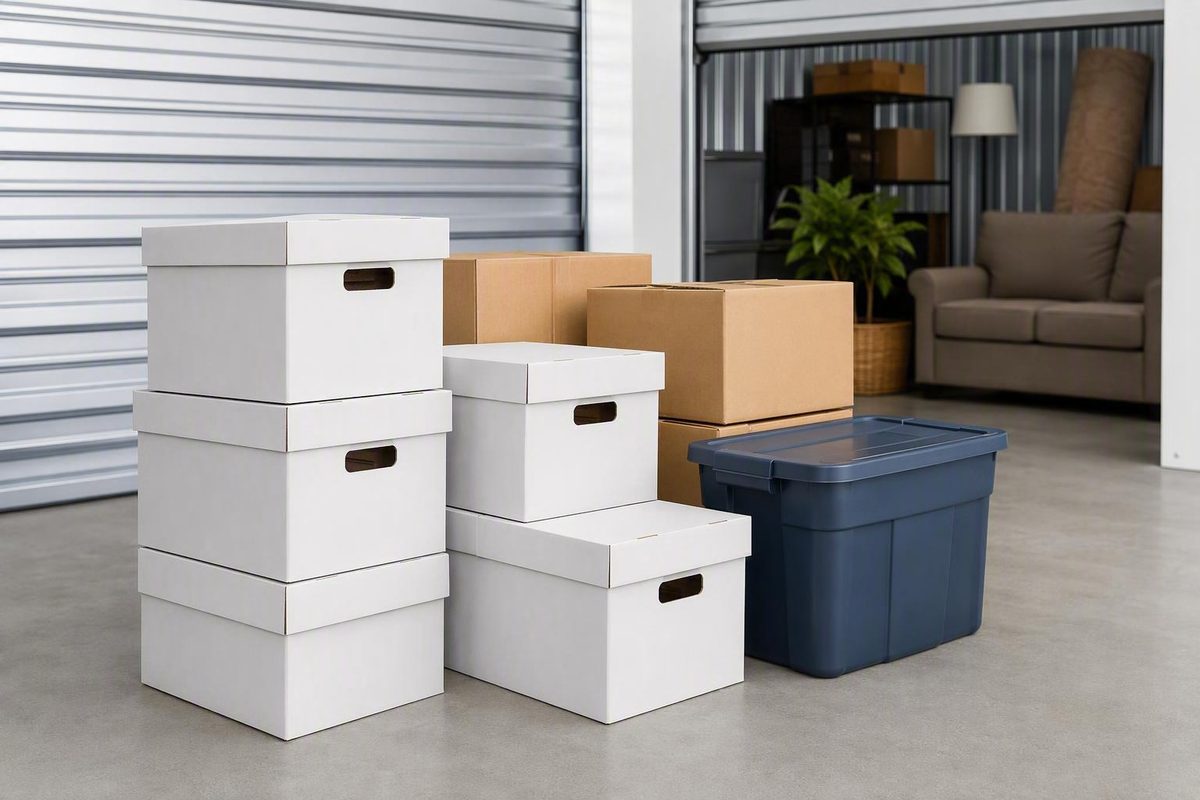
If you are planning file storage for a move, a basement cleanout, or a self-storage unit, “banker box dimensions” does not have one universal answer. Generic “standard” sizes are better treated as commonly cited approximations, not official industry rules.
That distinction matters because people use “banker box” to mean at least three different things: a generic archive-style file box, a branded Bankers Box model, or a specialty variant for legal files, A4 papers, checks, photos, or half-size records. Those categories overlap, but they are not dimensionally identical.
For storage planning, you need two different measurements every time. Internal dimensions tell you whether your files, folders, or hanging rails fit. External dimensions tell you whether the assembled box clears a shelf, stacks well, and uses space efficiently inside a 5×5 or 5×10 unit.
The practical takeaway is simple: use model-specific dimensions when you have them, use generic sizes only as planning shorthand, and normalize everything into one house convention before comparing. In this guide, every measurement is expressed as length × width × height, with each box labeled as internal or external.
What Are Banker Boxes and Why Know Their Dimensions for Self-Storage
A banker box is a document-storage box designed for files and records. In the evidence pack, these boxes are commonly described as corrugated cardboard archive boxes with lift-off lids, hand holes, and, in some cases, tie closures or reinforced construction (The Customize Boxes). Specific branded examples in the same general family include the Bankers Box Stor/File letter/legal box with a lift-off lid and the Stor/File 705 legal-size box with a string-and-button closure (Office Depot item 117300; Nordisco model 705).
For self-storage, dimensions matter in two different ways. The inside tells you whether letter files, legal files, binders, or mixed records will fit at all. The outside tells you whether the assembled box will fit on shelving, whether two boxes can sit side by side on a shelf, and how tightly a row of boxes will pack along a unit wall. Those are separate questions, and a lot of planning mistakes come from treating them as the same one.
That difference becomes obvious with model-specific examples. One basic-duty Stor/File example is listed at 15 × 12 × 10 inches internally and about 16.25 × 12.5 × 10.5 inches externally, so the box you can file into is meaningfully smaller than the box you actually have to stack and store (OXO Packaging).
For volume planning, banker boxes often behave roughly like medium moving boxes, but only roughly. A commonly cited letter-size interior of 15 × 12 × 10 inches works out to about 1.04 cubic feet of internal volume, while LockerHelp says medium moving boxes average about 1.2 to 1.5 cubic feet packed (using 15 × 12 × 10 from The Customize Boxes and LockerHelp’s medium-box estimate in the storage unit size guide). That makes banker boxes a reasonable planning cousin to medium boxes, not a perfect one-to-one match.
There is also real variation by manufacturer, file type, and duty level. Third-party guides commonly cluster basic and medium archive boxes around the letter-size format, but legal-length, combo, heavy-duty, and specialty variants spread out quickly. So the useful question is not “What is the banker box size?” It is “Which banker box type or SKU am I actually using?”
Standard Banker Box Dimensions Across Common Types
The safest way to discuss “standard” banker box sizes is to separate commonly cited generic formats from named model specs. In the evidence pack, there is no single official universal standard that covers every seller and every brand. What you do have is a consistent cluster around a letter-size archive box, plus a longer legal-length format, plus shorter combo formats.
Here is the cleanest normalized shorthand from the available evidence:
- Commonly cited generic letter-size archive box, internal: 15 × 12 × 10 in. Multiple third-party guides repeat this size, sometimes as 10 × 12 × 15 when height is listed first rather than last (The Customize Boxes; OXO Packaging; Dream Custom Boxes; Legal Shred).
- Commonly cited dedicated legal-length box, internal or normalized listing size: 24 × 15 × 10 in. That appears in generic guides and also aligns with a named Bankers Box legal model when the listing is normalized from height × width × depth into length × width × height (Nordisco; also The Customize Boxes, OXO Packaging, Dream Custom Boxes).
- Commonly cited compact letter/legal combo box, external: about 16.25 × 12.5 × 10.5 in (Legal Shred), very close to the exact external size of one named Bankers Box letter/legal SKU discussed below.
The biggest source of confusion is not the numbers themselves. It is the dimension order. One guide may write a letter box as 15 × 12 × 10. Another may write the same footprint as 10 × 12 × 15 because it lists height × width × depth instead of length × width × height. Unless you normalize the order first, comparison shopping becomes needlessly confusing.
The next source of confusion is the word legal. In some contexts, “legal” means a truly long box with a 24-inch side. In others, it means a shorter box marketed for mixed letter/legal filing. Those are not the same storage object.
So if you are buying on dimensions rather than by brand loyalty, always verify these four points before assuming two listings match:
- Is the size internal or external?
- Is the dimension order length × width × height or something else?
- Is “legal” being used for a 24-inch-long box or a combo box?
- Is the listing describing a generic category or a specific SKU?
Model-Specific Dimensions: Popular Bankers Box Examples
When you need actual fit, model-level evidence is much stronger than generic archive-box shorthand. The cleanest example in the pack is the Bankers Box Stor/File item 117300, which Office Depot lists as a letter/legal box with a lift-off lid. Normalized into length × width × height, the assembled external dimensions are 16 5/16 × 12 1/2 × 10 1/2 inches, and the carton contains 4 boxes (Office Depot). For storage planning, that external footprint is the number that matters.
A second clear example is the Bankers Box Stor/File 705 legal-size storage box. Nordisco lists it at 24 × 15 × 10 inches when normalized to length × width × height, with a string-and-button tie closure, sold in a carton of 12. The listing also says it is for moderate stacking or shelving and can be stacked up to five high at an average 550 pounds distributed weight (Nordisco model 705).
Those two SKUs show why generic shorthand is not enough. The 117300 is a relatively compact letter/legal box with a footprint in the mid-16-inch range on its long side. The 705 is a true long-format legal box with a 24-inch side. If you are planning shelves, that is not a minor difference. It changes shelf depth, turning clearance, and how far boxes protrude into a narrow aisle.
A third useful reference is the Stor/File 703 example cited by OXO Packaging. That guide gives the box internal dimensions as 15 × 12 × 10 inches and the external footprint as about 16.25 × 12.5 × 10.5 inches (OXO Packaging basic-duty example). Even though that page is a vendor guide rather than a retailer spec sheet, it illustrates a practical pattern you see often: the familiar filing cavity on the inside and a slightly larger assembled footprint on the outside.
Legal Shred offers a category-level comparison that lands close to those numbers. It lists a standard letter box at 15 × 12 × 10 inches and a letter/legal combo box at 16.25 × 12.5 × 10.5 inches (Legal Shred). That does not make those figures official Bankers Box brand specs, but it does reinforce the general difference between a classic letter archive box and the slightly longer combo format.
Put together, the model-specific evidence supports a more precise rule of thumb:
- Use SKU dimensions when you are buying a named product.
- Use generic dimensions only for rough planning.
- Never assume that two boxes labeled “letter/legal” have the same outside footprint.
Dimensions by Duty Level: Basic, Medium, and Heavy-Duty
Duty level is useful, but not in the way many buyers assume. It tells you more about strength and stacking suitability than about exact size.
In the evidence pack, third-party guides commonly place basic-duty and medium-duty archive boxes in the same broad letter-file class, around 15 × 12 × 10 inches when normalized (OXO Packaging; Dream Custom Boxes). That means moving from basic to medium duty often changes wall strength or bottom design more than it changes the space you need to reserve on a shelf.
The named examples support that logic. Office Depot describes item 117300 as standard duty and gives it an external size of 16 5/16 × 12 1/2 × 10 1/2 inches. OXO’s basic-duty 703 example lands at about 16.25 × 12.5 × 10.5 inches externally.
Heavy-duty is where generic sizing gets inconsistent. One guide lists a large/heavy-duty box at 17 × 12.5 × 10.5 inches (Legal Shred). Other guides describe heavy-duty options as either a letter-size format around 15 × 12 × 10 inches or a long legal/combo format around 15 × 24 × 10 inches (OXO Packaging; Dream Custom Boxes). So “heavy-duty banker box dimensions” is not a dependable search phrase by itself. It can point to a stronger letter box, a larger combo box, or a long legal-length file box.
The same caution applies to stacking claims. OXO says a basic-duty box can support up to 450 pounds. Nordisco says the Stor/File 705 can be stacked up to five high at an average 550 pounds distributed weight. Legal Shred gives a more general safe stacking guideline of 4 to 5 high. Those are useful as reference points, but they are still model-specific or guide-level numbers, not a universal promise for every archive box.
Specialty drawer-style formats widen the spread further. Dream Custom Boxes describes drawer-style banker boxes as generally running about 24 inches on the long side, 12 to 15 inches on the short side, and 10 to 12 inches high. That is a useful planning clue, but it is exactly the sort of category-level dimension that should be treated as approximate rather than official.
So for planning purposes, use duty level to answer this question: How safely can I stack and handle the box when full? Use model specs to answer this one: How much space does it actually take up?
Letter vs Legal vs Combo: File Size Dimensions Guide
If your goal is simple fit, the cleanest distinction is not duty level. It is file type.
For letter-size files, the most commonly cited generic banker box interior is 15 × 12 × 10 inches, sometimes written as 10 × 12 × 15 in a different measurement order (The Customize Boxes; OXO Packaging; Dream Custom Boxes; Legal Shred). This is the archive-box shape most people picture when they think of a standard records box.
For legal-size files, the important question is whether you need a true legal-length box. In the evidence pack, the long-format legal example is 24 × 15 × 10 inches when normalized to length × width × height, and the named Stor/File 705 matches that format (Nordisco model 705; also OXO Packaging and Dream Custom Boxes on generic legal-length sizing). That extra-long side is what changes your shelf planning.
For combo or letter/legal boxes, a common external size is about 16.25 × 12.5 × 10.5 inches according to Legal Shred, and the named Bankers Box 117300 sits very close to that at 16 5/16 × 12 1/2 × 10 1/2 inches externally (Legal Shred; Office Depot item 117300). In other words, combo boxes are often only modestly larger than a classic letter box on the outside. They are not automatically the same thing as a 24-inch legal-length records box.
For small or half-size records boxes, Legal Shred lists 12.5 × 8 × 10 inches.
A practical way to choose among them:
- Pick letter if your records are standard U.S. letter files and you want the most familiar archive-box footprint.
- Pick true legal-length if your filing system actually depends on the long side and you have shelf depth to support it.
- Pick combo if you want some mixed-format flexibility without stepping all the way up to a 24-inch-long box.
- Pick half-size if carry weight matters more than storage density.
For self-storage, that distinction matters more than the label on the marketing page. Ten compact combo boxes and ten true legal-length boxes can represent very different aisle and shelf requirements even when both are described casually as “banker boxes.”
Internal vs External Dimensions and Volume Calculations
Internal and external dimensions should never be used interchangeably.
Internal dimensions describe the usable cavity. That is what matters for file fit. External dimensions describe the assembled outer footprint. That is what matters for shelving, stacking, and aisle clearance.
The Stor/File 703 example makes that difference concrete. OXO Packaging lists it at 15 × 12 × 10 inches internally and about 16.25 × 12.5 × 10.5 inches externally. In that example, the assembled box grows by about 1.25 inches on the long side and about 0.5 inch on the other two dimensions once walls, folds, and lid are included (OXO Packaging basic-duty example).
That difference is why two common planning errors keep happening. First, people size shelving to the filing cavity rather than the assembled box. Second, they calculate unit capacity using interior volume and forget that the outer footprint is what actually occupies floor area.
Using the commonly cited 15 × 12 × 10 inch internal letter-box size, the internal volume is about 1,800 cubic inches, or 1.04 cubic feet once you divide by 1,728 cubic inches per cubic foot (using the 15 × 12 × 10 dimensions cited by The Customize Boxes, OXO Packaging, Dream Custom Boxes, and Legal Shred).
But similar is not identical. LockerHelp says medium moving boxes average about 1.2 to 1.5 cubic feet packed, so a common letter-size banker box is somewhat smaller internally than the average packed medium moving box in that guide (LockerHelp storage unit size guide). That is close enough to use as a planning benchmark, but not close enough to pretend the categories are exactly interchangeable.
Weight reinforces that point. Legal Shred says an empty banker box weighs about 1 to 2 pounds, a box full of paper is around 30 to 35 pounds, and a box full of legal files is about 35 to 40 pounds.
A4-oriented variants show the same internal-versus-external caution. One third-party guide lists an A4 banker box at about 12 × 14.9 × 11.2 inches (The Customize Boxes), while Dream Custom Boxes gives a different A4 approximation. That disagreement is exactly why international and specialty formats should be treated as model- or seller-specific rather than assumed to be standardized.
The simplest workflow is:
- Choose the box by internal dimensions.
- Plan shelves and stacks by external dimensions.
- Use cubic feet only as a rough planning layer after you know which actual box you have.
That order keeps storage math grounded in the real object rather than in a shorthand number.
How Many Banker Boxes Fit in Popular Self-Storage Units
The evidence pack does not directly give banker-box-specific counts for each unit size. What LockerHelp gives is a first-party benchmark for medium moving boxes, and that is the most defensible planning proxy here.
If you are still deciding between unit sizes, the storage unit size guide gives the broader fit context behind these banker-box estimates.
LockerHelp estimates that a 5×5 unit at roughly 188 cubic feet fits about 10 to 15 medium moving boxes stacked three high, a 5×10 at roughly 375 cubic feet fits about 20 to 25 boxes, and a 10×10 at roughly 750 cubic feet fits about 30 to 40 medium boxes stacked 3 to 4 high. The same guide advises leaving about 20% of the space for access rather than packing every inch wall to wall (LockerHelp storage unit size guide).
For banker boxes, those counts should be read as planning estimates only if your boxes are in the common archive-box size class. That is a fair approximation because a commonly cited letter-size banker box has about 1.04 cubic feet of internal volume, while LockerHelp’s medium moving boxes average 1.2 to 1.5 cubic feet packed (The Customize Boxes and LockerHelp storage unit size guide). A true legal-length box, however, changes layout enough that the same cubic-foot math can feel very different in practice.
A reasonable interpretation looks like this:
If you are stacking banker boxes on pallets or warehouse-style shelves, Legal Shred offers another planning reference: a standard 48 × 40 inch pallet can hold about 40 to 50 standard banker boxes, with a general safe stacking range of 4 to 5 high. That is useful for bulk staging, but it should not be mistaken for a guarantee about what feels usable inside a self-storage unit (Legal Shred).
The most important storage lesson here is that access matters as much as capacity. A technically full unit is not necessarily a usable unit. If you cannot reach last year’s tax files without unstacking twelve boxes, you sized for maximum occupancy instead of real retrieval.
True legal-length boxes make that tradeoff sharper. The 24-inch long side on a box like the Stor/File 705 can eat shelf depth and walking space much faster than a compact letter or combo box. So when two units have the same headline cubic footage, the more usable one may simply be the one that lets your specific box footprint work cleanly.
International and Specialty Variants: A4, A5, Small Sizes
In the U.S., most shoppers mean letter or legal when they say “banker box.” Once you move into A4, A5, photo, check, or other specialty storage, the naming gets looser and the dimensions get less stable.
For A4, one third-party guide lists about 12 × 14.9 × 11.2 inches (The Customize Boxes), while another gives a different A4 approximation. That does not make either number unusable. It simply means A4 banker boxes are better treated as seller-specific formats than as a settled standard.
For A5, The Customize Boxes gives about 7 × 12 × 10 inches. Dream Custom Boxes gives a different A5 example, again reinforcing the same point: once you leave the mainstream letter/legal archive-box world, consistency drops off.
For small banker boxes, The Customize Boxes gives a broad range of roughly 12 to 14 inches long, 10 to 12 inches wide, and 10 to 12 inches high. That is useful as a category-level picture, but it is still a range, not a specification.
Dream Custom Boxes also lists specialty dimensions for narrower-use storage, including check-storage boxes with a 24-inch long side and photo-storage formats sized around common photo dimensions. Those examples are helpful mainly because they show how far the term “banker box” can stretch outside general file storage.
For self-storage planning, specialty sizes cut both ways.
That is why many storage users do best with one dominant box footprint and only a few specialty boxes around it. Uniformity helps more than people expect, especially when they are trying to build stable rows and preserve access in a small unit.
Practical Tips: Stacking Weights, Materials, and Storage Best Practices
Weight matters almost as much as dimensions when you are storing dense paper. Legal Shred puts empty banker boxes at about 1 to 2 pounds, boxes full of paper at about 30 to 35 pounds, and boxes full of legal files at about 35 to 40 pounds (Legal Shred).
For stacking, the evidence pack supports a cautious middle ground rather than an aggressive one. Legal Shred gives a general safe range of 4 to 5 high. Nordisco says the Stor/File 705 can be stacked up to five high at about 550 pounds distributed weight. OXO Packaging says a basic-duty example can support up to 450 pounds.
Material choice also matters. OXO Packaging suggests kraft for small boxes, cardboard for medium boxes, and corrugated cardboard for large boxes. That is best read as a practical rule of thumb rather than a universal materials standard, but it matches common sense: as paper load increases, the box needs more structural support.
For long-term document storage, the strongest caution in the first-party evidence is environmental rather than dimensional. LockerHelp advises against long-term document storage in cardboard boxes in non-climate-controlled units because moisture swings, pests such as silverfish, and thermal cycling can degrade paper. Its recommendation is to use plastic bins with lids and silica gel packets instead (LockerHelp guidance on what not to store and why).
That does not make banker boxes a bad product. It just narrows the ideal use case. They are less ideal for multi-year paper preservation in uncontrolled heat and humidity.
If your main goal is to rent the smallest viable unit without creating a retrieval nightmare, the best practice is straightforward:
- confirm the exact external footprint of the boxes you own,
- keep loaded weights in the manageable archive-box range,
- leave real access space instead of packing to the theoretical maximum,
- and reserve cardboard banker boxes for situations where access and organization matter more than museum-level paper preservation.
What is the standard banker box size?
There is no single universal size supported as an official standard across every brand. The most commonly cited generic letter-size banker box dimension in the evidence pack is 15 × 12 × 10 inches internally, sometimes written as 10 × 12 × 15 in a different measurement order (The Customize Boxes; OXO Packaging; Dream Custom Boxes; Legal Shred).
What are Bankers Box Stor/File letter/legal dimensions?
For the named Bankers Box Stor/File item 117300, Office Depot lists the assembled external dimensions as 16 5/16 × 12 1/2 × 10 1/2 inches, with a lift-off lid, sold in a 4-pack (Office Depot).
How many banker boxes fit in a 5x10 storage unit?
LockerHelp directly estimates a 5×10 at about 20 to 25 medium moving boxes, not banker boxes specifically. That is a reasonable planning proxy only if your banker boxes are in the common archive-box size range, since a typical letter-size banker box is about 1.04 cubic feet internally and LockerHelp’s medium boxes average about 1.2 to 1.5 cubic feet packed (LockerHelp storage unit size guide; generic 15 × 12 × 10 dimensions from The Customize Boxes).
Letter vs legal banker box dimensions?
A commonly cited letter-size banker box is about 15 × 12 × 10 inches internally. A true legal-length version is commonly shown around 24 × 15 × 10 inches when normalized to length × width × height. Combo boxes are often shorter than that, with an external footprint around 16.25 × 12.5 × 10.5 inches rather than a full 24-inch run (Nordisco model 705; Legal Shred; OXO Packaging; Dream Custom Boxes).
Internal vs external banker box measurements?
Internal measurements describe the usable filing space. External measurements describe the assembled outside footprint. In one basic-duty example, the box is 15 × 12 × 10 inches internally and about 16.25 × 12.5 × 10.5 inches externally, which is why shelf and unit planning should use the outside size, not the filing cavity (OXO Packaging basic-duty Stor/File 703 example).