
Master Shoe Box Sizes to Fit More in Your Storage Unit and Save Money
The common adult average is 13 × 7.5 × 4.5 in. Retail boxes suit storage estimates, while shipping requires the carton's outside dimensions.
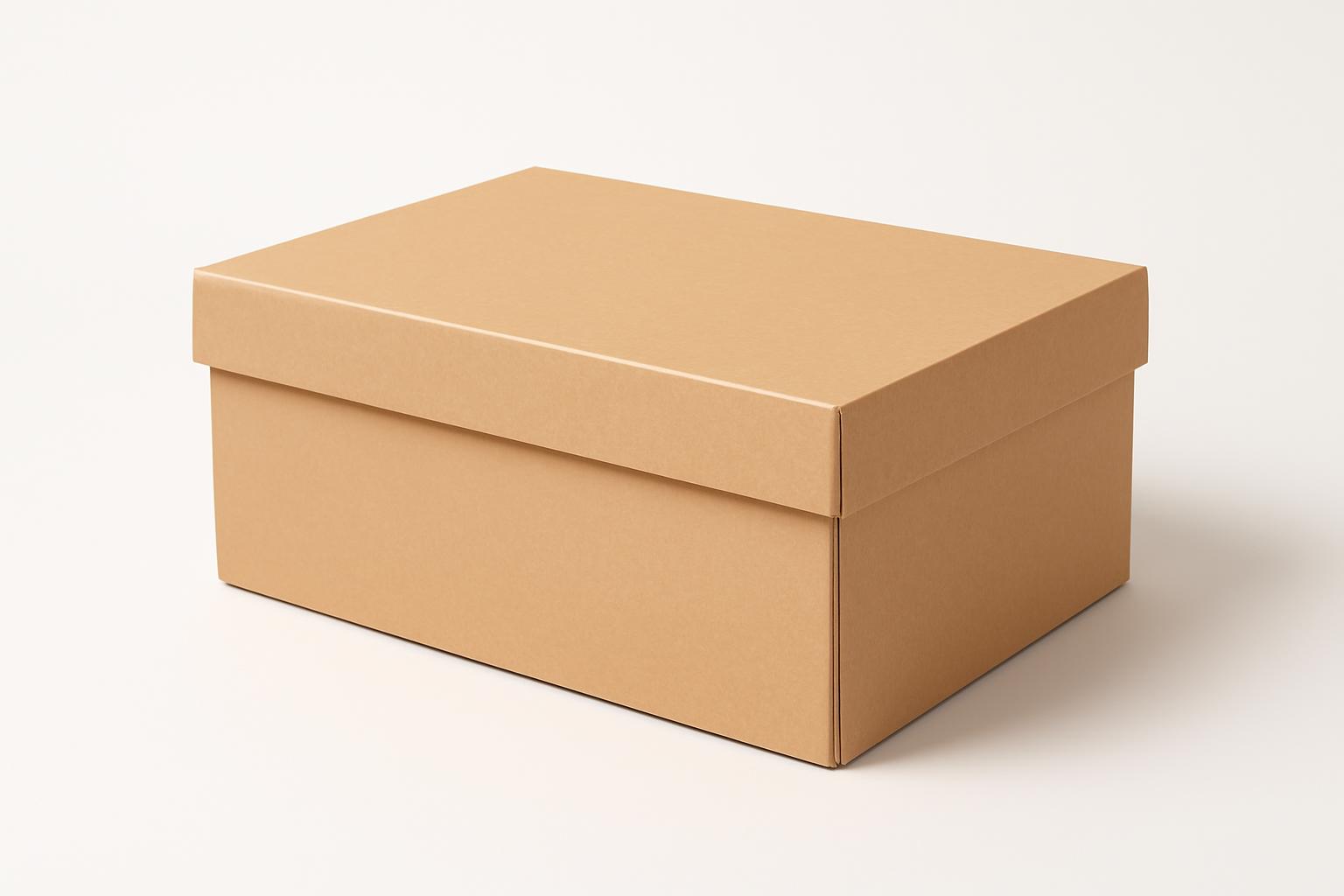
There is no single universal shoe box size. That is the first thing to know if you are trying to store a shoe collection, ship a pair safely, or estimate how much room boxed shoes will take on a shelf or in a self-storage unit.
What does exist is a usable pattern. Across multiple packaging-industry references, adult shoe boxes repeatedly cluster around a few common ranges. A practical overall average is about 13 in long × 7.5 in wide × 4.5 in high — roughly 33 × 19 × 11.5 cm. Men’s boxes usually run a bit longer or wider, women’s boxes slightly smaller, and children’s boxes much smaller. Boots and some athletic shoes sit outside the average because they often need more height or depth.
That average is useful even though it is not an official standard. It gives you a planning unit for storage, shelf layout, and shipping. It also helps explain why the phrase shoe box size can be confusing: sometimes people mean a retail shoe box, and sometimes they mean a shipping carton such as the official USPS Priority Mail Shoe Box, which has its own published dimensions.
One important caveat up front: most published shoe-box dimension guides come from packaging companies, not from a central standards body. So the numbers in this article should be treated as common ranges and consensus estimates, not as permanent official standards for every brand and every shoe line. Where exact published specifications exist — most notably for USPS packaging — those are called out separately.
Why Shoe Box Size Matters for Self-Storage
For self-storage, shoe box dimensions matter because they let you plan with measurements instead of guesswork.
LockerHelp’s storage size guide says the most expensive mistake in self-storage is renting by feel rather than measurement, and it frames common unit sizes by real cubic footage so renters can avoid taking more space than they actually need. That principle applies well to boxed shoes because shoe collections often look small in a room but add up fast when you keep the original boxes.
Using the common adult average of 13 × 7.5 × 4.5 inches, one retail shoe box occupies about:
- 438.75 cubic inches
- or about 0.25 cubic feet
That seems minor until you multiply it:
- 10 adult boxes = about 2.5 cubic feet
- 20 adult boxes = about 5 cubic feet
- 50 adult boxes = about 12.5 cubic feet
Those figures are only for the boxes themselves. They do not include shelf thickness, access space, stack inefficiency, or the other things most people store alongside shoes.
LockerHelp describes common storage sizes this way:
- 5×5 = about 188 cubic feet
- 5×10 = about 375 cubic feet
- 10×10 = about 750 cubic feet
On paper, that makes even a fairly large shoe collection look tiny compared with a storage unit. In practice, usable space is always lower than the raw cubic-foot number suggests. Boxes do not pack perfectly, different brands vary in width, boot boxes interrupt neat stacking, and many renters want at least some ability to reach specific pairs without rebuilding an entire wall of boxes.
That is why shoe box size is helpful as an estimating tool, not as a magic “boxes per unit” answer.
A simple planning method works well:
- Start with the average size of the boxes you actually own.
- Convert that to volume.
- Multiply by the number of pairs.
- Compare the result with the unit’s cubic footage.
- Then reduce your theoretical capacity for access, uneven stacking, and anything else stored in the unit.
Two quick examples show why this is useful:
- A collection of 12 adult boxed pairs at roughly 0.25 cubic feet each is about 3 cubic feet before any wasted space.
- A mixed household stash of 20 adult boxes plus 10 children’s boxes can still add up meaningfully. Using a common children’s example of 8 × 5 × 3 inches, each children’s box is about 120 cubic inches, or about 0.07 cubic feet. That puts the mixed total at roughly 5.7 cubic feet before gaps and access space.
So the point is not that shoe boxes require a large unit by themselves. The point is that once shoes are boxed, stacked, and combined with luggage, bins, furniture, or seasonal items, the real storage footprint becomes easier to estimate when you know the box dimensions first.
Average Shoe Box Dimensions Across All Types
If you want one baseline number, use this:
Average shoe box size: about 13 × 7.5 × 4.5 inches Metric equivalent: about 33 × 19 × 11.5 cm
That average appears repeatedly across packaging references and is a solid planning benchmark for standard adult retail boxes. But it is still an approximation, not a rule. There is no universal shoe-box standard used by every manufacturer.
Published dimensions vary because of:
- men’s, women’s, and children’s sizing
- sneakers vs. dress shoes vs. boots
- shoe size within the same category
- brand packaging choices
- regional packaging preferences
- retail box vs. shipping box use
That last distinction matters. A retail shoe box is usually sized closely around the shoes. A shipping box is often larger so it can hold the retail box and some protective material.
Here is a practical reference table.
| Box type | Typical dimensions | Metric equivalent |
|---|---|---|
| Overall average shoe box | 13 × 7.5 × 4.5 in | 33 × 19 × 11.5 cm |
| Common shipping box example | 14 × 8 × 5 in | 35.5 × 20 × 12.5 cm |
| USPS Priority Mail Shoe Box outer size | 14-7/8 × 5-1/4 × 7-3/8 in | about 37.8 × 13.3 × 18.7 cm |
Those numbers come from different kinds of sources. The first two reflect common packaging-reference averages. The USPS figure is an official postal specification for a named shipping product.
How to calculate shoe box volume
The standard formula is:
Length × Width × Height = Volume
For the average adult retail box:
- 13 × 7.5 × 4.5 = 438.75 cubic inches
- 438.75 ÷ 1,728 = about 0.25 cubic feet
For the USPS Priority Mail Shoe Box outer dimensions:
- 14.875 × 5.25 × 7.375 = 575.42 cubic inches
That exact USPS number is especially useful because it shows how different a shipping-oriented shoe box can be from a standard retail one. Compared with the average adult retail box, the USPS box is taller and narrower.
The main takeaway is simple:
- For storage planning, the average retail-box dimensions are usually the right starting point.
- For shipping, use the actual outside dimensions of the shipping carton, because carriers bill based on the shipping package, not the shoe box inside.
Shoe Box Sizes by Gender and Age
The most useful broad breakdown is by men’s, women’s, and children’s boxes. These are still ranges, not strict standards, but they are good working estimates for shelf planning, stacking, and rough storage calculations.
| Category | Typical size in inches | Typical size in cm |
|---|---|---|
| Men’s | 13–14 L × 7–8 W × 4–5 H | 33–35.5 L × 18–20 W × 10–13 H |
| Women’s | 12–13 L × 7–8 W × 4–5 H | 30.5–33 L × 18–20 W × 10–13 H |
| Children’s | 7–10 L × 5–6 W × 2–4 H | 18–25.5 L × 13–15 W × 5–8 H |
These ranges reflect the broad consensus across the packaging references, even though individual articles sometimes publish slightly different “standard” examples.
Men’s shoe boxes are usually the largest of the three core categories. A practical planning range is:
- 13 to 14 inches long
- 7 to 8 inches wide
- 4 to 5 inches high
Some references report wider men’s boxes — especially for athletic styles or larger sizes — sometimes pushing width toward 9 or 10 inches. That does not make 9- or 10-inch width universal. It means the wide end of men’s packaging can be noticeably bulkier than a basic dress-shoe box.
Women’s shoe boxes are usually slightly shorter and sometimes a bit lower:
- 12 to 13 inches long
- 7 to 8 inches wide
- 4 to 5 inches high
A frequently cited women’s example is 12 × 7 × 4 inches, but women’s sneakers and fashion styles often edge closer to the overall adult average.
Children’s shoe boxes are much smaller, and the category varies more by age:
- 7 to 10 inches long
- 5 to 6 inches wide
- 2 to 4 inches high
You will see smaller toddler examples such as 8 × 5 × 3 inches, and somewhat larger youth examples around 10 × 6 × 3.5 inches.
The important planning point is this: these are working ranges, not official standards. If you are estimating storage for a mixed household, the overall adult average may be enough. If you are planning a closet, shelving system, or shipping supply order, it is smarter to separate adult men’s, adult women’s, and children’s boxes first, because the differences are real enough to affect fit.
Brand-Specific Shoe Box Size Examples
Brand packaging is one reason there is no universal shoe box size. Nike, Adidas, Puma, Reebok, and Converse all show up in the same general adult range, but the reported dimensions differ enough to matter when you are stacking dozens of boxes or choosing a shipping carton.
These are best read as representative third-party examples, not as permanent official standards from the brands themselves. Packaging changes over time, and a brand’s box can vary by model, size run, and market.
| Brand | Example men’s box | Example women’s box | Notes |
|---|---|---|---|
| Nike | about 13.4 × 9.4 × 4.7 in | about 12 × 7 × 4 in | Men’s example is wider than the overall average |
| Adidas | about 13.5 × 8.5 × 5 in | about 12.6 × 7.9 × 4 in | Close to the common adult range |
| Puma | about 13 × 7.5 × 4 to 4.5 in | about 11.5 × 7 × 4 in | Similar footprint to standard adult boxes |
| Reebok | about 13 × 8.7 × 4.3 in | not consistently cited | Athletic styles can run wider |
| Converse | about 13 × 7.5 × 5 in | about 12 × 7 × 4 in | Height can be slightly taller |
A few practical implications follow from those examples.
First, width is often the biggest day-to-day difference. A half-inch or inch of extra width affects shelf depth, row alignment, and how neatly boxes stack against one another.
Second, the examples reinforce the idea that athletic boxes often run wider than simple casual or dress-shoe packaging. That matters more in a closet or on shelving than a small difference in length usually does.
Third, for shipping, the actual retail box matters because your outer carton has to fit it. A wide men’s sneaker box and a narrow women’s fashion box do not need the same mailer.
If you are organizing at home, the safest move is not to rely too heavily on brand averages at all. Use them to understand the landscape, then measure your own largest boxes before buying shelves or bins. The reported brand dimensions are useful reference points, but they are not universal brand standards.
USPS Priority Mail Shoe Box Dimensions
The most exact published specifications in this topic come from the USPS Priority Mail Shoe Box, because USPS provides both inside and outside measurements.
USPS Priority Mail Shoe Box dimensions
Outside dimensions:
- 14-7/8 in length
- 5-1/4 in width
- 7-3/8 in height
Inside dimensions:
- 14-3/8 in length
- 5-1/8 in width
- 7-1/4 in height
USPS also publishes:
- Girth: 25.300 inches
- Outer dimensional volume: 575.42 cubic inches
There is a small inconsistency in the USPS listing. The main specifications give the inside height as 7-1/4 inches, while a comparison table on the same listing gives 7-1/2 inches. The safest interpretation is to treat 7-1/4 inches as the primary specification and recognize that the listing contains a minor discrepancy.
USPS describes the box as a Priority Mail packaging option for footwear, intended for shipping footwear by sliding in a boxed pair of shoes. The listing also notes:
- Priority Mail service
- maximum 70 pounds
- $100 insurance included
Those terms apply to the USPS mailing product, not to retail shoe boxes generally.
Why does this box matter so much in a shoe-box guide?
- It is one of the few cases where the dimensions are officially published rather than estimated by third-party packaging sites.
- It shows clearly that a shipping shoe box can have a very different shape from a retail shoe box.
Its proportions are narrower and taller than the common adult retail average. So it is useful for postal planning, but it is not a good stand-in for a standard closet stack of retail shoe boxes.
Shoe Box Sizes by Type: Sneakers, Heels, Boots
Shoe type changes box size almost as much as gender and age do. The evidence here is thinner and less standardized than the men’s/women’s/children’s ranges, so it is best to think in terms of tendencies rather than strict dimensions.
Sneakers and athletic shoes usually stay near normal adult box lengths, but they often run wider or deeper than dress shoes because of thicker soles and bulkier uppers. That pattern shows up repeatedly across packaging references and also helps explain why some men’s brand examples are notably wide.
In practice, that means:
- men’s athletic boxes often sit at the wide end of adult ranges
- women’s sneaker boxes may be closer to the overall adult average than slim fashion-shoe boxes
- some athletic boxes also appear slightly taller
If most of your collection is running shoes, basketball shoes, or chunky sneakers, the plain 13 × 7.5 × 4.5 benchmark may understate the shelf depth you need.
Heels are more variable. Published guidance agrees that high heels usually need more vertical clearance than flats, but it is not consistent enough to support one firm standard. One packaging source suggests a modest increase in box height, roughly 2 to 4 cm, while others simply note that heel boxes tend to be taller or shaped differently. The safer conclusion is that heel boxes often stay close to standard women’s footprints in length and width, but are less uniform in height.
Boots are the clearest outlier. Multiple packaging references describe boot boxes as much taller than standard adult shoe boxes, often around 10 to 14 inches high.
That is a major shift. A standard adult box may be only 4 to 5 inches high. A boot box can be more than double that, which changes storage planning quickly:
- fewer layers fit in the same vertical stack
- shelf spacing has to increase
- stacks become less uniform
- total volume rises faster than many people expect
Casual and dress shoes usually stay closest to the standard adult ranges already covered. Pointed dress shoes may slightly lengthen the box, but they usually do not create the same storage problems as tall boots or bulky athletic footwear.
A good planning rule is to separate your collection into broad types before you estimate:
- sneakers or athletic shoes
- heels
- boots
- ordinary casual or dress shoes
That approach is more reliable than pretending one “shoe box size” covers all footwear.
How to Measure Shoe Box Dimensions Accurately
Accurate measurement is simple, but consistency matters. Some packaging examples use inconsistent labels, so it helps to stick to the plain physical definition of each dimension.
Measure in this order:
- Length: the longest side, usually front to back
- Width: the shorter horizontal side, side to side
- Height: bottom to top
Write the result as:
Length × Width × Height
For example:
13 × 7.5 × 4.5 inches
Outside vs. inside dimensions
Whether you measure the outside or the inside depends on your goal.
Use outside dimensions when you are:
- planning shelf footprint
- stacking boxes in a closet or storage unit
- comparing with a shipping carton
- estimating dimensional weight
Use inside dimensions when you are:
- checking whether a particular pair of shoes will fit
- planning tissue, inserts, or accessories
- designing packaging around the contents rather than around the outside footprint
Some packaging guides recommend leaving modest internal clearance rather than sizing a shoe box right to the exact shoe outline. One commonly cited rule of thumb is roughly 1 to 1.5 cm in length and 1 to 2 cm in width and height. That can be useful as a packaging estimate, but it should be treated as a vendor guideline, not as a universal rule. If you are working with an actual pair of shoes, inserts, or tissue paper, measuring the real contents is better than relying on a generic allowance.
The same caution applies to shipping cartons. Several packaging sources suggest using an outer carton about 20% larger than the retail box to allow for protective material. Again, that is best treated as a rough rule of thumb, not as a fixed standard. The goal is modest padding space, not dead air.
Material thickness matters
Box material reduces usable interior space, especially when you are comparing a retail box with a shipping carton.
Published material-thickness ranges commonly fall around:
- 1 to 3 mm for lighter cardboard or kraft styles
- 3 to 5 mm for corrugated board
That sounds minor, but when a fit is tight, a few millimeters matter — especially in narrow mailers or when you are trying to fit a retail box inside a shipping box.
A simple measuring routine
- Put the box on a flat surface.
- Measure the longest outside edge for length.
- Measure the shorter outside edge for width.
- Measure from the base to the top for height.
- If fit matters, repeat the process inside the box.
- Note anything that affects stacking, such as lid overhang or corner crush.
Common measurement mistakes
- mixing inside and outside dimensions in the same calculation
- turning the box and changing which side you call length
- ignoring lid thickness
- forgetting tissue, inserts, or thick soles
- using a brand’s reported average instead of measuring your actual box
For one pair of shoes, a small error is not a big deal. For a large collection, shipping-supply order, or shelf build, those small errors accumulate.
Fitting Shoe Boxes into Self-Storage Units
Self-storage planning works best when you combine shoe-box dimensions with the published cubic footage of the unit and then add a reality check for access and stacking.
LockerHelp’s storage size guide gives these common reference points:
- 5×5: about 188 cubic feet
- 5×10: about 375 cubic feet
- 10×10: about 750 cubic feet
- typical ceilings: roughly 7.5 to 10 feet
Those figures are useful, but they should not be turned into exact shoe-box counts. The evidence does not support a universal answer to “How many shoe boxes fit in a 5×5?” because the result depends on ceiling height, aisle space, shelving, mixed box sizes, and what else is stored in the unit.
What the LockerHelp guide does establish is the broader unit context:
5×5 unit
LockerHelp describes a 5×5 as similar to a large walk-in closet and says realistic contents include:
- a twin mattress set or a queen mattress alone
- 10 to 15 medium moving boxes stacked three high
- a bicycle, flat art, or seasonal equipment
For shoe storage, that is best used as a scale reference, not as a shoe-specific guarantee. It tells you a 5×5 is a small unit whose real usefulness depends heavily on how tightly and how accessibly you load it.
5×10 unit
LockerHelp describes a 5×10 as about half a standard one-car garage and says realistic contents include:
- studio apartment contents
- a sofa, queen bed, dresser
- 20 to 25 boxes
The guide also warns that people tend to overestimate what a 5×10 holds once they try to preserve an aisle and stack properly. That is directly relevant if shoes are only one part of the load.
10×10 unit
LockerHelp describes a 10×10 as suitable for the contents of a one-bedroom apartment, including:
- bedroom and living-room furniture
- a dining set
- 30 to 40 medium boxes
Again, the important point is context. A 10×10 is a furniture-plus-boxes unit, not a shoe-storage benchmark.
A better way to use those unit sizes
Instead of asking, “Which unit size is for shoes?” ask:
- What is the box volume of my collection?
- How much of the unit do my other items take?
- How much access do I want after loading?
- What is the ceiling height?
A few rough examples make that easier:
- 20 adult retail boxes at about 0.25 cubic feet each = roughly 5 cubic feet
- 40 adult retail boxes = roughly 10 cubic feet
- 50 adult retail boxes = roughly 12.5 cubic feet
Those numbers are small compared with a 188-cubic-foot 5×5, but they still do not answer the real-life layout question. Once you add shelves, bins, suitcases, furniture, or a desire to reach specific pairs, the practical space required grows.
Ceiling height matters too. LockerHelp notes that the same floor footprint holds more at a 10-foot ceiling than at a 7.5-foot ceiling. That matters for boxed shoes because they stack well only up to the point where the stack becomes unstable or inaccessible.
So the safe storage conclusion is this: use shoe-box dimensions to estimate your collection’s volume, then compare that estimate with the unit’s published cubic footage, and only then make a decision. That is much more reliable than choosing a unit by eye.
If you are comparing units in detail, a dedicated storage unit size guide is the better next step than trying to infer capacity from floor area alone.
Shipping Considerations for Shoe Boxes
A good shipping box is not just “big enough.” It needs to fit the product closely enough to avoid wasted dimensional weight while still leaving room for protection.
Across packaging references, a very common starting point for shipping is:
14 × 8 × 5 inches
That size is close to many adult retail shoe-box dimensions but slightly roomier, which is why it shows up so often in shipping discussions.
Several packaging sources also suggest an outer carton roughly 20% larger than the retail box to make room for protective material. That can be a reasonable planning shortcut, but it is still only a rule of thumb. Shipping cost depends on the actual outside measurements, so measuring the real retail box and then adding only the padding you need is the better approach.
Dimensional weight
Many carriers use dimensional weight formulas. A commonly cited one is:
Length × Width × Height ÷ 139
Using the common 14 × 8 × 5 example:
- 14 × 8 × 5 = 560
- 560 ÷ 139 = about 4.03 lb
So a lightweight pair of shoes in that box may be billed at roughly 4 pounds of dimensional weight, depending on carrier rules and rounding.
That is why oversized cartons get expensive quickly even when the shoes themselves are light.
Retail box vs. shipping box
A retail shoe box is for presentation and basic protection. A shipping box is for transport stress.
For mailing shoes, the two most common approaches are:
- place the retail box inside a slightly larger corrugated shipping carton with light padding
- use a shipping box specifically sized for footwear
What you want to avoid is a large empty carton that lets the contents move around. Too much empty space increases both damage risk and shipping cost.
Where USPS fits in
The USPS Priority Mail Shoe Box is a real shipping option with published dimensions, but it is not a universal standard for all shoe shipments. Its tall, narrow shape works for certain footwear shipments and certain retail boxes, not for every pair.
Before using it, compare the USPS inside dimensions with the actual retail box or product you plan to mail.
Best shipping practice
Choose the smallest sturdy outer carton that:
- fits the retail box or shoes comfortably
- leaves room for modest protective material
- protects corners and edges
- avoids unnecessary dimensional weight
For many adult pairs, around 14 × 8 × 5 inches is a good starting point. For wider men’s athletic boxes, you may need more width. For boots, you may need much more height.
Quick answers to the most common questions:
What is the most common average shoe box size?
The most commonly cited overall average is 13 × 7.5 × 4.5 inches, or about 33 × 19 × 11.5 cm. Treat that as a planning average rather than an official standard. It is a useful benchmark for adult retail shoe-box volume, shelf depth, and rough storage estimates.
Are there standard shoe box sizes for men’s vs women’s shoes?
There are common ranges, but not strict universal standards. A practical guide is:
- Men’s: about 13–14 × 7–8 × 4–5 in
- Women’s: about 12–13 × 7–8 × 4–5 in
Children’s boxes are smaller, usually around 7–10 × 5–6 × 2–4 in. Brand, shoe type, and shoe size can shift those numbers.
What fits in the USPS Priority Mail Shoe Box?
USPS publishes the box at 14-7/8 × 5-1/4 × 7-3/8 inches outside and about 14-3/8 × 5-1/8 × 7-1/4 inches inside. USPS describes it as a Priority Mail box for shipping footwear. What fits depends on the actual product or retail-box dimensions, so measure before assuming compatibility.
How do shoe box sizes affect self-storage unit choice?
They help you estimate your boxed-shoe volume before you rent. An average adult shoe box is about 0.25 cubic feet, which makes it possible to total a collection and compare it with published unit sizes such as a 5×5 at roughly 188 cubic feet or a 5×10 at roughly 375 cubic feet. That does not translate into exact box counts, because real storage also requires access, safe stacking, and room for anything else in the unit.
What clearance should I add inside a shoe box for safe storage?
The safest answer is measure the actual shoes and leave modest clearance for tissue, inserts, and easy closing. Some packaging guides suggest rough allowances of about 1 to 1.5 cm in length and 1 to 2 cm in width and height, but those are packaging-industry rules of thumb rather than fixed standards. The same applies to advice about making shipping cartons about 20% larger than the retail box: useful as a starting estimate, but not something to use blindly.
Knowing your likely shoe box size will not give you a perfect answer for every brand or style, but it is enough to make much better storage and shipping decisions. Use the average dimensions as a baseline, separate out boots and bulkier athletic boxes, measure actual boxes when precision matters, and compare your estimated volume with real unit cubic footage before you rent. That is the practical way to plan more accurately, avoid paying for empty space, and store smarter.