
A Practical Guide to Sofa Weight Before You Move or Store It
Commercial guides estimate many conventional sofas at approximately 100-300 lb and basic three-seaters at approximately 120-200 lb.
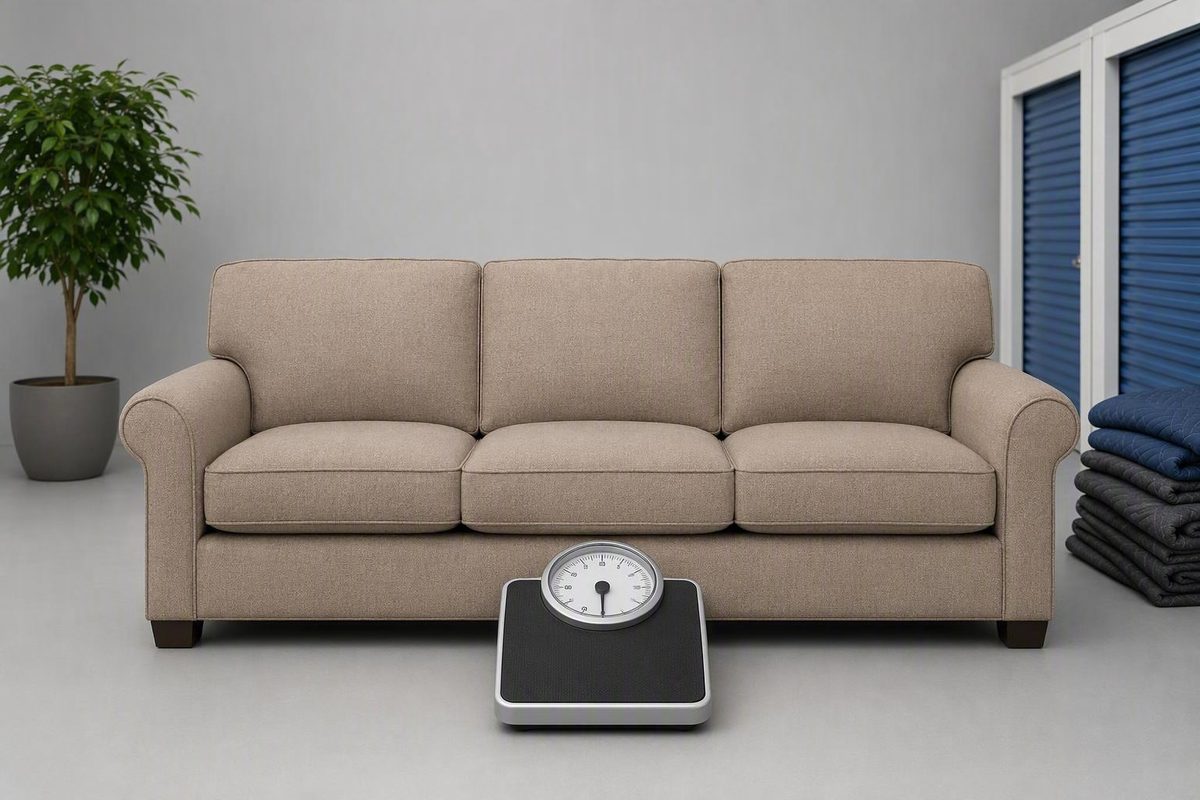
The short answer: a sofa may weigh about 100–300 pounds
Sofa weight varies widely, but a broad commercial-guide estimate is useful when you need a preliminary answer and do not yet know the model.
Quick answer
- Many conventional sofas: approximately 100–300 lb (45–136 kg), according to The Back Saver Movers’ general estimate
- Basic three-seat sofa: approximately 120–200 lb (54–91 kg) in Homebaa’s retailer guide
- Before moving, shipping, or storing: verify the manufacturer’s net product weight for the exact model and configuration
The narrower three-seat estimate carries substantial uncertainty. Across the supplied commercial guides, standard-sofa figures begin as low as approximately 80 lb, as shown in a service provider’s three-seat sofa estimates.
At the other end, a furniture retailer lists detailed standard-sofa estimates reaching approximately 264 lb, demonstrating that the broader category spans roughly 80–264 lb across sources rather than following one consistent range in its category breakdown.
These numbers are not measured market averages or industry standards. They come primarily from furniture retailers, moving companies, and other commercial service providers. The guides do not disclose representative samples, consistent definitions, or item-by-item measurement methods. Their overlapping figures can help with early planning, but they cannot establish the weight of a particular sofa.
The practical distinction is between an estimate and a verified specification:
- Use an estimate to classify an unknown sofa as probably light, moderate, or heavy.
- Use the manufacturer’s exact product weight when selecting rated equipment or checking a formal limit.
- Use individual module weights when a sectional separates for transport.
- Use packaged weight rather than net weight when the sofa will remain boxed.
Do not use a broad category range to certify compliance with an elevator, dolly, ramp, vehicle, trailer, floor, carrier, or other load limit. An estimate also cannot establish whether a particular route or lifting plan is safe. If exceeding a limit could cause damage, delay, or unsafe handling, obtain the specification for the exact model and configuration or seek a professional assessment.
Estimated sofa weight by type
The table below presents low-confidence commercial-guide estimates, not measured industry averages. Its central category ranges follow WJS Home’s published figures for standard sofas, sleepers, sectionals, recliners, futons, and modular pieces in its sofa-weight breakdown. The wider endpoints reflect comparisons with the other supplied commercial guides.
| Sofa type | Rough weight in pounds | Rough weight in kilograms | Planning note |
|---|---|---|---|
| Loveseat | 80–150 lb | 36–68 kg | Compact dimensions do not guarantee low weight; reclining or storage features can make a loveseat heavier. |
| Standard three-seat sofa | 100–250 lb | 45–113 kg | For many basic fixed-frame models, 120–200 lb (54–91 kg) is a narrower but still low-confidence working estimate. |
| Sleeper sofa | 180–350 lb | 82–159 kg | The bed frame and mattress generally place sleepers among the heavier categories. |
| Sectional sofa | 200–500+ lb total | 91–227+ kg total | Confirm the selected configuration and the weight of every detachable section. Large assemblies may exceed this range. |
| Reclining sofa | 150–300+ lb | 68–136+ kg | Manual or powered mechanisms and related hardware can add substantial mass. |
| Futon | 55–150 lb | 25–68 kg | Frame and mattress construction produce a particularly broad range across guides. |
| Modular sofa piece | 50–150 lb per piece | 23–68 kg per piece | This is the approximate weight of one component, not the complete arrangement. |
Every figure in the table is approximate. An individual product may fall below or above its category range.
Large sectionals, sleeper sofas, and reclining sofas generally sit among the heavier categories because they combine substantial structures with additional components. A sleeper includes the parts needed to support and deploy a bed. A reclining model may include linkages, supports, motors, or power components. A sectional can accumulate considerable total weight by combining seats, corners, chaises, consoles, and other modules.
That does not mean every sleeper is heavier than every fixed-frame sofa or sectional. The ranges overlap. A compact sleeper may weigh less than an oversized conventional sofa, while one minimalist modular component may weigh less than a heavily built loveseat.
Seat count is therefore not a dependable weight formula. Two three-seat sofas can have different widths, depths, frames, cushions, bases, arms, mechanisms, and upholstery systems. Likewise, “four-piece sectional” identifies the number of pieces but not their dimensions or construction.
Confidence note: These ranges overlap across several commercial guides, but the sources do not provide a representative measurement dataset. Treat the table as category-level planning guidance. For rated equipment, transport limits, or formal handling requirements, use the exact model specification.
When the model is unknown, choose the category that most closely reflects the sofa’s construction rather than relying solely on the seller’s product name. A substantial convertible futon may need to be planned more like a sleeper. A reclining loveseat belongs closer to the reclining category than to a minimalist loveseat estimate. Evaluate a sectional both as a complete assembly and as a series of individual carried pieces.
Why published sofa-weight estimates disagree
Commercial guides often attach very different figures to the same category. Loveseats illustrate the problem: Homebaa lists approximately 40–80 lb, while other guides place the category at approximately 100–150 lb. The same retailer lists 120–200 lb for a three-seater and 200–400+ lb for a sectional, showing how much the result depends on the source’s category boundaries in its published weight table.
The disagreement is even more pronounced when moving calculators enter the comparison. The commercial sofa guides collectively place standard sofas across a spread of approximately 80–264 lb, but the Movers Corp calculator assigns 350 lb to a sofa. It also assigns 950 lb to a four-piece sectional, compared with the more common category-planning range of 200–500+ lb total. The calculator describes its figures as close estimates based on industry averages, but it does not provide a transparent item-level measurement method on its moving-weight calculator.
Those calculator values should not automatically be declared wrong, but they should not replace a product specification. A shipment calculator may use assumptions designed for estimating an entire moving load rather than describing the net weight of a retail sofa. The available methodology is not detailed enough to reconcile the difference confidently.
Several plausible factors can produce inconsistent ranges:
- Dimensions: A “three-seat sofa” may be a compact apartment model or a much wider and deeper design.
- Configuration: Chaises, corners, consoles, ottomans, and extra modules change what is included.
- Materials and construction: Frames, supports, cushion systems, bases, and upholstery assemblies vary.
- Mechanisms: Sleepers, recliners, powered seats, and storage features introduce additional components.
- Treatment of modules: One source may report an assembled sectional total while another discusses individual pieces.
- Estimation purpose: A furniture shopping guide and a moving-load calculator may be built around different assumptions.
Averaging these incompatible figures would create false precision. The inputs do not describe a common product sample or use a shared category definition.
A better evidence hierarchy is:
- Model-specific manufacturer specification: Best for the exact sofa, provided the listing covers the selected configuration and distinguishes net from packaged weight.
- Category planning estimate: Useful when the model is unknown and a provisional range is sufficient.
- Undocumented moving-calculator value: A fallback for broad shipment planning, not proof of an individual item’s weight.
When estimates conflict, move up this hierarchy rather than attempting to manufacture an authoritative average from unrelated figures.
What makes one sofa heavier than another
Sofa weight reflects the complete construction system. Overall dimensions matter, but so do the frame, internal supports, cushions, configuration, and built-in features. Povison’s commercial furniture guide identifies frame construction, cushion density, upholstery, springs, storage, and reclining components as potential sources of variation in its discussion of sofa construction.
Overall dimensions
A wider, deeper, or taller sofa usually contains more structural and upholstery material than a compact design. Larger seat decks, backs, arms, and bases can all contribute to total weight.
Dimensions alone still cannot predict an exact figure. Two sofas with identical exterior measurements may use different frame layouts, supports, cushion systems, or mechanisms. Measurements can help explain why an oversized sofa might be heavier, but the supplied evidence does not support a dependable pounds-per-inch formula.
Frame construction and internal supports
The frame forms the load-bearing structure beneath the visible upholstery.
This is why appearance can be deceptive. Two sofas may share a similar silhouette while containing very different internal structures. A visually bulky sofa is not necessarily heavier than a streamlined model with substantial supports and hardware.
Do not assume that a named frame material adds a fixed number of pounds. The quantity and dimensions of the material matter, as do the other components. General labels such as hardwood, metal, plywood, or engineered wood are not sufficient to calculate a finished sofa’s weight.
Cushion density and seating construction
Deep seating and thick cushions can add material, but appearance does not reveal the exact internal construction.
Loose cushions also matter operationally. Carrying them separately can reduce the weight and bulk of the main frame during a particular trip. Their removal does not change the sofa’s total product weight; it redistributes that weight among separate carries.
Configuration
A one-piece sofa, chaise sectional, corner sectional, and modular arrangement may provide similar seating capacity while distributing their weight differently.
A sectional can have a high assembled total because it combines several frames. If its pieces separate as designed, however, no individual carry may equal the full assembled weight. A lighter one-piece sofa must still be controlled as one long, rigid object.
Built-in features and mechanisms
Sleeper frames, mattresses, reclining mechanisms, motors, power supplies, storage compartments, consoles, cupholders, and built-in tables can increase total weight. The amount varies too much to assign a universal pound addition to any feature.
These components may also affect how the sofa must be prepared. Follow the manufacturer’s instructions when securing a sleeper mechanism, disconnecting power components, or removing an approved part. Do not infer a disassembly procedure from the sofa’s appearance.
Upholstery
But a label such as “leather” or “fabric” does not establish the finished weight.
Claims that leather, thick fabric, or another covering always adds a fixed number of pounds or percentage are too simplistic for planning a particular move. Frame construction and mechanisms may have more influence than the upholstery label or stated seat count.
Three bounded comparisons help illustrate the distinction:
- Minimalist fixed-frame sofa versus sleeper: If their exterior dimensions are similar, the sleeper will generally be heavier because it includes a bed assembly and mattress. The difference remains model-specific.
- Conventional sofa versus powered recliner: A powered reclining model contains movement and power components absent from a basic fixed frame, so it will often weigh more. Width and construction can still reverse the comparison between individual products.
- One-piece sofa versus modular sectional: The sectional may weigh more in total, but its separate pieces may be easier to carry. The one-piece sofa may be lighter overall yet harder to turn, grip, and control.
The useful question is not simply, “How many seats does it have?” It is, “What structure, mechanisms, options, and removable components are included in this exact configuration?”
Product weight, shipping weight, module weight, and weight capacity are not interchangeable
A product page may display several figures containing the word “weight.” Choosing the wrong one can distort a moving, delivery, or equipment plan. WJS Home distinguishes the sofa’s own weight from packaged weight, supported load, and detachable-module weight in its specification guidance.
- Product weight or net weight is the weight of the sofa itself without shipping packaging. This is normally the relevant figure when moving an unpackaged sofa.
- Package or shipping weight includes the sofa and its packaging. A shipment divided among several boxes may list a separate packaged weight for each carton.
- Module weight is the weight of one detachable sectional or modular component.
- Total assembled weight is the combined product weight of all pieces in the chosen configuration.
- Weight capacity is the load the sofa is designed to support. It is not the weight of the empty sofa.
Never substitute weight capacity for product weight. Likewise, do not treat a sectional’s assembled total as the weight of every module.
A hypothetical specification shows how the terms can appear together:
A sectional listing shows 400 lb total assembled weight and separate weights for each detachable module. Its boxed shipment weighs more because the cartons and protective materials are included. Elsewhere, the listing provides a higher seating weight capacity.
For moving the unboxed sectional, use the individual module weights to plan each carry and the 400 lb figure when the combined total matters. For receiving it while boxed, use the relevant package weights. Do not use seating capacity for either calculation.
These numbers illustrate how a specification might be organized; they are not claims about typical sectional weights.
Also verify that the total applies to the selected arrangement. One product family may offer armless seats, corners, chaises, ottomans, consoles, or powered options. The configuration shown in a photograph may not weigh the same as the arrangement selected for purchase.
How to find the exact weight of your sofa
The most reliable process begins with identifying the sofa rather than trying to estimate it from appearance.
-
Identify the brand and model. Check purchase receipts, order emails, retailer accounts, manuals, and warranty records. A model or stock-keeping number is more useful than a general collection name.
-
Inspect the underside and frame labels. Look beneath the sofa, under removable cushions, or near the rear frame. Photograph the label so you can search its model, item, and configuration codes without repeatedly moving the furniture.
-
Search the manufacturer’s product page. Use the complete model number. If the original sales page is unavailable, look for an official specification sheet, assembly guide, or manual.
-
Read the weight label carefully. Look specifically for net weight, product weight, or assembled weight. Do not mistake weight capacity, carton weight, or package dimensions for the sofa’s own weight.
-
Check the manual or specification sheet. Detailed documents may distinguish individual carton weights, module weights, and configuration options more clearly than the main sales page.
-
Contact the manufacturer or retailer. Provide the complete model number, selected configuration, and relevant options. Ask explicitly for the net product weight and, where applicable, the net weight of every removable module.
For a sectional, confirm:
- The exact number and type of modules
- Whether a chaise, corner, console, or ottoman is included
- The total assembled product weight
- The net weight of each detachable component
- Whether each quoted figure is net or packaged weight
For a sleeper sofa, verify that the specification covers the same bed size, mattress, and mechanism. Similar-looking versions within one collection may contain different components.
For a reclining sofa, confirm whether the listing covers the manual or powered version and whether consoles or other options are included. Do not assume that two versions with the same upholstery and dimensions have identical weights.
If the model is unknown, select the closest category range and disclose the uncertainty to movers, delivery crews, or storage personnel. A conservative estimate may be appropriate when underestimating would create a problem, but it should never be described as a measured value.
Dimensions and seat count cannot produce a dependable exact weight from the supplied evidence. Trying to judge the answer by lifting one end is also unreliable: leverage, grip, floor contact, position, and weight distribution can all affect how heavy the object feels.
When a verified figure is required for rated equipment or load-limit compliance, use a manufacturer-supported answer or a professional assessment. An uncertain household estimate should not be used to certify a formal limit.
Plan the move around shape and access, not weight alone
A sofa can be difficult to move even when its estimated weight appears manageable. It may be long, rigid, awkward to grip, or unable to rotate through a stairwell. Weight helps with planning, but it does not show whether the sofa will clear the route.
Before moving it, complete this checklist:
- [ ] Measure the sofa’s maximum width, height, depth, and relevant diagonal.
- [ ] Measure doorway width and height, accounting for hinges and hardware.
- [ ] Check hallways for narrow points, radiators, railings, fixtures, and low ceilings.
- [ ] Measure corners and determine whether there is room to rotate the sofa.
- [ ] Check stair width, ceiling clearance, railings, and turns.
- [ ] Confirm that each stair landing provides enough repositioning space.
- [ ] Measure the elevator door and the elevator’s interior dimensions.
- [ ] Clear the route from the room to the exit.
- [ ] Check the vehicle’s cargo opening, not only its interior capacity.
- [ ] Plan how the sofa will be secured during transport.
- [ ] Protect walls, floors, doors, and upholstery without covering necessary grip points.
- [ ] Confirm which components the manufacturer designed for removal.
Commercial moving guidance similarly emphasizes route planning, protection, helpers, and securement rather than relying on weight alone in its sofa-moving recommendations.
Remove loose cushions before carrying the main frame. Legs, arms, sleeper mattresses, and sectional modules may also be removable, but detach only parts identified by the manufacturer as designed for removal. A visible fastener does not establish that an arm, support, or mechanism can safely be dismantled by the owner.
Removing approved components can change the logistics of an individual carry:
- The main frame may become lighter.
- Its exterior dimensions may become smaller.
- The object may be easier to grip or turn.
- Detached parts can be packed separately according to the manufacturer’s guidance.
Removal does not change the total assembled weight. A sofa totaling 200 lb still represents 200 lb of furniture even if it is transported in several approved pieces.
This explains why a heavier modular sectional may be easier to transport than a lighter one-piece sofa. Separate modules can be moved and turned individually. A lighter fixed-frame sofa may have to pass through the entire route as one long, rigid object.
Do not select the number of helpers from weight alone. Moving difficulty also depends on dimensions, stairs, corners, balance, grip points, equipment, individual physical ability, and whether the furniture separates. The evidence does not support a universal weight below which one-person handling is automatically appropriate.
Professional assistance is sensible when:
- The sofa’s weight is unknown.
- The route includes stairs, tight turns, or constrained landings.
- The sofa contains a sleeper or reclining mechanism.
- The furniture cannot be gripped or controlled securely.
- Manufacturer removal instructions are unclear.
- Specialized equipment is required.
- Anyone involved is uncertain about safe handling.
The objective is not merely to lift the sofa. It is to keep it controlled throughout the complete route without relying on an uncertain estimate or improvised disassembly.
Using sofa weight and volume to plan self-storage
Weight and volume answer different storage questions:
- Weight in pounds or kilograms affects handling and transport.
- Dimensions and cubic volume determine how much storage space the sofa occupies.
LockerHelp uses approximately 60 cubic feet as a planning allowance for a full sofa. Its unit-size guide describes a 5×10 unit as potentially holding typical studio contents, including a sofa, queen bed, dresser, and 20–25 boxes. It describes a 10×10 unit as suitable for typical one-bedroom furniture that includes a sofa in its storage-unit sizing examples.
These are general fit examples, not guarantees. Results depend on the sofa’s dimensions, the other items being stored, ceiling height, door dimensions, stacking constraints, and the access space retained inside the unit.
A 60-cubic-foot estimate cannot be converted into sofa weight without model-specific information about construction and materials. Two sofas may occupy similar volumes while using different frames, supports, cushions, and mechanisms. Conversely, a modular sofa may pack differently after manufacturer-approved separation.
Choose a storage unit by measuring:
- The sofa’s length, depth, and height
- The unit door’s clear width and height
- The unit’s interior dimensions and ceiling height
- Any hallway, elevator, or corner between unloading and the unit
- The other furniture and boxes in the load
- The access space you need after loading
The door opening may be more restrictive than the unit’s nominal floor area. Confirm that the sofa can enter before deciding that the interior provides enough space.
Plan the load before arrival. If the sofa separates into approved modules, record each component’s dimensions and keep its hardware labeled. Do not select a unit merely because the sofa’s estimated weight sounds modest; pounds do not establish whether the furniture will fit.
Preparation matters as much as unit size. LockerHelp advises allowing wet cushions to dry completely in open air before storage and using breathable coverings rather than plastic on leather furniture in its furniture-storage precautions.
Clean and dry all sofa components before packing, retain the manufacturer’s hardware and instructions, and follow model-specific guidance on disassembly and positioning. For a broader preparation process, LockerHelp also publishes a direct furniture-storage checklist covering cleaning, disassembly, wrapping, elevation, arrangement, climate control, and insurance checks. That guidance concerns storage preparation, not sofa-weight evidence.
The practical rule is simple: commercial guides place many conventional sofas at approximately 100–300 lb, while a basic three-seater is often estimated at approximately 120–200 lb. Treat both as preliminary ranges only. Find the manufacturer’s net weight, check each detachable module, measure the complete route, and plan every carry around both weight and geometry. For storage, choose the unit using dimensions and volume rather than pounds.
Frequently asked questions
How much does a standard three-seat sofa weigh?
A standard three-seat sofa can be estimated at approximately 100–250 lb (45–113 kg) for preliminary planning. For many basic fixed-frame models, 120–200 lb (54–91 kg) is a narrower but low-confidence working estimate.
The commercial estimates reviewed for the broader category span approximately 80–264 lb, so an individual sofa may fall outside the narrower range. Dimensions, frame construction, cushions, supports, and built-in mechanisms all matter. Use the manufacturer’s net product weight whenever an exact value is required.
How much does a sleeper sofa weigh?
A sleeper sofa may weigh approximately 180–350 lb (82–159 kg) as a category-level planning estimate. Individual models can fall outside that range. The internal bed frame and mattress generally make sleepers heavier than similarly sized fixed-frame sofas.
Confirm the exact model, bed size, mattress, and mechanism. If the manufacturer identifies the mattress or another component as removable for transport, carrying it separately may reduce the weight of the main frame during that trip. It does not change the sofa’s total assembled weight.
Does a sectional’s listed weight apply to the whole sofa or each piece?
It depends on the label. Total assembled weight applies to the complete selected configuration, while module weight applies to one detachable section. A product page may list both.
Check the specification heading and confirm which modules are included. Do not assume that the assembled total applies to every section, and do not multiply a total weight by the number of modules. For moving, the total supports overall transport planning, while the module weights describe the individual carries.
Is shipping weight the same as the sofa’s actual weight?
No. Product or net weight refers to the sofa itself. Shipping or package weight includes packaging and may be listed separately for each carton.
Use net weight for an unpackaged sofa and package weight when planning receipt or transport while it remains boxed. Neither figure should be confused with weight capacity, which describes the load the sofa is designed to support.
Can one person move a sofa?
Weight alone cannot answer that safely. Length, rigidity, grip points, balance, removable parts, stairs, corners, available equipment, and the individual’s physical ability all affect handling.
Even a relatively light sofa may be difficult to control through a doorway or on stairs. Do not rely on a universal one-person threshold. Remove only components designed for removal, clear and measure the route, and seek professional help when the weight is unknown, the path is constrained, the sofa contains substantial mechanisms, or safe control is uncertain.