
How Much Space Does a Baby Grand Really Need?
Plan on 4 ft 11 in to 5 ft 6 in long and around 5 ft wide. Then check the exact model and add the bench, seated player, lid and walking paths.
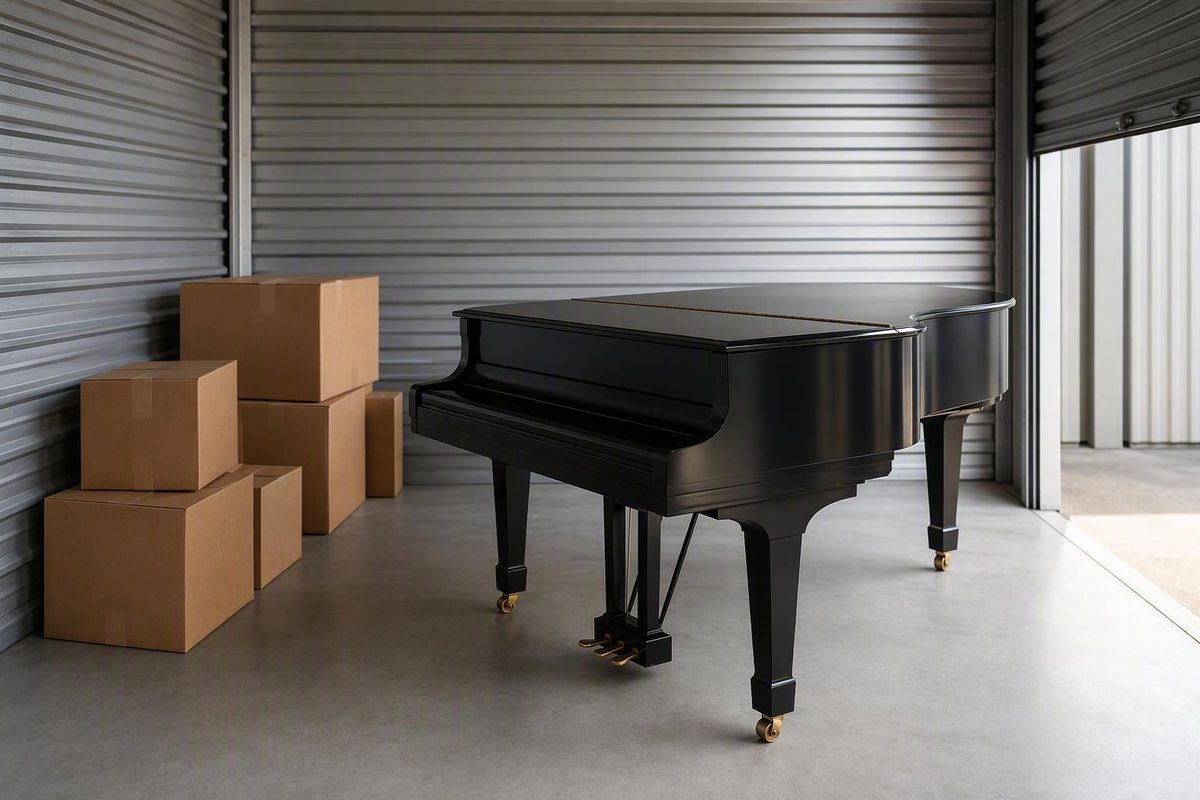
A practical starting estimate for baby grand piano dimensions is 4 ft 11 in to 5 ft 6 in long, roughly 5 ft wide, 3 ft to 3 ft 3 in high with the lid closed, and 500–700 lb (227–318 kg). These are planning estimates, not universal specifications. Cameron Piano publishes these commonly used dimensions and weight ranges.
For an initial layout, allow an instrument zone of roughly 5 ft wide by up to 5 ft 6 in long. Before ordering a piano, booking movers, or renting storage, replace that rectangle with the exact model’s dimensions and curved outline. Then add the bench, seated player, lid operation, circulation space, and the complete delivery or storage route.
The reason for that caution is simple: “baby grand” is not a standardized dimensional category. Different manufacturers and sellers apply the label to different lengths.
Baby grand dimensions at a glance
The following figures are useful for preliminary screening. Width varies less than length among conventional 88-key pianos, but published general widths still extend from roughly 55 to 60 inches (140–153 cm). Riverton Piano reports that general width range for most 88-note pianos.
| Measurement | Imperial planning estimate | Metric planning estimate |
|---|---|---|
| Length | 4 ft 11 in–5 ft 6 in | 150–168 cm |
| Maximum width | Approximately 4 ft 7 in–5 ft | Roughly 140–153 cm |
| Closed-lid height | 3 ft–3 ft 3 in | 91–100 cm |
| Weight | Approximately 500–700 lb | 227–318 kg |
Every figure in the table is a planning estimate. Confirm the exact length, maximum exterior width, closed height, and published model weight before making a purchase or delivery decision. Open-lid height is a separate, model-specific measurement.
Important: Across published classification systems, instruments called baby grands extend from roughly 4 ft 8 in to 5 ft 11 in. One measuring guide, for example, places baby grands at 4 ft 8 in to 5 ft 1 in, while other supplied conventions extend the category considerably farther. American Piano Covers explicitly notes that category names and ranges vary among manufacturers.
Grand pianos are classified principally by length, measured from the keyboard end to the tail. Width tends to vary less among conventional 88-key instruments because their keyboards are similar in width, but the keyboard measurement should not be substituted for the maximum exterior case width.
The instrument itself is only the first layer of space planning. A usable installation must also account for:
- The actual bench
- The seated pianist
- Space to use the pedals
- The lid’s movement and open position
- Normal walking paths
- Door, closet, and cabinet swings
- Tuning, cleaning, and maintenance access
A piano may fit inside a bare rectangle while making the room awkward or preventing the player from using it comfortably.
Why the term “baby grand” does not guarantee one size
“Baby grand” is a market category rather than a universally fixed engineering standard. Manufacturers, dealers, movers, cover suppliers, and owners divide the grand-piano range in different ways.
Several published conventions illustrate the disagreement:
| Published convention | Length called “baby grand” | What it demonstrates |
|---|---|---|
| Piano Price Point classification | 4 ft 9 in–5 ft 4 in | Some systems include instruments below five feet |
| Riverton Piano size guide | Approximately 4 ft 11 in–5 ft 6 in | A practical range often used for home planning |
| Klaviano classification | 5 ft 1 in–5 ft 11 in | Another system starts and ends the category later |
| American Piano Covers measuring guide | 4 ft 8 in–5 ft 1 in | A shorter convention moves longer models into “parlor grand” |
These are examples of naming systems, not competing physical laws.
A piano around 5 ft 1 in may sit near the upper end of one seller’s baby-grand category, at the bottom of another’s, or at a boundary between miniature, baby, and parlor grands. Labels encountered in listings include:
- Petite grand
- Miniature grand
- Baby grand
- Small grand
- Living-room grand
- Medium grand
- Parlor grand
A listing title therefore does not establish whether an instrument will fit. Evaluate the manufacturer, exact model number, production year if known, and verified dimensions.
Common length conversions
| Imperial length | Approximate metric length |
|---|---|
| 4 ft 11 in | 150 cm |
| 5 ft 1 in | 155 cm |
| 5 ft 3 in | 160 cm |
| 5 ft 6 in | 168 cm |
Width also requires direct measurement. Most modern acoustic pianos have 88 keys, so many grands fall within a relatively narrow width band. A published comparison of grand-piano categories likewise notes that modern 88-key widths are broadly similar while older and extra-key instruments can differ. Luxury Pianos gives an average modern width of about 4 ft 9 in while acknowledging those exceptions.
The safest rule is straightforward: use the category name to find candidates, then use the exact model specifications to determine fit.
How to measure a baby grand correctly
Measure the piano with its lid completely closed. Use a rigid tape measure where practical, keep it straight and level, and record the results in both inches and centimeters.
-
Identify the piano. Record the manufacturer, model number, serial number, and production year if known. Photograph the instrument and any model or serial plate. These details can help the manufacturer, seller, technician, or mover locate the correct documentation.
-
Close the lid completely. General grand-piano measurements are normally taken with the lid closed. A closed-height measurement does not describe the piano’s height or operating envelope with the lid raised.
-
Measure overall length in a straight line. Measure from the front edge of the keyboard or keys to the farthest point of the tail, including the keyboard projection. Keep the tape perpendicular to the keyboard rather than following the curved rim. This straight-line, lid-closed method is also used in published grand-piano measuring guidance. Piano Price Point describes measuring the longest point perpendicular to the keys.
-
Measure maximum exterior width. Measure across the widest exterior part of the case near the keyboard.
-
Measure closed height. Measure vertically from the floor to the highest point of the piano with the lid closed. Keep the tape upright rather than angling it along a leg or panel.
-
Find the published model weight. Prioritize the manufacturer’s specification or reliable model documentation. Do not infer weight from length alone, because similarly sized instruments can differ. Give the published figure to the mover for crew, equipment, elevator, and route planning. If authoritative documentation cannot be found, ask the mover how the uncertainty affects the handling plan rather than presenting a handling estimate as an exact manufacturer weight.
-
Measure the bench separately. Record its width, depth, and height. Then measure how far it sits from the keyboard when occupied and how far it must move backward for the pianist to sit down and stand up.
-
Request the open-lid envelope. Ask the manufacturer or seller for the model-specific height with the lid fully open, the area through which the lid moves, and any side clearance required to operate it. General baby-grand averages do not establish these values.
-
Obtain a footprint drawing if available. A top-view outline is more useful than length and width alone because it represents the straight keyboard edge, curved side, narrowing tail, and leg locations.
-
Check every measurement twice. Repeat each measurement and label it clearly. If two readings differ, measure again before sending the figures to a mover, seller, or storage facility.
Keep two distinct records:
- Physical measurements: figures taken from the instrument itself
- Published specifications: figures provided in manufacturer or reliable model documentation
If the two sets do not agree, confirm that the model has been identified correctly and ask the manufacturer, seller, technician, or mover to resolve the discrepancy before planning around either set.
From piano footprint to usable room space
“How much room does a baby grand need?” has three different answers:
- Instrument footprint: the floor area occupied by the piano
- Playing footprint: the piano, bench, and seated player
- Usable room space: the playing footprint plus circulation, lid operation, furniture clearance, and service access
Separating these concepts prevents a common mistake: proving that the case fits while overlooking whether anyone can play the instrument or move through the room.
The instrument footprint
For preliminary planning, use an instrument zone approximately 5 ft wide by up to 5 ft 6 in long. This does not include the bench, pianist, lid operation, access path, or maintenance space.
Multiplying maximum length by maximum width creates a bounding rectangle, not the piano’s true footprint. A grand’s curved rim narrows toward the tail, leaving part of that rectangle unoccupied. The same curved body, however, can make rotation through a doorway or placement beside furniture more complicated than a simple rectangle suggests.
One commercial guide describes 5 ft by 7 ft as a minimum baby-grand footprint while explicitly treating the bench and other operating clearance as additional requirements. It should not be interpreted as a complete minimum room size. The Las Vegas Pianos guide distinguishes that footprint from added bench, lid, pedal, and seating space.
The playing footprint
Add the actual bench rather than relying on a generic bench estimate. Place it where the pianist would use it and test:
- Sitting down and standing up
- Moving the bench backward
- Reaching the full keyboard
- Using the pedals without obstruction
- Passing behind the player if that route must remain open
The keyboard end is often where the piano competes most directly with the rest of the room. A plan that leaves generous space around the tail but traps the player between the bench and a wall, sofa, or cabinet is not workable.
Circulation and service space
Mark everything else that competes for the same floor or overhead area:
- Door swings
- Closet and cabinet doors
- Floor vents and radiators
- Fixed columns and hearths
- Sofas, tables, shelves, and lamps
- Regular walking routes
- Tuning and maintenance access
- The lid’s open position and operating path
There is no supported universal requirement for exactly three feet of empty space on every side. A rule based only on the total length of the room’s walls is also not a reliable test of physical fit. Clearance depends on the particular piano, bench, room, furniture, and circulation pattern.
Make a full-size floor template
Create a layout using painter’s tape, kraft paper, flattened cardboard, or a manufacturer-supplied template.
Mark:
- The front edge of the keyboard
- The widest point of the exterior case
- The center and farthest point of the tail
- The curved side of the rim
- All three leg positions
- The pedal assembly area
- The bench in playing position
- The seated player’s zone
- The bench’s pull-back area
- The open-lid operating area
- Door and furniture swings
- Normal walking paths
If only the overall length and width are available, start with the bounding rectangle but do not treat it as the final outline. Use verified measurements and photographs to approximate the curve, then replace that approximation with a model-specific drawing or template when one becomes available.
Test more than one orientation. Because the tail is narrower than the keyboard end, rotating the piano may allow the tail to extend beside furniture, into a corner, or toward the edge of a low-traffic area. A layout that appears impossible as a rectangle may work once the true tapered form is represented.
Finally, keep physical fit separate from acoustic suitability. A piano can fit dimensionally yet feel visually dominant or sound overpowering in a reflective room. A smaller piano is not automatically acoustically suitable simply because it leaves more uncovered floor area.
Weight and delivery-route measurements
A commonly published baby-grand planning range is approximately 500–700 lb (227–318 kg), but the specific model’s documented weight should control delivery planning. Roger’s Piano reports average and compact-model weights within this broader range while noting construction differences.
Room fit does not prove delivery feasibility. An instrument may fit comfortably after installation yet be unable to pass through the entrance, rotate around a hallway corner, cross a landing, or enter an elevator.
Measure the complete route from the unloading point to the final position.
Exterior and entrance
- Parking or loading access
- Gates and exterior steps
- Porch depth
- Clear exterior-door width and height
- Threshold height
- Overhangs, lights, and low ceilings
- Turning space immediately inside the entrance
Doors and corridors
- Clear opening of every doorway
- Whether a door can be temporarily removed
- Hinges, stops, trim, and handles that reduce clearance
- Narrowest hallway width
- Radiators, shelves, rails, or other projections
- Every 90-degree turn
- Diagonal space available at each turn
Stairs and landings
- Clear stair width
- Tread and riser arrangement
- Landing length and width
- Overhead clearance
- Handrails, banisters, and newel posts
- Turns at the top and bottom
- Changes in stair direction
Elevators
- Clear elevator-door opening
- Interior width, depth, and diagonal
- Ceiling height
- Door-closing behavior
- Posted capacity
- Route between the elevator and destination room
- Building requirements for reservations, padding, or service-elevator use
Tight turns and landings deserve particular attention. A doorway can be wider than one piano dimension while the long, curved body still lacks room to rotate into the next corridor.
Specialist movers commonly prepare a grand piano for transport on its side with the legs removed. The resulting transport envelope still depends on the model, padding, skid board, dollies, and handling method. The assembled width or height should therefore not be treated as a universal moving dimension. PianoSpeed’s delivery guide emphasizes checking the make, model, doors, corridors, turns, stairs, landings, and headroom.
Before booking, provide the mover with:
- Manufacturer and exact model
- Serial number or approximate production year
- Exact length, width, and closed height
- Published model weight or the best available documentation
- Photographs of the piano from several angles
- Photographs and measurements of every tight route section
- Stair and elevator details
- The intended final orientation in the room
Raise floor capacity as a separate question when there is uncertainty, particularly in an older building, an altered structure, or an unusual proposed location. Ask the property owner or building manager whether professional assessment is required.
A real model shows why averages are only a starting point
The Steinway & Sons Model S is a useful manufacturer example, not the definition of a baby grand.
Steinway specifies the Model S at 5 ft 1 in (155 cm) long, 57.75 in (147 cm) wide, and 579 lb (263 kg). See the manufacturer’s Model S specifications.
| Model S specification | Published figure | Comparison with planning estimates |
|---|---|---|
| Length | 5 ft 1 in / 155 cm | Within several common baby-grand ranges |
| Width | 57.75 in / 147 cm | Slightly under five feet |
| Weight | 579 lb / 263 kg | Within the commonly reported 500–700 lb range |
A practical planning exercise for this model would proceed as follows:
- Mark a bounding area 5 ft 1 in long by 57.75 in wide.
- Align the keyboard edge with the intended playing position.
- Replace the rectangle with the exact Model S footprint if a drawing or template is available.
- Mark the three legs and pedal area.
- Add the actual bench dimensions.
- Show the bench in occupied and pulled-back positions.
- Add the manufacturer-confirmed lid-open envelope.
- Mark doors, furniture, and walking routes.
- Measure the complete delivery path.
- Send the specifications, photographs, and route measurements to a qualified piano mover.
The example demonstrates why model-specific width and weight are more useful than assumptions based only on an 88-key keyboard. Pianos of similar length can still have different exterior widths, curved outlines, weights, and delivery requirements.
The Model S figures do not establish another piano’s closed height, open-lid envelope, footprint, or moving dimensions. Even a piano sold at the same nominal length requires its own specifications.
How size relates to sound—and where the comparison stops
A longer grand case can provide room for longer bass strings and a larger soundboard. Those design possibilities may influence bass response, resonance, and projection.
Length does not act alone. It interacts with:
- Scale design
- String arrangement
- Soundboard design and condition
- Rim and frame construction
- Action design and regulation
- Hammer condition and voicing
- Tuning and maintenance
- Overall construction quality
- Room size, surfaces, and furnishings
A commercial comparison of grand-piano sizes associates longer strings and larger soundboards with greater resonance while also acknowledging the importance of construction, maintenance, voicing, action, and brand. Luxury Pianos presents those factors as qualifications rather than guarantees.
Dimensions therefore create design possibilities, not guaranteed performance outcomes. Every additional inch does not necessarily produce a dramatic improvement, and crossing a particular length threshold does not guarantee clear bass or superior quality. A well-designed, well-maintained smaller instrument may be more satisfying than a longer piano in poor condition or one unsuited to its room.
Size labels remain useful only for approximate navigation:
- Petite and miniature grands are generally shorter.
- Baby grands occupy the compact end of the acoustic-grand range.
- Medium, living-room, and parlor grands are generally longer.
- Category boundaries overlap among manufacturers and sellers.
When comparing instruments, measure them—but also play and listen to the actual models. Assess touch, tone, dynamic range, and bass response where possible, and consider how the destination room may differ from the showroom in size, furnishings, and reflectivity.
The best choice is not automatically the largest piano that can be fitted into the floor plan. It is the instrument whose dimensions, sound, condition, playing characteristics, delivery requirements, and cost work together for the intended setting.
Final checklist for buying, moving, or storing a baby grand
Use this checklist before paying a deposit, arranging delivery, or signing a storage agreement.
Piano specifications
- [ ] Manufacturer and exact model
- [ ] Serial number
- [ ] Production year, if known
- [ ] Overall length, including the keyboard projection
- [ ] Maximum exterior case width
- [ ] Closed-lid height
- [ ] Published or reliably documented model weight
- [ ] Number and location of legs
- [ ] Bench width, depth, and height
- [ ] Bench position when occupied
- [ ] Bench pull-back area
- [ ] Open-lid height
- [ ] Lid sweep or operating envelope
- [ ] Model-specific footprint drawing
- [ ] Removable or projecting components relevant to delivery
Destination space
- [ ] Usable floor length and width
- [ ] Intended piano orientation
- [ ] Curved footprint traced at full size
- [ ] Door, closet, and cabinet swings
- [ ] Fixed furniture and obstructions
- [ ] Floor vents, radiators, columns, and hearths
- [ ] Ceiling and open-lid clearance
- [ ] Space for cleaning
- [ ] Access for tuning and maintenance
- [ ] Clear route for eventual removal or retrieval
Playing space
- [ ] Bench fits in playing position
- [ ] Pianist can sit down and stand comfortably
- [ ] Bench can move backward as needed
- [ ] Pedals remain unobstructed
- [ ] Required walking paths remain usable
- [ ] Open lid does not conflict with walls, lights, or furniture
- [ ] Piano does not prevent the room’s normal use
Delivery route
- [ ] Exterior gate and entrance
- [ ] Every doorway’s clear opening
- [ ] Removable doors or trim identified
- [ ] Hallway widths
- [ ] Tight and 90-degree turns
- [ ] Stair widths
- [ ] Landing dimensions
- [ ] Railings and newel posts
- [ ] Thresholds and level changes
- [ ] Overhead clearance
- [ ] Elevator-door opening
- [ ] Elevator interior and diagonal
- [ ] Elevator capacity
- [ ] Building access and reservation requirements
- [ ] Route photographs supplied to the mover
Self-storage checks
A nominal storage-unit size cannot establish whether a baby grand fits. General storage-unit sizing guidance likewise recommends measuring the items rather than choosing space by feel.
- [ ] Facility accepts the piano under its rules
- [ ] Actual unit interior dimensions verified
- [ ] Clear unit-door width and height measured
- [ ] Corridors and turns checked
- [ ] Elevator or loading access measured
- [ ] Columns, pipes, tracks, and other obstructions recorded
- [ ] Professional placement space available
- [ ] Workable retrieval path preserved
- [ ] Nothing will be stacked on the piano
- [ ] Other belongings will not be packed tightly against the case
- [ ] Climate requirements confirmed with the manufacturer or technician
- [ ] Insurance terms confirmed with the insurer
- [ ] Preparation and handling requirements confirmed with the mover
- [ ] Facility access rules and operating hours checked
No particular storage-unit size can be recommended from the “baby grand” label alone. A piano may fit within the advertised floor area yet fail at the unit door, corridor turn, elevator, or placement stage.
Professional handling
- [ ] Qualified piano mover has reviewed the model and route
- [ ] Mover has current photographs and measurements
- [ ] Crew and equipment requirements are confirmed
- [ ] Building-management requirements are confirmed
- [ ] Floor-capacity concerns have been raised where appropriate
- [ ] Delivery and retrieval plans are documented
The decision rule is simple: use category averages for initial screening, but use exact piano, bench, room, route, and storage-unit measurements before committing.
Roughly five feet by five-and-a-half feet is a reasonable first-pass instrument zone. Replace it with the exact model outline, then add the real bench, player, lid, circulation, and service areas. Before buying, moving, or storing the piano, have a qualified piano mover review its dimensions, documented weight, and every doorway, turn, stair, elevator, and access point.
Frequently asked questions
What is the average size of a baby grand piano?
A practical planning estimate is 4 ft 11 in to 5 ft 6 in long, around 5 ft wide, and 3 ft to 3 ft 3 in high with the lid closed. These figures are a screening range rather than a standard; published category boundaries extend both shorter and longer. Cameron Piano publishes this commonly used planning range.
Is a baby grand always about five feet wide?
No. About five feet is useful for preliminary planning, but it is not a guaranteed exterior width. Most conventional 88-key pianos fall within a relatively narrow width band, while older 85-key and extra-key instruments can differ. Always measure the widest exterior point of the exact case.
How much does a baby grand piano weigh?
A commonly reported planning range is approximately 500–700 lb, or 227–318 kg. Model and construction differences matter, so use the manufacturer’s specification or reliable model documentation when planning movers, elevators, stairs, or placement. Published baby-grand weight estimates vary by model and construction.
What is the minimum room size for a baby grand piano?
There is no universal minimum room size. Start with the exact instrument footprint, then add the actual bench, seated player, bench pull-back area, lid operation, walking paths, door swings, and service access. A rectangular figure such as 5 ft by 7 ft should not be treated as a complete room requirement because the cited commercial guide excludes additional operating clearance.
Can a baby grand fit in a self-storage unit?
Potentially, but nominal unit dimensions alone cannot answer the question. Compare the exact piano and its mover-confirmed transport configuration with the unit’s actual interior, clear door opening, corridors, turns, elevator, obstructions, and placement space. Confirm facility rules, climate requirements, insurance terms, preparation, and handling arrangements before storage.