
Pack Pots and Pans Without Scratches, Rust or Overweight Boxes
Protect cookware during a move or in storage with material-specific steps for nesting nonstick, cast iron, enamel, stainless steel and glass lids.
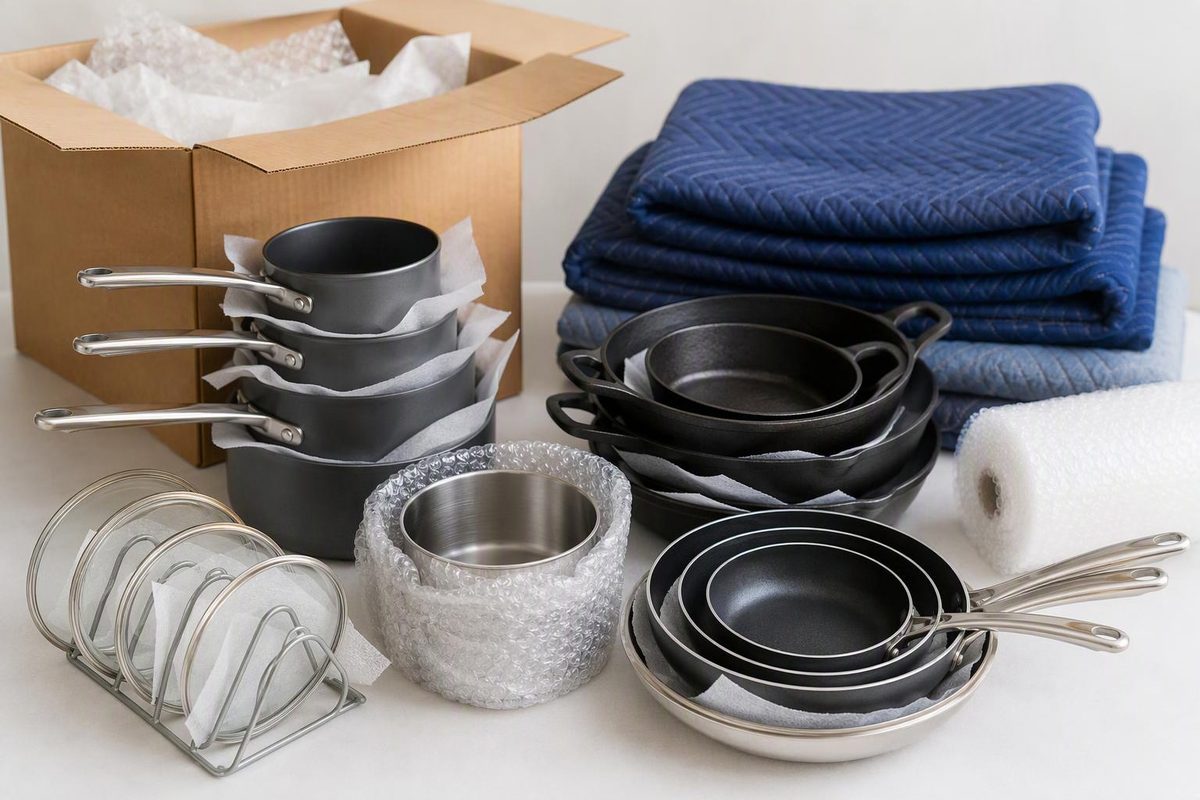
Pack pots and pans in small, sturdy boxes rather than one large carton. Clean and dry every piece, protect each cooking surface, nest only compatible cookware, wrap glass lids separately and fill empty space so nothing shifts.
Choose the cookware, lid and destination to see the safest packing setup.
Keep Nonstick and Glass Apart
Clean and completely dry both pieces before packing.
- Cookware protectionKeep nonstick cookware in a single layer. If nesting is unavoidable, use substantial separators, keep the stack shallow and never place cast iron inside it.
- Lid protectionWrap the glass lid in paper, cushion its rim and knob, and place cardboard between adjacent lids.
- Box placementUse a separate small box or protected section for the lid, with no cookware above it. Keep the carton off the bare storage floor and do not stack heavy boxes on it.
Stop adding cookware when the box becomes awkward to lift; the cited box limit is not a safe-lifting target.
Sources: Calphalon cookware-storage guidance, Lodge cast-iron care, U-Haul kitchen-packing guidance and Public Storage storage guidance.
Nesting saves space, but careless nesting scratches coatings and chips enamel. Put clean packing paper, a pan protector or a soft, completely dry cloth between every two pieces.
Gather the Packing Materials
You will need:
- Small moving boxes in good condition
- Packing paper or clean, dry dish towels
- Bubble cushioning for glass lids and fragile enamel
- Cardboard sheets or pan protectors
- Packing tape
- A marker and labels
- Small bags for removable handles and hardware
Choose boxes by strength and manageable loaded weight, not empty volume. Cookware is dense. U-Haul rates its small moving box for up to 65 pounds and markets it for small, heavy items, but that is a box specification—not a recommended lifting target. The cited guidance does not provide a universal safe lifting weight. Stop loading when a box becomes awkward to lift safely, even if space remains (U-Haul small moving box specifications).
Sort Cookware by Material and Shape
Set aside the pot, pan and lid you will need on your final night and first day. Pack them in an “open first” kitchen box rather than burying them in storage.
Group the remaining cookware by material and shape:
- Stainless steel
- Nonstick cookware
- Cast iron
- Enameled or ceramic-coated cookware
- Glass lids
- Oversized stockpots, roasting pans and griddles
Remove detachable handles and knobs only if the manufacturer permits it. Put the hardware in a labeled bag inside the matching pot.
Clean and Completely Dry Every Piece
Food residue, oil buildup and moisture should not enter a storage unit. Public Storage tells renters to store clean, dry household items and prohibits food and wet items. It directs customers to their rental agreements for the complete restrictions (Public Storage prohibited-items guidance). Extra Space Storage similarly says clean, empty cookware is allowed while food and spices are not (Extra Space Storage food policy). Check your own lease because facility rules differ.
Dry cookware promptly according to its care instructions. Leave it unpacked until no moisture remains in seams, rolled rims, hollow handles or lid undersides. Never pack a damp dish towel inside a pot.
Treat cast iron according to its maker’s instructions. Lodge advises drying cast iron completely and applying a thin layer of oil. It also identifies air-drying and moisture-prone environments as rust risks (Lodge cast-iron care). Use only a thin, even coating, with no pooled oil or saturated packing paper.
Build Shallow, Protected Nests
Start with the largest sturdy pot. Cover its cooking surface and rim with a fitted cardboard circle, pan protector or folded packing paper. Add a smaller compatible pot, then another separator. Continue only while the nest remains stable.
Do not let bare metal, enamel or nonstick coating rub against another piece. This matters most for nonstick pans. Calphalon recommends keeping its cookware in a single layer and avoiding stacking or nesting because contact can damage nonstick cooking surfaces (Calphalon cookware-storage guidance).
If limited moving space makes nesting unavoidable, use substantial separators, keep the stack shallow and never place cast iron inside nonstick cookware.
A workable nest could contain:
- A large stainless-steel stockpot
- A smaller stainless pot with a separator
- A lightweight saucepan with a separator
- Soft padding in the remaining cavity
Pack cast iron low in its own small box or with other durable cast iron. Wrap enameled pieces individually so their rims and handles cannot strike each other.
Pack Glass Lids Separately
Do not leave a loose lid rattling inside a pot. Wrapped metal lids can sit beside durable cookware if the box remains balanced.
Treat glass lids as fragile pieces:
- Wrap each lid in packing paper.
- Add bubble cushioning around the rim and knob.
- Place cardboard between adjacent lids.
- Put them in a separate small box or protected section with no cookware above them.
- Fill gaps so they cannot slide.
U-Haul likewise recommends nesting pots and pans with packing paper between them, wrapping glass lids and filling empty box space (U-Haul kitchen-packing guide).
Load Each Box From Heaviest to Lightest
Tape the bottom seam and reinforce it across both directions. Add a cushioning layer, then place the heaviest, most durable piece flat at the bottom.
Angle long handles into open corners or alternate their direction. Pad any point that touches the box wall. Fill cavities with clean paper or lightweight kitchen linens, but do not add so much that the carton bulges.
Close the flaps and gently rock the box. If anything moves, reopen it and add padding.
Label the top and at least two sides:
KITCHEN — POTS AND PANS — HEAVY — GLASS LIDS
Add a short inventory, such as “stockpot, three saucepans, two skillets.” That is more useful in a storage unit than a generic “kitchen” label.
Divide a Mixed Cookware Set Among Several Boxes
Suppose the load includes a stockpot, Dutch oven, three saucepans, three frying pans, one cast-iron skillet and six lids. A practical division is:
- Box 1: Nested stainless-steel pots and pans, with a separator between every piece
- Box 2: Cast iron and the Dutch oven, packed low and apart from coated cookware
- Box 3: Nonstick pans and individually wrapped glass lids, separated into protected sections
Three manageable boxes take more floor area than one overfilled carton, but they reduce pressure on coatings and keep glass away from cast iron.
Cookware alone is unlikely to determine storage-unit size. Count these boxes as part of the full household load and preserve aisle access. A unit’s door position and internal layout can matter as much as nominal floor area when you need regular access; see 5x10 vs. 10x5 storage layouts.
Keep Heavy Boxes Low in Storage
Keep cartons off a bare floor on a stable shelf or facility-permitted pallet. Put cast-iron and other heavy boxes on a low shelf. Do not stack heavy cartons on glass lids or nonstick cookware.
Keep frequently needed pieces near the aisle rather than building a tower you must dismantle to reach one pan. Reach-zone shelving can help you organize boxes by weight and access frequency.
Ordinary stainless-steel cookware generally does not justify climate control by itself when it is clean, dry and properly packed. Consider climate control when the wider load includes humidity-sensitive belongings or when long-term moisture exposure is a concern for cast iron, copper, wood handles or collectible cookware.
Ask what the facility’s “climate-controlled” label means. Public Storage says such spaces are designed to maintain more consistent conditions but do not guarantee a specific temperature or humidity range (Public Storage cookware-storage guidance).
Before renting, check the lease and quote for prohibited items, required insurance or protection coverage, lock requirements, one-time fees and whether the monthly rate can change. Better packing protects the cookware; it does not change the facility’s contract or total bill.