
Get More Storage Space Without Renting More Than You Need
Compare reorganizing at home, repacking an existing unit and renting self-storage by usable space, access, fees and the full cost of your stay.
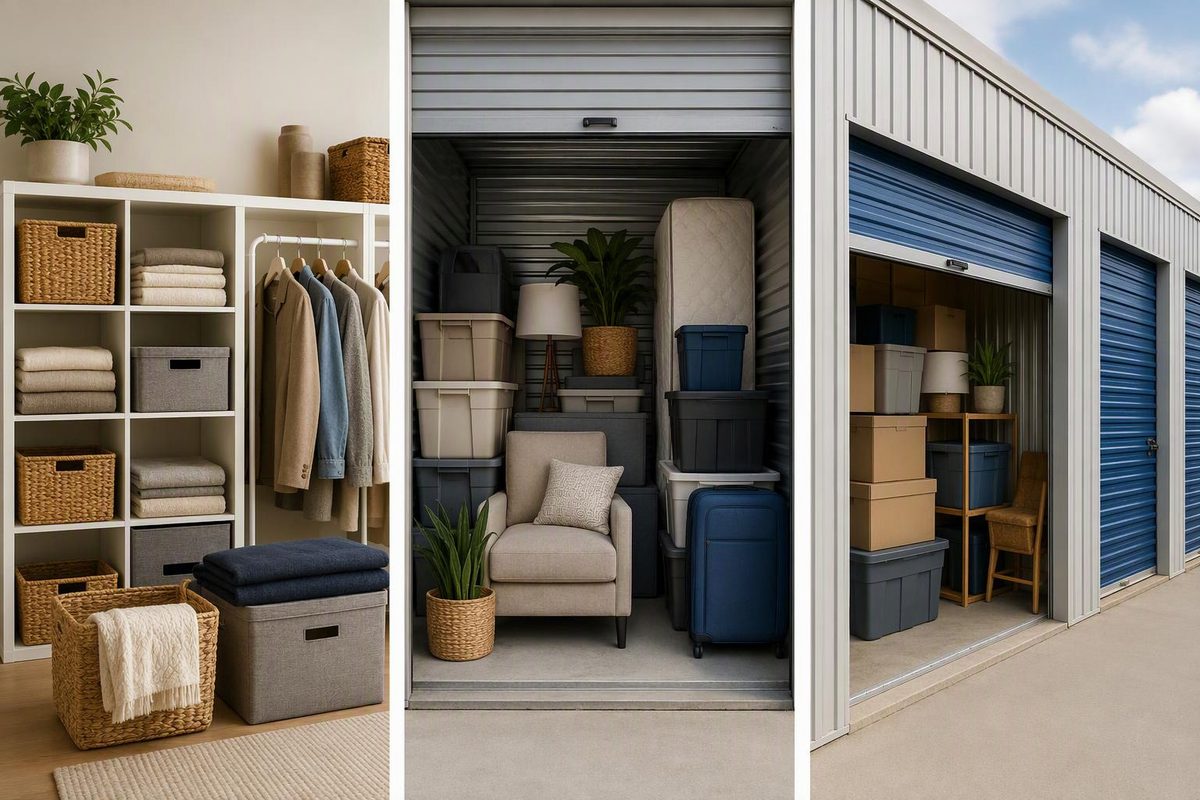
For belongings, start by reclaiming space you already have. Rent self-storage when the remaining load needs a separate home—not simply because your closets look full. If you already rent a unit, check its layout before paying for an upgrade.
The decision comes down to three things: what must fit, how often you need it and what the extra space will cost over your whole stay.
First, separate overflow from everyday belongings
Make an inventory and divide it into:
- Keep nearby: clothes, cookware, tools and other things you use regularly.
- Store elsewhere: seasonal decorations, spare furniture or belongings waiting for a move or renovation to end.
- Remove: things you can sell, donate, recycle or discard rather than pay to keep.
Measure the outside dimensions of packed boxes and the largest furniture pieces. Note what can safely be disassembled and what cannot support a stack.
Then choose the least disruptive option:
| Option | When it makes sense | Main trade-off |
|---|---|---|
| Reorganize a closet or spare room | The overflow is mostly boxes and small items | Shelves and containers still need accessible floor space |
| Reorganize an attic or garage | You already have suitable space for the particular belongings | Check access, temperature, dampness and safe loading before using it |
| Repack your existing storage unit | Unstable stacks, scattered boxes or assembled furniture waste space | Repacking takes time and may not solve an access problem |
| Rent or upgrade a unit | The measured load still will not fit safely | You add recurring rent, possible fees and trips to retrieve things |
Self-storage is a better candidate for seasonal overflow than for belongings you need every morning.
Recover usable space—not just empty corners
Use similarly sized, sturdy containers, label them on multiple sides and put frequently retrieved items near the front. Disassemble suitable tables and bed frames, keeping labeled hardware with the corresponding pieces.
In a storage unit, consider permitted freestanding shelving. Keep heavy items low, follow shelf weight limits and do not create stacks higher than you can comfortably reach. Public Storage’s organization guidance recommends these practices, a clear aisle and no drilling or permanent alterations to the unit. Follow the shelving manufacturer’s assembly and placement instructions as well; do not skip required anchoring just because the facility forbids drilling.
Shelving does not automatically create more capacity: it occupies floor space too. Its value is often that you can retrieve one box without dismantling a pile. For frequent visits, see our guide to shelving and reach zones.
If an existing unit only works when its walkway is filled, first try repacking or removing items. If you still cannot keep an adequate path clear, compare a larger unit or a different door layout. Get the transfer price, fees and billing treatment before moving anything.
Size the remaining load, including access
Suppose your overflow is 12 boxes measuring 18 × 18 × 16 inches each, two folding chairs and several seasonal sports items, with no sofa, mattress or appliances. If the boxes and contents can safely stack three high, four stacks would occupy 9 square feet and stand 4 feet tall, before allowing for gaps and access. A 5×5 is a reasonable starting point to inspect—not a guarantee of fit. Check where the awkward items will go.
Add a sofa, dresser and mattress, and inspect a 5×10 as well. Need to reach boxes behind the furniture regularly? Compare a 10×10 layout rather than assuming tight packing is acceptable. Public Storage identifies 5×5 and 5×10 units as small-storage options, but your measured inventory should control the choice, not an apartment-size label.
A nominal 5×10 has 50 square feet of floor area. An illustrative 2-foot-wide aisle running its full 10-foot depth uses 20 square feet, leaving 30 for belongings. That is layout arithmetic, not a required aisle width; leave enough room for your body and the items you will carry.
Before reserving, verify:
- Interior dimensions, usable height and clear door opening.
- The route from your vehicle, including stairs, elevators and tight turns.
- Access hours and availability of carts when you will actually visit.
- What any climate-control service maintains, if you are storing sensitive belongings.
Use our inventory-based unit sizing guide for a fuller comparison.
Compare the whole bill with the home-storage fix
Request a written quote covering rent, promotion length, required administrative fees, approved lock costs, any mandatory insurance or protection charge, applicable taxes, and move-out terms.
Fees are not merely hypothetical: as of October 14, 2026, Public Storage’s Tulsa listings showed a one-time $29 administrative fee alongside advertised rent and warned that additional taxes, fees and insurance may apply. That is an operator-specific example, not a universal fee schedule.
For an illustrative six-month rental, assume:
| Cost | Assumption | Six-month amount |
|---|---|---|
| Rent | $70 a month, unchanged | $420 |
| Insurance/protection | $12 a month | $72 |
| Administration | One-time $29 | $29 |
| Lock | One-time $20 | $20 |
| Total before taxes and transport | $541 |
Compare that with the actual price of a home-storage fix—say, a $100 shelving-and-container purchase if it safely accommodates the entire overflow.
Do not assume the initial rent lasts indefinitely. Extra Space Storage states that its original monthly rate is not guaranteed for the life of a rental. In the example above, a $20 increase for the final three months adds $60. Ask about rate-change terms and notice, not just the move-in discount. Our storage cost breakdown covers the other charges to check.
Check what can go—and plan when it comes out
Review the actual rental agreement before packing. For example, Extra Space Storage prohibits food, plants and flammable or combustible items. A larger unit does not make a prohibited item acceptable.
Set a retrieval or review date: after the renovation, at the next seasonal change or before the next billing period. Confirm how much move-out notice your agreement requires.
Rent when the measured, permitted load needs space you cannot reasonably reclaim at home. Choose the smallest layout that lets you store it safely and retrieve it without a partial unload.