
A 15 x 10 Storage Unit Gives You 150 Square Feet—Not Necessarily a Wider Door
Size a 15 x 10 storage unit by your furniture, aisle and door clearance. Compare 10x15 layouts, a local price example, fees and rate-change terms.
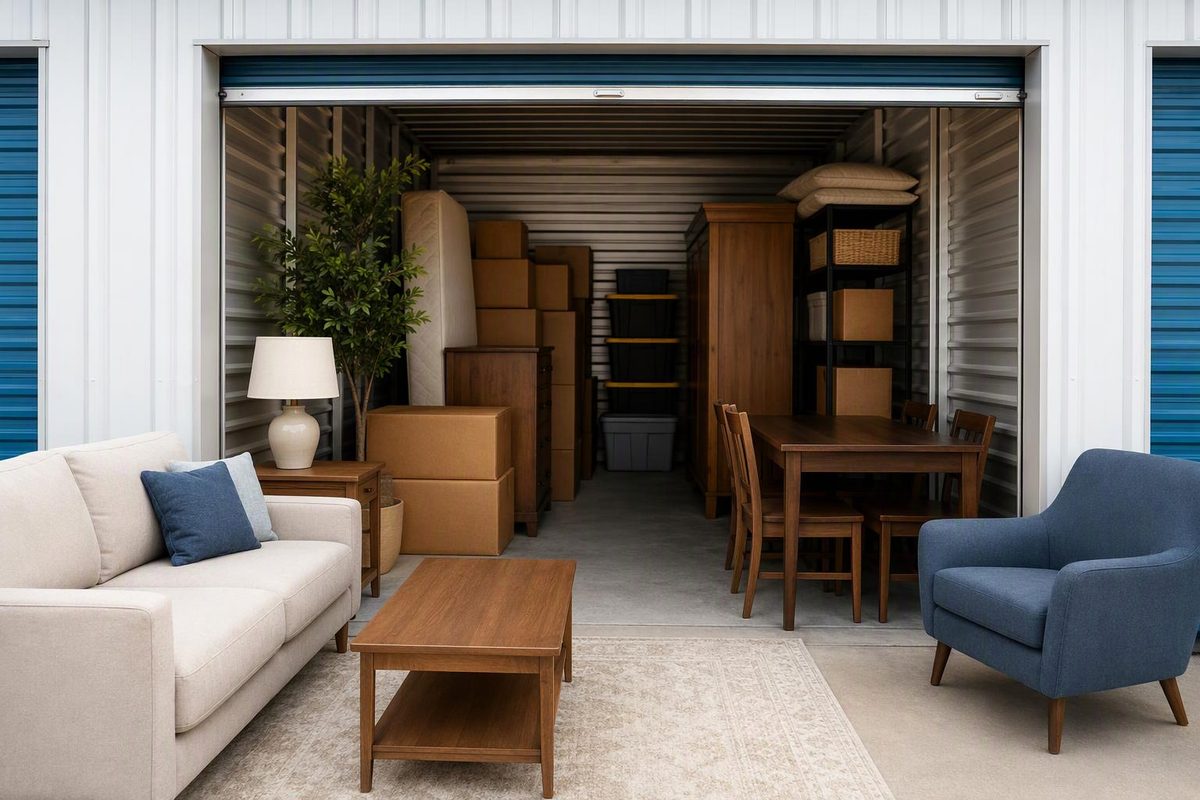
A 15 x 10 storage unit has a nominal 150-square-foot floor area, the same as a 10x15. It is a useful size to consider when a 10x10 cannot hold your furniture and boxes with the access space you need, but a 10x20 would leave substantial unused floor space.
The important difference may be orientation. A unit that is 15 feet wide and 10 feet deep can offer a shallower packing layout than one that is 10 feet wide and 15 feet deep. Neither label guarantees a wide door. Confirm the actual dimensions and entrance before reserving.
How much usable space do you get?
Some facilities distinguish the two layouts explicitly. Attic Self Storage in Riverside, California lists both a 15-foot-wide, 10-foot-long unit and a 10-foot-wide, 15-foot-long unit. Both have 150 square feet, and the operator warns that sizes are approximate.
Ceiling height changes theoretical volume:
| Measured ceiling height | Volume at a full 15 × 10 footprint |
|---|---|
| 8 feet | 1,200 cubic feet |
| 9 feet | 1,350 cubic feet |
| 10 feet | 1,500 cubic feet |
These are geometric calculations, not safe packing capacities. Public Storage’s 10x15 guide says ceiling heights vary by location and many units have 8-foot ceilings. Door hardware, obstructions, fragile furniture and stack limits can prevent you from using the full height.
An aisle also consumes meaningful floor area. Assuming the door is on the 15-foot wall, a straight 3-foot-wide aisle running the full 10-foot depth occupies 30 square feet, leaving 120 for belongings before other clearances. In a 10-foot-wide, 15-foot-deep layout with the door on the 10-foot wall, the equivalent full-depth aisle uses 45 square feet, leaving 105.
Three feet is a planning allowance here, not a code requirement or a guarantee that you can turn a loaded cart. Draw the aisle from the actual door position.
What fits: plan a load, not a bedroom count
Public Storage markets its 150-square-foot units for two-bedroom households and lists mattresses, couches, dressers, dining tables, appliances and boxes as possible contents. That does not mean every combination fits.
Use this illustrative inventory to test on your floor plan, not as a promised capacity:
- One queen mattress and a dismantled bed frame
- One straight sofa, approximately 8 × 3 feet
- Two dressers, each approximately 5 × 2 feet
- One dining table with removable legs and four chairs
- Twenty medium moving boxes
- One bicycle
The sofa and dressers alone occupy about 44 square feet if stored in their normal positions. A queen mattress stored flat adds roughly 33 square feet, based on standard dimensions of 60 × 80 inches. That leaves less room than the empty unit suggests once you add chairs, boxes and an aisle.
Measure the wrapped dimensions of each large piece. Decide which boxes can safely stack and which items cannot support anything above them. A sectional, second bed, washer and dryer, or several nonstackable pieces changes this load substantially.
For frequent visits, put retrieval boxes near the entrance and long-term furniture toward the back. Disassemble furniture where appropriate, but do not make the plan depend on balancing a sofa vertically or piling boxes on upholstery. For preparation and moisture precautions, use the furniture storage checklist.
Check the doorway and route before paying
Ask the facility to confirm:
- Clear door width and height: measure the usable opening, not the wall or advertised unit width.
- Interior dimensions: include columns, low beams and projecting door mechanisms.
- Loading route: check hallway turns, elevator openings and the distance from unloading to the unit.
- Access hours: confirm when you can reach your belongings, not just when the office is staffed.
- Climate-control scope: ask whether the facility manages temperature, humidity or both, and what limits it promises in writing.
Choose a 10x10 if your measured layout fits without blocking needed access. Move up to a 10x20 when large nonstackable items or retrieval space defeat the 150-square-foot plan—not simply because you have two bedrooms.
Compare the total bill, not just monthly rent
Prices depend on location, access type, amenities and availability. As a location-specific example, on October 3, 2026, Attic Self Storage’s Riverside rate page listed both orientations at $215 per month, plus a $25 one-time administrative fee, showing $240 for the first month. That is one facility’s advertised charge, not a national average or proof of the complete bill.
The same page advertised a new-customer offer to prepay two months and get the third month free, plus a free disc lock, and stated that rates were guaranteed for one year. Confirm which offer and guarantee apply to your chosen unit in the rental agreement.
For each quote, build this ledger:
| Cost or term | What to record |
|---|---|
| Rent | Promotional amount, duration and post-promotion rate |
| Insurance or protection | Required coverage, monthly charge and whether existing insurance qualifies |
| Move-in charges | Administration fee, approved lock and applicable taxes |
| Rate changes | Any price guarantee, permitted changes and notice terms |
| Move-out | Required notice, billing cutoff and refund policy |
Insurance requirements and rate terms are operator-specific. Public Storage requires insurance on stored goods; its pricing policy says rentals are month-to-month and rate changes receive at least 30 days’ advance notice. Do not assume that policy applies elsewhere.
Calculate your planned stay by adding each month’s rent and recurring charges, then one-time costs. If a later rate is not guaranteed, calculate a second scenario with a higher rent. The storage cost and fee guide explains the charges to check.
Remove prohibited items from the load
Get the facility’s restrictions before moving day. Public Storage’s policies prohibit hazardous, illegal, perishable and living items, with examples including toxic chemicals, food, plants and animals. Its packing guide also instructs renters to empty fuel from stored power tools and outdoor equipment.
A unit that physically holds your load is still the wrong rental if the lease prohibits part of it.