
Will a 10x10 Storage Unit Hold Your One-Bedroom Home?
See what fits in a 10x10 storage unit, how an aisle cuts usable space, current 2026 rates and which fees and restrictions to check before renting.
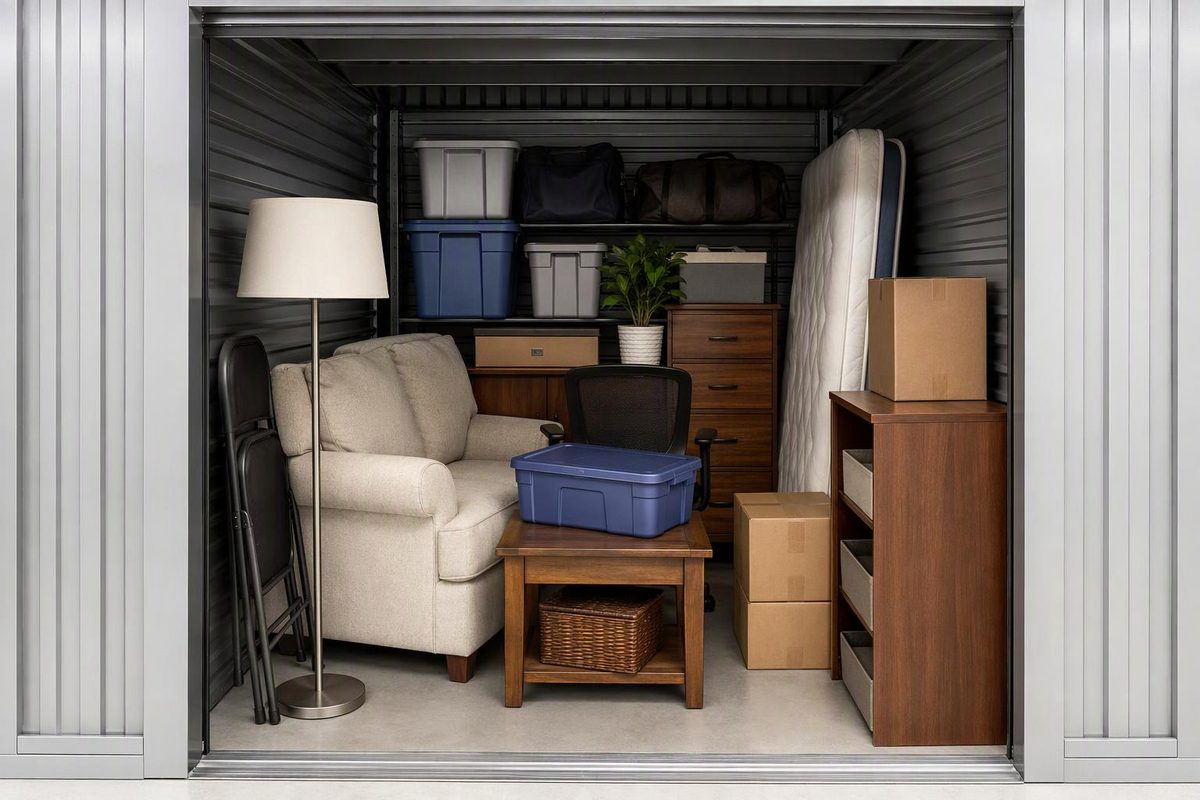
A nominal 10x10 storage unit provides 100 square feet of floor area. With an 8-foot ceiling, that is 800 cubic feet before accounting for an aisle, irregular dimensions and items that cannot be stacked.
It can be a workable size for a furnished one-bedroom apartment or a lightly furnished two-bedroom home. It is not a guaranteed fit: furniture shape, door clearance and the access you want after move-in matter as much as the room count.
Is a 10x10 the right size?
A 10x10 is a reasonable size to investigate for:
- A one-bedroom apartment with a typical mix of furniture and boxes
- Two bedrooms without a complete living-room and appliance set
- Furniture temporarily removed during a renovation
- Business stock arranged on shelving around an aisle
U-Haul lists 100 square feet, 800 cubic feet and an average 8-foot height, which varies by location. It describes a 10x10 as roughly half of a one-car garage and suitable for up to three rooms or two bedrooms. Public Storage gives similar estimates but says dimensions are approximate and ceiling height varies by facility (U-Haul; Public Storage). Treat those room counts as starting points, not capacity promises.
A 10x10 may be too large if you have only boxes, a mattress and a few small pieces; compare sizes against your actual inventory. It may be too small for a heavily furnished two-bedroom home, oversized sectional, garage equipment or a load with many items that cannot bear weight.
Frequency of access can change the answer. A tightly packed load may fit but require a partial unload whenever you need something from the back. If you need a center aisle, sorting space or room for inventory growth, compare the total cost of a 10x15 or 10x20 rather than forcing everything into the smaller unit.
Test a real load, not a room label
For a one-bedroom move, start by listing the actual pieces. A candidate inventory might include:
- One queen mattress set, bed frame and headboard
- One dresser and two nightstands
- One standard sofa, an armchair, coffee table and two end tables
- A four-seat dining table with removable legs and four chairs
- A washer and dryer
- One bicycle
- About 25 to 35 medium moving boxes
Do not assume that list fits just because it describes one bedroom. Measure the sofa, mattress, appliances and other inflexible pieces, then sketch them inside the unit’s measured footprint. A king bed, large sectional, refrigerator or more boxes can quickly eliminate the aisle.
For another point of reference, Public Storage estimates that an otherwise empty 10x10 could hold about 144 boxes measuring roughly 20 inches by 20 inches, but calls 100 boxes more realistic after allowing room at the door, at the top and for an aisle (Public Storage). A mixed household load usually leaves less predictable gaps around chairs, sofas and appliances.
An aisle reduces usable floor space
A 2-foot-wide aisle running the 10-foot depth occupies 20 square feet—one-fifth of the nominal floor area. Other losses can come from:
- A swinging door or hardware protruding into the unit
- Columns, pipes, ducts or sprinkler clearance
- Sloped or irregular walls
- Freestanding shelving
- Furniture and fragile boxes that cannot safely support a stack
- Clearance requirements in the lease or facility rules
Before paying, inspect the specific unit and measure:
- Interior width, depth and clear height
- Clear door width and height, not just the framed opening
- Hallway corners, elevator doors and loading-area clearances
- Columns, pipes or equipment inside the space
- The route from the loading area to the unit
Public Storage’s terms say actual unit sizes may vary from approximate estimates and advise customers to inspect before renting (Public Storage terms). Measure your widest sofa, tallest appliance and least flexible item before move-in. The door and approach route can rule out an item even when the total floor area looks sufficient.
Pack for access and stability
Plan the layout before unloading the truck:
- Put sturdy, rarely needed furniture toward the back.
- Disassemble tables and bed frames; bag and label their hardware.
- Use uniform boxes where practical, with heavier boxes at the bottom.
- Keep frequently needed belongings near the door or along the aisle.
- Follow posted rules for vents, controls, sprinklers and stacking height.
- Use freestanding shelving only if the lease permits it.
- Number boxes and mark their positions on a simple map.
Do not use upholstered furniture or weak boxes as structural supports. Clean and fully dry furniture, use breathable padding and raise pieces off bare concrete where practical. The furniture-storage checklist explains why moisture management matters more than wrapping everything in plastic.
Drive-up access can reduce carrying distance for a heavy load, but loading takes place directly in outdoor conditions. An indoor unit may offer a more sheltered route while adding hallways, doors or an elevator. “Climate controlled” is not a universal specification; ask what temperature or humidity is managed and whether either can vary.
What a 10x10 costs in 2026
For August 2026, StorageCafe reports national advertised street rates averaging $120 per month for a standard 10x10 and $136 for a climate-controlled 10x10, based on Yardi Matrix data. These are market averages, not all-in quotes, and local rates vary substantially (StorageCafe).
Compare the expected total, not only the banner rate:
(monthly rent × expected months) + administration fee + lock + required coverage + applicable taxes and service fees − discounts
Ask each facility for the written move-in total and the normal recurring monthly total. Check:
- Which months the promotion covers
- Whether the discount applies only to rent
- Administration or setup fees
- Lock type and purchase charge
- Insurance or protection-plan requirements
- Late, returned-payment and lock-cut fees
- Move-out notice and billing rules
- Whether the monthly rate can increase during your stay
Public Storage’s current terms say its promotions apply only to rent and that taxes, restrictions and administrative fees may apply. The company also requires customers to insure stored goods, while offering its own program as one option (promotion terms; insurance requirement). Its rentals are month to month, and it says rate changes receive at least 30 days’ advance notice (pricing policy). Those are operator-specific examples, so use the full storage-cost checklist on the facility you are considering.
Check prohibited items before loading
A 10x10’s capacity does not make every item acceptable. The facility lease controls. Public Storage, for example, prohibits unsafe, hazardous, illegal, perishable and living things, as well as living or working in a unit. U-Haul’s published list includes fuel, hazardous materials, pressurized tanks, perishable food, plants and animals (Public Storage policy; U-Haul restrictions).
Review the broader do-not-store list, then ask the facility about any vehicle, appliance, chemical or business inventory not clearly addressed in the lease.
Choose the 10x10 whose measured interior and access route fit your largest items, whose layout preserves the access you need and whose full bill remains acceptable after any promotion ends.