
Which Vinyl Measurement Do You Actually Need?
A protector can have suitable face dimensions and still not fit: a thick spine may exceed its capacity even when height and width look right.
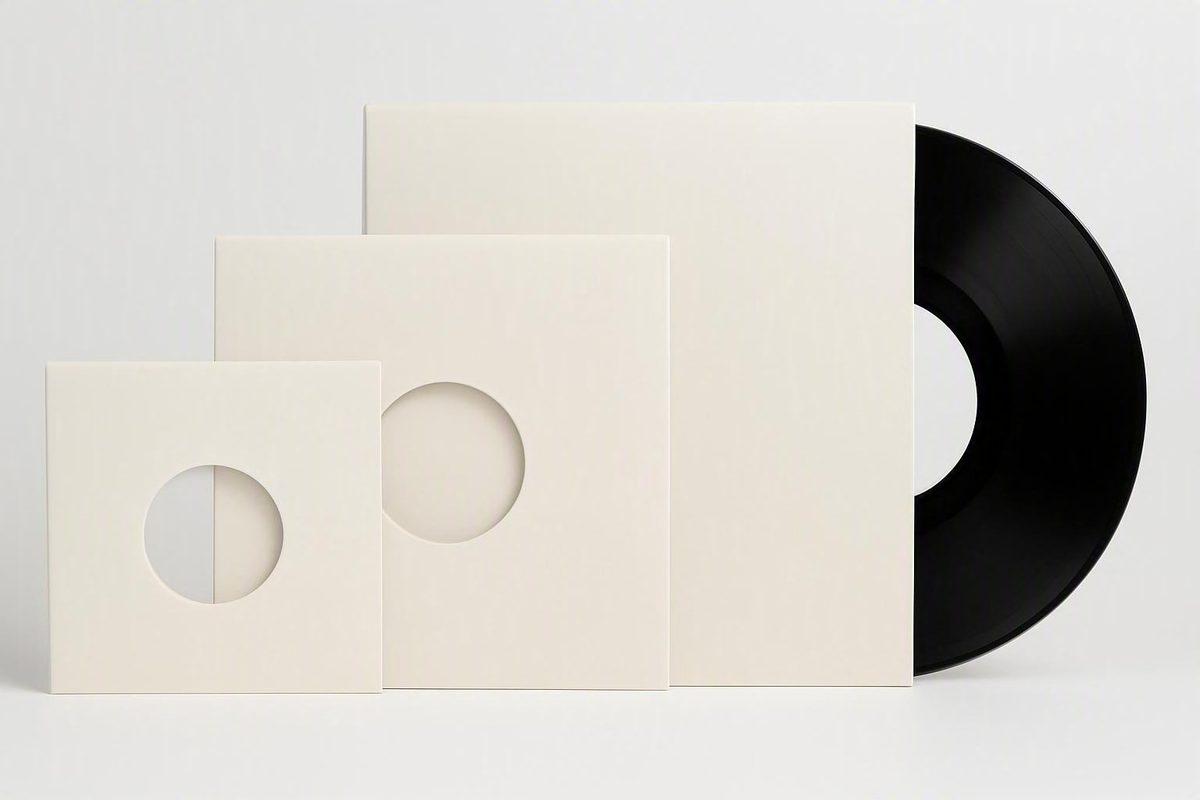
A “12-inch sleeve” can mean at least four different things: an inner sleeve for the disc, a printed record jacket, a clear protector around that jacket, or an artwork file prepared with bleed. None is necessarily a finished 12-inch square.
The same distinction applies to 7-inch and 10-inch formats. The nominal size describes the record’s diameter—not the finished dimensions of every layer around it. Before buying sleeves, designing packaging, or planning storage, identify the component being measured and whether the stated dimensions describe its exterior or usable interior.
Quick-reference vinyl sleeve dimension chart
The direct answer is that nominal record diameter is not the same as inner-sleeve size, finished-jacket size, protective-outer-sleeve size, or artwork size.
The figures below are typical working ranges compiled from commercial packaging and pressing guides. They are not a formal universal standard. Actual products vary with construction, board thickness, seams, folds, inserts, record count, and manufacturing tolerances.
| Record format | Record diameter | Typical inner sleeve | Typical finished printed jacket | Commonly reported clear protector |
|---|---|---|---|---|
| 7-inch | 7 in / 177.8 mm | Nominally about 7 × 7 in / 178 × 178 mm | About 7.125–7.25 in square / 181–184 mm / 18.1–18.4 cm | Supplier-specific; verify whether a listed measurement describes a jacket or a clear protector |
| 10-inch | 10 in / 254 mm | Nominally about 10 × 10 in / 254 × 254 mm | About 10.25–10.375 in square / 260–264 mm / 26.0–26.4 cm | Some protective products are listed around 10.5 × 10.5 in / 267 × 267 mm |
| 12-inch | 12 in / 304.8 mm | About 12–12.25 in square / 305–311 mm | About 12.25–12.375 in square / 311–314 mm / 31.1–31.4 cm | Commonly about 12.75 × 12.75 in / 324 × 324 mm / 32.4 × 32.4 cm |
For the 7-inch and 10-inch rows, Microforum lists nominal inner sleeves of 7 and 10 inches square and printed jackets of approximately 7.25 and 10.25 inches square; other commercial guides place the lower 7-inch jacket figure at approximately 7.125 inches and the upper 10-inch figure at approximately 10.375 inches (review the component-specific dimensions).
For 12-inch packaging, published figures include an inner sleeve of approximately 12.125 inches square and a finished jacket of approximately 12.375 inches square, supporting the broader working ranges shown in the table (see Music Gateway’s LP dimensions).
A retailer’s protective-sleeve chart lists products around 10.5 inches square for 10-inch records and 12.75 inches square for 12-inch LPs. The same guide warns that dimensions vary and that bulky packaging may need an oversized product (review the protective-sleeve chart).
Use the table according to your task:
- Buying a replacement inner sleeve? Start with the inner-sleeve column, then confirm that the sleeve accommodates the disc and enters the existing jacket.
- Replacing or manufacturing a printed cover? Use the jacket range only for preliminary planning. Production requires the manufacturer’s current specification.
- Buying a clear protective bag? Measure the complete filled jacket and compare it with the protector’s usable internal capacity.
- Designing artwork? Do not convert the table directly into a print template. Artwork may include bleed, folds, spine panels, and assembly areas.
- Planning storage? Use the dimensions of the protected jacket, including its depth—not the bare disc diameter.
The ranges overlap imperfectly because “record packaging” is not one uniform object. Every added layer needs enough room for the component nested inside it.
Record, inner sleeve, jacket, and outer protector are different things
Many conflicting answers about vinyl record sleeve dimensions are really conflicting definitions. One guide measures the disc, another calls the printed jacket an “outer sleeve,” a retailer uses “sleeve” for a clear plastic protector, and a printer quotes an artwork canvas containing material that will be cut away.
The relevant components are:
Record: The vinyl disc itself. The labels 7-inch, 10-inch, and 12-inch refer to nominal disc diameter. They do not define the dimensions of the complete package.
Inner sleeve: The paper or plastic component that directly holds the disc. It must accommodate the record while remaining small enough to enter the printed jacket. Its folds, seams, opening, and lining can affect both external size and usable capacity.
Printed jacket, cover, or album cover: The heavier paperboard package carrying the front, back, and spine artwork. A single-pocket jacket is usually close to square when viewed face-on. Gatefolds, multi-pocket jackets, tip-on constructions, and custom packages can be much thicker.
Protective outer sleeve: The clear aftermarket bag placed around the complete printed jacket. This is often what collectors mean when buying “outer sleeves,” but terminology is inconsistent. Some manufacturers use “outer sleeve” for the printed paperboard jacket and distinguish clear products as plastic outer protectors.
Artwork canvas or dieline: The production file used to print, fold, and cut the packaging. It may include bleed beyond the trim edge, a spine, glue areas, panel boundaries, folds, and material that will not remain visible. Its total dimensions should not be mistaken for the finished jacket size.
The nesting relationship is:
Clear protective outer sleeve
└── Printed jacket or album cover
    └── Inner sleeve
        └── Vinyl record
A gatefold adds connected panels to the printed-jacket layer. Box sets, rigid slipcases, booklet packages, and custom editions can add further layers.
This nesting principle explains why each successive component generally needs more room. It also explains why “What size is a 12-inch record sleeve?” has no reliable answer until the word sleeve is defined.
When comparing products, use precise terms:
- “12-inch record” for the disc
- “12-inch inner sleeve” for the component touching the disc
- “Finished LP jacket” for the printed cover
- “Clear LP protector” for the aftermarket bag
- “Jacket dieline” or “artwork canvas” for the production file
If a seller uses only the word “sleeve,” inspect the description, photographs, closure style, and stated purpose before relying on the measurements.
Why 12, 12.375, 12.5, and 12.75 inches can all be correct
These measurements are often presented as competing answers. They make sense when each number is labeled by component and purpose.
- 12 inches: record diameter or nominal sleeve category
A 12-inch record is nominally 12 inches, or 304.8 mm, in diameter. “12-inch inner sleeve” is also a product category, even though a finished inner sleeve may be slightly larger than the disc. Twelve inches is not normally the finished face dimension of the printed jacket.
- Approximately 12.25–12.375 inches: finished jacket
A conventional printed jacket is larger than the record and its inner sleeve. Commercial packaging guidance commonly places finished LP jackets between approximately 12.25 and 12.375 inches square, with 12.375 inches appearing frequently (compare reported jacket ranges).
- 12.5 × 12.5 inches: possible artwork canvas including bleed
A 12.5-inch-square file may describe a design canvas rather than a finished jacket. Disc Makers recommends a 12.5 × 12.5-inch design area including bleed for one standard 12-inch jacket workflow and directs designers to obtain the selected manufacturer’s template (review the artwork guidance).
Because bleed extends past the trim line, it is removed during production. It does not make the completed jacket 12.5 inches square.
The correct conversion is:
12.5 inches × 2.54 = 31.75 cm
Therefore, 12.5 inches equals 31.75 cm, not 32.7 cm.
- 12.75 × 12.75 inches: common clear-protector size
Approximately 12.75 inches square, or 324 mm square, is a commonly reported face size for a clear protector intended to surround a standard 12-inch LP jacket. It is not the diameter of the record or the usual finished-jacket measurement.
Together, the values describe a plausible sequence:
12-inch disc
→ roughly 12–12.25-inch inner sleeve
→ roughly 12.25–12.375-inch finished jacket
→ roughly 12.75-inch clear protector
This sequence is explanatory, not a guaranteed fit specification. A protector can have suitable face dimensions but insufficient capacity for a thick spine. A nominally correct inner sleeve can also be too tall or wide for an unusually tight jacket.
The governing rule is simple: label every number by component and purpose before using it for a purchase, storage plan, display, or print job.
How to measure an album before buying a protective sleeve
A product labeled “for 12-inch LPs” identifies a general category. It does not establish whether the protector will fit a particular album.
1. Assemble the complete package
Measure the album in the condition in which it will be stored. Include:
- Every record
- All inner sleeves
- Booklets and lyric sheets
- Posters and art prints
- Download cards or other retained inserts
- Obi strips or external paper bands
- Existing wraps or removable package elements
- Any extra sleeves kept inside the jacket
Do not measure an empty jacket if it will normally be stored full.
2. Measure the closed height
Stand or lay the jacket naturally without compressing it. Measure from its lowest to highest point.
Include any retained external element that projects beyond the jacket if the protector must enclose it.
3. Measure the closed width
Measure from side to side while the package is closed. For a gatefold, use the closed face width—not the full width when opened.
Check for flaps, tabs, attached booklets, rigid slipcases, decorative edges, and other features that create a wider point.
4. Measure total package depth
Measure the filled package from front to back at its thickest point, usually near the spine. Do not flatten a gatefold or multi-record package to obtain a more convenient measurement.
Depth can be the deciding dimension. Two albums may have nearly identical height and width but require different protectors because one is a slim single-pocket jacket and the other is a thick gatefold containing several records and inserts.
5. Determine what the seller’s measurements mean
Find out whether the listing gives:
- External height and width
- Internal usable capacity
- The dimensions of a flat, unfilled bag
- Finished dimensions after seams and closures are formed
- A maximum suggested jacket size
- A nominal format category rather than measured capacity
The available supplier guidance does not establish one universal convention. If the listing is unclear, ask the seller instead of assuming that its headline dimensions represent usable interior space.
6. Account for construction
Do not apply one arbitrary allowance to every brand. Compare the album’s height, width, and depth with the supplier’s stated usable capacity, seam arrangement, closure design, and manufacturing tolerance.
7. Judge the fit qualitatively
A useful fit lets you insert and remove the album without forcing the jacket, catching its corners, or placing obvious strain on the seams.
The protector should not be so loose that the jacket moves excessively during ordinary handling. However, there is no single numerical clearance that works for every material, seam design, closure, and package construction.
8. Test one sleeve before ordering many
Try a sample on the thickest relevant album—not merely the easiest slim jacket in the collection. Test insertion, closure, removal, and normal shelf handling.
A mixed collection may require more than one protector category. Forcing every release into one nominal size can leave bulky records in sleeves that are too tight and slim records in protectors that are needlessly loose.
Gatefolds, double LPs, inserts, and other fit exceptions
A gatefold can retain roughly conventional LP height and face width while closed but become approximately twice as wide when opened.
Published supplier-specific examples include approximately 12.375 × 24.75 inches for an open gatefold (see the reported Music Gateway dimensions) and approximately 12.5 × 25 inches in another commercial guide (compare the second gatefold example). These are examples, not universal specifications.
Open width matters for artwork and display planning.
Slim single LP
A single record in one inner sleeve and a conventional single-pocket jacket is the most likely candidate for a commonly listed 12.75-inch-square protector.
Even then, check the jacket’s actual dimensions and the protector’s usable capacity. A vintage jacket may be unusually tight or misshapen, while a modern release may use heavier board or contain a substantial booklet.
“Single LP” is useful context, not a guarantee of slim construction.
Gatefold double LP
A double LP often places more material inside a folding jacket. Its closed face may appear conventional, but its spine and outer edge can be considerably thicker than those of a single LP.
A standard LP protector category is a reasonable starting point, not a promise of fit. If a supplier gives only height and width, the listing does not establish whether the protector can wrap comfortably around the gatefold’s depth.
Insert-heavy or multi-record package
A triple LP, booklet-heavy reissue, rigid tip-on jacket, package with an obi strip, or custom release can exceed typical assumptions without appearing dramatically larger face-on. Its limiting dimension may be depth, a projecting insert, or a stiff structure that cannot flex during insertion.
Modern reissues, vintage records, Japanese releases with added packaging, and custom editions can all depart from typical working dimensions. Measure the item instead of applying a categorical rule based on age, origin, record count, or jacket style.
Treat box sets and other rigid packages as separate objects. Do not infer a protector size from the number or diameter of the records inside. Unless a supplier publishes reliable usable depth and expressly supports that construction, direct measurement and a physical test are safer than guessing.
Artwork dimensions are not finished sleeve dimensions
Designers need a production specification, not merely the dimensions of an album in a collector’s hands. The measurements are related, but they are not interchangeable.
A print file can contain several distinct areas:
- Finished trim size: The dimensions after cutting and finishing
- Bleed: Artwork extending beyond the trim edge
- Safe area: An inset region intended to keep essential content away from cuts and folds
- Spine: The panel connecting the front and back faces
- Fold lines: Boundaries where the board bends
- Glue areas: Sections used in assembly and potentially hidden
- Panels or pockets: Additional structures in gatefold and multi-record packaging
Bleed exists so the artwork continues beyond the intended cut. It is trimmed away during production and therefore does not increase the completed jacket’s physical size.
Commercial guidance commonly calls for artwork at full 1:1 scale, at least 300 dpi, and approximately 0.125 inch of bleed, while exact requirements vary by manufacturer. One pressing-company guide specifies 300 dpi and approximately one-eighth inch of bleed but also emphasizes that actual packaging dimensions can vary (review the production measurements).
Other suppliers use different requirements. RPM Records, for example, specifies 1:1 artwork at a minimum of 300 dpi but calls for 5 mm of bleed in its own workflow (see its supplier-specific design guidance).
That variation is why 12.375 inches and 12.5 inches can both appear in a design discussion:
- Approximately 12.375 inches square may describe the finished jacket face.
- 12.5 inches square may describe an artwork canvas that includes bleed.
- Neither figure automatically defines the complete dieline for a jacket with a spine, back panel, folds, pockets, or glue tabs.
Keep titles, logos, catalog numbers, legal lines, faces, and other essential details away from cut and fold lines. A supplier may publish a specific safe zone, but its value should not be generalized to another printer or package.
Gatefold and multi-record packages require product-specific layouts. Their dielines must account for front, back, and interior panels; spine width; fold locations; pocket construction; and assembly areas. Spine width depends on the package being manufactured and should not be guessed from a generic LP measurement.
Before submitting artwork, complete this preflight checklist:
- [ ] Confirm the exact product and jacket construction.
- [ ] Obtain the manufacturer’s current dieline.
- [ ] Verify the finished trim dimensions.
- [ ] Verify bleed on every required edge.
- [ ] Identify the safe area for essential content.
- [ ] Confirm spine width and orientation.
- [ ] Confirm every fold, panel, pocket, and glue area.
- [ ] Build the file at the requested scale.
- [ ] Meet the required resolution.
- [ ] Use the requested color mode and file format.
- [ ] Confirm requirements for images, fonts, and outlined text.
- [ ] Review the current export settings.
- [ ] Inspect a proof before approving production.
Generic web dimensions are useful for estimates, mockups, budgets, and early composition. The selected pressing plant or printer’s current dieline is authoritative for the actual job.
Use the packaged dimensions when planning shelves, boxes, frames, or storage
Storage and display systems must accommodate the largest nested component—usually the printed jacket inside its clear protector. Designing around the bare 12-inch disc will leave insufficient room for a typical LP package.
For conventional 12-inch LPs, approximately 13 inches of vertical shelf clearance is a reported starting point rather than a guarantee for every package. The same commercial guide reports typical shelf depths of approximately 13–15 inches, while noting that packaging can vary.
A separate storage guide recommends at least 33 cm of internal shelf depth for typical 12-inch LPs in protective sleeves (see the reported storage dimensions). Measure bulky gatefolds, rigid packages, and projecting external elements directly rather than treating that figure as universal.
The required dimensions depend on the object being selected.
Shelves
Measure:
- Internal vertical clearance between shelves
- Usable depth from the front edge to the back panel
- Internal width between side panels or dividers
- Any lip, door, hinge, or trim intruding into the opening
- The thickest and tallest protected album
Also test the handling path. A nominally adequate opening may still be awkward if a door hinge, shelf lip, or divider prevents natural insertion and removal.
Crates and moving boxes
Measure the box’s interior rather than its advertised external size. Check:
- Internal height with the bottom and top closures folded
- Internal width at the narrowest point
- Usable depth after liners or dividers are installed
- Handle cutouts and reinforcement panels
- Space occupied by padding
- Whether the lid closes over the tallest protected album
Plan around the complete album package. If clear protectors will be added later, include their dimensions before choosing the box.
Frames and display holders
A frame’s face dimensions do not establish its usable package capacity. Check its internal opening, recess depth, backing-board position, clips, spacers, and closure mechanism.
A frame that accepts a slim jacket may not close around a thick gatefold. A holder supporting only the lower edge may have different limiting dimensions from a fully enclosed frame.
Storage containers and cabinets
Measure the internal space after doors, dividers, rails, and closures are installed. Identify the narrowest opening through which a record must pass—not merely the larger compartment behind it.
Allow enough handling room to insert and remove records without force or complicated tilting. The required clearance depends on access direction, package thickness, container shape, and handling frequency; no universal allowance applies.
For a larger collection, measure the packed record boxes and their handling orientation before selecting furniture or choosing the right storage unit size. The external dimensions of the packed boxes—not the diameter of the records inside—determine how much usable space the collection requires.
A final specification checklist before you buy, print, or store
A useful vinyl measurement always answers two questions:
- Which component is being measured?
- What will the measurement be used for?
Apply the relevant checklist before committing money or finalizing a design.
Replacement inner sleeves
- Confirm whether the disc is 7, 10, or 12 inches.
- Verify the inner sleeve’s finished external height and width.
- Confirm that it accommodates the disc.
- Check whether seams, folds, or lining affect usable capacity.
- Make sure it enters the existing jacket without folding, bunching, or excessive force.
- Test it on a tight jacket as well as a roomy one when buying for a mixed collection.
Clear protective sleeves
- Measure the closed jacket’s height.
- Measure its width.
- Measure filled depth at the spine or thickest point.
- Include every record, inner sleeve, and retained insert.
- Identify the closure type.
- Determine whether listed dimensions are internal or external.
- Check how seams, flaps, and resealable strips affect usable space.
- Review the supplier’s manufacturing tolerance.
- Test the thickest representative album before ordering in bulk.
Printed jackets and artwork
- Choose the exact jacket construction.
- Obtain the selected manufacturer’s current dieline.
- Confirm trim dimensions.
- Confirm bleed.
- Confirm the safe area.
- Verify spine width.
- Identify folds, pockets, panels, and glue areas.
- Confirm scale and resolution.
- Check the required color mode, file format, and export settings.
- Do not substitute a generic online measurement for a production template.
Shelves, crates, moving boxes, cabinets, and frames
- Measure internal rather than external dimensions.
- Use the complete protected package as the test object.
- Check height, width, and depth.
- Account for doors, lips, hinges, dividers, padding, and closures.
- Test the thickest or tallest unusual release.
- Allow practical handling room without assuming one universal clearance.
The compact decision path is:
Identify the component → measure the actual package → check usable internal capacity → test one unit → order or build.
Treat published vinyl record sleeve dimensions as typical starting points unless a manufacturer supplies a specification for the exact product.
Frequently asked questions
What size sleeve do I need for a standard 12-inch LP?
First determine whether you need an inner sleeve or a clear protector.
A typical 12-inch inner sleeve is approximately 12–12.25 inches square. The printed jacket commonly falls around 12.25–12.375 inches square, while a clear protective sleeve is often listed at approximately 12.75 × 12.75 inches, or 324 × 324 mm (compare the reported component dimensions).
For a slim conventional jacket, that protector category is a practical starting point. Measure the filled album’s height, width, and depth and verify usable capacity before buying.
Why is an LP jacket about 12.375 inches if the record is 12 inches?
The 12-inch measurement describes the record’s nominal diameter. The disc sits inside an inner sleeve, and that sleeve must fit inside the printed jacket. The jacket therefore needs a larger finished face than the bare record.
Approximately 12.375 inches is a frequently reported jacket dimension, not a universal requirement. Some jackets are closer to 12.25 inches, while custom construction, board thickness, folds, and manufacturing tolerances can produce different results.
Will a 12.75-inch outer sleeve fit a gatefold double LP?
Possibly, but the face measurement alone cannot guarantee it.
A gatefold double LP can have conventional closed height and width while being substantially thicker than a slim single LP. The protector must provide sufficient usable depth, and its seams and closure must accommodate the package without being forced.
Measure the filled gatefold while closed and test one protector before ordering in bulk. Do not assume that every product in the standard LP category will fit every double LP, triple LP, tip-on jacket, or insert-heavy release.
Are listed protective-sleeve dimensions internal or external measurements?
They may be either. Supplier terminology is not consistent enough to assume one convention.
A listing might provide outside dimensions, flat dimensions, usable interior dimensions, a maximum suggested jacket size, or simply a nominal format category. Seams, flaps, and resealable closures can make usable space smaller than the headline dimensions suggest.
Look for phrases such as “internal dimensions,” “usable capacity,” or “maximum jacket size.” If the listing is unclear, ask the supplier and test a sample.
Should vinyl artwork be 12.375 or 12.5 inches square?
Use the printer’s current dieline rather than choosing between those figures in isolation.
Approximately 12.375 inches may describe the finished face of a conventional LP jacket. A 12.5-inch-square artwork canvas may include bleed that will be trimmed away. Gatefolds and jackets with spines require larger, product-specific dielines containing all panels, folds, and assembly areas.
A 12-inch record therefore does not call for one universal 12-inch sleeve measurement. Identify whether you need an inner sleeve, finished-jacket specification, clear protector, artwork template, or storage clearance. Then measure the complete package, verify usable internal capacity, and test bulky or unusual albums before committing to a purchase or print run.