
Vinyl Record Size With Cover: Jackets, Artwork, Storage, and Frames
An LP disc is 12 inches across, but its finished cover is commonly about 12.375 inches square. "12-inch" names the disc, not the whole package.
Overview
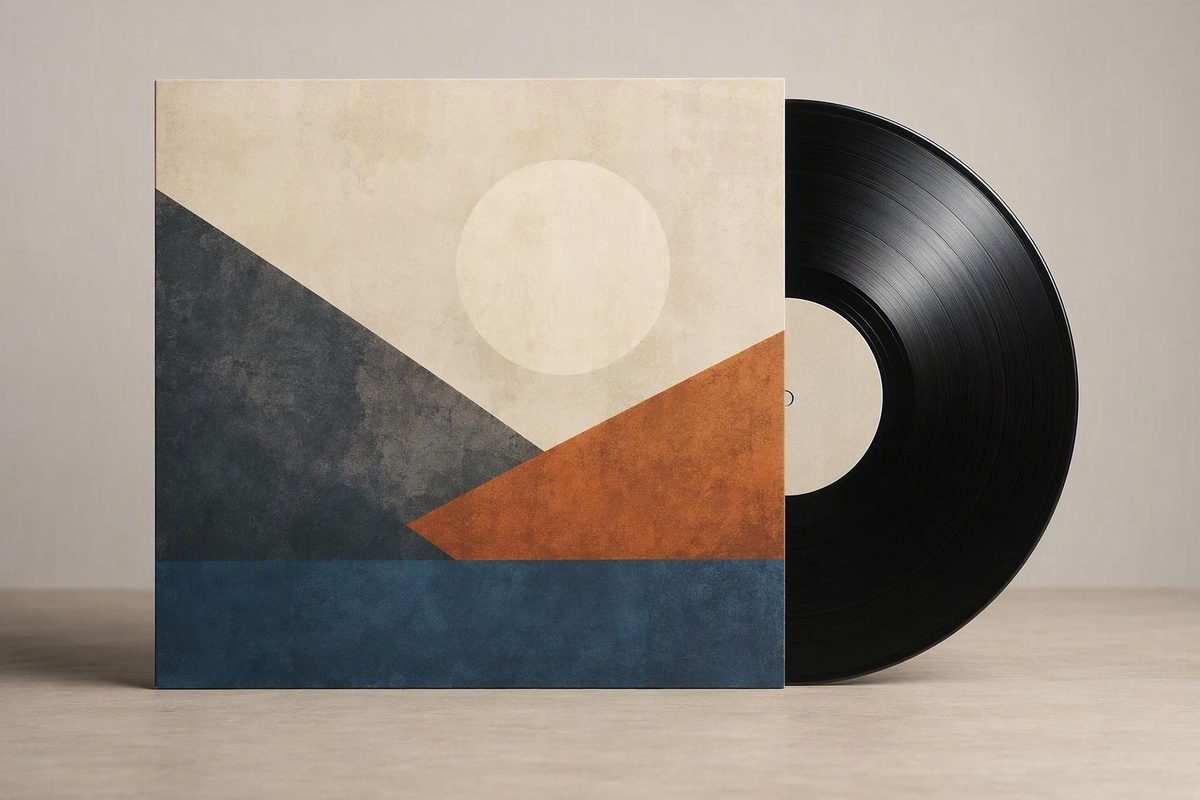
A standard LP record is 12 inches (30.48 cm) in diameter, but its finished cardboard cover is commonly about 12.375 inches (31.43 cm) square. Artwork files may be larger because they include bleed, while clear protective sleeves, gatefolds, and multi-record jackets can add further width or depth.
The key distinction is between nominal format and finished package size. “12-inch” describes the disc diameter, not the exact vinyl record cover dimensions. Both Music Gateway and the Album cover reference page report a typical finished LP jacket at 12.375 inches square.
For buying a shelf or frame, measure the complete package you intend to store. For print production, use the pressing or printing supplier’s template rather than treating the finished jacket measurement as the required artwork canvas.
Vinyl record and cover sizes by format
Nominal record sizes describe disc diameter. The corresponding jacket must be slightly larger so it can hold the disc and inner sleeve, but the supplied sources do not establish one universal finished dimension for every 7-inch or 10-inch product.
| Format | Nominal disc diameter | Commonly reported finished jacket | Artwork or protector decision |
|---|---|---|---|
| 7-inch single | 7 in (17.78 cm) | Approximately 7.25 × 7.25 in (18.4 × 18.4 cm) in one supplier guide | Confirm the printer’s jacket template and the protector’s stated internal dimensions |
| 10-inch record | 10 in | Approximately 10.25 × 10.25 in in one supplier guide | Treat this as an initial estimate, then verify the selected jacket construction and template |
| 12-inch LP | 12 in (30.48 cm) | Approximately 12.375 × 12.375 in (31.43 × 31.43 cm) | A typical artwork canvas may be 12.5 × 12.5 in including bleed; verify the final template and protector fit |
The smaller-format figures require particular care. Microforum reports approximate outer-sleeve dimensions of 7.25, 10.25, and 12.375 inches square for 7-inch, 10-inch, and 12-inch records. However, its own format table also distinguishes jacket and inner-sleeve measurements, showing why “sleeve size” can be ambiguous.
Supplier product lists reinforce that construction matters. United Record Pressing provides separate templates for 7-inch jackets, 10-inch single-pocket and gatefold jackets, and several 12-inch constructions. These format labels identify the intended record size, but they do not prove that every manufacturer uses identical trim, fold, or pocket tolerances.
Use the table for initial planning, not final manufacturing approval. For a physical purchase, check the product’s internal dimensions. For printing, download the exact supplier template for the format and construction being ordered.
Record, inner sleeve, jacket, and outer protector
A record package has several layers, and each has a different measurement boundary. In everyday use, “cover” often means the printed outer jacket, but sellers and collectors may also use “sleeve” for either the inner sleeve or the jacket.
The record is the grooved disc. Its nominal 7-inch, 10-inch, or 12-inch measurement refers to diameter.
The inner sleeve directly surrounds the disc inside the jacket. According to Microforum, its purpose is to protect the record from dust, static, and scratches. Reported inner-sleeve measurements differ from finished outer-jacket measurements, so an LP inner sleeve should not be used as the sizing reference for a frame or shelf.
The printed jacket holds both the record and its inner sleeve. It commonly carries the front and back artwork, track listing, liner information, and other printed material. For a standard 12-inch LP, the commonly reported finished jacket face is approximately 12.375 inches square.
A clear outer protector is an optional plastic sleeve placed around the printed jacket. The supplied evidence confirms that collectors use this additional layer, but it does not establish a universal external protector size. Its material, seams, closure, and intended capacity can affect fit. Check the protector’s stated internal dimensions and, when possible, measure the protected album before selecting a tight shelf compartment or display frame.
Print-ready cover artwork dimensions
A print-ready cover file is not the same size as the trimmed jacket. Disc Makers gives 12.5 × 12.5 inches as an artwork size for a standard 12-inch jacket, including bleed. By comparison, the commonly reported finished jacket is approximately 12.375 × 12.375 inches.
That difference is intentional. Bleed extends artwork beyond the final trim so minor cutting variation does not leave an unintended unprinted edge. It belongs in the production file but is removed from the visible finished dimensions during trimming.
For an initial 12-inch jacket setup:
- Prepare the artwork at 12.5 × 12.5 inches when that is the size specified by the production template.
- Use a minimum resolution of 300 dots per inch, following the guidance reported by Disc Makers.
- Keep essential text, logos, and other critical elements away from trim edges. Music Gateway reports a 0.25-inch safe zone.
- Obtain the template for the exact jacket construction from the selected manufacturer.
The supplier template is the controlling specification. It identifies where trim lines, folds, pockets, panels, and spine allowances belong. A generic square canvas cannot describe every part of a gatefold, wide-spine, fold-over, or multi-pocket package.
Do not enlarge a finished 12.375-inch cover measurement to 12.5 inches and assume the file is complete. Confirm the required bleed, safe area, color and file settings, panel orientation, and spine layout against the current production template before submission.
Gatefold and multi-record package dimensions
A gatefold can retain approximately the same square face as an ordinary LP jacket when closed while occupying twice the panel width when fully open. Music Gateway reports a closed size of 12.375 × 12.375 inches and an open layout of approximately 12.375 × 24.75 inches (31.43 × 62.86 cm).
That open width represents two standard-size panels side by side. It is useful for understanding the visible artwork area, but it is not a universal printer template. Fold positions, pocket construction, trim allowances, and the spine still have to follow the manufacturer’s production file.
A double LP does not automatically require one specific jacket style. The 2424 Vinyl template list includes both a standard 12-inch jacket with a wide spine for double LPs and a 12-inch gatefold jacket with a wide spine. This means record count and jacket construction must be considered together.
For storage, the closed face may remain close to the ordinary 12.375-inch-square footprint. For artwork, handling, or display, account for the doubled open width and the construction-specific spine.
Why spine and package depth vary
One depth measurement cannot be applied reliably to every single LP, gatefold, or double-LP package. Disc Makers notes that gatefold and double-LP designs need additional spine space based on the thickness of the vinyl.
A package holding more than one disc needs enough capacity for the records, inner sleeves, jacket panels, and folds. A gatefold may also use multiple pockets or thicker folded sections. Manufacturers therefore offer alternatives such as standard, wide-spine, and gatefold jackets rather than one universal construction.
The supplied evidence does not establish standard finished-depth ranges for these packages. Use the manufacturer’s spine specification for artwork and obtain the finished external depth when checking shipping, shelf, or frame compatibility.
Storage and framing clearance
For an ordinary covered LP, allow more room than the nominal 12-inch disc diameter. Music Gateway reports that standard vinyl shelving typically needs at least 13 inches of height and 13 to 15 inches of depth. These are planning figures, not guaranteed dimensions for every cabinet or package.
Height clearance must accommodate the approximately 12.375-inch jacket without forcing its top edge against the shelf. Depth depends on how the records are oriented and whether doors, dividers, handles, or other hardware intrude into the usable space. Measure the shelf’s clear internal opening rather than relying only on its advertised exterior dimensions.
For display, the same source reports that frames for album covers commonly have internal dimensions of approximately 12.5 × 12.5 inches. That provides modest clearance around an ordinary LP jacket, but face dimensions alone do not confirm compatibility. Frame depth, backing pressure, mounting method, and the package’s actual thickness also matter.
A protected or multi-record album needs individual verification. VinylCrafts describes a frame designed with additional space so thicker records and double LPs can fit, illustrating that frame capacity differs by design. A clear protector can also increase the package’s outside measurements even though the underlying jacket remains unchanged.
Before purchasing storage or a frame, measure the album at its widest, tallest, and thickest points in the exact condition in which it will be stored or displayed. Compare those figures with the product’s usable internal dimensions, including depth, rather than assuming every item labeled for a “12-inch record” fits a complete 12.375-inch jacket, outer protector, or wide-spine package.