
What You Will Really Pay to Rent a Storage Container
U-Haul puts monthly rent for one portable container at $80–$200. For a short project, transportation may exceed that rate and become the largest bill item.
The short answer: monthly rent is only the starting point
Prices checked August 7, 2026. This guide compares provider advertisements, provider-reported averages, and vendor estimates available in the supplied evidence. It is not based on an independent sample of local quotes. Undated vendor pages are identified as such, and every published price still requires confirmation for your address, dates, equipment, and service configuration.
Vendor-published examples and estimates span roughly $50 to $500 per month, but that is a span of heterogeneous vendor figures—not an independently verified national market range. Its endpoints come from broad estimates published by Atlas Self Storage, a Texas provider: as little as $50 for some long-term 20-foot rentals and as much as $500 for certain 30-foot rentals. The page does not specify all commitment, availability, or service assumptions behind those endpoints and does not provide a publication date (Atlas Self Storage’s container-cost estimates).
For portable household containers, U-Haul describes $80 to $200 per month as typical rent for one container. This is a provider estimate rather than a neutral market average. Delivery, pickup, shipping, coverage, labor, and other services can be additional (U-Haul’s portable-container cost guide).
Concrete provider figures show why one headline number is inadequate. Dry Box’s undated pricing page advertises $95 per month for a 10-foot steel container, $125 for a 20-foot container, and $175 for a 40-foot high cube. Delivery starts separately at $150 plus mileage (Dry Box’s advertised rental prices).
In an article posted July 24, 2025, PODS reports average on-site monthly rates of $139 for an 8-foot container, $159 for a 12-foot container, and $175 for a 16-foot container. PODS reports higher averages when the container is stored at one of its facilities rather than at the customer’s property (PODS’ reported average standard rates).
Those figures describe different equipment and services. They should not be blended into a single “average storage container rental cost.”
A one-month project can cost substantially more than one month of rent because delivery and pickup may each be charged separately. A container advertised at $125 per month might require base rent, two transportation charges, tax, a lock, coverage, and other fees before the project is complete.
The reliable way to price your project is to request a written, location-specific quote stating:
- Container type, size, usable dimensions, and condition
- Delivery and expected pickup addresses
- Requested delivery and pickup dates
- Whether the container stays on-site, moves to a facility, or travels elsewhere
- Billing cycle and minimum rental term
- Delivery distance and included mileage
- Placement conditions and truck-access requirements
- Every recurring charge, one-time charge, deposit, surcharge, and tax
- The minimum contractual commitment
- The event that stops billing
Treat advertisements as screening information. Treat the written quote and rental agreement as the budget.
First identify which kind of container you are pricing
“Storage container” can describe several products that differ in dimensions, transportation, access, billing, and service.
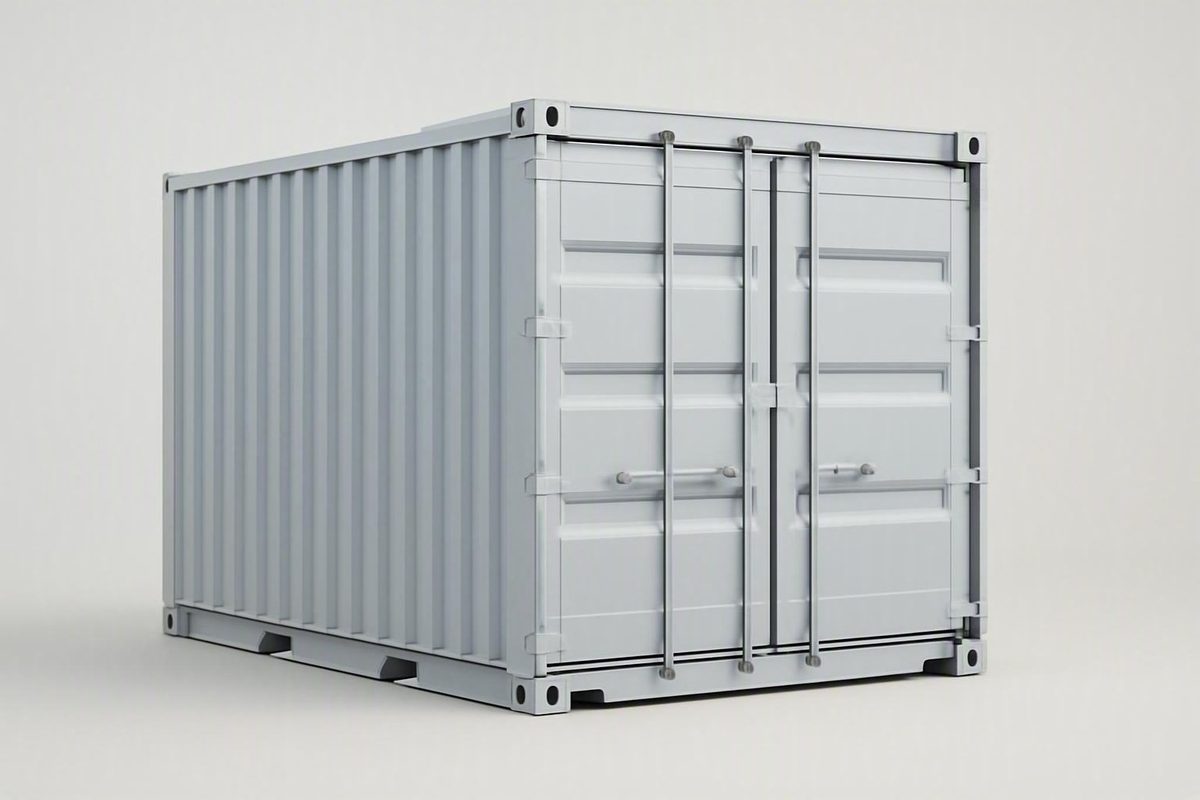
Stationary steel shipping or conex containers
These units are generally delivered to a home, business, farm, or jobsite and left in place until pickup. Common nominal lengths are 10, 20, and 40 feet. They are generally about 8 feet wide. Standard units are around 8 feet 6 inches high, while high-cube models add approximately one foot. A 20-foot container provides about 160 square feet of floor area, and a 40-foot container provides about 320 square feet (Mann’s Cans’ sizing and quote guidance).
Steel-container quotes may distinguish between:
- One-trip: A vendor category for a container described as having made a limited initial cargo journey
- Used wind-and-water-tight: An older storage-grade unit that may have cosmetic wear
- Standard height
- High cube
- Single-door or double-door configurations
These are provider condition and configuration labels. They do not prove that one container will be more economical, secure, or suitable for your belongings. Ask the provider to identify the grade, door operation, floor condition, vents, previous damage, and repair or exchange terms in writing.
Portable household moving containers
Household moving containers are usually sold as part of a broader service. The provider may:
- Deliver an empty container to your address.
- Leave it while you load.
- Keep it on your property for storage.
- Move it to the provider’s storage facility.
- Transport it to another local or long-distance address.
- Return it for unloading.
That service structure can produce charges that do not apply to a stationary jobsite container, including facility transport, relocation, destination delivery, scheduled access, and additional handling.
Nominal length does not establish equivalent capacity. U-Haul states that its U-Box measures 8 by 5 by 7.5 feet and provides 257 cubic feet. A conventional 20-foot steel container, by comparison, has roughly 160 square feet of floor area before height is considered. An “8-foot container” and an 8-foot-wide steel shipping container are therefore not merely shorter and longer versions of the same product.
Specialty containers and converted units
Do not mix ordinary storage rates with prices for:
- Ground-level offices
- Guard shacks
- Refrigerated containers
- Insulated or temperature-managed units
- Hazardous-material storage
- Spill-containment units
- Containers with enhanced lighting or ventilation
- Custom doors, shelving, ramps, or electrical packages
United Rentals, for example, lists standard 10-, 20-, and 40-foot storage containers separately from refrigerated and hazardous-material equipment (United Rentals’ storage-container catalog).
For a valid comparison, record more than exterior length. Compare:
- Interior length, width, and height
- Usable cubic capacity or floor area
- Door-opening width and height
- Largest-item dimensions
- Space lost to an access aisle
- Number of containers required
- Weight or loading restrictions
- On-site versus provider-facility storage
- Transportation included in the service
- Access arrangements after loading
A smaller container with better dimensions may fit the job. A longer unit can still fail if its door opening is too narrow or the delivery truck cannot reach the proposed placement area.
Published rental prices by container size and service type
The following figures are vendor advertisements, vendor-reported averages, or vendor-published estimates. They are not binding quotes or independently verified market averages.
Stationary steel storage containers
| Size | Published monthly or 28-day rate | Source context | Transportation treatment | Important limitations |
|---|---|---|---|---|
| 10 feet | $95 per month | Dry Box advertised rate on an undated provider page | Delivery starts at $150 plus mileage | Availability, route price, pickup, taxes, term, and other charges require confirmation |
| 20 feet | $125 per month | Dry Box advertised rate on the same page | Delivery starts at $150 plus mileage | Dry Box advertises service in selected states; condition and local availability may affect the quote |
| 40-foot high cube | $175 per month | Dry Box advertised rate on the same page | Delivery starts at $150 plus mileage | High-cube equipment is not directly equivalent to a standard-height 40-foot unit |
| 10 feet | $130–$200 per month | SiteBox estimate published June 5, 2025 | Delivery and pickup may be separate; fuel treatment may apply | SiteBox describes 10-foot units as limited-availability specialty sizes |
| 20 feet | $100–$250 per month | SiteBox’s broad 2025 vendor estimate | Separate transportation, fuel, and other charges may apply | Not an independently documented national average |
| 40 feet | $120–$250 per month | SiteBox’s broad 2025 vendor estimate | Separate transportation, fuel, and other charges may apply | Configuration, condition, market, and term can change the price |
| 20-foot one-trip | $145–$210 per 28-day cycle | Bolted Box’s Indiana regional estimate | Delivery and pickup priced as separate trips according to distance | Applies to one-trip commercial conex containers in Indiana |
| 40-foot one-trip high cube | $170–$240 per 28-day cycle | Bolted Box’s Indiana regional estimate | Delivery and pickup priced as separate trips according to distance | Regional and condition-specific, not a nationwide rate |
SiteBox published the three broad size estimates above on June 5, 2025 and explains that limited availability can make a 10-foot container cost as much as—or more than—a standard 20-foot unit (SiteBox’s 2025 pricing guide).
Bolted Box’s figures are narrower but apply specifically to one-trip commercial containers in Indiana and use four-week billing cycles. The provider’s page does not establish that its regional estimates represent other states or household moving-container services (Bolted Box’s Indiana rental guide).
That is why “shorter always means cheaper” can fail. If 10-foot inventory is scarce locally, specialty availability can offset the savings expected from a smaller unit.
Specialty-product warning: Dry Box lists office configurations at $450 per month for a 10-foot guard shack, $650 for a 20-foot office, and $850 for a 40-foot mobile office. These are provider-advertised office prices, not basic storage rates, and should not be included in an ordinary storage-container average.
Portable household moving containers
| Size and arrangement | PODS-reported average monthly rate | Service context | Transportation treatment | Important limitations |
|---|---|---|---|---|
| 8-foot, on-site | $139 | Container remains at the customer’s property | Delivery and pickup are separate considerations | Average of PODS standard rates across U.S. locations, not a guaranteed quote |
| 12-foot, on-site | $159 | On-site storage; the 12-foot model is limited to local moves and storage | Transportation priced separately | Location, season, terms, and availability affect price |
| 16-foot, on-site | $175 | Largest size in the cited PODS comparison | Transportation priced separately | Capacity is not equivalent to a steel container merely because the nominal lengths are similar |
| 8-foot, PODS facility | $189 | Stored at a PODS Storage Center | Additional movements may be required | Access arrangements and local availability require confirmation |
| 12-foot, PODS facility | $210 | Provider-facility storage | Additional movements may be required | Local-use restriction applies to the 12-foot model |
| 16-foot, PODS facility | $239 | Provider-facility storage | Additional movements may be required | A location-specific quote is still necessary |
These are PODS-reported averages of its own standard rates, not independent market averages. The same July 24, 2025 article reports delivery and pickup averaging about $80 each way, subject to the customer’s rental and service arrangement.
A separate, undated PODS pricing page advertises storage starting at $149 per month and says delivery and pickup fees average $74.99. Its wording does not clearly establish whether that figure applies to each service or to a combined charge. The page also says pricing changes with geography, season, container size and quantity, and whether the container stays on-site or moves to a PODS facility (PODS’ storage-cost page).
A starting price, a provider-reported average, a regional estimate, and a configured local quote answer different questions. None should be presented as interchangeable.
Calculate the all-in cost, not just the advertised rent
Use this budgeting formula:
All-in rental cost = (number of billable periods × base rent) + delivery + pickup + mileage or relocation + taxes + coverage or damage waiver + deposit + lock + permits + accessories + applicable surcharges
Break the quote into three groups.
Recurring charges
These may continue every calendar month or billing cycle:
- Base container rent
- Provider-facility storage premium
- Contents coverage or damage waiver
- Property or service fees
- Recurring accessory charges
- Applicable tax
- Scheduled or permitted rate increases
One-time, nonrefundable charges
These may occur at the beginning, during, or at the end of the rental:
- Initial delivery
- Final pickup
- Mileage or fuel treatment
- Relocation to another property
- Transport to or from a provider facility
- Lock purchase
- Permit or street-placement fee
- Setup or placement charge
-
Failed-delivery charge
-
Ramp, shelving, or other accessory charges
Do not assume a fee is one-time merely because it appears on the first invoice. Confirm whether relocation, facility access, accessories, or coverage can recur.
Refundable amounts
A security or equipment deposit may not become a permanent cost, but it still affects cash flow. Confirm:
- Deposit amount
- Conditions for a full refund
- Permitted deductions
- Inspection procedure
- Refund timing
- Whether any tax or processing treatment applies
SiteBox’s June 2025 guide says deposits are sometimes required and gives a provider estimate of $50 to $200, often refundable if the container is returned in good condition. That is not a universal deposit range; a provider may require no deposit or use different terms.
Transportation can dominate a short rental
U-Haul estimates portable-container delivery and pickup at $70 to $120 per container, depending on how the provider structures the charges. This is U-Haul’s published provider estimate, not evidence of one nationwide market price.
PODS separately reports about $80 each way in its July 2025 comparison. Its other pricing page gives the less-specific $74.99 average noted above, so the quote must identify exactly what each transportation figure covers.
Steel-container transportation may be higher because of distance, equipment, and placement requirements. Dry Box starts delivery at $150 plus mileage. Western Container Sales says its rent starts around $150 per month, while delivery and pickup each start around $150, making basic starting round-trip transportation equal to two months of starting rent (Western Container Sales’ total-cost explanation).
Bolted Box publishes Indiana one-way transportation estimates of $225 to $350 for 1 to 25 miles, with delivery and pickup treated as separate trips. These are regional vendor estimates for commercial steel containers, not nationwide transportation benchmarks.
Transportation wording is often ambiguous. Before comparing quotes, ask:
- Is the amount per trip or round trip?
- Is it charged each way?
- Is it per container?
- Does it include final pickup?
- How many miles are included?
- Where does mileage begin—the depot, provider yard, or customer address?
- Is fuel included or added later?
- Does relocation use the same rate?
- Is the final pickup price fixed now?
- What happens if the driver cannot complete delivery?
- Can waiting time or a second placement attempt create another charge?
Coverage and responsibility require separate checks
Do not assume the container company covers your belongings. Western Container Sales, for example, says it handles repairs to its rented container but does not cover the renter’s stored contents. Other contracts may allocate responsibility differently.
Because coverage depends on the actual policy and circumstances, ask your insurer for written confirmation addressing:
- Property stored on your premises
- Property stored at a provider facility
- Property while the container is in transit
- Theft, water intrusion, mold, pests, and temperature damage
- Business inventory, equipment, or tools
- Maximum coverage and deductible
- Required locks or security measures
Also identify whether a provider’s charge protects the container, the contents, or both.
For a short rental, calculate transportation first. It may exceed the advertised rent and become the largest part of the bill.
Worked budgets for one, three, six, and twelve months
These scenarios apply published provider figures to simple arithmetic. They are illustrations, not forecasts, independent averages, or quotes for another address.
Scenario 1: A 16-foot portable container kept on-site
The container is not moved to a facility or another address.
| Rental term | Calculation | Illustrative total |
|---|---|---|
| 1 month | $175 rent + $80 delivery + $80 pickup | $335 |
| 3 months | 3 × $175 + $160 transportation | $685 |
| 6 months | 6 × $175 + $160 transportation | $1,210 |
| 12 months | 12 × $175 + $160 transportation | $2,260 |
These calculations exclude taxes, coverage, permits, locks, labor, relocation, destination transport, promotions, and other charges. The underlying figures are PODS-reported averages and may not match a particular ZIP code, date, season, or service configuration.
Scenario 2: A steel container with a three-month minimum
Assumptions: Western Container Sales’ undated page states starting figures of $150 monthly rent, $150 delivery, and $150 pickup, with a three-month minimum. The container remains at one location, and the starting transportation figures do not increase because of distance or site conditions.
| Rental term | Calculation | Illustrative total |
|---|---|---|
| 1 month of actual use | 3 × $150 minimum rent + $300 transportation | $750 plus applicable tax |
| 3 months | 3 × $150 rent + $300 transportation | $750 plus applicable tax |
| 6 months | 6 × $150 rent + $300 transportation | $1,200 plus applicable tax |
| 12 months | 12 × $150 rent + $300 transportation | $2,100 plus applicable tax |
For a short project, the important number is not the first month’s $150 rent. It is the $750 minimum contractual commitment plus applicable tax under those starting assumptions. A longer route can push delivery and pickup above $150 each.
Scenario 3: SiteBox’s Wichita illustration
SiteBox’s June 5, 2025 guide publishes a Wichita example totaling $850 before applicable sales tax for a 20-foot container rented for three 28-day periods:
- Rent: $420
- Delivery including fuel surcharge: $172.50
- Pickup including fuel surcharge: $172.50
- Lock: $40
- Damage-waiver coverage: $45
- Total before sales tax: $850
This example is useful because it exposes the calculation rather than presenting only the implied $140-per-cycle rent. It remains one vendor’s illustration for one market and one set of assumptions.
Calendar months versus 28-day cycles
A four-week billing period is not a calendar month. Thirteen consecutive 28-day cycles equal 364 days.
At $150 per 28-day cycle:
- 13 × $150 = $1,950 for 364 days
At $150 per calendar month:
- 12 × $150 = $1,800 for 12 monthly charges
The displayed rate is the same, but the near-annual rent differs by $150. Annualize a 28-day rate by multiplying it by 13 rather than 12.
None of these examples can substitute for a local quote. Price can change with the container’s condition, inventory, delivery route, dates, tax jurisdiction, placement difficulty, provider policies, and services added after delivery.
Why your local quote may be higher or lower
Several variables can change both base rent and the final total.
Market, dates, and inventory
Location determines which sizes and condition grades are available, how far the truck must travel, and which providers serve the address. Requested dates and season may also affect portable-container pricing.
A quote may change with:
- ZIP code and service area
- Delivery and pickup dates
- Local container inventory
- Number of units requested
- Rental duration
- On-site versus provider-facility storage
- Standard versus specialty configuration
- Promotional eligibility
- Advance notice
Promotions should be treated as conditional until the written quote states their duration, eligibility rules, and effect on the minimum commitment.
Size, quantity, and condition
A larger unit often costs more, but the relationship is not perfectly linear. Limited availability can make a 10-foot steel unit comparatively expensive. Two 20-foot units can also produce different transportation and placement requirements from one 40-foot unit.
Ask providers to define condition using their own written grading systems. “One-trip” and “used wind-and-water-tight” are vendor categories, not universal guarantees. Before loading, inspect and photograph:
- Exterior dents and corrosion
- Door operation
- Gaskets and seals
- Floor condition
- Existing moisture or stains
- Vents and modifications
- Locking hardware
Record whether the contract permits repair, replacement, or exchange if the delivered container differs materially from the written description.
Transportation and placement
Delivery cost may reflect more than mileage. Providers can consider:
- Driver time
- Fuel treatment
-
Truck and trailer type
-
Depot location
- Number of trips
-
Container size and weight
-
Pickup conditions
- Failed placement attempts
The site can determine whether delivery is feasible. Providers may ask for firm, level ground, adequate gate width, straight-line clearance, turning space, and freedom from trees, wires, eaves, or other overhead obstacles.
A placement that appears easy from the street may not work for a tilt-bed truck.
Before accepting a quote, send:
- Gate and driveway measurements
- Straight-line clearance measurements
- Photos from the street to the placement point
- Photos of slopes and overhead obstacles
- Surface type and current condition
- Exact desired door orientation
- Container size and intended use
- Delivery and expected removal dates
- Contact information for the person supervising placement
Ask the provider to confirm in writing that the proposed truck and container can use the supplied route.
Features and modifications
High-cube height, double doors, offices, refrigeration, insulation, ventilation, lighting, shelving, ramps, spill containment, electrical equipment, and enhanced safety features may increase the rate or require custom pricing.
Confirm whether each feature is:
- Included in base rent
- Rented per billing period
- Purchased once
- Charged as an installation or removal service
- Available only on certain container sizes or conditions
Permits, zoning, and private-property rules
Placement requirements vary by jurisdiction and property. A container placed on a public street can be treated differently from one placed on a private driveway or commercial yard. Western Container Sales states that street placement under its process requires an obstruction permit before delivery, but that provider policy does not establish the rules in every jurisdiction.
SmartStop likewise identifies permits and HOA approval as possible container-related requirements rather than universal obligations (SmartStop’s container and self-storage comparison).
Do not rely solely on the rental company to determine legality. Verify the actual placement with the relevant city or county, property owner, landlord, and association. Establish who applies, who pays, and who bears cancellation or rescheduling costs if approval is delayed or denied.
Portable container, self-storage, or buying: compare the whole job
A portable container is not merely rented space. It can combine storage with doorstep loading and, in some cases, transportation to a facility or another address. Conventional self-storage provides fixed space at a facility, leaving the customer responsible for moving belongings to and from that location.
When a portable container may fit
A portable container may suit:
- A renovation requiring temporary storage at the property
- A move with uncertain loading or closing dates
- A project where repeated facility trips would be disruptive
- Jobsite tools or business inventory needed near the work
- A move in which the loaded container will travel to another address
Its value depends partly on the handling or travel it replaces. Compare the container package with the cost and effort of renting a truck, loading it, driving to self-storage, unloading, and reversing the process later.
When conventional self-storage may fit
A conventional facility may suit ongoing local storage when you want regular access away from the property, do not have placement space, or need a feature offered by a particular facility.
Neither option is always cheaper. Compare equivalent:
- Usable capacity
- Rental duration
- Loading and unloading labor
- Truck rental or provider transportation
- Personal travel
- Access schedule
- Environmental requirements
- Insurance or coverage
- Locks and setup fees
- Taxes
- Rate-change rules
- Minimum commitments
A portable container stored at the provider’s facility may have a different monthly price from one kept on-site. It may also require advance notice, scheduled retrieval, or another truck movement before access. Confirm how access works and whether each request creates a charge.
If you are considering a conventional unit, use LockerHelp’s separate guide to self-storage costs beyond the advertised rate. Those self-storage considerations should not be imported as portable-container prices because the equipment and service models are different.
Renting versus buying
Buying can be worth evaluating for continuous, long-term use at a fixed location, but the supplied vendor guidance does not support a universal break-even month.
WillScot recommends renting for needs under 12 months and considering purchase beyond that point, while Bolted Box estimates that buying may begin to make sense after roughly two to four years of continuous fixed-location use. Those are provider rules of thumb based on different assumptions, not independent financial thresholds (WillScot’s rent-versus-buy guidance).
A proper ownership comparison includes:
- Purchase price
- Initial delivery
- Future relocation or removal
- Site preparation
- Maintenance and repairs
- Insurance
- Permits and taxes
- Modifications
- Financing cost
- Expected utilization
- Resale value
- Disposal cost if resale is impractical
Renting may preserve flexibility and transfer some maintenance responsibility to the provider, depending on the contract. Buying may provide more control over modifications and availability. The correct choice depends on project economics, not a generic time threshold.
How to compare quotes and lower the final bill
Request several written local quotes built on identical assumptions. Give every provider the same address, placement instructions, dimensions, dates, intended use, and service plan.
Copy and send this checklist:
Storage container quote request
- Exact container type:
- Exterior dimensions:
- Interior usable dimensions:
- Door-opening dimensions:
- Standard or high-cube:
- Condition grade:
- Number of containers:
- Requested delivery date:
- Expected pickup date:
- Delivery address:
- Final pickup address:
- On-site or provider-facility storage:
- Billing cycle—calendar month or 28 days:
- Minimum rental term:
- Base rate per billing period:
- Rate guaranteed for how long:
- Included mileage:
- Delivery charge:
- Pickup charge:
- Relocation or facility-transport charge:
- Fuel, distance, property, or service surcharges:
- Taxes:
- Deposit and refund rules:
- Coverage or damage-waiver charge:
- Lock requirement and price:
- Accessories and charges:
- Permit responsibility:
- Total minimum contractual commitment:
- Estimated all-in total for the requested term:
Require written answers to these contract questions:
- Can the rental rate change during the agreement?
- What price applies if the rental is extended?
- Does early return reduce the total?
- What is the cancellation deadline?
- What are the cancellation and rescheduling charges?
- What happens after a failed delivery?
- How much pickup notice is required?
- Does billing continue while pickup is pending?
- What event stops billing: the request, scheduled date, or physical removal?
- Who is responsible for damage to the container?
- Who handles ordinary maintenance and leaks?
- What responsibility does the provider accept for stored contents?
- How is pre-existing damage documented?
- Can transportation prices change at pickup?
- Are promotions tied to prepayment or a minimum term?
Normalize the numbers
Convert every quote to the same duration. Multiply a 28-day rate by 13 for a near-annual comparison with 12 calendar-month payments. Then add transportation, recurring charges, and the minimum term.
Do not compare:
- One month of rent with another provider’s three-month total
- An on-site rate with a provider-facility rate
- A used standard container with a one-trip high cube
- A base rate with an all-inclusive quote
- One container with a quote requiring two smaller units
Avoid paying for unusable capacity
Choose the smallest container that safely accommodates:
- Total belongings
- Largest-item dimensions
- Door clearance
- Safe stacking
- Required access aisle
- Future retrieval needs
A tightly packed container may maximize volume but make mid-rental access impossible. Paying for a slightly larger unit can be rational if you need an aisle; paying for unused length without a loading plan is not.
Ask about discounts without assuming savings
Longer terms and multiple-container rentals may qualify for lower rates, but a discount can create a minimum commitment. Compare the discounted contractual total with a flexible alternative.
Bolted Box says two 20-foot containers can often travel on one truck for one delivery charge. That is a provider-specific possibility, not a guarantee. Truck capacity, route, placement order, provider policy, and site access determine whether it can be done.
It should not be treated as a default option.
The final decision rule is simple:
Choose the quote with the best total contractual commitment and service fit—not the lowest displayed monthly rate.
Frequently asked questions
What is the average monthly storage container rental cost?
There is no independently verified national average in the available evidence. Vendor examples and estimates span roughly $50 to $500 per month, but that range combines different products, sizes, conditions, markets, and commitments.
For a narrower provider reference, U-Haul describes $80 to $200 per month as typical for one portable container. PODS reports average on-site rates of $139 to $175 across its three sizes. These are provider-published estimates and provider-reported averages, not guaranteed local prices.
How much does it cost to rent a 20-foot storage container?
Published steel-container figures include:
- Dry Box: $125 per month
- SiteBox: $100 to $250 per month as a broad estimate published June 5, 2025
- Bolted Box: $145 to $210 per 28-day cycle for a one-trip commercial unit in Indiana
These figures use different regions, billing periods, condition categories, and methodologies. Delivery, pickup, tax, coverage, locks, and other charges may be additional.
Are delivery and pickup included in the monthly rental price?
Often they are separate, but contract structures vary. Some providers charge delivery and pickup individually, some collect both on the first invoice, and some may bundle or waive selected services under particular terms.
Ask whether transportation is priced per trip, each way, per container, or as a combined round-trip amount. Confirm mileage, fuel treatment, relocation, failed-delivery charges, and whether the pickup price is fixed before signing.
Do storage container companies bill by the month or every 28 days?
Both structures exist. PODS says its containers are rented by the month, while SiteBox and Bolted Box publish examples using 28-day or four-week cycles.
The distinction matters over longer terms: 13 consecutive 28-day periods equal 364 days. Annualize a 28-day rate by multiplying it by 13 before comparing it with 12 calendar-month payments.
Do I need a permit or HOA approval for a storage container?
Possibly. Requirements depend on the jurisdiction, property, placement location, container size, and duration. Public-street placement may be treated differently from placement on a private driveway or commercial site.
Confirm the rules with the relevant local authority, property owner, landlord, and HOA before delivery. Also establish who obtains and pays for approval—and who bears the cost if delivery must be cancelled or rescheduled because permission was not secured.
The bottom line
A useful storage-container budget starts by identifying the correct service type and ends with the full contractual commitment. Multiply the rate by the actual number of billable periods, add round-trip transportation and every applicable fee, verify placement and local-rule constraints, and compare several written quotes built on identical assumptions.
The lowest advertised monthly rate is not necessarily the lowest total cost.