
Choose a Container Lock That Fits the Doors—and the Risk
With a lock box, choose the tightest-fitting compatible protected- or concealed-shackle design that can be operated normally inside it.
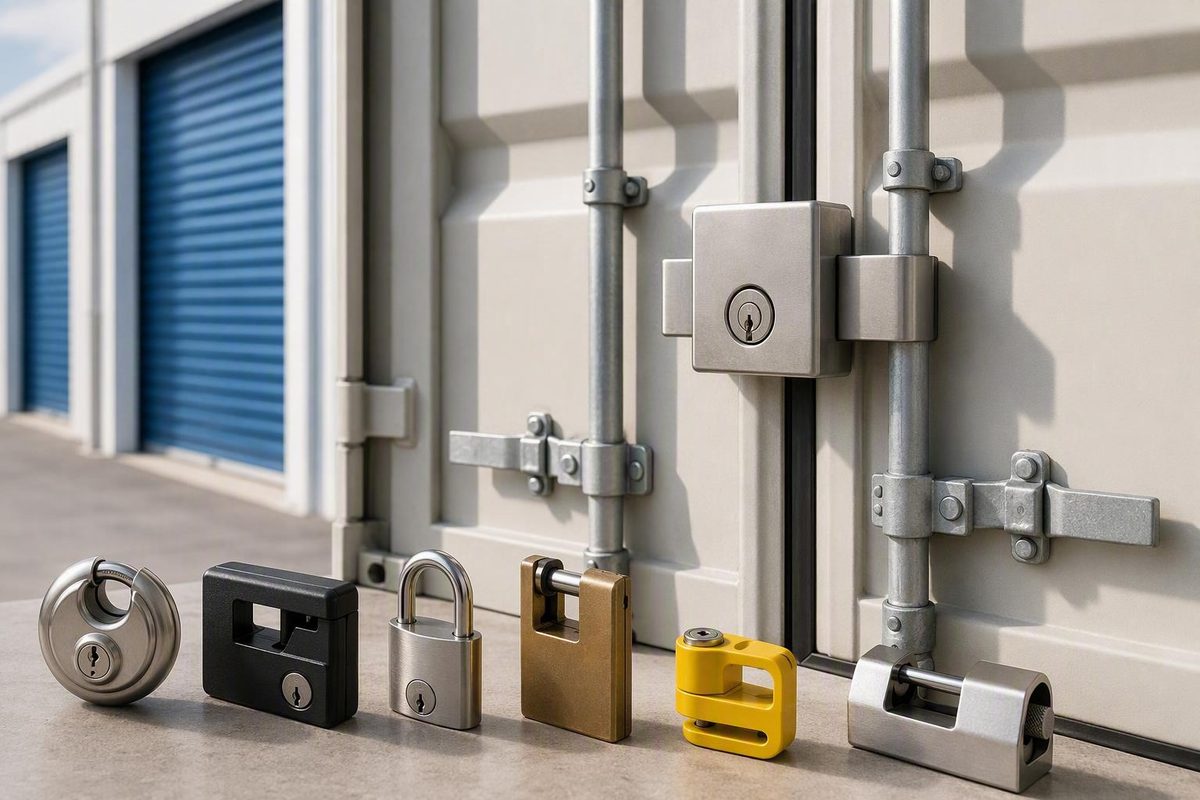
Choose a storage container lock by inspecting the doors it must secure—not by trusting a “heavy-duty” label or assuming one design fits every container. Start with the lock box, hasp, vertical locking rods, handles, clearances, and closed-door alignment. Then select a configuration that limits exposed cutting and prying access while meeting the site’s access, weather, modification, and budget requirements.
No lock guarantees security. The practical objective is to make unauthorized entry slower, louder, more tool-intensive, and more likely to be noticed. That requires a sound mount, serviceable door hardware, deliberate key control, and, where the risk justifies it, additional physical and site controls.
What This Guide Means by a Storage Container Lock
This guide concerns steel shipping, Conex, intermodal, and portable storage containers with cargo doors. It does not cover plastic storage bins.
It also does not directly cover the roll-up or swing doors at ordinary self-storage facilities. Disc-lock and cylinder-lock advice for those units should not be transferred to container cargo doors without checking the actual hardware. LockerHelp’s article on prohibited items and self-storage security addresses conventional storage units, while its self-storage cost guide discusses facility lock expenses rather than shipping-container compatibility.
Typical cargo doors use vertical steel locking bars, handles, cams, and keepers to hold the doors closed. The user normally adds a lock or locking system to control who can operate that hardware. A container may have a factory-installed or retrofitted lock box, an exposed hasp, only the standard rods and handles, or some combination of these features. Falcon Structures illustrates the common arrangement of steel bars, handles, cams, and a lock box at the cargo-door seam.
The qualified short answer is:
- Compatible steel lock box already present: Consider a tightly fitted puck, block, shutter, disc, D-shaped, straight-shackle, or other protected-shackle lock.
- No lock box, or permanent modification prohibited: Consider a removable crossbar or cargo-door lock that fits the vertical rods or handles.
- Only an exposed hasp available: Choose the closest-fitting suitable lock and minimize unnecessary shackle exposure or gaps.
- Additional personnel doors or windows: Assess and protect each opening independently.
A lock box is an enclosure that shields a compatible lock from direct tool access; it is not usually the locking mechanism itself. A crossbar works differently by clamping around or spanning door rods, handles, or both doors to obstruct their operation.
Neither arrangement makes a container theft-proof. Concealing a shackle or adding a second barrier can reduce easy access and increase the required time, noise, tools, and effort. An attacker may instead target the cylinder, mount, welds, rods, handles, hinges, doors, walls, windows, or the container itself.
Do not buy from photographs of a similar container. Standard, high-cube, refrigerated, older, repaired, and modified units can have different door geometry. Even outwardly similar containers may differ because of replacement parts, bent rods, added hasps, worn cams, or previous modifications.
Measure the Container Before Shopping
Measure with both cargo doors fully closed, correctly seated, and aligned. A lock should retain doors that already close properly; it should not pull distorted or misaligned doors into position.
Measurement worksheet
| Item to check | What to measure or document | Why it matters |
|---|---|---|
| Hasp opening | Internal width, height, and shape | Determines whether the shackle or locking pin can enter |
| Maximum pin or shackle diameter | Largest diameter the closed hardware accepts | A pin may be too thick even when the body appears to fit |
| Horizontal clearance | Space beside the hasp, rods, ribs, and lock box | Determines usable lock-body width |
| Vertical clearance | Space above and below the attachment point | Prevents interference with handles, retainers, and ribs |
| Lock-body depth | Available projection from the door surface | A deep body may strike a rod, cover, handle, or adjacent door |
| Lock-box interior | Internal width, height, depth, and entrance shape | Determines which body and shackle configurations can seat inside |
| Key-access opening | Width, height, depth, and approach angle | The lock is unusable if the key cannot be inserted and turned |
| Operating space | Finger and hand clearance for unlocking and removal | Important with gloves, recessed boxes, and heavy locks |
| Installed shackle or pin exposure | Visible and reachable portion after locking | Package dimensions do not reveal the installed attack surface |
| Door seam and alignment | Relative position of both doors when secured | Misalignment can prevent seating or load the lock incorrectly |
For a crossbar or cargo-door lock, also record:
- Center-to-center spacing of the rods it will engage.
- Diameter and shape of each rod.
- Distance between each rod and the door surface.
- Locations of handles, retainers, ribs, seals, brackets, and identification plates.
- Whether the device can be installed and removed without opening the doors.
- Whether its cylinder or keyway remains reachable when fully tightened.
- Whether it interferes with normal handle movement after removal.
A seller’s statement that a product fits “shipping containers” is not a compatibility specification. One lock box may accept a puck lock while another is shaped for a D-shaped, block, shutter, disc, or straight-shackle design. A crossbar may still conflict with unusual rod spacing, oversized handles, door ribs, or repairs.
Inspect the complete attachment path
Follow the load path from the lock through every component that keeps the doors closed. Look for:
- A thin, worn, bent, or cracked hasp.
- Loose or missing fasteners.
- Cracked, incomplete, or heavily corroded welds.
- Bent vertical rods.
- Worn cams or keepers.
- Handles that do not seat fully in their retainers.
- Corrosion around bolt holes or welded attachments.
- Distorted doors or a changing door gap.
- Hardware that moves when pulled by hand.
A strong lock cannot compensate for a failed mount. Replacing the lock while ignoring a cracked weld, loose hasp, or worn cam leaves the more important weakness untouched.
Evaluate the installed fit
A long open shackle may make a difficult hasp usable, but it can also leave additional room for cutters or pry tools. Conversely, a heavily shielded lock that barely enters the enclosure may be impractical if the key cannot turn or the body binds against the doors.
If product drawings are incomplete, photograph the closed hardware with a ruler or tape measure in the frame. Send the photographs and measurements to the seller and request written compatibility confirmation. Check the return policy before marking, forcing, or exposing the lock outdoors.
After delivery, perform a final fit test:
- Close and secure the cargo doors normally.
- Insert the lock without pulling the doors together or levering the hasp.
- Confirm that it seats and closes without force.
- Check that the keyway remains reachable.
- Insert, turn, and remove the key from a normal hand position.
- Confirm that the body does not obstruct a handle or rod.
- Examine the installed lock for avoidable gaps or exposed shackle.
- Unlock and remove it several times to confirm repeatable operation.
Container Lock Types Compared
Names such as puck, block, shutter, bullet, D-shaped, and hidden-shackle describe aspects of body shape or locking geometry. They do not establish common dimensions or verified performance.
| Mechanism | Compatible hardware | Exposed attack surface | Installation | Portability | Access convenience | Weather considerations | Best-fit scenario |
|---|---|---|---|---|---|---|---|
| Conventional open-shackle padlock | Hasp, staple, locking-bar eye, or sufficiently large box | Depends heavily on shackle length and surrounding shielding | Usually none beyond existing hardware | High | Familiar and generally easy to handle | Exposed shackle and keyway; choose outdoor-suitable construction | Sound existing hasp at a monitored, lower-risk site |
| Closed- or protected-shackle padlock | Precisely sized hasp or enclosure | Less shackle may be reachable than with a long open shackle | Usually uses existing hardware | High | Can be harder to operate in a confined box | Check drainage and keyway protection | Hasp or box matching the restricted opening |
| Straight-shackle or shutter lock | Aligned hasp or lock-box geometry designed for a straight pin | Pin can be closely enclosed when fitted correctly | Usually no modification if compatible hardware exists | High | Exact alignment is important | Recessed mechanisms can collect contamination | Narrow, aligned openings with little room for a curved shackle |
| Puck, block, bullet, or hidden-shackle lock | Matching hasp, box, or recessed housing | Much of the locking component is concealed | May use existing hardware or require a matching hasp | Moderate to high | Body weight and key access vary | Check covers, drainage, materials, and contamination resistance | Compatible enclosure where minimal shackle exposure is desired |
| Disc lock | Hasp or enclosure accepting the circular body and restricted opening | Circular body limits some exposed shackle access | Usually none beyond compatible hardware | High | May be awkward in a narrow or deep box | Inspect keyway protection and drainage | Hardware specifically shaped for the disc body |
| Lock box plus compatible lock | Enclosure across the door seam with a matching internal attachment | Restricts direct access to the enclosed lock | Weld-on or bolt-on enclosure | Lock is portable; box is not | Access opening must permit normal operation | Box should not trap water, dirt, or ice | Owned container where permanent shielding is acceptable |
| Crossbar or cargo-door lock | Rods, handles, or both doors, depending on design | Cylinder, pin, joints, and clamps remain possible targets | Some versions clamp on without welding or drilling | Moderate; often bulky | Convenient when aligned but heavier to remove | Exposed surfaces and moving joints require inspection | Rental, mobile unit, or container without a lock box |
| Integrated cylinder lock | Purpose-designed receiver or box mechanism | No conventional shackle, but cylinder and mount remain exposed | Depends on the integrated hardware | Low | Often convenient once fitted | Protect the cylinder face and moving parts | Container equipped for the exact cylinder format |
| Combination lock | Compatible hasp, box, or crossbar | Determined by physical design, not the absence of a key | Usually minimal | High | No physical key to distribute | Dials can collect dirt, water, or ice | Controlled access where code management is practical |
| Electronic or smart lock | Purpose-built hasp, enclosure, crossbar, or integrated system | Physical body and mount still determine exposure | Varies from replacement to wired installation | Varies | May support codes, RFID, apps, logs, or alerts | Batteries, sealing, temperature, and connectivity require planning | Multiple users or containers needing managed access |
| Numbered bolt or cable seal | Seal eye, locking bars, or transit seal point | Intended to reveal removal or interference | Usually single-use | High before use | Simple but replaced after opening | Match the seal to the operating environment | Tamper evidence and chain-of-custody support |
Padlocks and protected-shackle designs
Conventional padlocks are familiar, portable, and widely available. Their suitability depends on shackle diameter, usable clearance, body dimensions, and how much shackle remains reachable after installation.
Closed-shackle and straight-shackle designs can reduce exposure compared with a long open shackle. Puck, block, shutter, bullet, and similar designs conceal or recess much of the locking component. That is a geometric advantage, not proof that the complete assembly cannot be cut, drilled, pried, manipulated, or defeated through its mount.
Lock boxes
A lock box is a steel enclosure welded or bolted around the cargo-door seam. Its purpose is to restrict direct tool access to a compatible lock. The lock inside normally provides the actual access control.
Treat the enclosure and lock as one system. A large body may not enter the box; a key may be impossible to turn through a narrow slot; or a poorly positioned internal hasp may leave the lock crooked. Attachment quality, fasteners, corrosion protection, drainage, and the condition of the surrounding door steel also matter.
Crossbars and cargo-door locks
A crossbar or cargo-door lock adds a separate barrier across the doors or around selected rods and handles. Some versions are removable and require neither welding nor drilling, subject to their design and the container’s geometry. For example, Proven Industries describes one model as joining the two innermost vertical bars without permanent mounting, but that model-specific arrangement does not establish universal compatibility with other doors or rod layouts (see the seller’s listed configurations).
Cylinder and smart locks
“Cylinder lock” is a category, not a compatibility specification. A cylinder may fit an integrated receiver on one container and be unusable on another.
Electronic locks may add keypads, codes, RFID credentials, apps, logs, notifications, or remote administration. Those features can improve access management, but they do not inherently strengthen the lock body, door hardware, or mount. Evaluate physical design and digital administration separately.
Locks versus seals
Numbered bolt and cable seals can make opening or interference visible and support chain-of-custody procedures. They are commonly broken or cut during authorized access and therefore serve a different purpose from a reusable lock. The supplied commercial guidance also discusses ISO 17712 in relation to high-security cargo seals—not as a general rating for reusable container locks (Delta Mark’s distinction between seals and reusable locks).
Choose a Configuration for Your Doors and Site
Use a hardware-first decision tree rather than starting with a product ranking.
1. Is there an existing lock box?
Yes: Measure the enclosure and internal attachment. Choose the tightest-fitting compatible protected- or concealed-shackle lock that:
- Seats without forcing.
- Leaves the least avoidable pin or shackle exposure.
- Allows practical key insertion and turning.
- Does not interfere with either door.
- Can be removed reliably during normal access.
- Suits the site’s weather and contaminants.
Do not order by body diameter alone. Internal depth, entrance shape, pin position, and key-access angle may be equally important.
No: Continue to the next question.
2. Is permanent modification allowed?
No, or the container is rented: Consider a removable crossbar or cargo-door lock sized for the rods or handles. Verify the lease, rod dimensions, handle clearance, coating contact points, and removal procedure before buying.
Yes, and the container is owned: Compare a professionally installed lock box or reinforced hasp with a removable system. A permanent enclosure may improve integration and reduce daily handling, but it adds labor, coating repair, and future removal costs.
3. What is the site and asset risk?
Monitored, lower-risk site: A weather-resistant, closely fitted padlock may be practical when the hasp, mount, doors, rods, and cams are sound. Avoid unnecessary shackle length merely because it makes installation easier.
Remote site or valuable contents: Consider a protected lock in a securely installed box, potentially supplemented by a compatible crossbar. Add detection and site controls according to the exposure. This is layering for delay and detection, not a guarantee against entry.
Risk is not defined by cargo value alone. Consider public visibility, vehicle access, response time, unsupervised hours, lighting, previous interference, and whether tool use would attract attention.
4. How often will users open it?
Frequent access: Prioritize:
- Reachable key or keypad access.
- Manageable weight.
- Easy alignment.
- Operation without awkward lifting or dismantling.
- Reliable use with work gloves, if relevant.
- A safe place to retain the removed lock.
A theoretically more protected design becomes an operational liability if users leave it unsecured because it is too difficult to refit.
Long-term or infrequent access: Prioritize corrosion protection, drainage, contamination control, inspection access, and a recovery plan for a seized or damaged mechanism. Long periods without use can conceal rust, ice, debris, alignment changes, or cylinder problems.
5. Is the container mobile or leased?
Favor reversible, no-drill systems unless the owner expressly authorizes modification. A removable device may transfer among compatible fleet units, but portability does not mean universal interchangeability.
6. Does the container have other openings?
A cargo-door lock secures only the cargo doors. A modified personnel door needs a separate assessment of its deadbolt or latch, frame, hinges, and possible latch guard. Windows may need burglar bars or comparable protection suitable for the opening.
If people will occupy the container, consult qualified local professionals before changing doors, windows, or exit arrangements.
7. Is this one container or a fleet?
For multiple containers, include credential administration in the purchase decision. Consider how keys or codes will be issued, recovered, changed, and audited. The consequences of one compromised shared key may outweigh the convenience of using the same key everywhere.
Judge Security Features Without Trusting the Label
Prioritize characteristics that can be inspected or documented:
- Minimal exposed shackle or locking pin.
- Close fit with limited gaps and pry leverage.
- A protected but usable keyway.
- A sound, well-mounted hasp or enclosure.
- Correct alignment without stress on the lock.
- Materials and finishes suitable for outdoor exposure.
- Serviceable cylinders or available replacement parts where needed.
- Clear dimensions and configuration-specific documentation.
Stainless steel can be useful where corrosion is a concern. Hardened steel or boron-alloy components may be intended to address particular physical attacks. Neither a material name nor one strong component proves the performance of the complete lock-and-door system.
Treat terms such as heavy-duty, industrial-grade, all-weather, maximum security, bolt-cutter-proof, and bypass-proof as marketing unless they are tied to the exact model, a disclosed test method, and traceable documentation. Product weight, price, warranty length, and seller-hosted review averages are not substitutes for forced-entry evidence.
Standards require exact-model evidence
If a seller invokes EN 12320 or CEN padlock grades, request certification records identifying the exact model, body, shackle or pin configuration, and claimed grade. A generic explanation of a grading system does not establish that a promoted product has been certified. One retailer article illustrates this problem by discussing CEN grades generally without providing exact-model certification for every promoted lock (commercial CEN discussion).
Keep cargo-seal standards separate from reusable locks. Do not treat an ISO 17712 reference associated with a bolt seal as evidence that a padlock, puck lock, cylinder, or crossbar has equivalent performance.
How to read a product page
Separate measurable facts from resistance claims.
Potentially verifiable specifications:
- Body width, height, depth, and weight.
- Locking-pin or shackle diameter and clearance.
- Materials and finishes.
- Cylinder type.
- Number of included keys.
- Keyed-alike, keyed-different, or keyed-specific options.
- Rekeying or replacement-cylinder support.
- Environmental or ingress rating, if documented.
- Warranty terms, exclusions, and return window.
Claims requiring supporting evidence:
- Resistance to cutters, grinders, drills, picking, prying, or bypass.
- A declared security grade.
- “Insurance-approved” or carrier-approved status.
- Compatibility with every container.
- Superior weather life.
- Claims that the mechanism cannot be defeated.
Price shows market variety—not proven security
In the seller-listing snapshot reviewed for this guide on August 14, 2026, visible standalone padlock prices ranged from $39.99 to $222.99 in one freight-container collection. Those were seller prices for individual locks, not a complete installed system, and prices and availability can change (Squire Locks USA collection).
In the same review snapshot, Lockitt displayed one hidden-shackle container lock at $77.13, with keyed-different, keyed-alike, and keyed-specific options. The retailer also described the cylinder as replaceable and the lock as rekeyable. Those details are model-specific seller information, not evidence of forced-entry performance (Lockitt product listing).
Buyer verification box
Before ordering, ask the seller for:
- A complete dimensional drawing.
- Exact-model records for any claimed certification or grade.
- The replacement-key and authorized-duplication process.
- Confirmation of whether the cylinder is replaceable or rekeyable.
- A documented environmental or ingress rating, if claimed.
- Maintenance instructions for the exact mechanism.
- Warranty exclusions involving corrosion, freezing, contamination, or misuse.
- Return terms when the lock does not fit.
- Written compatibility confirmation based on your measurements and photographs.
Plan for Keys, Users, Weather, and Maintenance
The physical lock is only one part of access control. How keys, codes, phones, and administrator accounts are managed can determine whether a suitable system remains controlled and usable.
Compare access arrangements
- Keyed different: Each lock uses a different key. A lost key generally affects fewer containers, but users must carry and identify more keys.
- Keyed alike: One key operates several locks. This simplifies fleet access, but a lost or copied key can expose the entire keyed-alike group.
- Keyed specific: The buyer orders a lock for an identified key arrangement supported by the supplier. Confirm ownership controls and whether future orders can duplicate it.
- Rekeyable: The keying can be changed without replacing the entire lock, if the model supports that function.
- Replaceable cylinder: A failed or compromised cylinder can be exchanged while retaining the body.
- Combination: No physical key is required, but codes can be observed, shared, forgotten, or left unchanged after personnel changes.
- Keypad or RFID: Credentials may be assigned or changed, subject to the system’s power and administration requirements.
- App-managed: Remote administration or logs may be convenient, but phones, accounts, software, and connectivity become part of the failure path.
For multi-user or fleet environments, document:
- Who receives each key or credential.
- Which containers it opens.
- Whether duplication is authorized.
- When keys must be returned.
- What happens after a loss or suspected copy.
- When codes are changed.
- Who controls administrator accounts and recovery details.
Keyed alike may suit a small, tightly controlled group needing rapid access. It may be a poor choice where temporary workers, subcontractors, or former users could retain a key. Keyed-different locks reduce the scope of one compromised key but increase administrative effort.
Rekeying or a replaceable cylinder may avoid replacing the complete lock after a key compromise, but only if the selected model supports the function and replacement parts remain available.
Plan for smart-lock failure
Before adopting an electronic lock, decide what happens when:
- Batteries are depleted.
- Connectivity is unavailable.
- A phone is lost or replaced.
- The account owner becomes unavailable.
- Login or recovery details cannot be accessed.
- The app or cloud service is discontinued.
- The keypad or reader is damaged.
- The mechanical override fails or its key is unavailable.
Confirm the documented override procedure, battery-replacement method, administrator recovery process, and offline functionality. Remote administration does not resolve a failed mount, damaged cylinder, or inaccessible mechanical override.
Match the lock to outdoor exposure
Consider the actual climate and contaminants:
- Persistent rain or wind-driven water.
- Coastal salt.
- Fine dust, sand, or construction debris.
- Ice and freeze-thaw conditions.
- Condensation inside an enclosure.
- High heat and direct sun.
- UV exposure to covers and seals.
- Water trapped by blocked drainage.
- Contamination entering an exposed or upward-facing keyway.
Check operation whenever the container is accessed. Periodically inspect for rust, blocked drainage, stiff movement, contaminated keyways, worn or bent keys, loose mounts, cracked welds, damaged covers, and changes in door alignment.
Use only a lubricant and maintenance method suitable for the manufacturer’s mechanism. A product appropriate for one cylinder may attract contamination or interfere with another. Follow model-specific instructions rather than inventing a universal interval.
Keep authorized spare keys in a controlled location—not inside the locked container. Record the lock model, key identifiers, cylinder details, seller, and purchase date. Identify a qualified locksmith or installer before a failure occurs, particularly when emergency access to tools or operational equipment matters.
Installation, Modification, and the Real Budget
Installation method affects permanence, portability, labor, and suitability for rented equipment.
| System | Modification | Typical tools or labor | Portability | Likely use |
|---|---|---|---|---|
| Weld-on lock box or hasp | Permanent attachment to the doors | Surface preparation, welding, finishing, and coating repair | None after installation | Owned container where permanent shielding is acceptable |
| Bolt-on lock box or hasp | Drilled holes and fasteners | Drilling, alignment, fastening, sealing, and coating repair | Potentially removable, but holes remain | Owned container or expressly authorized modification |
| Clamp-on crossbar or cargo-door lock | May require no drilling or welding | Measurement, adjustment, and normal installation | Generally portable among compatible doors | Rental, mobile fleet, or temporary site |
| Existing hasp plus removable lock | No new modification if the hardware is sound | Usually none | High | Straightforward replacement or lower-complexity installation |
Weld-on boxes permanently alter the doors. Bolt-on boxes require drilled holes. Some removable crossbars avoid both procedures, but only when their clamps and geometry fit the rods or handles.
Renters should review the lease and obtain written permission before drilling, welding, replacing hardware, or changing the doors. Do not assume approval preserves the container’s coating, weather seal, warranty, or condition. Ask the owner to specify permitted work and any required installer or restoration standard.
Keep installation guidance high level. The cited commercial weld-on guide uses welding and grinding equipment and lists protective helmets, gloves, hearing protection, and a welding jacket; it is not comprehensive professional safety instruction. Use a qualified installer where the work exceeds your training or the owner’s requirements (ContainerSpace installation overview).
At a broad level, a weld-on installation involves:
- Closing and aligning the doors.
- Positioning both enclosure components so the finished box and lock will align.
- Marking and preparing the mounting surfaces.
- Attaching each component to its respective door.
- Finishing the attachment without obstructing door movement.
- Restoring the protective coating and checking drainage.
- Testing the intended lock through repeated operating cycles.
This outline explains the labor involved. It is not a complete welding, grinding, fire-control, or structural procedure.
Price the complete system
Include more than the lock:
- Lock body and cylinder.
- Lock box or reinforced hasp.
- Crossbar or cargo-door device.
- Professional installation.
- Drilling, welding, grinding, or fitting.
- Replacement of damaged door hardware.
- Coating and paint repair.
- Freight and shipping.
- Spare or duplicate keys.
- Replacement cylinders.
- Smart-lock batteries or supporting equipment.
- Routine maintenance.
- Future removal or restoration.
The standalone price examples above do not represent an installed-cost range. Enclosures, crossbars, repairs, shipping, keying, and professional labor can be separate purchases.
The cheapest lock may be wasted money if it fits poorly, leaves avoidable exposure, or cannot be operated through the lock box. A higher price does not prove better resistance. Fit, mounting strength, documentation, serviceability, and environmental suitability are more useful comparisons.
Confirm the return process before purchase. Ask whether the lock may be test-fitted, what condition it must be in for return, who pays shipping, and whether special-keyed or keyed-alike orders are final.
Build Security Around the Lock
The effective security level is constrained by the weakest practical entry path. That path may be:
- The lock.
- The hasp or staple.
- Lock-box welds, bolts, or surrounding door steel.
- Externally accessible fasteners.
- Vertical locking bars.
- Handles, retainers, cams, or keepers.
- Hinges or hinge attachments.
- Distorted or corroded doors.
- Container walls or roof.
- Added windows.
- A modified personnel door and frame.
- The ability to lift, tow, or move the container.
Separate five functions that are often conflated:
- Physical delay: Locks, enclosures, crossbars, reinforced hardware, and protected openings increase the work required for entry.
- Visible deterrence: Lighting, obvious barriers, signage, and controlled access may influence site selection.
- Intrusion detection: Alarms and sensors can report activity.
- Evidence collection: Cameras and access logs can document events.
- Tamper evidence: Numbered seals can show that a controlled opening or disturbance occurred.
A camera does not reinforce a weak hasp. A seal does not replace a reusable lock. A strong lock does not send an alert.
Depending on the site and assets, consider lighting, controlled vehicle and pedestrian access, fencing, alarms, cameras, routine inspections, and location tracking. These measures may deter, detect, document, or help locate; they do not physically guarantee prevention.
Windows need burglar bars or comparable protection appropriate to the opening. For a personnel door, assess the deadbolt or latch, latch area, frame, hinges, and possible latch guard independently.
Example configurations
Higher-risk remote site
- Securely mounted lock box.
- Closely fitted concealed- or protected-shackle lock.
- Compatible crossbar or cargo-door lock.
- Alarm or intrusion sensor.
- Lighting and camera coverage.
- Restricted site and vehicle access.
- Routine inspection and a response plan.
This creates several layers, but the arrangement remains vulnerable if the box attachment, doors, secondary openings, or response process are weak.
Monitored, lower-risk site
- Sound hasp, rods, cams, and doors.
- Closely fitted weather-resistant lock.
- Controlled keys.
- Site lighting.
- Routine hardware inspection.
This simpler arrangement may be operationally reasonable where access is controlled and abnormal activity is likely to be noticed.
Mobile or leased container
- Removable cargo-door lock or crossbar sized to the actual rods.
- Controlled keys or credentials.
- Tamper-evident numbered seal when chain-of-custody documentation is needed.
- Location monitoring where justified.
- No permanent modification without written authorization.
Pre-purchase checklist
Before ordering a storage container lock, confirm:
- [ ] I inspected the actual container with both doors closed.
- [ ] I identified the lock box, hasp, rods, handles, cams, and interference points.
- [ ] I measured the hasp opening and maximum usable pin or shackle diameter.
- [ ] I measured body, enclosure, key-access, and hand clearances.
- [ ] I measured rod diameter and spacing for a crossbar.
- [ ] The doors close and align without assistance from the lock.
- [ ] The hasp, fasteners, welds, rods, cams, hinges, and doors are sound.
- [ ] I assessed installed shackle or pin exposure—not only package dimensions.
- [ ] The lock and keyway suit the site’s rain, salt, dust, ice, heat, and condensation.
- [ ] The design matches the expected access frequency.
- [ ] The owner or lessor authorized any drilling, welding, or hardware changes in writing.
- [ ] Keys, codes, duplication, returns, and compromise response are documented.
- [ ] Electronic access has a battery, connectivity, account, and override failure plan.
- [ ] The seller supplied dimensions and evidence for any exact-model certification claim.
- [ ] I checked warranty exclusions and fit-related return terms.
- [ ] The budget includes the mount, labor, coating repair, keys, cylinders, batteries, and maintenance.
- [ ] Personnel doors, windows, hinges, walls, and container movement were assessed separately.
- [ ] Detection, lighting, access control, cameras, alarms, or tracking were considered according to risk.
Frequently Asked Questions
What is the best lock for a storage container that already has a lock box?
Choose the tightest-fitting compatible protected- or concealed-shackle design that can be operated normally inside the box. Depending on its geometry, that may be a puck, block, shutter, disc, D-shaped, straight-shackle, or closed-shackle lock.
Measure the box’s internal width, height, depth, entrance, attachment point, and key-access opening. The best choice is the compatible configuration that minimizes avoidable pin or shackle exposure without forcing the doors or making the key inaccessible.
How can I secure a storage container without welding or drilling?
Consider a removable crossbar or cargo-door lock that clamps around the vertical rods or handles. Some designs require no permanent mounting and may suit rented or mobile containers.
Measure rod diameter and spacing, then check for interference from handles, retainers, seals, and ribs. Review the lease even when the device is removable, and confirm that its contact points will not damage coatings or hardware.
Is a crossbar better than a puck lock and lock box?
Not universally. They protect the doors in different ways.
A crossbar restrains rods, handles, or both doors and may avoid permanent modification. A puck lock in a securely installed box shields the primary locking point and limits exposed shackle access. Either can be undermined by poor fit, a weak cylinder, damaged rods, bad welds, vulnerable doors, or another opening.
Compatible systems may be used together at a higher-risk site, but the supplied evidence does not establish a universal winner or quantify the additional delay.
Should multiple containers use keyed-alike or keyed-different locks?
Use keyed alike when operational convenience matters and the shared key can be tightly controlled. One key simplifies access, but a lost or copied key may expose every lock in that group.
Use keyed different when limiting the effect of one compromised key is more important than carrying and administering multiple keys. For a larger fleet, also investigate supported master-key arrangements, keyed-specific ordering, rekeyable locks, or replaceable cylinders. Maintain a key register in every case.
Does a shipping-container seal replace a reusable lock?
No. A numbered bolt or cable seal primarily provides tamper evidence and chain-of-custody information. It is normally broken or cut when the container is opened.
Use a reusable physical lock for recurring access control. Add a numbered seal when the operation also needs evidence that the doors were opened or the seal was disturbed. Do not treat a seal standard or identification number as proof of a reusable lock’s security performance.
The final choice should remain measurement-first: inspect the actual doors, determine whether the container has a usable lock box or only exposed rods and handles, and measure every relevant clearance. Choose the configuration that leaves the least avoidable attack surface while meeting access, weather, lease, and budget constraints.
A lock is only as useful as its mount and surrounding hardware. For higher-risk storage, add compatible physical layers and site controls, maintain the system, manage keys or codes deliberately, and avoid any product promising theft-proof container security.