
Facility Camera Gaps Thieves Exploit – Insights for Safer Self-Storage Choices
Cameras mounted 15 feet or higher can create steep top-down angles that weaken identification of faces, vehicle interiors and license plates.
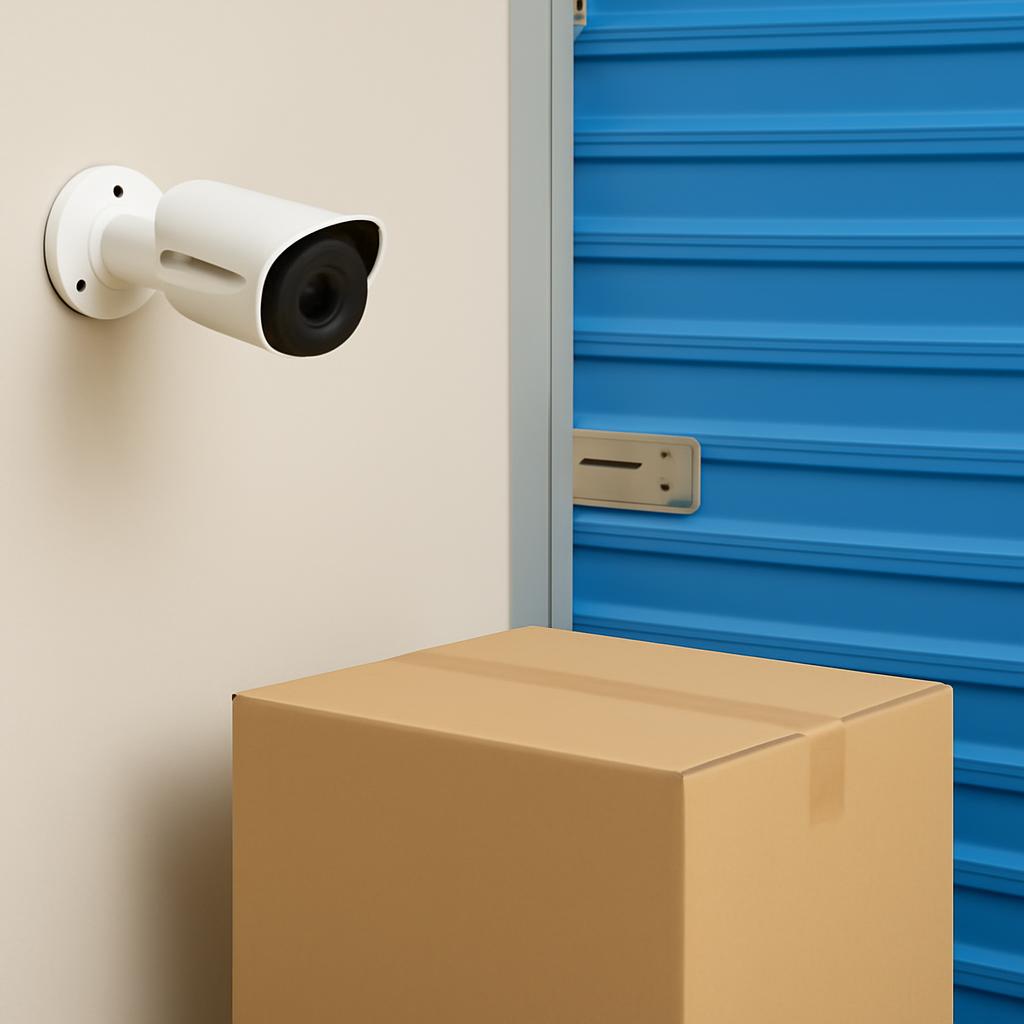
When people search security camera blind spots shoplift, they are usually trying to answer two linked questions: how do thieves find weak coverage, and how do better layouts and camera plans reduce those weak spots? Most published guidance on that topic comes from retail security, where staff and cameras have to deal with corners, aisles, loading areas, entrances, obstructed sightlines, and low-light trouble spots.
For self-storage renters, that retail material is useful only up to a point. It does not prove that storage theft works exactly like store theft. What it does show, consistently, is how blind spots happen in monitored properties: cameras can miss faces, corners, pauses, or movement between key areas if placement, lighting, or sightlines are poor. That is highly relevant when you are evaluating a storage facility, because “there are cameras” is not the same thing as “the facility can actually see what matters.”
The practical goal, then, is not to become a surveillance designer. It is to learn what causes blind spots, what kinds of areas tend to need coverage, and what questions a renter can ask about gates, hallways, loading areas, lighting, locks, and footage review before signing a lease.
What Causes Security Camera Blind Spots?
Blind spots usually come from geometry, obstructions, and operating conditions, not just from a low camera count.
One recurring problem is mounting height. Arann Tech says cameras mounted on poles at 15 feet or higher can create a steep top-down angle that weakens identification, especially for faces, vehicle interiors, and license plates. The same source says mounts around 8 to 10 feet can improve usable identification when paired with vandal-resistant hardware and lighting checks (5 Security Camera Blind Spots That Let Thieves Walk Right In). The important point for a renter is not that every camera should be low. It is that wide overview coverage and identification-quality coverage are different jobs.
Inside buildings, obstructions are a major cause of coverage gaps. Zetronix says blind spots commonly develop when high shelving, display fixtures, poor camera angles, crowded layouts, and low lighting interfere with the image, especially in aisles, fitting-room approaches, stockroom entrances, and behind displays (Stop Shoplifting: Security Camera Blind Spots | Zetronix®). In storage terms, that same logic applies to hallway turns, elevator lobbies, door recesses, loading bays, and exterior rows broken up by walls or corners.
Lighting matters just as much as placement. Zetronix includes low lighting among the direct causes of poor surveillance quality, and Arann Tech describes dusk light testing during site surveys to find areas that still disappear into shadow even when cameras are present (Stop Shoplifting: Security Camera Blind Spots | Zetronix®). A dark corner is still a dark corner if the camera cannot pull useful detail from it.
Field of view is another common issue. Arann Tech highlights loading-dock dead angles and corridor problems, while Zetronix describes unseen zones caused by camera position and obstacles rather than total camera absence (Stop Shoplifting: Security Camera Blind Spots | Zetronix®). In other words, a facility can have visible cameras and still leave important movement paths poorly covered.
For a storage renter, the takeaway is straightforward: ask what each camera is meant to capture. A gate camera may record that a vehicle entered. That does not mean the facility gets a clear face, a usable plate, or continuous visibility from gate to hallway to unit area.
How Do Shoplifters Spot and Use Blind Spots?
Retail sources broadly agree on one point: people stealing from monitored spaces often do not just stumble into blind spots. They look for weak coverage first.
Mammoth Security says suspicious shoppers may take unusual paths, backtrack, or linger in blind spots, while Zetronix says experienced thieves often scan camera locations and employee visibility before acting (Spot a Shoplifter with Security Cameras | Mammoth Security). Silver Star Protection Group describes the same opportunity structure in low-visibility corners, tight aisles, back areas, fitting-room entrances, and display-blocked sightlines.
The behavioral signs in these sources should be treated carefully. Mammoth and Zetronix list nervous scanning, watching staff instead of products, oversized bags, baggy or seasonally odd clothing, avoiding eye contact, and working in pairs as possible warning signs, not proof of wrongdoing (Spot a Shoplifter with Security Cameras | Mammoth Security). Silver Star makes the same distinction more responsibly: lingering in a low-visibility area is an indicator that merits attention, not an automatic conclusion.
What blind spots give a thief is not magic; it is time, privacy, and a break in observation. BrickHouse Security says experienced offenders and dishonest employees often learn where standard cameras are and use hidden corners or known gaps to conceal activity, especially in areas where ordinary visibility is interrupted (Retail Loss Prevention). That is the part a storage renter should care about. Any area that lets someone pause unseen, change direction, or avoid a clear identification shot is a place worth asking about.
So while retail shoplifting behavior is not a direct map of self-storage crime, it does explain the basic security problem. A monitored property is strongest when it does not merely watch entrances, but also denies easy low-visibility pause points between entrances and targets.
Key Areas Needing Coverage: Entrances to Blind Zones
If a property cannot cover every square foot equally well, the best-supported approach is to prioritize choke points, transitions, and known low-visibility areas.
Bay Alarm recommends camera placement at entrances and exits, points of sale, high-value displays, stock rooms, loading docks, and blind spots (How security cameras in retail stores deter and improve safety - Bay Alarm). Silver Star points to similar areas: checkouts, fitting-room entrances, stockrooms, corners, tight aisles, and other places where sightlines break down. Eufy adds that coverage works better when camera views overlap, so movement out of one frame becomes movement into another instead of disappearance into a dead angle.
Bay Alarm’s most practical advice is its “thief’s eye view” walkthrough: examine the property the way a trespasser or thief would, looking for the points where someone could enter, pause, conceal activity, or leave without being seen clearly. For storage renters, that is a very usable method.
On a storage tour, you can adapt that walkthrough without pretending to audit the entire system:
- Where does a person or vehicle first enter the property?
- Where could someone stop without staff seeing them?
- Are there turns, alcoves, or exterior rows that vanish from the office?
- Does coverage appear to hand off from gate to office area to interior corridors or loading areas?
- Are elevators, loading zones, and hallway intersections treated as priority points?
These are not technical questions for their own sake. They help you distinguish between marketing cameras and operational coverage.
A facility that covers only the gate may document arrival. A facility that also covers the office entrance, elevators, loading area, and major corridor turns is thinking more like the sources above: not just about presence, but about movement through vulnerable transitions.
Visible vs. Hidden Cameras for Blind Spot Coverage
Visible cameras and hidden cameras solve different problems, and the evidence here supports a mixed role, not an either-or answer.
Visible cameras are mainly about deterrence. Bay Alarm says visibility itself matters because people behave differently when they know they are being watched, describing this as a Hawthorne-effect style response to surveillance awareness. In practical terms, the message is simple: a clearly visible camera and surveillance signage can raise the psychological cost of misbehavior before anything happens.
Hidden cameras are more about capturing activity where offenders think they are safe. BrickHouse Security says covert cameras can supplement standard systems in known blind spots because experienced thieves often learn the locations of obvious cameras first (Retail Loss Prevention). That is a reasonable operational distinction: visible cameras try to prevent; concealed ones may help document.
There is also an important caution here. A Quora answer from a self-described retail installer claims that some large, visible store cameras are decoys while smaller hidden cameras do the detailed monitoring. Because that is an anecdote, it should not be treated as reliable evidence about how most facilities operate. But it does support one modest, practical point: you cannot judge real coverage just by counting obvious cameras.
On legality, the evidence here is limited and high-level. BrickHouse says covert cameras are generally used in retail areas without a reasonable expectation of privacy, while bathrooms and similar spaces are off-limits, and it warns that state law and audio-recording rules vary. That is a caution, not a legal rule you should rely on. For a renter, the useful question is not whether a facility has secret cameras. It is whether management can explain, in general terms, how blind corners and repeat trouble spots are covered and reviewed.
Fixes Beyond Cameras: Mirrors, Layout, and Audits
The most useful lesson from the retail material is that cameras alone are not enough.
One of the cheapest blind-spot tools is the convex mirror. Chain Store Age describes convex mirrors and mirrored domes as affordable ways to reduce visual blind spots at aisle corners, intersections, warehouse-style spaces, and under shopping baskets. Mirrors do not record evidence, but they can restore sightlines where another camera would be awkward, expensive, or still partly blocked.
Layout and sightlines matter just as much. Silver Star recommends reducing concealment opportunities through better layout, staff visibility, and layered security rather than relying on surveillance alone. Eufy similarly advises clearer sightlines, fewer hidden corners, strong lighting, and cameras positioned with overlapping views across entrances, exits, high-risk aisles, and stockrooms.
Lighting deserves special emphasis. Zetronix identifies low lighting as a direct cause of weak surveillance images, and that is an especially practical issue for storage properties with exterior drive aisles, indoor hall transitions, or nighttime access. Good lighting does not just help cameras. It also improves natural visibility for staff and customers.
Regular audits and repositioning matter because blind spots change. Zetronix recommends recurring surveillance reviews and camera repositioning as conditions change. Chain Store Age adds that darkened domes or globes can create uncertainty because people cannot easily tell whether they contain a live camera.
For storage renters, these are useful inspection clues, not proof of safety. A property with mirrors at hallway turns, even lighting, and obvious attention to sightlines may be managing blind spots more thoughtfully than one that simply advertises “24/7 video.” But the real value is in using those clues to ask better questions.
Dome vs. Bullet Cameras for Fewer Blind Spots
There is no clean, trustworthy rule that one camera housing always eliminates blind spots better than the other. The safer summary is that purpose, lens, position, and scene obstacles matter more than the shell.
Milesight says dome cameras often offer a wider field of view and may suit larger indoor areas with fewer blind spots, while bullet cameras are more directional and are often used for targeted, longer-range monitoring. Avigilon describes a similar split, with domes fitting short-range, wide-area indoor coverage such as shop floors, reception areas, and storage rooms, while bullet cameras are more visible and often better for longer viewing distances.
But not every source describes domes as automatically better for blind spots. Security Systems OKC says dome cameras can have design-related blind spots, while bullet cameras may have fewer blind spots in some installations, even though bullets also have a more limited viewing angle overall.
That conflict is the useful lesson. Camera-type debates can distract from the real question: what does this camera actually see from this mount point, in this lighting, with these obstacles?
A renter usually cannot and should not try to design the system. But you can still ask sensible questions:
- Is this camera meant to capture a wide area or identify faces?
- Does it overlap with another view?
- What happens at the corner beyond its line of sight?
- Is lighting good enough for the scene it covers?
That is more practical than assuming “dome” means wide and “bullet” means better, or vice versa.
Applying to Self-Storage: Evaluate Facility Security
This is where the article should become most practical for renters.
First, remember the priority order: the unit lock and unit location matter more to your specific unit than the facility’s camera count. LockerHelp says many facilities use a single shared gate PIN code, meaning current or former tenants who still know the code may be able to access the property. The same source says the unit lock itself is the primary protection, and that interior units are meaningfully more secure than drive-up exterior units, while upper-floor units in multi-story facilities generally see fewer break-ins than ground-floor exterior units (What Not to Store: 14 Categories That Cause Damage, Theft, or Lease Termination). That is why the first layer is still the lock; start with why cylinder locks matter for storage units.
Second, do not separate “security” from lease compliance and claims risk. LockerHelp’s prohibited-items guide explains that some categories can lead to lease termination, denied insurance claims, added fire risk, pest problems, or other damage issues (What Not to Store: 14 Categories That Cause Damage, Theft, or Lease Termination). If you want a fuller checklist before move-in, review items that can trigger lease problems or theft issues.
Third, when staff say the facility has cameras, ask about coverage and review, not just presence. The retail evidence above points repeatedly to blind corners, loading areas, entrances, overlap, lighting, and periodic reviews as the real questions, not camera count alone.
Useful renter questions include:
- Do cameras cover only the gate, or also the office entrance, loading area, elevators, and interior hall intersections?
- Are blind corners handled with mirrors, extra lighting, or overlapping views?
- Has coverage been reviewed after layout changes or remodels?
- Is nighttime lighting strong enough for usable footage?
- If an incident happens, who can retrieve footage and how quickly?
Fourth, verify insurance before you store anything worth replacing. LockerHelp’s cost guide says facility-run insurance commonly costs about $12 to $20 per month for lower coverage tiers, while homeowner’s or renter’s policies typically cover stored property at about 10% of the personal property limit, often around $5,000 to $15,000 (Self-Storage Costs: What You’ll Actually Pay Beyond the Advertised Rate). That makes insurance part of theft planning, not just an add-on fee. If you are comparing options, see what storage insurance really costs in practice.
Finally, evaluate the facility as a layered system. LockerHelp’s About page says facility evaluation should include gate access and lock quality, not just marketing claims. That matches the surveillance material well. The strongest setup is usually several modest controls working together:
- a better unit location,
- a stronger lock,
- compliance with prohibited-items rules,
- confirmed insurance,
- and surveillance that covers key routes rather than just the front gate.
That is the bottom line for self-storage renters. Camera blind spots are real because every property has corners, transitions, lighting limits, and places where visibility can degrade. But the answer is not “pick the facility with the most cameras.” It is to choose a property that can show some thought about access control, unit placement, locks, lighting, and how footage actually follows movement through the property.
Do competent facilities have no security camera blind spots?
Not necessarily. A Quora answer from a self-described retail installer claims some good retail systems cover nearly the entire store outside private areas and that some apparent gaps may actually be watched by less obvious cameras, but that is anecdotal and not strong evidence for a broad rule. In practice, layouts, lighting, and obstacles change, so a competent facility should be expected to review and manage blind spots, not pretend they never exist.
Are hidden cameras legal for covering blind spots?
The source here only supports a limited caution. BrickHouse says covert cameras are generally used in retail areas where there is no reasonable expectation of privacy, while bathrooms and similar spaces are off-limits, and it warns that state laws and audio rules vary. Treat that as a starting point, not legal advice.
How often should facilities audit for blind spots?
The evidence supports regular reviews, but it does not establish a universal schedule. Zetronix recommends recurring surveillance audits and repositioning as conditions change, and Arann Tech frames blind-spot problems as something many properties discover only after a bad incident. For renters, the practical standard is simple: ask whether coverage is reviewed after remodels, layout changes, lighting changes, or repeated security issues.
What theft protections matter most in self-storage?
For the renter, the basics are still lock quality, unit location, and insurance. LockerHelp says the unit lock matters more than the gate, interior and upper-floor units are generally safer than ground-floor exterior ones, and off-premises coverage may exist through a homeowner’s or renter’s policy if you verify the details first. Cameras help, but they are one layer.
Can mirrors replace cameras in blind spots?
No. Chain Store Age presents convex mirrors and mirrored domes as affordable ways to improve visibility at corners, intersections, and other awkward sightlines. But mirrors do not record footage, preserve evidence, or give you a reviewable timeline later. They are a supplement, not a substitute.
Sources
- Commercial Blog · 5 Security Camera Blind Spots That Let Thieves Walk Right In.
- First Party · About | LockerHelp.
- First Party · Self-Storage Costs: What You’ll Actually Pay Beyond the Advertised Rate.
- First Party · What Not to Store: 14 Categories That Cause Damage, Theft, or Lease Termination.
- Q&A Forum · Why do stores make their cameras so noticeable? Wouldnt it be better to hide them so people who want to do the crime not know where they are you could just find blind spots? - Quora.
- Third Party · Bullet vs Dome Cameras: Which is the Better Option?.
- Third Party · Dome Or Bullet Commercial Security Camera – Which is Better?.
- Third Party · Dome vs. Bullet Security Cameras: Key Differences, Features, and Best Use Cases | Milesight.
- Third Party · How security cameras in retail stores deter and improve safety - Bay Alarm.
- Third Party · How to Prevent Shoplifting | Silver Star Protection Group.
- Third Party · Retail Loss Prevention.
- Third Party · Shoplifting: How to prevent ‘blind spots’ in the store layout | Chain Store Age.
- Third Party · Spot a Shoplifter with Security Cameras | Mammoth Security.
- Third Party · Stop Shoplifting: Security Camera Blind Spots | Zetronix®.
- Third Party · Ways to Improve Theft in Retail Stores: What Actually Works - eufy US.