
How to Choose and Fit the Right Cylinder for Your Door
A 40/60 cylinder and a 50/50 cylinder would both total 100 mm, but their cams would sit in different positions relative to the door and its furniture.
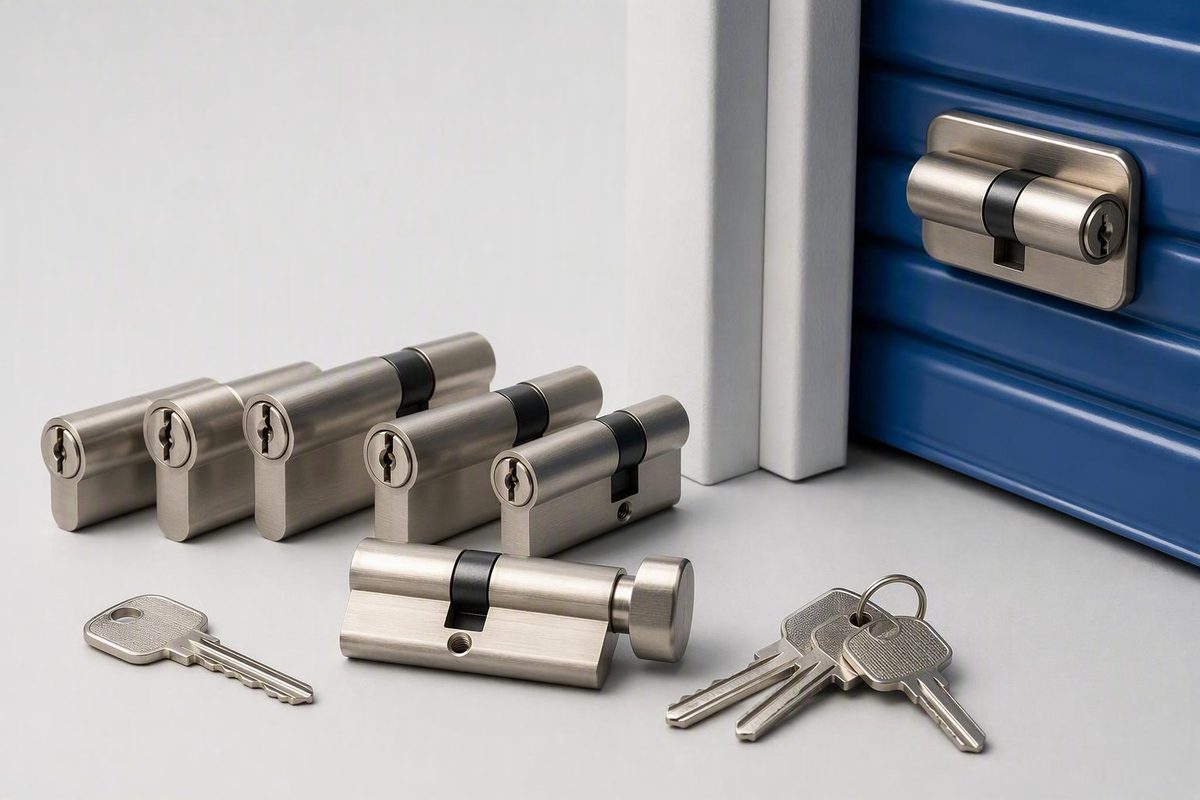
Choosing a Euro cylinder lock is not simply a matter of finding another cylinder with the same outline. A suitable replacement must match the door in four ways:
- Physical fit: profile, exterior and interior dimensions, projection, and orientation.
- Mechanical operation: cam or cogwheel, rotation, lock-case interface, and opposite-side behavior.
- User needs: key-key, thumbturn, half-cylinder, emergency function, and keying plan.
- Whole-door security: verified cylinder rating, compatible furniture, door alignment, glazing, letterbox position, and any insurer or regulatory requirements.
A compatible cylinder can often be changed independently of the lock case. But a cylinder that fits the opening may still be wrong if it cannot operate the existing latch, deadbolt, hooks, rollers, or bolts.
Measure first, document how the current mechanism works, and test the replacement completely while the door remains open. If the door is locked, no usable key is available, or the mechanism is damaged, this is no longer a routine replacement job.
What a Euro-profile cylinder is—and what it is not
A Euro-profile cylinder is the replaceable component into which you insert a key—or, on some versions, turn an interior thumbturn. Viewed from the end, its body has a characteristic light-bulb-like profile. A central cam transfers the cylinder’s rotation to a separate, compatible lock case.
In a typical pin-tumbler cylinder, the key lifts pins by different amounts. The correct key positions the divisions between the pins at the shear line, allowing the plug to rotate. The plug then moves the cam, which operates the lock case. This practical sequence is described in a specialist overview of Euro-cylinder construction.
The parts you need to recognize are:
- Keyway: The opening into which the key is inserted.
- Thumbturn: An interior knob used instead of a key on applicable models.
- Plug: The rotating inner portion containing the keyway.
- Cylinder body: The fixed outer housing.
- Cam: The central rotating component that engages the lock case.
- Fixing-screw hole: The threaded hole through the cylinder near the cam.
- Retaining screw: The long screw inserted through the door edge into the cylinder.
- Lock case: The separate mechanism fitted inside the door.
- Handle: The lever or pull used to operate or move the door.
- Escutcheon or backplate: The furniture surrounding and protecting the cylinder opening.
The cylinder is not the complete lock. It is also not:
- The multipoint strip running along the door edge
- The mortice or sash lock case inside the door
- The handle set
- The keepers fitted to the frame
- The complete door assembly
That distinction matters when diagnosing a fault. Replacing a cylinder may solve a lost-key problem, change who has access, or replace a damaged cylinder. It will not automatically repair:
- A failed multipoint gearbox
- Misaligned hooks, rollers, or bolts
- A sticking latch
- Loose or broken handles
- A warped or dropped door
- Misaligned frame keeps
- Internal damage to the lock case
Euro cylinders are used with multipoint systems and sash locks on some uPVC, timber, and composite doors. An oval cylinder works on a similar principle but has a different external profile. Converting from oval to Euro may require a Euro-compatible lock case, compatible handles or escutcheons, and a correctly sized cylinder rather than a cylinder-only exchange, as explained in this measurement and replacement guide.
Do not assume every door made from a particular material uses a Euro cylinder. Confirm the visible profile before buying anything.
Even after confirming the profile, look beyond the outline. Two Euro cylinders can differ in:
- Length and side offset
- Cam design or cogwheel arrangement
- Keyway
- Operating rotation
- Thumbturn placement
- Emergency or double-clutch behavior
- Handing and required orientation
- Exterior security features
Matching the profile is only the first compatibility check.
Choose the operating format: double, thumbturn, half, or emergency function
The operating format determines who can unlock the door, from which side, and whether a key must be available inside.
| Format | Operation | Typical use | Main advantage | Main concern |
|---|---|---|---|---|
| Key-key double cylinder | Accepts a key from both sides | Entrance or room requiring controlled access from either side | Both sides require a key | Exit may be delayed if the interior key is unavailable |
| Key-thumbturn cylinder | Key on one side, knob on the other | Entrance requiring keyless interior operation | Convenient, quick operation from inside | Thumbturn may be vulnerable to reach-through access |
| Half or single cylinder | Operates from one side only | Garage, storage door, or another one-sided opening | Avoids unnecessary second-side operation | Unsuitable where operation is required from both sides |
| Thumbturn-only variant | Knob operation without an ordinary keyed side, depending on design | Privacy or specialist one-sided use | Simple keyless operation | Does not provide conventional keyed access |
| Emergency-function cylinder | May remain operable from one side when a key is inserted on the other | Door where reliable two-sided operation is important | Reduces opposite-key lockout behavior | Behavior must be confirmed for the exact model |
A key-key double cylinder has a keyway on each end. That does not mean both sides will always remain usable simultaneously. On some standard double cylinders, fully inserting a key on one side disengages the opposite side. An emergency-function model may keep both sides operational. These are model-specific characteristics; for example, Mul-T-Lock distinguishes standard opposite-side behavior from its emergency-cylinder option.
A key-thumbturn cylinder provides keyed access on one side and hand-operated knob control on the other. It can make everyday exit easier and may help a person who finds inserting and turning a key difficult.
The trade-off is reach-through exposure. If an interior thumbturn can be reached through broken or open glazing, an adjacent window, or a letterbox, someone outside may be able to operate it. Conversely, a key-key cylinder depends on an interior key being available when occupants need to leave. A locksmith’s comparison of thumbturn and key-key cylinders discusses both the convenience and reach-through considerations.
Neither format is universally better. Use the door’s purpose and surroundings to narrow the choice:
- External entrance: Balance convenient egress against the position of glazing, windows, and the letterbox. Confirm whether emergency-function behavior is needed.
- Internal room: Decide whether locking from both sides is genuinely necessary and whether privacy or controlled access is the priority.
- Garage or storage door: A half cylinder may be suitable if operation is needed from only one side.
- Shared or managed property: Establish who must enter, who must exit without assistance, how emergency access works, and who controls duplicate keys.
- Door near accessible glazing: Assess whether a person outside could physically reach the thumbturn. Do not base the decision merely on whether the door contains glass.
- Door used by someone with limited dexterity: A suitable thumbturn may be easier to use, subject to the surrounding security risks.
For a flat, rental property, workplace, shared building, or designated escape door, check the requirements that apply to that specific building and jurisdiction. This article does not establish compliance with fire, escape, accessibility, tenancy, or occupancy rules. Obtain written guidance from the responsible building authority, fire-safety professional, landlord, insurer, or other appropriate party rather than relying on a retailer’s general statement.
How to measure a Euro cylinder correctly
Euro-cylinder sizes are commonly stated in millimeters. Measure separately from each end of the cylinder to the center of the fixing-screw hole or central cam.
Measurement diagram
             EXTERIOR SIDE                 INTERIOR SIDE
                   │                             │
Cylinder end       │      fixing-screw          │      Cylinder end
     ▼             │       hole / cam           │           ▼
 ┌──── exterior-side measurement ──┼── interior-side measurement ───┐
 │                                 ●                                │
 └──────────────────────────────────────────────────────────────────┘

Exterior-side measurement = exterior end to fixing-screw center
Interior-side measurement = fixing-screw center to interior end
Total length = both side measurements added together
A manufacturer may call these dimensions A and B, but the letters are not the controlling information. Record which measurement belongs to the exterior and which belongs to the interior.
What size labels mean
Common size descriptions include:
- 35/35: Two 35 mm sides, producing a symmetrical total length of 70 mm.
- 40/60: A 40 mm side and a 60 mm side, producing an offset total length of 100 mm.
- 55/35: A 55 mm side and a 35 mm side, producing an offset total length of 90 mm.
These measurements and the rule that total length equals both side measurements added together are illustrated in the Euro-cylinder measuring guidance.
Equal side measurements require a symmetrical cylinder. Unequal measurements require an offset or asymmetrical cylinder.
Do not order by total length alone. A 40/60 cylinder and a 50/50 cylinder would both total 100 mm, but their cams would sit in different positions relative to the door and its furniture. Only the correct side dimensions will place both ends as intended.
Workflow 1: Measure after removal
Removing the existing cylinder usually gives the clearest result:
- Open the door.
- Remove the cylinder using the procedure later in this guide.
- Place it on a flat surface.
- Measure from one end to the center of the fixing-screw hole.
- Measure from that center to the opposite end.
- Mark which side faced outside.
- Record thumbturn placement and any orientation markings.
- Note how far each end projected from, or sat within, the surrounding furniture.
Measure the cylinder body, not the end of a key or the outer edge of a thumbturn knob.
Workflow 2: Measure with the cylinder installed
If removal is not yet appropriate:
- Identify the retaining screw on the open door edge.
- Use the centerline of that screw as the central reference.
- Measure from the centerline to the outer face of the exterior handle, backplate, or escutcheon.
- Measure separately from the centerline to the corresponding interior face.
- Account for the cylinder position specified by the cylinder and furniture manufacturers.
- Record the existing projection, but do not automatically assume it is correct.
Measure the assembled door rather than estimating from nominal door thickness. Handles, backplates, escutcheons, reinforcement, and the lock-case position all affect the required dimensions.
Excessive exterior projection can provide more purchase for a gripping attack. There is no single projection limit suitable for every cylinder and furniture combination. Follow the specified position for the exact cylinder, handle, and escutcheon.
Do not assume an offset security cylinder can simply be reversed. Exterior orientation may be determined by:
- Thumbturn placement
- Manufacturer markings
- Handed construction
- Sacrificial snap-point position
- Internal clutch design
- Different protection on each end
Printable measurement record
EURO CYLINDER MEASUREMENT RECORD

Property/door: __________________________________________

Profile:
[ ] Euro profile
[ ] Oval profile
[ ] Uncertain

Exterior-side measurement to fixing-screw center: ______ mm
Interior-side measurement to fixing-screw center: ______ mm
Total length:                                            ______ mm

Existing exterior projection: __________________________ mm
Existing interior position/projection: _________________ mm

Operating format:
[ ] Key-key
[ ] Key-thumbturn
[ ] Half cylinder
[ ] Thumbturn-only
[ ] Emergency function
[ ] Uncertain

Thumbturn side, if present: ______________________________

Exterior orientation marks/features: ____________________
_________________________________________________________

Cam or cogwheel description: ____________________________
_________________________________________________________

Observed key rotation/number of turns: ___________________

Handle or escutcheon model: ______________________________

Cylinder model or markings: ______________________________
Check compatibility before ordering
A correctly measured Euro cylinder may still fail to operate the lock. Size answers only one part of the compatibility question.
Use this checklist before ordering:
- [ ] The existing opening is Euro profile, not oval or another profile.
- [ ] Both side measurements match.
- [ ] Exterior and interior dimensions are assigned correctly.
- [ ] Exterior security features will face the required direction.
- [ ] The cam shape and position match the lock case.
- [ ] Any cogwheel has the correct dimensions and tooth arrangement.
- [ ] The keyway suits the required key system.
- [ ] The thumbturn is on the intended side.
- [ ] Standard clutch, double-clutch, or emergency behavior is suitable.
- [ ] Operating rotation matches the lock case.
- [ ] Manufacturer-specific handing or orientation is correct.
- [ ] Handles and escutcheons accommodate the cylinder.
- [ ] The cylinder can actuate every required part of the lock mechanism.
A compatible Euro cylinder can often be replaced without changing the complete lock case because the two are separate components. That is true only when the replacement has the correct interface and works with the surrounding furniture.
Rotation is a separate specification
Euro cylinders do not all operate identically. Product guidance describes both 90-degree and 360-degree operation. A lock case requiring multiple turns to extend its deadbolt may not work with a 90-degree cylinder, so rotation must be checked independently of size, as noted in this Euro-cylinder catalog guidance.
Before removing the old cylinder, document:
- How far the key turns
- Whether locking requires one turn or several
- Whether the handle must first be lifted
- Which direction locks and unlocks
- Whether a key inserted on one side affects the other
- How the cam or cogwheel looks
- How the cylinder is retained
- Which latch, deadbolt, hooks, rollers, or bolts move
- Any lock-case, cylinder, or hardware model numbers
Incorrect length is only one possible cause.
Multipoint-lock caution
A replacement is therefore not proven compatible merely because it slides into the Euro-shaped opening.
With the door open, confirm that the key or thumbturn can:
- Operate the latch as intended.
- Lock and unlock the central case.
- Engage and retract the hooks, rollers, or bolts.
- Work with any required handle-lifting sequence.
- Return to the correct key-removal position.
An oval-to-Euro conversion is a different project from a routine cylinder swap. It may require a new lock case, new furniture, and a new cylinder.
Obtain written manufacturer confirmation or use a qualified locksmith when the existing assembly has:
- An unusual cam
- A toothed cogwheel
- An electronic or access-control component
- Unclear operating rotation
- Handed construction
- Undocumented security features
When seeking confirmation, provide the manufacturer with photographs, the lock-case model, cylinder markings, side measurements, cam or cogwheel details, operating rotation, and required thumbturn or emergency behavior.
Evaluate security claims and ratings without relying on marketing
Security should be assessed against relevant attack methods rather than a vague “high-security” description. Depending on the product and installation, those methods may include:
- Snapping
- Drilling
- Picking
- Bumping
- Plug extraction
- Manipulation of exposed components
- Reach-through operation of an interior thumbturn
Some anti-snap designs use a sacrificial break line intended to let an attacked outer section break away without exposing or disabling the locking cam. That is a design principle, not proof that every product marketed as “anti-snap” performs equally.
Do not treat any of the following as proof of attack resistance:
- Price
- Brand recognition
- Dimple-shaped or unusual-looking keys
- Pin count
- Heavy packaging
- “Professional,” “premium,” or “insurance approved” wording
- An uncited claim of compliance with a standard
Standards and certification labels are not interchangeable
The available evidence for this guide consists largely of manufacturer, supplier, retailer, and locksmith material rather than current primary standards documents or official certification databases. The following distinctions should therefore be treated as a buying framework, not as confirmation that a particular product is certified.
BS EN 1303 concerns the classification of cylinders across specified performance characteristics. A bare reference to “EN 1303” does not reveal the exact classification, certificate scope, variant, or attack performance. Ask for the complete classification and supporting documentation for the exact product.
TS007 is described in the supplied multi-association guidance through a star-rating approach. That guidance presents a one-star cylinder combined with compatible two-star security furniture as a route to a three-star installation. It presents a three-star cylinder as not requiring that specific supporting furniture and describes three-star cylinders as tested against snapping, drilling, picking, bumping, and plug extraction. These descriptions appear in the multi-association Euro-cylinder installation guide, but current status must still be checked for the exact model and variant.
Sold Secure is a separate certification scheme with its own categories and test scope. A Sold Secure claim should be checked against the exact product, variant, and stated level rather than inferred from similar packaging or a related model.
BS 3621 concerns a different scope associated with complete lock assemblies and should not be treated as interchangeable with a cylinder’s BS EN 1303 or TS007 reference. Retailer guidance contrasting Euro cylinders with BS 3621 mortice-style locks also underscores that these labels do not describe the same thing; insurer acceptance still depends on the relevant policy and installation (see the comparison).
A practical verification workflow
Before paying more for a security claim:
- Record the complete product identity. Note the manufacturer, exact model, size, finish, keyed or thumbturn variant, keying option, and product code.
- Ask for the certificate or listing identifier. Do not accept a generic logo or a certificate for a related range without confirming that your variant is included.
- Check the issuing organization. Verify the record through the certification organization’s current listing service or by contacting it directly.
- Match every relevant detail. Compare the model name, variant, rating, certificate number, validity, size range, thumbturn configuration, and keying option.
- Check the scope. Establish what was tested and what the classification actually covers.
- Identify required furniture. Determine whether the claimed installation rating depends on compatible handles, backplates, or escutcheons.
- Confirm orientation. Check which end must face outside and whether a sacrificial section or other feature is handed.
- Keep evidence. Retain the certificate or listing record, product label, invoice, installation instructions, and photographs of the completed installation.
- Check the insurance policy directly. Ask the insurer to confirm acceptance if the wording is unclear; “insurance approved” is not a universal category.
If the seller cannot identify the certificate number, exact covered variant, issuing organization, and required supporting hardware, treat the claim as unverified.
The cylinder is only one part of the door’s security. Handles, escutcheons, the lock case, alignment, glazing, nearby windows, and letterbox position can all affect exposure.
Plan keys and access: different, alike, or master keyed
Cylinder format determines how the door operates. The keying plan determines which keys operate which cylinders.
Keyed different
Each cylinder has its own operating key. A key for one cylinder does not ordinarily operate the others.
This may suit a single garage door or a group of rooms requiring separate access. Losing one operating key primarily affects the cylinder or doors that key operates, although replacement or rekeying may still be required.
Keyed alike
One operating key opens every cylinder included in the keyed-alike group. This can be useful where a household has separate front, back, side, and garage doors.
The benefit is convenience: fewer keys need to be carried and identified. The trade-off is broader exposure. If the shared operating key is lost or copied without authorization, every cylinder in that group may be affected.
Master keyed
In a basic master-key system, each cylinder can have an individual differ key while an authorized master key operates all included cylinders. For example, office users might receive keys for their own rooms while a facilities manager holds a master key.
Loss of an individual differ key may affect only the doors assigned to it. Loss of a master key can have much wider consequences across the system.
Retailer catalogs show that half, thumbturn-only, key-key, key-thumbturn, keyed-alike, and master-keyed Euro-cylinder formats are commercially available. Availability does not establish comparative attack resistance or the suitability of a particular access plan, as illustrated by this Euro-cylinder product catalog.
Common-entrance systems can be designed to give several users access to a shared entrance while preserving separate access elsewhere. Do not improvise such a system from a catalog description. A qualified system designer should define:
- Access rights
- Key hierarchy
- Duplication controls
- Cylinder identification
- Recordkeeping
- The response to loss of an operating key
- The response to loss of a master key
Ask a prospective supplier:
- Who may order duplicate keys?
- Is an authorization card, code, signature, or account approval required?
- What documents identify the system and each cylinder position?
- Can cylinders be rekeyed, or must they be replaced?
- What happens after an operating key is lost?
- What happens after a master key is lost?
- Can more cylinders be added to the keyed-alike group later?
- How are obsolete keys and access records controlled?
- Are custom-keyed products returnable?
- What manufacturer support is available if the system must be expanded?
Key management and physical cylinder security are separate decisions.
How to replace and test a Euro cylinder
This workflow applies only to an open door with an accessible retaining screw and a usable key. It is not a guide to bypassing a locked or inaccessible door.
If the door is locked, the key is unavailable, or the cylinder has been attacked, bent, drilled, or seized, stop and use an appropriate locksmith or door-repair professional.
What you will typically need
- A confirmed compatible replacement cylinder
- The existing usable key
- The new keys
- A correctly fitting manual screwdriver
- A millimeter ruler, tape, or calipers
- The cylinder manufacturer’s instructions
Inspect the actual screw head before choosing a screwdriver. Do not assume the tool type from a generic guide.
Before removing anything
- Confirm the replacement profile, side measurements, cam, orientation, and operating format.
- Inspect the cylinder for visible damage, including damage around a sacrificial snap section.
- Where the manufacturer permits it, check that the new keys, plug, cam, and thumbturn move smoothly before installation. This does not establish lock-case compatibility.
- Open the door and leave it open.
- Check that the door hangs squarely and does not bind.
- Operate the existing lock with the door open and document its movement.
Removal
-
Find the retaining screw. Look on the door edge in line with the lower part of the cylinder. In many common installations it is an M5 machine screw, but identify the actual fastener rather than relying on appearance alone. Its usual location is illustrated in this retailer-authored replacement guide.
-
Remove the screw manually. Use a correctly fitting screwdriver and avoid damaging the head.
-
Insert the existing key. Turn it slightly left or right until the central cam aligns with the cylinder body. One retailer guide gives approximately 10 degrees as an example, but the required angle varies by mechanism (see the illustrated procedure).
-
Withdraw the cylinder gently. Hold the key at the alignment angle and pull the cylinder straight out. Do not bend, twist, lever, or force it.
-
Address furniture restriction cautiously. If a handle, backplate, or escutcheon is pressing on the cylinder, loosening its fixings slightly may relieve the restriction. Do not dismantle more of the door than necessary.
Once the old cylinder is out, compare it with the replacement. Recheck both side dimensions, cam position, thumbturn side, and exterior orientation.
Installation
- Insert a new key or position the thumbturn as directed by the manufacturer.
- Rotate it slightly to align the cam with the cylinder body.
- Hold the cylinder horizontally and square to the door face.
- Slide it into the lock case without force.
- Confirm that the exterior end, snap feature, thumbturn, and orientation markings face the intended directions.
- Align the fixing-screw hole.
- Insert the retaining screw and start the thread gently by hand.
- Tighten it with a manual screwdriver until properly engaged and secure, without excessive force.
- Do not use a power driver.
- Refit or retighten loosened furniture without shifting or clamping the cylinder out of alignment.
Multi-association installation guidance warns against forcing the cylinder, overtightening the retaining screw, using a power tool, or damaging a sacrificial snap point. It also states that manufacturer instructions take precedence where designs differ (installation guidance).
Test before closing the door
Keep the door open and test:
- The key from the exterior side
- The key from the interior side, if present
- The thumbturn
- Emergency or double-clutch operation
- Key insertion and withdrawal positions
- The latch
- The deadbolt
- Multipoint hooks, rollers, or bolts
- Handle-lifting and return action
After open-door testing, bring the door gently to the frame without fully committing to closure. Check whether the latch, deadbolt, hooks, rollers, and bolts align with their keepers.
If the lock operates smoothly while open but becomes stiff against the frame, investigate door and keeper alignment rather than immediately assuming the new cylinder is defective.
Do not close and lock the door until operation has been confirmed from every required side.
Troubleshooting, stop-work points, and the final buying checklist
Troubleshoot by symptom and avoid escalating force.
| Symptom | Likely cause | Safe check | When to stop |
|---|---|---|---|
| Cylinder will not withdraw after screw removal | Cam not aligned; furniture pressing on cylinder; wrong screw removed | Rotate the usable key slightly in both directions while applying gentle straight-line pull; verify screw position; loosen furniture slightly | Stop if it remains fixed, the key will not turn normally, or force would be required |
| Cylinder will not insert squarely | Cam misaligned; wrong profile or dimensions; incorrect orientation; obstruction | Center the cam, compare old and new cylinders, verify measurements and profile | Stop if it jams, tilts, or requires impact |
| Exterior end projects too far | Wrong exterior-side measurement or unsuitable furniture combination | Recheck each side separately and consult the permitted position for the furniture | Stop rather than accepting an exposed fit |
| Cylinder sits too deeply | Wrong dimensions, reversed offset, or incompatible furniture | Confirm exterior/interior assignment and manufacturer specifications | Stop if the key or thumbturn cannot be used normally |
| Operation is stiff | Cylinder clamped by furniture; retaining screw overtightened; alignment problem | Test with the door open and inspect the furniture position; gently relieve screw tension if appropriate | Stop if binding persists or the key begins to bend |
| Works open but not closed | Door, keeper, deadbolt, or multipoint alignment problem | Bring the door gently to the frame and identify where resistance begins | Stop before repeatedly forcing the key or handle |
| Key or thumbturn rotates but bolt does not move | Wrong cam, cogwheel, rotation, or lock-case interface; lock-case fault | Compare old and new interfaces and document the movement | Stop and obtain model confirmation or professional diagnosis |
| Works from only one side | Model-specific opposite-key behavior; key left inserted; wrong format; incompatible emergency function | Remove the opposite key and test according to the model instructions | Stop if the advertised emergency behavior is absent |
| Retaining screw will not engage | Misalignment, incorrect screw, damaged thread, or wrong cylinder position | Remove the screw, realign the cylinder, and start the thread gently by hand | Stop if the thread is damaged or force is needed |
| Retaining screw is seized or damaged | Corrosion, damaged head, cross-threading, or earlier overtightening | Avoid further damage and preserve access for a professional | Use a locksmith or door-repair professional; do not chisel the screw |
| New cylinder fits but the multipoint system fails | Lock-case incompatibility or an existing gearbox fault | Compare documented old and new behavior with the door open | Stop if the mechanism binds or behaves unreliably |
Stop DIY work when:
- The door is locked.
- No usable key is available.
- The cylinder has been attacked, bent, drilled, or otherwise damaged.
- The mechanism is seized.
- The retaining screw is stripped, seized, or inaccessible.
- The cam or cogwheel is unusual.
- An electronic or access-control component is involved.
- The cylinder cannot be inserted or removed without force.
- Binding persists after basic alignment checks.
- Required orientation or operation cannot be verified.
- The door has a regulated escape, shared-access, or specialist security function that you are not qualified to assess.
Candidate comparison record
Use the same fields for every product so that marketing language does not obscure compatibility:
| Field | Candidate 1 | Candidate 2 | Candidate 3 |
|---|---|---|---|
| Exact manufacturer and model | |||
| Exterior/interior dimensions | |||
| Exterior orientation | |||
| Operating format | |||
| Cam or cogwheel | |||
| Rotation and number of turns | |||
| Opposite-key/emergency behavior | |||
| Certificate or listing number | |||
| Exact certified variant confirmed | |||
| Required security furniture | |||
| Duplicate-key controls | |||
| Warranty and support | |||
| Custom-keying return restrictions |
Final buying checklist
Before ordering, confirm:
- [ ] Exact Euro profile—not oval or another cylinder type
- [ ] Separate exterior and interior dimensions
- [ ] Correct exterior orientation
- [ ] Acceptable projection for the specified furniture
- [ ] Key-key, key-thumbturn, half, thumbturn-only, or emergency format
- [ ] Correct cam or cogwheel
- [ ] Correct operating rotation and number of turns
- [ ] Required opposite-key or emergency behavior
- [ ] Keyed-different, keyed-alike, or master-key plan
- [ ] Exact security model and current certification record
- [ ] Certificate scope covers the chosen variant
- [ ] Required compatible handles or escutcheons
- [ ] Lock-case and multipoint compatibility
- [ ] Applicable insurer and regulatory checks
- [ ] Supplier warranty and support
- [ ] Return terms, especially for custom-keyed products
- [ ] Authorized duplicate-key process
- [ ] Manufacturer installation instructions
After installation, retain the model, size, certificate details, key-control information, instructions, and purchase records securely. Dispose of the old cylinder and obsolete keys so they cannot be casually recovered and reused, following any applicable local recycling or waste guidance.
The decision rule is straightforward: confirm the Euro profile, record the exterior and interior dimensions separately, match the operating mechanism and key plan, verify the exact security credential and supporting hardware, and test the complete lock with the door open. If the door is locked, the key is missing, the cylinder or retaining screw is damaged, or compatibility remains uncertain, stop rather than forcing the mechanism and use a qualified locksmith.
Frequently asked questions
Can I replace a Euro cylinder without changing the multipoint lock?
Often, yes. The cylinder and multipoint mechanism are separate components, so a compatible cylinder can commonly be replaced while the lock case and strip remain in the door.
The replacement must still match the profile, side dimensions, cam or cogwheel, rotation, orientation, and lock-case operation.
What is the difference between a 35/35 and a 40/60 Euro cylinder?
A 35/35 cylinder measures 35 mm from each end to the fixing-screw center. It is symmetrical and totals 70 mm.
A 40/60 cylinder has a 40 mm side and a 60 mm side. It is offset and totals 100 mm. Record which side faces outside because the offset, thumbturn, or security features may make the cylinder non-reversible.
Is a thumbturn or key-key Euro cylinder better?
Neither is universally better.
A thumbturn provides convenient keyless interior operation and may be easier for someone with limited dexterity. It can, however, create a reach-through risk if accessible through glazing, a window, or a letterbox.
A key-key cylinder may reduce that exposure, but prompt exit depends on an interior key being available. Base the choice on the actual door, occupants, surroundings, access needs, and applicable building requirements.
Does an anti-snap or high-security label prove that a cylinder is independently certified?
No. Those terms may be marketing descriptions.
Check the exact model and variant against a current certificate or authoritative listing. Confirm the certificate number, rating scope, validity, orientation, and any required supporting furniture. Do not infer certification from price, key shape, pin count, packaging, or comparison with a rated product.
Why will my Euro cylinder not slide out after I remove the retaining screw?
The central cam may not be aligned with the cylinder body, or the handles, backplate, or escutcheon may be pressing on the cylinder.
Insert the usable key and rotate it slightly left and right while applying only gentle, straight-line pulling pressure. Loosen surrounding furniture slightly if it is causing misalignment. Do not twist or force the cylinder. If it remains stuck, the mechanism appears damaged, or you may have removed the wrong screw, stop and use a locksmith or door-repair professional.