
Cylinder Locks for Storage Units: Practical Guide to Fitting, Using, and Choosing the Right One
For self-storage, cylinders are often 17-19 mm. Confirm the approved model before buying. A disc lock is generally easier to reuse elsewhere.
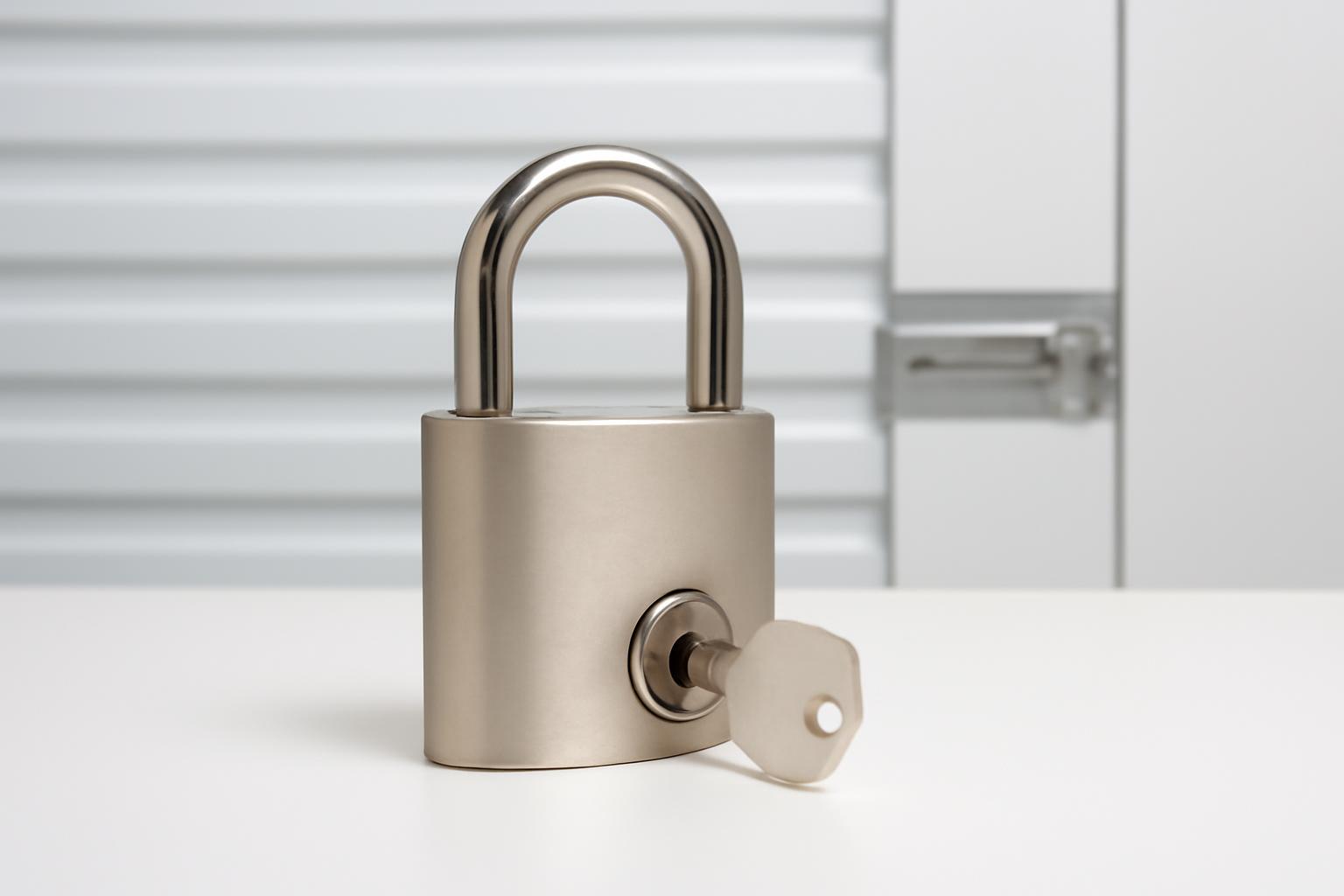
If you’re renting a storage unit and the facility mentions cylinder locks, they usually mean a lock that fits into the unit’s latch, not a standard hanging padlock. That sounds straightforward, but this is where many renters get tripped up: in general hardware, cylinder lock can mean many different door-lock parts, while in self-storage it often means a storage-specific format made for certain unit doors.
For renters, the real questions are practical:
- Will a cylinder lock fit your unit?
- Does your facility allow you to bring your own?
- Is it better than buying the disc lock at the front desk?
- What should you expect to pay?
The short answer: cylinder locks can be a good fit when the door is built for them, especially because they sit flush or low-profile in the latch area instead of hanging below it. But that same integrated design makes compatibility more important than with a disc lock. In many cases, renters still prefer disc locks because they are easier to buy, easier to understand, and easier to move from one facility to another.
The safest approach is simple: confirm the facility’s lock format first, follow the exact locking steps the provider gives, and shop by fit before price. When you do that, you have a much better chance of meeting the lease requirements without paying same-day counter pricing for the wrong lock.
What Are Cylinder Locks in Self-Storage?
In self-storage, a cylinder lock is typically a compact lock that fits directly into the storage door latch or lock opening. Public Storage and Extra Space Storage both describe units that use cylinder locks in exactly that storage-door context, rather than as ordinary padlocks or general door hardware. Public Storage’s lock guide places cylinder locks alongside disc locks and electronic locks for unit access, and Extra Space says cylinder locks “fit directly into the unit’s door latch.”
That is the key difference from other lock styles:
- Padlocks hang externally and leave the shackle exposed.
- Disc locks also hang externally, but their round body shields most of the shackle.
- Cylinder locks, in the storage-specific sense, go into the latch opening itself.
That flush or integrated fit is why cylinder locks come up so often in storage. On a compatible door, the lock becomes part of the latch setup rather than a separate hanging lock.
Storage cylinder locks are a specific subcategory
This is the part that causes the most shopping mistakes.
In the broader hardware world, cylinder lock can refer to many categories of lock parts and door cylinders. Taylor Security’s cylinder catalog and Home Depot’s lock-cylinder category include items such as:
- mortise cylinders
- rim cylinders
- interchangeable cores
- replacement cylinders
- double-cylinder door hardware
Those are real cylinder products, but they are not automatically self-storage locks. For storage renters, the relevant products are storage-specific cylinder locks sold for unit latches, often in the 17 mm to 19 mm range. Storage-focused supplier listings from All From 1 Supply, for example, include a Mr. Lock Cylinder Lock 19 mm, several LAI 19 mm models, and an LAI Enforcer Universal Cylinder 17–19 mm.
So when a facility says “cylinder lock,” the correct follow-up question is usually not “Do you mean any cylinder lock?” but “Which storage cylinder size or model fits this door?”
They are common enough that major chains give instructions for them
Public Storage’s help guide says its units may use disc locks, cylinder locks, or eLocks. Extra Space Storage’s FAQ says renters there may use disc locks or cylinder locks, depending on the unit or facility. That does not mean every location at those chains uses cylinders, but it does show that cylinder-lock units are common enough to be part of routine customer instructions.
They come in different keying options and brands
Storage suppliers and marketplace listings show several storage-cylinder variations. In the cited listings, brands include:
- Mr. Lock
- LAI Lock America
- Chateau in marketplace listings
And the products may be offered as:
- keyed-different or single-lock models
- keyed-alike models
- manager-use or vacancy-control variants
For most renters, though, the practical questions stay basic:
- Will it fit my unit?
- How many keys does it include?
- Is it a normal renter lock or a manager-use/vacancy item?
Facilities may sell them on-site, but that does not make every office lock mandatory
Many storage offices sell locks at move-in. SpareFoot’s storage-lock guide says facilities often offer locks for purchase in the office, and LockerHelp’s storage-cost guide notes that many facilities sell disc or cylinder locks at the counter. That is convenient, but it does not answer the more important question of whether the facility will approve a customer-supplied lock.
Because cylinder locks are more format-specific than disc locks, the better question is:
Does this facility allow bring-your-own locks for this unit type, and if so, what exact size or model is approved?
Extra Space’s own FAQ gives a useful clue here: it notes that a lock fee may be refundable if you bring your own lock and it is approved for compatibility by the store manager. That is a practical sign that approval can depend on both the lease and the door hardware.
So the cleanest definition is this:
In self-storage, a cylinder lock is usually a storage-specific lock that inserts into the unit’s latch opening, rather than hanging outside the latch like a padlock or disc lock.
That flush fit is the main appeal. The main drawback is that you usually need the right cylinder, not just any product with “cylinder” in the name.
How to Use Cylinder Locks on Storage Units
Cylinder locks are not difficult to use, but the order matters. Public Storage and Extra Space both describe a similar overall sequence: get the door fully shut, secure the latch, use the key with the lock, and only walk away after checking that the latch is actually holding.
How to lock a storage unit with a cylinder lock
Public Storage’s cylinder-lock instructions are the clearest step-by-step locking guide in the evidence set. Their process is:
-
Close the door tightly For a roll-up door, Public Storage says to step on the kick plate so the bottom of the door seals properly.
-
Secure the latch Slide the latch across to the secure position.
-
Tug the door Public Storage specifically says to give the door a tug and make sure the latch is holding firm.
-
Unlock the cylinder lock and leave the key in Public Storage says the key should stay in the cylinder during insertion.
-
Insert the lock fully into the opening Slide the cylinder into the hole until it is fully inserted.
-
Turn the key to lock it Public Storage says to apply gentle pressure while turning the key to lock.
-
Remove the key Remove the key only after the lock is engaged.
That sequence matters because a cylinder lock depends on the latch being in the right position. If the door is slightly high or the latch is not properly across, the lock may not seat correctly.
How to unlock it
Extra Space Storage gives the clearest provider description of the unlocking sequence. Its FAQ says cylinder locks are opened by:
- Inserting the key into the lock
- Turning the key clockwise to unlock
- Removing the lock from the latch
- Sliding or lifting the door mechanism
- Opening the storage unit door
That is provider-specific guidance, so if your facility gives different written instructions for its own door hardware, follow those.
What providers agree on
Across the Public Storage and Extra Space instructions, the common rules are:
- the door must be fully shut first
- the latch has to be in the secure position
- the key stays with the lock during the operating step
- the lock is removed from the latch to open the unit
- you should check that the door is actually secured before leaving
Common reasons renters struggle with cylinder locks
The most common practical problems are usually not mysterious lock failures. They are simpler:
- the roll-up door is not completely down
- the latch is not fully across
- the lock is not inserted all the way
- the renter bought a cylinder that is not actually the correct format for that door
Public Storage’s guide strongly suggests checking the first three before blaming the lock itself. If the fit still seems wrong, that is when compatibility becomes the next question.
A simple move-in tip
If you are moving in for the first time and the office hands you a cylinder lock, it is worth locking and unlocking it once before you leave the facility. That is not a sourced facility rule; it is just practical renter discipline. With cylinder-format doors, it is better to discover a fit or technique problem while staff are nearby than after your unloading window is over.
Cylinder Locks vs. Disc Locks: Key Differences for Storage
For most renters, the real decision is not whether cylinder locks are “good” in the abstract. It is:
Should you use a cylinder lock or a disc lock for your unit?
The evidence supports a practical answer rather than a universal winner.
The short version
- Choose a cylinder lock if your door is built for one or the facility confirms that your unit uses that exact format.
- Choose a disc lock if your unit accepts external locks and you want the easiest bring-your-own option.
Side-by-side comparison
| Feature | Cylinder locks | Disc locks |
|---|---|---|
| How they fit | Insert into the latch opening | Hang through the hasp as an external lock |
| Best use case | Doors designed for cylinder systems | Units that accept customer-provided external locks |
| Portability | Lower; often tied to a specific latch format | Higher; usually easy to move between facilities |
| Availability | More limited in storage-specific sizes | Widely sold by storage offices and retailers |
| Ease for renters | Can be simple once matched correctly | Usually more familiar to renters |
| Hardware profile | Flush or low-profile in the latch area | External, though with a shielded shackle |
| Compatibility risk | Higher | Lower |
Public Storage and Extra Space both recognize cylinder and disc locks as standard storage lock types. Extra Space’s FAQ goes further and says disc locks are the most common choice for renters, while cylinder locks are often installed by the facility and fit directly into the latch.
Why renters often end up with disc locks
There are three practical reasons disc locks keep winning for ordinary renters:
-
They are easier to shop for. You can buy disc locks at many facilities and retailers without decoding a storage-specific cylinder format.
-
They travel better. If you change facilities later, a disc lock is more likely to come with you.
-
They are the standard bring-your-own choice in provider guidance. Extra Space says disc locks are generally the standard if you’re bringing your own.
That portability matters if you are:
- comparing multiple facilities before signing
- unsure whether you may switch units later
- trying to avoid buying a lock that works on only one door type
Why some facilities or unit types use cylinder locks
Cylinder locks make the most sense when the door hardware is already built around them. Extra Space says they fit directly into the unit’s latch, and Public Storage provides separate instructions for cylinder-lock units. In that setting, the cylinder format is not an optional style preference so much as the right tool for that latch.
For a renter, that can be perfectly fine if:
- the office confirms the exact lock type needed
- the unit door is clearly cylinder-lock compatible
- you do not care much about moving the same lock to a different facility later
Are cylinder locks more secure than disc locks?
This is where the evidence needs restraint.
Some seller pages and facility FAQs describe cylinder locks as hard to tamper with or more protected because they do not hang outside the latch. That design observation is reasonable: a flush or internal fit exposes less protruding hardware than a standard padlock. But the evidence here does not include independent, controlled testing showing that storage-specific cylinder locks are universally better than good disc locks.
What the sources do support is narrower:
- both disc locks and cylinder locks are common self-storage choices
- many facilities prefer one of those over a standard exposed padlock
- neither style should be treated as theft-proof
- real attacks may target the latch, hasp, or door, not just the lock body
Operator forum discussions underline that point. Some operators prefer cylinder systems; some prefer disc locks for ease of use or standardization; some report that thieves attack latches or sheet metal instead of spending time on the lock itself.
The bigger security picture
Urban Storage’s guide and operator discussions both point beyond the lock alone. Your real-world risk is also shaped by things like:
- controlled gate access
- cameras
- lighting
- staff presence
- unit placement
- latch and door strength
That is the practical frame to keep: lock choice matters, but facility operations still matter a lot.
A renter decision matrix
If you want the sharpest decision rule, use this:
Bring your own cylinder lock only if all three are true: - the facility says customer-supplied locks are allowed for that unit - the office confirms the exact format, size, or compatible model - you can buy a clearly storage-specific cylinder before move-in
Buy at the office if any of these are true: - you are moving in the same day - the unit has facility-specific latch hardware - the staff cannot or will not give written size/model guidance in advance - you want staff to confirm the fit immediately
Choose a disc lock instead if: - the facility allows either disc or cylinder - portability matters to you - you want the simplest renter-friendly option
For many renters, disc locks win on convenience. For doors set up for cylinders, the right cylinder lock is the correct choice. The mistake is assuming the two formats are interchangeable on every unit.
Security Realities of Cylinder Locks
Cylinder locks are often marketed with big security language. In self-storage, that can include phrases like “tamper-resistant,” “high security,” or claims about drilling and picking. The evidence pack here supports a more careful, more useful answer.
What the design does offer
A storage cylinder lock typically sits inside or flush with the latch area instead of hanging down like a conventional padlock. Storage supplier pages and provider FAQs describe that lower-profile fit as a reason cylinder locks are used on storage doors. That means there is less protruding hardware than with a basic padlock.
That is a fair design advantage to describe.
What the evidence does not prove
The evidence provided here does not establish that storage cylinder locks are:
- drill-proof
- pick-proof
- automatically better than quality disc locks
- the most secure storage lock in every circumstance
Those stronger claims appear mainly in seller pages, provider marketing, or opinion-based articles. The evidence set does not include independent third-party testing that compares storage-specific cylinder locks and disc locks under the same attack conditions.
So if you are storing valuable items, the honest reason to use a cylinder lock is usually not “because it has been independently proven superior.” It is more practical:
- your facility uses that format
- your unit is built for it
- it avoids the exposed-hanging-lock format of a standard padlock
What operators report in practice
The operator forums are anecdotal, not lab data, but they are still useful when presented honestly.
In those discussions:
- some operators report very few successful break-ins on cylinder-lock units
- one operator described unsuccessful break-in attempts on a cylinder-lock building
- some operators say cylinder locks can still be drilled
- some say drilling takes time and may deter casual thieves
- some stress that thieves may attack the latch or door instead
- some like cylinder systems because they keep units locked and support facility procedures
- others prefer disc locks because customers understand them more easily
That is not enough to crown one format. It is enough to show that the security question is broader than the lock body alone.
The weak point may be the latch or door
One of the most practical insights from the operator discussions is that the lock is not always the part that fails first. Thieves may go after:
- the latch
- the hasp
- the sheet-metal door
- the surrounding hardware
That is why a lock debate can become misleading if it ignores the door and site around it.
What matters more for many renters
If you are choosing between facilities, these questions may matter at least as much as the cylinder-versus-disc argument:
- Are there visible cameras?
- Is gate access controlled?
- Is the site well lit?
- Does the latch hardware look solid?
- Does the facility seem staffed and monitored?
- Do you have insurance and a contents record?
Urban Storage’s storage-lock guide also points renters toward cameras, gates, lighting, and on-site management as part of the bigger security picture.
A realistic way to think about it
Cylinder locks are not magic. They are a door-compatible storage lock format with a useful benefit: a flush or integrated fit on the right units. That may reduce exposed hardware compared with a basic padlock, but it does not eliminate attack methods or settle every security comparison with disc locks.
If you are storing especially valuable property, the safer plan is to:
- follow the facility’s lock rules exactly
- choose a confirmed compatible lock
- use insurance
- document your contents
- avoid relying on marketing superlatives alone
That is a stronger security plan than assuming one lock type solves the whole problem.
Where to Buy Cylinder Locks and What They Cost
If you need a cylinder lock for self-storage, the biggest money-saving move is to shop before move-in day if the facility confirms the exact format in advance. If you wait until you are standing at the counter with a truck to unload, convenience usually wins.
One important note before the price list: “cylinder lock” search results are messy. Some are true self-storage locks. Many are ordinary mortise or rim cylinders for doors. The examples below separate those categories on purpose.
Also, prices below are example listing prices from the cited source material and can change.
1. Storage-specific suppliers
This is the cleanest place to price real self-storage cylinder locks.
All From 1 Supply’s storage-cylinder listings include:
- Mr. Lock Cylinder Lock 19 mm — $8.69
- LAI B522Z-D3 Stop/Go Cylinder Lock 19 mm — $11.99
- LAI Cylinder Lock Keyed Alike 19 mm — $12.59
- LAI Enforcer Universal Cylinder 17–19 mm — $11.99
- 19 mm Nylon Manager Cylinder Key 10 Pack — $23.99
Those examples are useful because they show the normal retail territory for storage-specific cylinders: roughly the high single digits to low teens for many standard models.
All From 1 Supply also lists a 100-count case of Mr. Lock 19 mm cylinders at $729.00, which works out to about $7.29 each. That is mainly relevant to operators, not a one-unit renter, but it helps show where facility margins can come from on bulk-purchased lock inventory.
2. Facility counters
LockerHelp’s storage-cost guide says many facilities sell disc or cylinder locks at the counter for about $15 to $25. Urban Storage’s guide gives a lower specific provider example, listing a cylinder lock at $11.99 and a disc lock at $10.99. Put together, those sources suggest that office pricing can run anywhere from the low teens to the mid-$20s depending on the facility and the exact lock.
That does not automatically make the office price unreasonable. You may be paying for:
- immediate availability
- compatibility confirmation
- staff help
- no shipping delay
- no risk of showing up with the wrong item
But if the facility has already told you exactly what fits, storage-supplier pricing can be materially lower.
3. Big-box and hardware-store searches: useful for category context, risky for fit
This is where many renters get confused.
Home Depot’s lock-cylinder category shows products such as:
- Prime-Line Cylinder Lock 1-1/4 in. — $8.59
- Premier Lock 1-1/8 in. mortise cylinder KW1 — $13.61
- Premier Lock 1-1/8 in. mortise cylinder SC1 — $14.79
- Prime-Line Mortise Cylinder 1-1/4 in. — $23.97
- Premier Lock High Security Rim Cylinder — $42.79
Those are useful examples of what happens when you search “cylinder lock” at a home center: you mostly see general door cylinders, not self-storage latch cylinders.
Walmart’s category results are similarly mixed. The provided text includes a WEIOUKC Roll-Up Door Cylinder Lock at $8.98 and another generic KFFKFF Cylinder Lock at $14.99, but the listing detail is thin and does not establish storage-unit compatibility.
So the practical takeaway is:
Hardware-store and mass-retailer searches may help you spot pricing territory, but they are not reliable substitutes for confirmed storage-cylinder listings unless the product is clearly described as a storage or roll-up-door cylinder and the facility says it fits.
4. Online marketplaces
Marketplaces can be the cheapest source, and also the messiest.
The eBay category page in the evidence pack includes:
- Chateau 7-pin cylinder lock for storage units — $3.75 to $4.99 plus shipping, listed with 2 keys
- a public storage unit lock — $19.28
- thousands of other “cylinder lock” listings, many of them unbranded or unrelated to self-storage
The eBay page also shows how noisy this shopping category is. Its cylinder-lock results include deadbolt cylinders, mortise cylinders, rim cylinders, and even mismatched non-lock items pulled into the results.
So marketplace shopping can absolutely save money, but only if you verify all of the following first:
- it is actually a storage-unit cylinder lock
- the size matches your facility’s requirement
- the seller shows the right format
- the number of keys is acceptable
- returns are possible if it does not fit
A sharper buying rule: when to bring your own vs. buy at the office
If you are trying to avoid an unnecessary upsell, this is the cleanest decision framework.
| Situation | Better move |
|---|---|
| Facility confirms exact cylinder size/model in advance | Bring your own if you can source that exact storage-specific lock |
| You have several days before move-in | Compare supplier and marketplace options first |
| Same-day move-in and no written size guidance | Buy at the office |
| Door uses facility-specific latch hardware | Buy the confirmed compatible lock, often from the office |
| Facility allows either disc or cylinder and you want portability | Bring a disc lock instead |
| Marketplace listing is cheap but vague | Skip it unless the seller can confirm fit |
Reasonable budget expectations
For a single storage unit, the evidence supports these rough expectations:
- about $8 to $13 for many storage-specific cylinder locks from storage suppliers
- roughly low teens to mid-$20s at facility counters, depending on the provider
- under $5 at the very low marketplace end for some storage-labeled listings, but with more fit and quality uncertainty
- a wide range for general door cylinders at home centers, which should not be treated as storage-lock comparators unless compatibility is confirmed
The best way to save money is not simply “buy the cheapest cylinder lock.” It is buy the cheapest confirmed-compatible cylinder lock.
Facility Policies on Cylinder Locks
This is the part of the topic where renters can make bad assumptions very quickly. Lock rules depend on two things:
- what the lease or facility rules say
- what the door hardware actually accepts
What many facilities prefer or require
LockerHelp’s storage-cost guide says most facilities require a disc lock or cylinder lock rather than a standard padlock. Public Storage’s help guide says its units may use disc locks, cylinder locks, or eLocks. Extra Space likewise says renters there use either a disc lock or a cylinder lock, depending on the unit.
That supports a practical rule: many facilities want something other than a basic exposed-shackle padlock.
Some units are effectively built around cylinder systems
Extra Space says cylinder locks fit directly into the door latch. SpareFoot notes that some facilities may require a specific type of lock. Its explanation of cylinder locks also says storage doors can be built specifically for certain cylinder formats.
That is why “Can I bring my own?” is usually a compatibility question first.
If the unit is built for a particular cylinder style, the real issue is not just policy. It is whether the door will physically accept what you bring.
Can you bring your own lock?
The evidence supports a cautious answer: often yes, but only if the facility approves it for that unit type.
SpareFoot says renters are generally required to use their own lock, while many facilities also sell locks in the office. Extra Space says a lock fee may be refundable if you bring your own lock and it is approved for compatibility by the store manager. LockerHelp’s storage-cost guide advises bringing your own if it meets the required spec.
What the evidence does not safely support is a broad legal rule about what a facility can or cannot require in every jurisdiction. So the practical advice is:
- ask whether customer-supplied locks are allowed
- ask what exact type or size is required
- ask whether manager approval is needed
- rely on the written lease and written confirmation, not assumptions
Watch the lease for specific lock language
The written rules may mention things like:
- no standard padlocks
- disc-style lock requirements
- hardened shackle requirements for external locks
- approval requirements for customer-provided locks
- digital-access exceptions on some units
LockerHelp specifically mentions a typical spec of disc-style, hardened shackle for bring-your-own locks where external locks are allowed. SpareFoot’s guide also emphasizes shackle size and hardened steel for external-lock selection. But for cylinder-format units, the more important detail is still fit.
Lost-key and move-out policies can be strict
Extra Space says tenants are not able to cut or break their own locks and should contact the facility manager, who has special tools to remove or replace them. SpareFoot says some managers require key return at the end of the lease or replace the cylinder for the next tenant. Operator discussions add that some facilities drill out cylinders at move-out or turnover if keys are not returned.
Those are not universal policies, but they are common enough to ask about in advance.
Five questions to ask before you sign
If you want to avoid lock surprises, ask these questions before move-in:
- Does my unit use a cylinder lock, disc lock, or either?
- May I bring my own lock?
- What exact size, model, or format is approved?
- What happens if I lose the key?
- Are there move-out or key-return rules?
Those answers will tell you more than generic “high security” marketing copy ever will.
Types and Sizes of Cylinder Locks for Storage
This is the section that saves renters from buying the wrong thing.
The phrase cylinder lock covers a lot of hardware. For self-storage, only a narrow slice of that market is usually relevant.
Storage-specific cylinder locks
For storage renters, the useful starting point is the storage-cylinder category sold for unit doors. In the evidence provided, the common size range is 17 mm to 19 mm, with 19 mm appearing repeatedly in storage-supplier listings.
Examples include:
- Mr. Lock 19 mm
- LAI 19 mm
- LAI Enforcer 17–19 mm
If you are talking to a facility and they say “cylinder lock,” asking whether the unit takes a 19 mm storage cylinder is a much better question than just asking whether “a cylinder lock” will work.
General cylinder types you will see in stores
When you browse home centers, locksmith sites, or hardware catalogs, you will also see other cylinder categories.
Rim cylinders
Ace Hardware’s buying guide says rim cylinders are used for surface-mounted deadbolts and night latches. eBay’s cylinder category also breaks out rim-cylinder listings separately.
These are not automatically storage-door cylinders.
Mortise cylinders
Ace says mortise cylinders are threaded for mortise lock bodies, with common lengths around 1 inch to 1.25 inches. Home Depot’s category includes several mortise-cylinder examples in that range, such as 1-1/8-inch and 1-1/4-inch products.
Again, those are legitimate door-hardware parts, but they are a different shopping track from most storage-unit cylinders.
Interchangeable cores and replacement cylinders
Taylor Security’s catalog shows still more categories, including interchangeable cores, housings, and replacement cylinders for institutional and commercial door systems. Those are useful proof that the term cylinder is broad, but they are usually irrelevant to a renter trying to secure a roll-up storage door.
Keying options
Storage suppliers and hardware retailers also use keying terms that can sound more technical than they need to be.
Common examples include:
- keyed different
- keyed alike
- KW1
- SC1
The KW1 and SC1 terms show up in Home Depot and Ace listings for general door cylinders. They matter when matching existing door keyways, but they are not usually the first thing a one-unit storage renter needs to worry about.
For most renters, the better questions are:
- how many keys come with the lock?
- is this a renter lock or a manager-use/vacancy item?
- did the facility confirm this exact cylinder format fits my latch?
A simple way to avoid the wrong purchase
There are really two separate shopping tracks hiding under one phrase.
Track 1: Self-storage renters You want a storage-specific cylinder lock, often around 17–19 mm or 19 mm, for a unit latch.
Track 2: General door-hardware shoppers They want mortise, rim, replacement, or interchangeable cylinders for residential or commercial doors.
If you mix those tracks, you can buy the wrong part very fast.
How to verify fit before you order
Before you buy, try to confirm at least one of these:
- the exact model
- the required diameter or size
- a facility-approved product description
- a photo of the latch that the facility or seller confirms fits
If the office only says “bring a cylinder lock,” that instruction is too vague by itself.
Handling Lost Keys and Maintenance
Cylinder locks are easy when everything goes right. The trouble usually starts in two situations:
- the key is lost
- the lock starts wearing or sticking
Because cylinder locks are tied closely to the unit’s hardware, those issues can be more disruptive than they would be with a generic padlock.
What to do if you lose the key
Extra Space’s guidance is straightforward: if the key is lost or the lock is broken, contact the facility manager immediately. Their FAQ says tenants are not able to cut or break their own locks, and managers have special tools to remove them without damaging the unit.
Operator discussions suggest that if the lock cannot be non-destructively removed, drilling may be the fallback. That is anecdotal facility experience, not a universal rule, but it is consistent with the practical problem: a lost key can turn into a service event, not just an inconvenience.
What may happen at move-out
SpareFoot says some managers require key return at lease end or replace the cylinder for the next tenant. Operator forum discussions go further and describe facilities that:
- require tenants to remove the lock at vacate
- drill the lock if keys are not returned
- avoid rekeying and instead replace or destroy the old lock
Those are operator reports, not industry-wide rules, but they reinforce the same point: move-out procedures can be more lock-specific with cylinder systems, so ask before there is a problem.
Signs the lock may be wearing out
The most useful general maintenance sign in the evidence set comes from Park Avenue Locks’ cylinder-lock explainer: a first fault sign is when the key sticks or becomes hard to turn.
That is a general cylinder-lock observation, not a storage-specific lab finding, but it is practical. If your key starts binding, do not just force it harder and hope for the best.
How long do they last?
The evidence here is anecdotal, not controlled durability testing. In an operator discussion, one user described cylinder locks wearing after around 10 years and switching formats afterward.
That should be treated as operator experience, not a guaranteed lifespan. Real life will depend on:
- lock quality
- weather exposure
- how often the unit is opened
- how clean the latch area stays
For most short-term renters, compatibility and lost-key handling are more important than theoretical lifespan anyway.
Nylon and manager-use variants
Storage supplier listings also include products like a 19 mm Nylon Manager Cylinder Key 10 Pack, and operator discussions mention nylon locks used on vacant units. Those are usually facility-operation items, not what an ordinary renter should casually buy.
So if you see a nylon or manager-labeled cylinder online, read the listing carefully before assuming it is a normal customer lock.
Practical renter maintenance habits
The simplest low-drama approach is:
- keep a spare key somewhere safe outside the unit
- test the lock before leaving on move-in day
- do not force a sticky key
- ask the office what the lost-key removal process is before you need it
A lost key is annoying. A broken key inside a facility-specific cylinder is worse.
FAQ
Can I bring my own cylinder lock to a storage facility?
Often yes, if the facility allows customer-supplied locks for that unit and approves the format. SpareFoot says renters are generally expected to use their own lock, while facilities often sell locks in the office. Extra Space says a lock fee may be refundable if you bring your own lock and it is approved by the store manager for compatibility. The key point is that “bring your own” does not mean “bring any cylinder lock.” Ask for the exact spec first.
How much do cylinder locks cost at stores vs. facilities?
For storage-specific cylinder locks, supplier examples in the evidence set run about $8 to $13 for many 19 mm models, including $8.69, $11.99, and $12.59 listings from All From 1 Supply. LockerHelp’s storage-cost guide says facilities often sell locks around $15 to $25 at the counter, while Urban Storage gives one provider example at $11.99 for a cylinder lock. Marketplace listings can be cheaper, including eBay examples below $5, but fit and quality risk go up fast.
What’s the difference between cylinder and disc locks for storage?
A cylinder lock fits into the storage-unit latch and usually sits flush or low-profile in the door hardware. A disc lock hangs externally through the hasp like a round padlock with a shielded shackle. Extra Space says disc locks are the most common choice for renters, while cylinder locks are often installed by the facility and fit directly into the latch. In practice, disc locks are usually easier to reuse across facilities, while cylinder locks make sense when the door is specifically built for them.
Do all storage units use cylinder locks?
No. Public Storage says its units may use disc locks, cylinder locks, or eLocks. Extra Space says renters there use either disc locks or cylinder locks, and some locations may also offer digital access. The safe assumption is that lock type varies by facility, by building, and sometimes by individual unit type.
What happens if I lose the key to my cylinder lock?
In most cases, you need to contact the facility manager. Extra Space says tenants are not allowed to cut or break their own locks and that managers have special tools to remove them. Operator discussions suggest drilling may sometimes be necessary if the key is lost or not returned. Ask about that process before move-in, because it may involve ID verification, staff scheduling, replacement-lock costs, or other fees.
For most renters, the practical conclusion is simple: use a cylinder lock when the unit is built for it, but do not assume every cylinder lock fits every storage door. Start with facility approval, then confirm the size or model, with 17–19 mm and especially 19 mm being common in the storage-specific listings reviewed here. If your facility allows either format, a disc lock may still be the easier renter choice. And whichever lock you use, remember that the full security picture includes the door hardware, the site itself, and the procedures around lost keys, cameras, lighting, and access control.