
Choose a Gym Locker Padlock by Fit, Security and Access
Measure the locker hardware, compare security claims, and choose key or combination access. Know when a gym lock is unsuitable for self-storage.
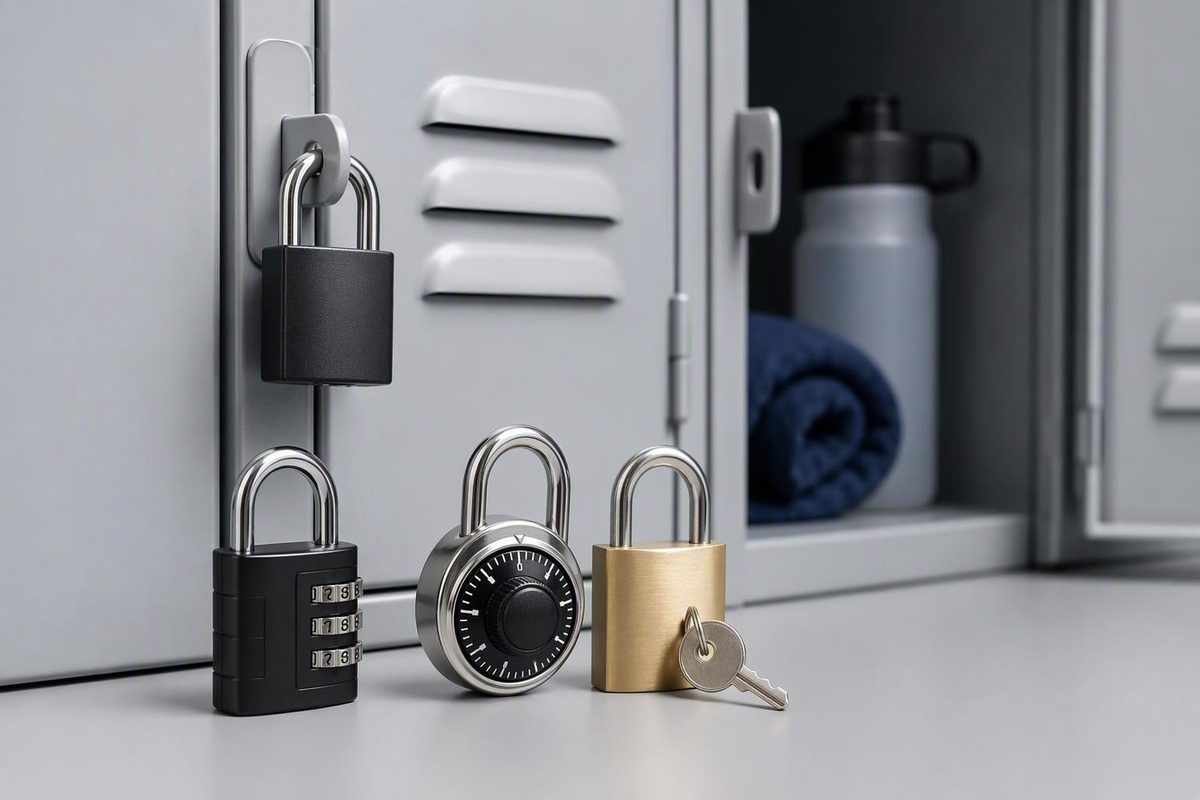
Start with a hardened-shackle padlock that fits the locker closely and that you can reliably operate. Choose key or combination access around your workout routine—not on the assumption that either mechanism is automatically more secure. For higher-value belongings, look beyond “gym locker” labeling to the exact model’s security features and intended use.
The same fit-first approach applies to staff lockers at a self-storage facility. It does not mean the same lock belongs on a rented storage-unit door.
Check the facility’s rules before buying
Ask whether you need to bring a lock, whether there are size restrictions, and when you must remove it. A locker with an integrated lock may not need your padlock at all.
Check whether the locker is day-use or an assigned rental. For example, the Greater Green Bay YMCA’s published policy, checked in October 2026, says unauthorized locks left overnight will be cut and contents removed; permanent lockers in its men’s and women’s locker rooms may be rented for a monthly fee. That is an operator-specific rule, not a universal gym policy.
If you want to leave shoes or toiletries between visits, compare the locker rental fee and any lock requirement before paying. A stronger padlock does not grant permission to store belongings overnight.
Measure four things—not just the lock body
The shackle is the metal loop that passes through the locker’s locking hole or hasp. Record:
| Measurement | What to check |
|---|---|
| Shackle diameter | It must pass through the smallest opening without force. |
| Internal vertical clearance | The closed loop must accommodate the hardware’s height or thickness. |
| Internal horizontal clearance | The space between the shackle legs must accommodate the hardware. |
| Body and operating clearance | The body must clear the door and handle, with room to turn the key or use the dial. |
Manufacturer specifications distinguish these dimensions. For example, the Master Lock 140D lists a 1/4-inch shackle diameter, 7/8-inch shackle length and 13/16-inch shackle width. Those are a measurement example, not a universal locker size or a product recommendation. Use the manufacturer’s dimension drawing to check what its length and width labels measure.
Choose the shortest shackle that closes and operates normally. Avoid unnecessary exposed loop space, but do not buy a lock so tight that you must force it against the door. Test the actual fit before relying on it.
Buy security features, not a reassuring label
Look for a stated hardened-steel or hardened-alloy shackle, documented locking features, and a clear description of the theft risk the model is intended to address. Treat manufacturer descriptions as product claims, not independent proof of resistance to attack.
“Gym lock” does not necessarily mean high security. ABUS describes its combination lock 78 as suitable for lesser-value goods or low theft risk, despite its hardened-steel shackle. Likewise, Master Lock classifies the keyed 140D as basic security for low-risk environments. Neither a key nor hardened steel alone establishes the whole lock’s resistance.
For increased physical protection, consider a shrouded-shackle design if it fits. ABUS explains that the guard on its 83CS/55 makes access with tools such as bolt cutters more difficult. That explains the design’s benefit; it does not make that large industrial model the right gym purchase.
Also inspect the locker. If the hasp is loose, the door is damaged, or the locking parts do not engage properly, ask for another locker rather than trying to compensate with a more expensive padlock. Leave unnecessary valuables at home.
Choose access you can manage during a workout
- Keyed: Useful if you prefer not to read or remember a combination. Plan a secure way to carry the key; keep a spare outside the locker.
- Combination: Useful if carrying a key is awkward. Check dial readability and operation. Learn the opening procedure before use, shield the code, and spin or scramble the combination controls after closing as the maker directs.
Judge the exact model, not just the access type. More digits or a heavier body should not substitute for documented security features.
For poolside or damp use, check corrosion protection as well. Follow the maker’s maintenance instructions rather than applying a household lubricant indiscriminately. Master Lock’s care guidance, for example, recommends periodic cleaning and lubrication and specifically warns against dry graphite and silicone lubricant.
Before leaving the locker
Close the door, secure the shackle, move any combination controls off the opening setting as instructed, then tug the lock and check that the door stays shut. Keep the key or recovery information somewhere you can access without opening the locker.
For storage-facility staff, record day-use limits and authorized recovery procedures in the workplace locker allocation policy. For a rented self-storage unit, make a separate hardware-led choice using the storage-unit lock guide—do not assume a convenient gym padlock is suitable for long-term unattended storage.