
Choose a Gate Lock That Fits the Hardware and Survives the Exposure
Measure the opening the shackle must pass through, closed-shackle working space and body clearance. If fit is unreliable, compare an integrated lock.
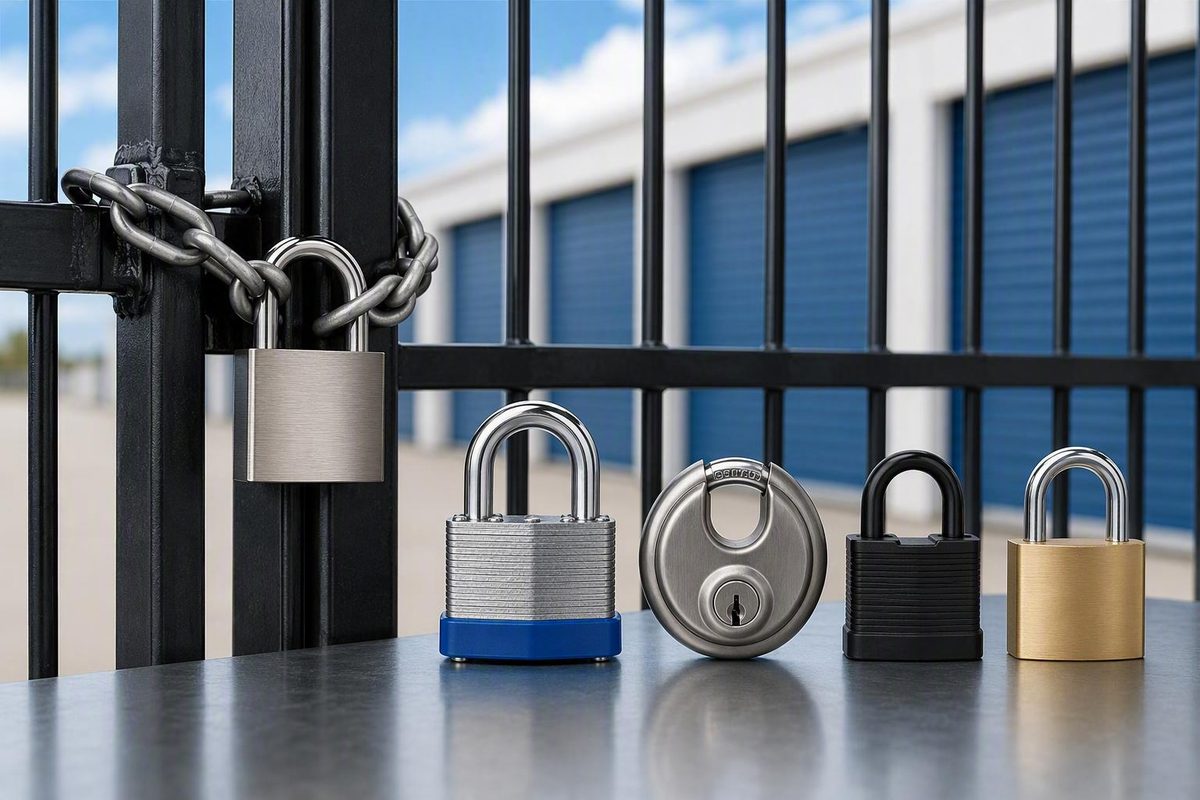
A metal gate padlock should be chosen from the gate outward—not from the lock shelf inward. A large body, high price, familiar brand, or imposing shape does not establish whether the shackle will pass through the latch, the body can rotate into position, or the mechanism will remain usable in rain, salt, grit, and freezing conditions.
This guide is a measurement and selection framework, not a ranking of particular models. Start by deciding whether the gate is suited to a removable padlock. Then inspect and repair the gate, record the relevant dimensions, compare shackle designs, assess weather durability separately from attack resistance, and choose an access method that suits the people using the gate.
The final result depends on the complete assembly: lock, latch or hasp, chain, fasteners, frame, posts, strike, and hinges.
First decide whether you need a padlock or an integrated gate lock
A conventional padlock is removable. Its shackle passes through a compatible hasp, a purpose-made opening in a lockable latch, or one or more chain links. You can remove the entire lock after opening it and replace it without permanently altering the gate, provided the replacement remains dimensionally compatible.
That differs from a basic gate latch, which may only hold the gate closed. A lockable latch adds an opening or attachment point intended to accept a padlock. Before shopping, verify that the existing latch is genuinely padlock-ready rather than assuming that any visible hole, slot, or loop is suitable.
An integrated gate lock becomes part of the gate assembly. Common categories include:
- Bolt-on locks, mechanically fastened to the frame
- Weld-in locks, permanently welded into the gate
- Mortice locks, installed in a pocket in the frame
- Keyed latches and deadlocks
- Mechanical keypad locks
- Long-throw or adjustable locks
- Sliding-gate locks
- Quick-exit assemblies with an internal lever or push pad
Gatemaster distinguishes bolt-on, weld-in, and mortice installations in its metal-gate guidance. Its bolt-on category says the displayed products attach after three holes are drilled in the frame, using the supplied fixings. That catalog primarily contains installed keyed, keypad, deadlock, latch, sliding-gate, and quick-exit assemblies rather than removable padlocks. Installation suitability still depends on the particular frame and gate construction. Review Gatemaster’s bolt-on metal-gate lock category.
Borg’s metal hollow-section gate range follows a similar pattern. It lists installed mechanical keypad and latch-based products, including configurations with internal operating hardware and optional key override, rather than identifying a conventional removable padlock. Review Borg’s metal-gate lock range.
Retain a padlock arrangement when:
- The existing hasp or lockable latch is sound, aligned, and in good condition.
- Removable or readily replaceable locking is useful.
- Managing a key or combination is practical.
- A suitably protected shackle can fit without excessive unused clearance.
- The surrounding hardware is reasonably matched to the proposed lock.
Investigate an integrated lock when:
- There is no suitable hasp or padlock-ready latch.
- The gate-to-post gap is too large or variable for a sensible padlock arrangement.
- Thick tubing or difficult frame geometry makes an ordinary latch awkward.
- Many people need regular access and distributing keys is undesirable.
- Users need a convenient way to leave from the inside.
- The gate slides rather than swings.
- Repeatedly removing and handling a padlock would be inconvenient.
A sliding gate may likewise benefit from hardware designed for its direction of travel. Gatemaster’s vendor guide describes long-throw locks for larger gaps or thicker frames and identifies keyed-alike systems in which one key operates multiple compatible locks. These are vendor descriptions, not independent performance findings. Read the installed gate-lock selection guide.
Some gates are used around pools, shared entrances, controlled-access areas, or routes people may need to leave through quickly. This article cannot establish the legal, accessibility, fire-access, pool-safety, or emergency-egress requirements for any location. Ask the relevant local authority or a qualified professional before selecting hardware for such a gate. As one example of the limitation, Yardlock’s commercial guide tells pool-gate users to follow applicable local laws and building codes, but it does not identify or interpret those requirements. See Yardlock’s pool-safety qualification.
Inspect the gate before shopping for a lock
A lock that sticks, hangs at an angle, or closes only when the gate is lifted may be revealing a gate problem. It could also be damaged or contaminated, so inspect both the gate and the lock before deciding what to replace.
Record the following:
- Gate material: steel, stainless steel, aluminum, or mixed construction
- Frame or tubing shape: round, square, rectangular, solid, or hollow
- Latch type and how it engages the strike or post
- Whether the latch has a purpose-made padlock opening
- Gate-to-post gap at latch height
- Swing direction when viewed from the operating side
- Available hand space around the latch
- Space beneath, beside, and behind the latch for the lock body
- Whether an open padlock can be inserted and rotated without hitting the frame
Open and close the gate several times. Let it close naturally rather than lifting it, pushing it sideways, or forcing it against the post. Watch how the latch approaches the strike.
If the latch rubs, misses the strike, or requires pressure to engage, check for:
- Sagging or worn hinges
- Loose hinge fasteners
- A post that moves under load
- A twisted or flexing frame
- A loose latch or strike
- Ground or debris interfering with travel
- A gate-to-post gap that changes substantially while closing
- A damaged, corroded, or contaminated lock mechanism
Correct identifiable gate problems before selecting a tightly fitted padlock. Measurements taken while the gate is being forced into position may not represent its resting geometry. Yardlock’s gate guide similarly emphasizes measuring the gap at latch height, checking swing direction, aligning the latch and strike, and testing the action repeatedly; its recommendations remain manufacturer guidance rather than an independent installation standard.
Next, inspect every component that would remain after a padlock upgrade:
- Hasp or latch: Look for thin material, cracks, severe corrosion, bending, loose joints, or an opening that leaves much of the shackle exposed.
- Chain: Check the working links, connectors, and attachment points.
- Fasteners: Identify fixings accessible from the unsecured side.
- Frame: Look for deformation, corrosion, loose joints, or cracked welds.
- Hinges: Check their condition, attachment, and external accessibility.
- Post and strike: Confirm that they remain stable when the gate is pushed or pulled.
Assess the setting separately from the weather. A lightly used garden gate protecting little of value does not necessarily justify the same hardware or key-management system as a street-facing commercial gate, laneway entrance, shared service gate, or enclosure holding tools and inventory. These categories do not predict an attack; they help identify the consequences of unauthorized access and the operational burden users can tolerate.
Then create a separate exposure profile:
- Direct or sheltered rain
- Wind-driven water
- Persistent humidity
- Coastal salt
- Road or de-icing salt
- Dust, sand, or construction grit
- Freezing temperatures
- Repeated thawing and refreezing
- Strong temperature cycling
- Irrigation or wash-down exposure
Security exposure and weather exposure are different questions. A sheltered lock in a higher-consequence location may require greater documented attack resistance but only moderate weather protection. A low-consequence coastal gate may need excellent corrosion resistance and reliable outdoor operation even when deliberate attack is not the principal concern.
Measure the hasp, chain, shackle, and operating clearance
Padlock packaging often emphasizes body width, but body width alone does not establish fit. The decisive measurements are the opening through which the shackle must pass, the working space needed inside the closed shackle, and the clearance required by the body.
Use a worksheet before buying:
| Measurement | Your measurement | What it determines |
|---|---|---|
| Narrowest hasp or latch-hole width | Maximum shackle diameter that can pass through | |
| Latch-hole height or depth | Whether the shackle can enter without binding | |
| Maximum shackle diameter | Thickest compatible shackle | |
| Required usable shackle width | Horizontal working space inside the closed shackle | |
| Required usable shackle length | Vertical working space inside the closed shackle | |
| Chain-link opening, if used | Whether the shackle passes through the intended links | |
| Space around the lock body | Whether the body can seat against the hardware | |
| Rotation and insertion clearance | Whether the open lock can be positioned and closed | |
| Gate movement allowance | Tolerance needed for normal movement | |
| Maximum acceptable exposed shackle | Unused working space remaining after closure |
Shackle diameter is the thickness of the metal that must pass through the hasp, latch hole, or chain link. Measure the narrowest point along the actual route. Paint buildup, burrs, deformation, and angled openings can make the usable space smaller than it appears from the front.
Usable shackle length is the working space inside the shackle when the lock is closed. It is not the padlock’s total exterior height. Also verify usable internal width; two shackles with similar overall height may provide different working clearances.
Measure the complete path. If the shackle passes through two offset parts of a latch, confirm that the openings align when the gate is resting naturally. Do not size the lock around a position that requires pushing the gate hard against the post.
For a chain, test the intended links rather than assuming that a shackle fitting one loose link will fit the completed arrangement. Confirm that:
- The shackle passes through the selected link or links.
- The links can be brought together without excessive tension.
- The lock body does not hit the chain before the shackle closes.
- The chain cannot simply be slipped off its anchor.
- The closed arrangement does not leave unnecessary shackle space.
Minimizing unused clearance can leave less working room for some cutters or prying tools. The fit should not be so tight, however, that ordinary gate movement prevents closure. If substantial movement is needed to operate the lock, repair the gate rather than compensating automatically with a much longer shackle.
Body clearance is especially important with discus, closed-shackle, shrouded, and hidden-shackle designs. The shackle may pass through the opening while the protective body collides with the frame, weld bead, post, chain, or latch shoulder. The lock may also need room to rotate during insertion even when its final position appears compact.
Before ordering, compare the worksheet with the manufacturer’s dimensional drawing for the exact model and variant. A specialist retailer’s catalog illustrates why category names are insufficient: gate-related products appear in different materials, body sizes, shackle arrangements, and conventional, discus, or hidden-shackle formats. The catalog does not establish which one fits a particular gate. See the range of padlock and hasp formats listed by Hoover Fence.
Confirm all of the following:
- Shackle diameter
- Horizontal internal clearance
- Vertical usable clearance
- Body height and width
- Opening direction
- Required insertion angle
- Key-removal clearance
- Dial-operating clearance, if applicable
Do not buy until every fit dimension is confirmed. No general guide can determine the correct shackle size for a gate that has not been measured.
Compare open, shrouded, discus, and hidden-shackle designs
Padlock shape affects compatibility and the amount of accessible shackle. Shape alone does not establish overall security performance.
A traditional open-shackle padlock has a separate body and a visible U-shaped shackle. It is often the easiest format to fit through existing hasps and chain links, especially when the hardware requires greater vertical or horizontal reach. Its trade-off is greater shackle exposure.
A discus or disc lock has a circular body and a shorter, rounded shackle partially enclosed by that body. OneMonroe describes this structural distinction between an exposed U-shaped padlock and a circular disc lock, although its broad security discussion is not a substitute for exact-model testing. See the illustrated comparison of padlocks and disc locks.
A shrouded or closed-shackle padlock places shoulders or surrounding body material beside part of the shackle. That arrangement can restrict access to portions of the shackle, but the shoulders require additional space around the latch.
A hidden-shackle padlock conceals most of the locking interface.
| Design | Ease of fitting existing hardware | Typical shackle exposure | Body-clearance demand | Specialized hardware likely? | Main trade-off |
|---|---|---|---|---|---|
| Open shackle | Usually most adaptable | High | Low to moderate | Usually no | Easier fit, more exposed shackle |
| Discus | Geometry-sensitive | Low to moderate | Moderate to high | Sometimes | Reduced exposure, but the circular body may hit the frame |
| Shrouded or closed shackle | Moderate to difficult | Low | High around the latch | Sometimes | Protective shoulders restrict compatible latch shapes |
| Hidden shackle | Low with ordinary latches | Very low | High and model-specific | Often | Protected interface, but commonly needs a matching hasp |
Reducing exposed shackle space can leave less room for certain hand tools. It does not prove that a lock resists cutting, prying, picking, drilling, twisting, impact, or powered tools. Those outcomes depend on the complete model, its materials and mechanism, the surrounding hardware, and the scope of any verified testing.
A protected shape can also be a poor choice if it does not seat correctly. A discus lock hanging at an angle, a shrouded lock that cannot close fully, or a hidden-shackle body paired with an improvised hasp may be less practical than a conventional padlock that fits correctly.
For each candidate, ask:
- Is an independent grade or certification named?
- Can you find the exact model in the certifier’s listing or manufacturer documentation?
- Does the documentation identify the exact model number and variant?
- Does the grade cover the complete lock or only a component?
- Which test methods or attack types are within its stated scope?
- Was the lock tested with a particular hasp or installation arrangement?
- Does the proposed gate installation resemble the documented configuration?
- Is the latch or hasp documented to a comparable level?
Rating systems and terminology differ by market. The supplied sources do not support naming a universal grade or claiming equivalence between systems. Verify the exact listing with the relevant certification body, manufacturer, insurer, facility operator, or local specification rather than relying on a seller’s use of terms such as “heavy duty” or “high security.”
Evaluate weather durability separately from attack resistance
Outdoor suitability has three distinct dimensions:
- Corrosion resistance: How the lock’s materials and finishes tolerate the stated environment.
- Operational reliability: Whether it continues to open, close, drain, and release in ordinary use.
- Attack resistance: Its documented performance against the attack methods covered by a test or rating.
A lock can perform well in one dimension and poorly in another. A corrosion-resistant body does not establish that the shackle, cylinder, springs, locking elements, pins, or fasteners have equivalent protection. Likewise, a hardened-steel shackle selected for cut resistance still needs corrosion protection appropriate to its exposure.
Common construction options include:
- Stainless steel: Used for bodies, shackles, or components where corrosion resistance is sought; the exact grade and complete assembly still matter.
- Brass: Used in some bodies and internal components where corrosion resistance is desired.
- Laminated steel: Constructed from stacked plates and sold with different finishes or covers.
- Aluminum: Used for some lightweight, corrosion-resistant bodies.
- Hardened steel: Commonly specified for shackles where cut resistance is a priority.
- Protective coatings: Applied to isolate underlying metal from direct exposure.
- Rubber or polymer covers: Used to shield the body, keyway, or dials from direct contamination.
- Seals and protected keyways: Intended to reduce the entry of water, dust, or grit.
- Shrouds: Used to reduce both direct shackle exposure and access around it.
None of these features guarantees complete-lock performance. Evaluate the body, shackle, mechanism, seals, coatings, and internal parts as a system.
Treat “weather-resistant” and “weatherproof” as general marketing language unless the documentation defines the term. A commercial outdoor-padlock guide distinguishes ordinary weather resistance from more complete protection against water intrusion, but it does not provide independent testing for every product discussed. Review the seller’s distinction between weatherproof and waterproof locks.
Seek exact-model documentation for:
- Any named ingress or water-exposure rating
- Corrosion-test method and result
- Salt-exposure specification
- Approved operating-temperature range
- Required drainage or installation orientation
- Body, shackle, cylinder, and locking-part materials
- Manufacturer-approved cleaning and lubrication procedures
- Restrictions on coastal, dusty, or freezing use
- Independent security grade or certification, where applicable
Do not infer immersion resistance, freeze resistance, coastal suitability, or an operating-temperature range from a cover or “outdoor” label alone.
Exposure severity matters. A lock under a porch in a mild climate faces different conditions from one beside a salted road, near the coast, or in direct spray. Persistent humidity, deposited salt, wind-driven rain, construction dust, grit, and repeated freezing deserve closer scrutiny than occasional sheltered rain.
Combination locks require attention to exposed dials and narrow gaps where contamination may collect. Keyed locks also have openings and internal moving parts.
Informal reports illustrate variability but cannot rank products. In one forum thread, pseudonymous participants described different climates, covers, service lives, and lubrication routines, while one participant said locks marketed as weatherproof still froze. The reports were uncontrolled and did not consistently identify exact models. Read the forum thread as anecdotal experience only.
Do not treat forum maintenance or thawing suggestions as instructions. Use only the cleaning, lubrication, drainage, and de-icing procedures approved by the selected lock’s manufacturer for the expected operating temperature.
Choose an access method that matches how the gate is used
Choose the access method by considering who uses the gate, how frequently they use it, how permissions change, and how people are expected to leave.
Keyed padlocks avoid the need to remember or circulate a code. Depending on the model, a lost key may lead to rekeying or replacement.
Combination padlocks avoid physical key distribution and allow a code to be shared. Outdoor dials also need model-specific protection appropriate to water, salt, grit, and freezing.
Compare the cylinder or combination mechanism, construction, independent documentation, environmental specification, and access-management consequences for the exact model.
Rekeyable locks may suit properties where tenants, employees, or contractors change. The keying can be altered without replacing the entire compatible lock, subject to the system’s administration requirements.
Keyed-alike locks allow one key to operate multiple compatible locks.
Mechanical keypad gate locks can suit frequently used shared entrances where circulating keys is undesirable. Some installed models provide a key override, while others offer keypads on both sides or combine exterior code entry with an internal operating handle.
Quick-exit or internal push-pad configurations are installed options intended to make inside operation straightforward. This description does not establish that a particular product complies with emergency-egress, accessibility, fire, or building requirements. Where such requirements may matter, obtain a determination from the relevant local authority or a qualified professional before purchase.
Automatic latching or re-locking can reduce reliance on a user remembering to secure the gate. It does not demonstrate greater attack resistance, and the gate must align consistently for the mechanism to engage.
| Use case | Practical access options | Questions to resolve |
|---|---|---|
| Single household gate | Individual keyed or combination padlock | Who needs access, and what is the lost-key or forgotten-code procedure? |
| Several service gates | Keyed-alike or managed rekeyable locks | Should one key open every gate, or should access be divided? |
| Employee or contractor entrance | Rekeyable system or installed mechanical keypad | How quickly must access be granted and revoked? |
| Sliding gate | Purpose-built sliding-gate lock | Does the hardware suit the gate’s movement and resting geometry? |
| Gate requiring inside operation | Installed internal lever or push-pad configuration | Has the relevant authority or qualified professional confirmed the required configuration? |
Convenient operation can matter more than achieving the smallest possible exposed shackle. A difficult-to-reach lock may be awkward in darkness, while wearing gloves, or when users need to move through the gate promptly. Balance restricted tool access with dependable human operation.
Strengthen the whole gate, not just the padlock
A strong padlock cannot compensate for a hasp that bends, a chain with a weaker link, removable external fasteners, or unsound surrounding hardware. Retailer guidance on storage-gate locks similarly emphasizes evaluating the latch, hasp, fasteners, fit, weather exposure, and key-control needs alongside the padlock itself. See the retailer’s whole-system gate-lock guidance.
Start with the latch or hasp. Look for:
- Thin or easily deformed material
- Excessive movement between components
- Cracked joints or severe corrosion
- Fixings accessible from the unsecured side
- Projections or gaps that provide room to twist or lever the assembly
- A staple that leaves unnecessary shackle space
- A mounting position that allows the assembly to rotate
- Misalignment that places continuing side load on the lock
If the gate uses a chain, compare the complete chain arrangement with the proposed padlock. Upgrading the lock does not change the construction of a thinner link, connector, or anchor point. Confirm that the chain cannot simply be lifted, slipped, or unhooked from the gate or post.
Inspect the frame, posts, hinges, strike, and mounting hardware. The objective is not to make every component identical; it is to avoid an obvious, readily accessible weak point next to the lock.
Concealed or tamper-resistant fastening may be worth considering, but the fastening method must be selected for:
- Gate metal
- Hollow or solid construction
- Tubing profile
- Wall thickness
- Expected loads
- Available access behind the fixing
- Corrosion environment
- Hardware manufacturer’s installation requirements
Do not assume that generic screws supplied for wood, masonry, or another gate type are appropriate for hollow steel or aluminum. Where documentation does not specify a suitable method, ask the hardware manufacturer or a qualified gate installer to determine whether the application calls for through-bolting, threaded inserts, backing plates, welding, brackets, or another approach.
Use this diagnostic sequence before reassessing the padlock:
- Identify and repair gate sag. Inspect hinges, connections, and frame alignment.
- Stabilize the post. Confirm that it does not move during ordinary operation.
- Tighten or replace appropriate fasteners. Use hardware specified for the structure and environment.
- Realign the latch and strike. They should engage without lifting or forcing the gate.
- Test closing repeatedly. Operate the gate from its normal approach direction.
- Measure the resting geometry again.
- Reassess padlock fit. Determine the actual movement allowance only after alignment is corrected.
Lighting and cameras may add visibility, monitoring, or evidence, but they do not physically strengthen the padlock, chain, hasp, or gate. Treat them as complementary layers.
Use a qualified locksmith, gate installer, or metal fabricator when the work requires a new welded hasp, weld-in lock, mortice pocket, structural reinforcement, or substantial frame modification. For gates associated with safety, regulated access, or required egress, obtain advice from professionals familiar with the applicable local requirements.
Use a final buying and maintenance checklist
Compare exact models rather than broad product categories.
Fit and geometry
- [ ] Exact model and variant identified
- [ ] Manufacturer’s dimensional drawing obtained
- [ ] Shackle diameter fits the narrowest opening
- [ ] Usable shackle width and length are sufficient
- [ ] Intended chain links fit, if applicable
- [ ] Body clears the frame, latch, welds, chain, and post
- [ ] Lock can be inserted and rotated into place
- [ ] Key or dials remain accessible when installed
- [ ] Shackle closes completely
- [ ] Unnecessary exposed shackle space is minimized
- [ ] Normal gate movement does not cause binding
Materials and outdoor protection
- [ ] Body material stated
- [ ] Shackle material stated
- [ ] Shackle coating or corrosion protection identified
- [ ] Cylinder and internal protection described
- [ ] Keyway or dial cover provided if needed
- [ ] Required drainage or installation orientation specified
- [ ] Corrosion test or environmental rating named
- [ ] Operating-temperature range covers expected conditions
- [ ] Coastal, salt, dust, or freezing limitations checked
Security and surrounding hardware
- [ ] Independent security grade or test identified
- [ ] Exact model appears in the supporting documentation
- [ ] Scope of the rating or test understood
- [ ] Hasp or latch condition verified
- [ ] Chain and attachment points checked
- [ ] Fasteners suit the gate construction
- [ ] Hinges and accessible pins inspected
- [ ] Frame, strike, and posts are sound
- [ ] Lock seats without unnecessary leverage-producing gaps
Access management
- [ ] Keyed, combination, rekeyable, keyed-alike, or keypad method selected
- [ ] Lost-key or forgotten-code procedure established
- [ ] Key-copy control considered
- [ ] Code-change responsibility assigned
- [ ] Inside-operation needs reviewed
- [ ] Any applicable local requirements checked with the appropriate authority
Cost and support
- [ ] Purchase price recorded
- [ ] New hasp, latch, or chain included in the estimate
- [ ] Specialized fasteners included
- [ ] Cover or protective accessory included
- [ ] Fabrication and labor included
- [ ] Tax and delivery included
- [ ] Rekeying or duplicate-key costs considered
- [ ] Warranty terms checked
- [ ] Manufacturer’s maintenance instructions available
Retail prices are temporary snapshots, not evidence of security, durability, or availability. Compare total installed cost, which may include a new hasp or chain, specialized fasteners, protective accessories, fabrication, tax, delivery, and professional labor.
After installation, inspect the complete assembly periodically and after severe weather, flooding, heavy salt exposure, impact, or suspected interference. Look for:
- New corrosion or coating damage
- Salt, dust, or grit accumulation
- Difficult key insertion or dial movement
- Incomplete shackle engagement
- Loose fasteners
- Changing gate alignment
- Cracks, bends, or damaged joints
- A key or code that may have been compromised
Follow the exact manufacturer’s instructions for cleaning, lubrication, drainage, and de-icing. Do not assume that one product or maintenance interval is suitable for every lock and environment.
Replace or obtain professional assessment of the assembly when there is structural damage, severe corrosion, unreliable locking, a compromised key or code, a damaged mechanism, or hardware that can no longer be aligned dependably. If replacement locks continue to bind, return to the gate geometry rather than treating repeated failure as normal.
Use this final decision sequence:
- Choose between a removable padlock and an integrated gate lock.
- Repair and align the gate.
- Measure every fit and clearance dimension.
- Match the shackle design to the latch geometry.
- Verify weather and security documentation separately.
- Choose an access method suited to actual users.
- Inspect the hasp, chain, fasteners, hinges, frame, strike, and posts.
- Compare total installed cost and maintenance requirements.
- Test the completed assembly repeatedly.
Is a discus lock always better than a standard padlock for a metal gate?
No. A discus lock normally exposes less shackle than a traditional open-shackle design, but its circular body may hit the frame, restrict insertion, or prevent complete closure.
Choose one only when its exact dimensions fit the gate and its model-level documentation is appropriate for the exposure and security objective.
How do I know what shackle size will fit my gate latch or chain?
Measure the narrowest opening to determine the maximum shackle diameter. Then measure the internal width and usable length needed when the lock is closed.
Also confirm body clearance and the space required to insert and rotate the lock. Compare every measurement with the exact model’s dimensional drawing.
Does weatherproof mean that a gate padlock is waterproof or freeze-proof?
No. General “weatherproof” or “weather-resistant” wording does not by itself establish immersion resistance, freeze resistance, salt suitability, or an operating-temperature range.
Look for defined water-exposure, corrosion, material, and temperature specifications for the exact model.
When should I replace a padlock and hasp with an integrated metal-gate lock?
Consider an integrated lock when there is no sound padlock-ready latch, the gap is too large or variable, the frame geometry prevents reliable padlock use, or frequent shared access makes a removable lock inconvenient.
Installed long-throw, sliding-gate, keypad, keyed, or inside-operating configurations may be more practical in those situations. If the gate may be subject to legal, safety, accessibility, or egress requirements, have the proposed arrangement reviewed by the relevant local authority or a qualified professional.
Why does my padlock or latch only close when I lift or push the gate?
Gate sag or latch misalignment is a common possibility, but the lock itself may also be damaged, corroded, or contaminated. Inspect the hinges, fasteners, post, frame, strike, latch, and lock mechanism.
Correct the underlying problem, test the gate in its natural resting position, and then measure again before buying replacement hardware.
The defensible choice is not a universally ranked lock but a correctly fitted system. Repair the gate first, measure the real geometry, minimize unnecessary shackle clearance without causing binding, and verify weather durability separately from documented attack resistance. If the existing gate cannot accept a protected padlock reliably—or needs shared access, sliding operation, a longer throw, or dependable inside operation—compare purpose-built integrated locks instead.