
Choose a Storage Lock That Fits the Door—and Protects the Shackle
Use a recessed cylinder on doors built for one. For an external hasp, start with a keyed disc lock, but switch to a shrouded padlock if the body won't clear.
The short answer: choose by door hardware, not marketing labels
The best lock for a storage unit is the one that matches the facility’s door hardware, allows the latch to close completely, limits exposed shackle material, works reliably in the local environment, and complies with the rental agreement.
Related: Cylinder Locks: What Self-Storage Renters Need to Know About Usage, Buying, and Facility Rules.
Use this hardware-based decision path—not a universal security ranking:
- Integrated or bezel-style cylinder latch: Use the facility-approved recessed cylinder lock.
- Conventional hasp or slide latch: Start with a quality keyed disc lock that fits closely.
- Insufficient clearance for a disc body: Use a keyed closed-shackle or shrouded padlock.
- Specialized compatible hardware: Consider an approved puck lock.
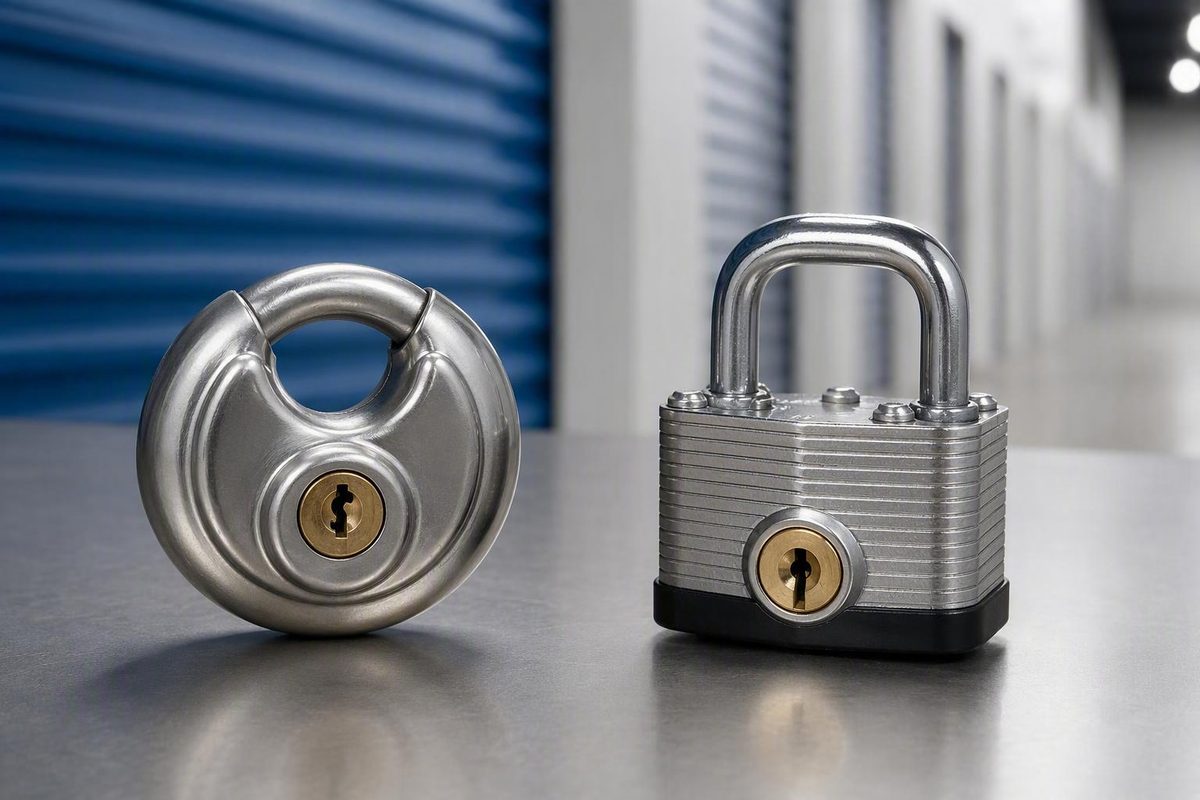
Cylinder locks sit within compatible door-latch hardware instead of hanging from a hasp. Disc locks use a short, rounded shackle that is largely enclosed by the body. Closed-shackle and shrouded padlocks protect more of the shackle than ordinary open-shackle padlocks. These designs reduce the material and working space available to cutting or leverage tools, but no lock is impossible to defeat. SpareFoot similarly describes storage locks as deterrents rather than foolproof defenses.
That conditional answer is more useful than a ranked list of models. The available guidance consistently favors protected-shackle designs, but most recommendations come from storage operators, lock sellers, marketplaces, affiliate publishers, and other commercially interested sources. The reviewed material does not provide transparent, reproducible, side-by-side destructive testing sufficient to identify one objectively best model.
Your practical objective is to:
- Choose a lock category the facility permits.
- Verify that the shackle and body fit the assigned unit.
- Let the slide bolt or latch engage completely.
- Minimize exposed shackle and unnecessary clearance.
- Select a mechanism suitable for the expected weather.
- Establish a manageable key, code, or battery plan.
- Inspect the door hardware as well as the lock.
No lock is theft-proof. A stronger, better-fitted lock can increase the effort required for unauthorized entry and discourage opportunistic attacks, but it cannot compensate for a weak hasp, damaged slide bolt, flimsy door panel, uncontrolled access, or poor facility management.
LockerHelp states that it does not accept sponsored storage-company listings or affiliate deals. That distinction matters because many “best lock” lists are commercial recommendations rather than independent laboratory evaluations. Commercial guidance can still explain useful design differences, but rankings, star scores, and superlatives should not be mistaken for certified comparative performance.
Editorial approach: This guide compares lock categories by hardware compatibility, installed geometry, access method, environmental needs, and documented operating considerations. It does not rank individual models because the reviewed sources do not supply comparable independent attack-test results.
Why disc locks are the practical default for typical hasps
A disc lock is a shackle-style lock with a circular body and a short, rounded shackle integrated into that body. When closed, most of the shackle is enclosed, leaving only the portion needed to pass through the latch exposed.
A conventional open-shackle padlock has different geometry. Its U-shaped shackle projects above the body, creating more visible and potentially reachable metal. An industrial supplier’s category comparison illustrates the distinction: disc locks have short, partially concealed shackles, while conventional padlocks have exposed U-shaped shackles.
That geometry is why a keyed disc lock is the practical default for many conventional storage-unit hasps. Less exposed shackle generally gives bolt cutters and leverage tools less room to reach, grip, or reposition around it. This is a bounded benefit—not a claim that a disc lock cannot be cut, drilled, picked, ground, twisted, or pried.
The round body alone does not establish security. What matters is the installed configuration:
- How much of the shackle remains accessible?
- How closely does the shackle fit the latch opening?
- Does the body help shield the opening?
- Can the latch close completely?
- Is there enough room to insert and turn the key?
- Does the body bind against the door, bezel, or slide bolt?
A loose fit can leave more room for tools. A shackle that is much longer than necessary gives up part of the benefit of a protected-shackle design. A lock that enters the hole but leaves the latch partly open is not compatible.
The same principle explains why a good shrouded padlock may be preferable to a poorly fitted disc lock. Installed geometry matters more than the category name on the package.
Storage operators and commercial publishers broadly converge on disc locks for ordinary hasps. Extra Space Storage, for example, describes a short, largely enclosed shackle and mentions common 2.75-inch and 3-inch product descriptions while directing renters to confirm the correct fit with facility staff. Those numbers are product-size references, not universal latch standards.
This convergence supports a cautious category-level recommendation: prefer less exposed shackle when the lock fits. It does not establish that every disc lock is stronger than every shrouded padlock or compatible cylinder system.
Disc, cylinder, shrouded, combination, smart, and puck locks compared
Start with the door and latch system, then compare only the lock types that can operate correctly with that hardware.
| Lock type | Compatible door or latch | Shackle exposure | Access method | Weather considerations | Convenience | Typical cost | Principal drawback |
|---|---|---|---|---|---|---|---|
| Recessed cylinder lock | Integrated or bezel-style latch designed for the correct cylinder | None hanging outside | Physical key | Recessed placement may reduce direct exposure, but the cylinder must still operate reliably in local conditions | Clean installation; facility may control compatible cylinders | Varies widely | Cannot substitute for a padlock and usually must be supplied or approved by the facility |
| Keyed disc lock | Many conventional hasps and slide latches | Low when fitted correctly | Physical key | Look for corrosion resistance, reliable outdoor operation, and suitable keyway protection | Portable and familiar | Historical publisher-reported ranges span $15–$50: one operator lists $15–$25, while another lists $20–$50 (STOR-N-LOCK; Storwell) | Circular body may not clear every latch or door |
| Closed-shackle or shrouded keyed padlock | Conventional hasps with insufficient clearance for a disc body | Low to moderate | Physical key | Depends on construction, coating, drainage, and keyway design | Familiar form with more fit options than some disc locks | Highly variable | More shackle may remain exposed than with a well-fitted disc lock |
| Open-shackle keyed padlock | Many ordinary hasps | High | Physical key | Outdoor versions exist, but exposed components still require inspection | Widely available and easy to use | Usually inexpensive to moderate | Projecting shackle provides more access for cutting and leverage tools |
| Basic combination lock | Hasps that accept its shackle | Usually moderate to high | Dial or wheels | Dirt, moisture, and freezing may affect exposed controls | No key to lose; codes can be shared | Usually inexpensive | Low-cost versions are generally treated as a weaker primary choice |
| Smart or Bluetooth lock | Only compatible latches at facilities that permit the model | Model-dependent | Phone, app, digital credential, and sometimes a backup method | Electronics and batteries must suit the installation environment | May offer digital sharing, logs, or alerts | Generally more expensive | Battery, phone, account, and electronic-failure dependencies |
| Puck lock | Specialized compatible hasp or latch | Very low or hidden | Usually physical key | Housing may shield the mechanism; environmental suitability is model-dependent | Compact once compatible hardware is present | Variable; compatible hardware may add cost | Does not fit a standard latch unless the hardware was designed for it |
| Chain or bike lock | Rarely a proper match for a storage-door latch | High amount of accessible material | Key or combination | Multiple links and components remain exposed | Flexible but awkward on typical units | Usually inexpensive to moderate | Poor fit and excessive reachable material |
The prices in the table are historical publisher-reported ranges, not current quotes, standardized market data, or evidence that a more expensive lock resists attack better.
Cylinder locks
A storage cylinder lock is not an ordinary padlock with a cylindrical body. It is a replaceable core that fits into a compatible integrated or bezel-style latch. Because it sits within the hardware, there is no hanging shackle to grip or cut.
Use a cylinder when the facility’s door was built for it and the operator approves the specific cylinder. Do not insert a generic cylinder merely because it looks similar. A commercial hardware guide confirms that storage cylinders fit compatible bezel-latch systems, while disc locks serve many external hasps.
Disc locks
For a typical external hasp, a keyed disc lock offers a useful balance of protected geometry, availability, portability, and straightforward operation. It is the broad practical choice, not a universal one. Some latch openings are too small for the shackle, while some doors leave too little clearance for the circular body.
Closed-shackle or shrouded keyed padlocks
These are the preferred traditional-padlock alternatives. Raised shoulders or surrounding casing shield part of a short shackle, reducing the amount accessible to tools. They are especially useful when the latch accepts a normal padlock shackle but the door shape prevents a disc body from rotating or lying flat.
Conventional open-shackle padlocks
Open-shackle padlocks are familiar, widely available, and sometimes robustly constructed. Their category-level disadvantage is the exposed U-shaped shackle. Even when the metal is thick or hardened, the projecting shape can provide more working room than a close-fitting disc or shrouded design.
Basic combination locks
Combination access avoids carrying a key, which can be convenient for occasional shared use. The tradeoff is that inexpensive dial and multi-wheel locks are generally presented by the reviewed commercial guides as weaker primary choices than quality keyed disc or shrouded locks.
That does not mean every combination mechanism is weaker than every keyed mechanism. It means “keyless” is a convenience feature, not evidence of attack resistance.
Smart or Bluetooth locks
Depending on the model, a smart lock may support digital-key sharing, access records, or tamper alerts. Those features can help a family or business manage access without distributing multiple physical keys, but they do not automatically make the mechanical components stronger.
Smart access also creates dependencies involving battery condition, phone availability, account access, and electronic operation. Before using one, verify:
- Facility permission
- Mechanical fit
- Suitability for the installation environment
- Battery-replacement procedure
- Backup access method
- Account ownership and recovery process
- Responsibility for responding to alerts
Puck locks
That geometry can substantially limit access, but only when paired with compatible hardware. It is not a drop-in replacement for every disc lock or padlock. Ask the facility whether its latch supports the model and whether any hardware changes are permitted.
Chain or bike locks
Do not use a chain or bike lock as the primary lock on a normal storage door. Chains are poorly matched to compact storage latches and leave multiple links or cable sections accessible. Flexibility is not an advantage when the objective is a close, protected fit.
Check these measurements and rules before buying
Contact the facility before purchasing a lock. Ask which categories are required, permitted, or prohibited, and whether the answer differs by building or unit type. Storage operators also report that facilities may recommend or require particular styles, so confirm the policy for the assigned unit rather than assuming customer-supplied hardware will be accepted. Mini Mall Storage’s overview makes the same facility-specific qualification.
If possible, take the lock specifications—or the unopened lock itself—to the facility and check:
- Latch-hole diameter: The clear diameter of the opening through which the shackle must pass.
- Maximum shackle diameter: The thickest shackle the closed latch accepts without binding.
- Body clearance: The room around and below the latch for a disc, shrouded, or puck-style body.
- Moving-component spacing: The distance between overlapping latch plates, slide-bolt components, and the door face.
- Closed-latch alignment: Whether the openings line up completely when the door is seated.
- Cylinder bezel: Whether the door contains a purpose-built opening for a recessed cylinder.
- Key access: Enough clearance to insert and turn the key without bending or scraping it.
- Facility restrictions: Rules concerning combinations, smart locks, duplicate keys, renter-installed hardware, or facility-controlled cylinders.
Close the door and move the latch through its full travel before measuring. The latch must align and close completely before the lock is inserted. If a shackle passes through only when the slide bolt is slightly open, the lock does not fit properly.
They do not, by themselves, specify the shackle diameter, opening width, opening height, or clearance needed behind the latch. The cited Extra Space guidance above mentions common 2.75-inch and 3-inch products but still directs renters to confirm compatibility.
Cylinder locks require a different process. They are not interchangeable with ordinary padlocks and depend on the facility’s bezel, latch, and operating procedures. Ask the manager for the exact approved cylinder rather than shopping by approximate diameter or appearance.
If the lease, office instructions, or insurance documents appear inconsistent, request clarification in writing. Insurance requirements and coverage decisions are policy-specific; do not assume a particular lock automatically satisfies a policy or guarantees that a claim will be covered.
A concise decision path is:
- Integrated cylinder latch: Use the approved cylinder.
- Compatible conventional hasp: Test a keyed disc lock.
- Insufficient clearance for the disc body: Try a keyed closed-shackle or shrouded padlock.
- Specialized compatible hasp: Consider an approved puck lock.
- No clearly compatible option: Ask the facility for the required specification before storing anything.
Keep the receipt and packaging until the lock has been test-fitted, operated several times, and accepted by the facility. Test it on the assigned door while the door is fully closed—not only on the lock itself in a store aisle.
What features matter—and what does not prove security
Once you know which lock types fit, compare verifiable construction and operating features.
Prioritize:
- Limited shackle exposure after installation
- Hardened, all-metal body and shackle construction where specified
- The thickest practical shackle that still permits complete latch engagement
- A close fit without binding
- Corrosion-resistant construction or finish
- A protected or covered keyway where appropriate
- Anti-drill plates, guarded components, or other stated tamper-resistant features
- Clear body and shackle dimensions
- Manufacturer maintenance instructions
- Reliable key insertion, turning, locking, and release
Shackle thickness matters only within the limits of compatibility. A thick shackle that prevents the holes from aligning or leaves the latch partly open is worse than a slightly thinner one that lets the hardware close correctly. A large body may look formidable but still be unsuitable if it binds against the door.
Some commercial guides recommend a shackle around 3/8 inch or 10 mm and a mechanism with at least five locking pins. SpareFoot presents those figures as buying guidance, not as independently validated thresholds that guarantee security. Its guide also stresses using the thickest shackle that still fits the hasp. Treat the dimensions and pin count as publisher recommendations, not universal performance standards.
Those figures may help compare otherwise similar locks, but they do not account for body design, keyway protection, manufacturing quality, latch strength, installation, or attack methods other than those the feature is intended to address.
Be skeptical of labels such as:
- Heavy-duty
- Maximum security
- Professional grade
- Drill-resistant
- Anti-pick
- Cut-resistant
- Weatherproof
- Tamper-proof
A specific feature may be real, but the label alone does not reveal the test method, duration, tools, pass threshold, or comparison group. “Drill-resistant,” for example, may describe one protected component rather than the complete installed lock.
Do not treat any single characteristic as proof of overall security:
- Weight
- Price
- Pin count
- Shackle diameter
- A named metal or alloy
- Brand recognition
- Customer-review volume
- Affiliate star rating
- A seller’s “best” badge
Named-model roundups may publish ratings and prices without recognized security certifications or reproducible attack-test results. Move.org, for example, discloses that its product guide may earn money when readers use its links. Such editorial ratings are not equivalent to laboratory grades.
Use this checklist to separate specifications from promises:
| Verifiable before purchase | Requires supporting evidence |
|---|---|
| Body width, height, and depth | “Strongest storage lock” |
| Shackle diameter and opening dimensions | “Impossible to cut” |
| Key, combination, or app access | “Unpickable” |
| Stated body and shackle materials | “Maximum security” |
| Keyway cover or weather shield | “Weatherproof in all climates” |
| Replaceable battery and stated backup method | “Cannot be hacked” |
| Number of supplied keys | “Professional grade” |
| Manufacturer maintenance instructions | Unqualified claims of superior attack resistance |
| A clearly identified recognized certification | Star ratings without a disclosed physical test method |
Specifications are not meaningless. Dimensions, materials, access method, and weather protection help eliminate unsuitable products. They simply cannot establish complete installed security on their own.
Choose for weather, access needs, and total ownership cost
An outdoor unit needs more than a generic “weather-resistant” label. Consider the actual exposure: wind-driven rain, coastal salt, humidity, airborne dust, freezing temperatures, snowmelt, or large temperature swings.
Look for a design that:
- Resists corrosion across the body, shackle, springs, and internal components.
- Shields the keyway from direct rain and grit where practical.
- Provides drainage or avoids trapping water.
- Remains manageable with cold or wet hands.
- Has maintenance instructions appropriate to the mechanism.
- Can be replaced before corrosion or unreliable operation causes a lockout.
The available material advice conflicts. Some commercial publishers favor hardened or stainless steel, while another recommends brass or brass alloys for some outdoor uses and acknowledges their tradeoffs. Without comparative environmental testing, there is no basis for declaring one material universally best. Evaluate the complete lock: substrate, hardening, finish, seals, drainage, keyway protection, tolerances, and maintenance requirements.
For shared family or business access, compare two workable systems.
Controlled spare keys are simple and do not depend on batteries or phones. Keep an access list, limit copies, and recover keys when a person no longer needs entry.
A facility-permitted smart lock may simplify digital sharing and provide model-dependent logs or alerts. Before choosing one, document the procedure for a depleted battery, unavailable phone, inaccessible account, or electronic malfunction. At least one authorized person should understand the backup method.
Budget buyers should favor a compatible keyed disc lock or keyed shrouded padlock over a cheap open-shackle padlock, basic combination lock, or chain. A modestly priced lock with protected geometry and a correct fit is more rational than an expensive lock that binds against the door—or a bargain lock that leaves a long shackle exposed.
As shown in the cited comparison table, commercial guides place ordinary disc locks across an approximate historical range of $15–$50. The figures vary by publisher, date, seller, region, and product tier. They are not current quotations or evidence that one price level offers greater attack resistance.
Total ownership cost can include:
- Initial purchase price
- Spare or replacement keys
- Batteries
- Corrosion-related replacement
- Replacement after damage or unreliable operation
- Lost-key removal
- Locksmith service
- Facility assistance or administrative charges
- Replacement of a facility-specific cylinder
- Time and travel required to resolve a lockout
A premium mechanical or smart lock may cost more than an ordinary disc lock. The additional expense may be worthwhile for fit, durability, managed access, or documented performance, but price alone proves nothing.
You can bring a compatible lock instead of assuming an on-site purchase is mandatory, but verify the facility’s current policy and exact specification first. Be prepared to buy an approved lock at the office if the assigned unit uses different hardware than expected. For budgeting beyond the lock, LockerHelp’s self-storage cost guide covers common storage expense categories.
Install, test, inspect, and manage the lock correctly
Correct installation is as important as choosing the lock.
- Close the door fully. Keep ropes, straps, boxes, and packing materials clear of the opening.
- Seat the bottom edge where applicable. Some roll-up doors require steady downward pressure before the latch holes align.
- Align the latch. Do not force a misaligned slide bolt.
- Slide the latch completely into its locked position.
- Insert the cylinder, shackle, or locking pin through the intended opening.
- Engage the lock fully. Confirm that the key has returned to the proper removal position or that the mechanism has completed its locking cycle.
- Remove the key or finish the app-based locking process.
- Tug-test the lock and latch.
- Pull or lift the door to confirm that it remains closed.
- Check visually that the latch has not moved back to a partly open position.
A strong lock adds little value if the slide bolt is only partially engaged, the roll-up door is not seated, or the shackle catches one plate but misses another. Otter Self Storage likewise advises renters to close the door, align the latch, secure the lock, tug-test it, and inspect for corrosion, jamming, and damage during visits. Its storage-lock mistakes guide summarizes those steps.
Inspect the lock every time you visit. Watch for:
- Rust or discoloration
- Grit in the keyway
- Cracks, dents, or tool marks
- Loose latch components
- A shackle that no longer aligns easily
- A cylinder that shifts in its bezel
- Increasing key resistance
- Incomplete locking or release
- Water accumulation
- A damaged keyway cover
- Smart-lock battery or connectivity warnings
Do not normalize worsening operation. A lock that intermittently refuses to engage or release can leave the unit unsecured or cause a lockout. Replace it or have it professionally serviced before it fails completely.
Avoid applying one universal lubricant by habit. Follow the manufacturer’s maintenance instructions. If instructions are unavailable and operation is deteriorating, contact the manufacturer or a locksmith rather than experimenting while the lock remains attached.
Key control also matters:
- Keep a spare in a controlled location away from the unit.
- Record who has each copy.
- Avoid unnecessary duplicates.
- Recover keys when shared access ends.
- Do not hide a key near the unit.
- Never label a key with both the facility name and unit number.
- Consider replacing the lock if an identifiable key is lost and unauthorized access is plausible.
Before a key is lost, ask what identification the facility requires before lock removal and whether staff, a locksmith, or the renter must arrange the work. Procedures and charges vary, so obtain current terms rather than relying on an old quoted fee.
For a smart lock, add routine battery checks, documented account-recovery information, backup credentials, and an emergency-access plan. Decide who will respond if the primary account holder is unavailable.
The lock is only one link in the security chain
A premium lock protects one point on a larger assembly. The hasp, slide bolt, latch fasteners, hinges, door panels, frame, or surrounding wall may be weaker. Check for bending, loose fasteners, excessive movement, corrosion, damaged welds, or holes that no longer align.
Do not alter facility hardware yourself. Report defects and request another unit or a documented repair if the door does not close cleanly. A better lock cannot make a damaged latch sound.
Evaluate the facility as a system:
- Controlled gate or building access: Are credentials unique to each renter?
- Access records: Can management associate entries with individual credentials?
- Lighting: Are corridors, drive aisles, doors, elevators, and pedestrian routes illuminated?
- Video surveillance: Do cameras cover the approach to your unit rather than only the office or entrance?
- Individual unit alarms: Are they available, and how are alerts handled?
- Perimeter condition: Look for damaged fencing, pedestrian gaps, unsecured doors, and blind areas.
- Management practices: Is the property maintained, are defects addressed, and are access rules enforced?
- After-hours controls: Understand who can enter and what happens when an alarm activates.
A camera somewhere on the property is not the same as useful coverage of your unit’s corridor or drive aisle. Ask where the relevant cameras point, whether views are obstructed, and whether footage is monitored or only recorded. Commercial facility guidance also recommends combining the unit lock with measures such as controlled access, surveillance, alarms, insurance, inventories, and periodic visits rather than relying on the lock alone. Mini Mall Storage describes that layered approach.
Add renter-controlled layers:
- Confirm that insurance is appropriate for the property being stored.
- Read the applicable limits, exclusions, documentation requirements, and coverage terms.
- Create a dated inventory.
- Photograph valuable or difficult-to-replace items and identifying numbers.
- Keep records somewhere other than inside the unit.
- Visit periodically instead of leaving the unit unchecked for long periods.
- Place valuable items away from the entrance and immediate view.
- Avoid labels that advertise high-value contents.
Gates, cameras, lighting, alarms, insurance, and premium locks address different parts of the risk. None eliminates theft, damage, or loss. Insurance may manage some financial consequences but does not secure the door. Surveillance may document activity but does not guarantee intervention. Controlled entry can regulate ordinary access while still being misused or bypassed.
Compare the value, sensitivity, and replaceability of the contents with the continuing cost of storage and protection. Irreplaceable records, sentimental objects, and essential business inventory may warrant a different storage decision—not merely a more expensive lock.
Before leaving the facility, use this final checklist:
- The lock type is approved.
- Its dimensions have been verified on the assigned unit.
- The latch closes completely.
- The installed shackle is substantially protected.
- The body does not bind against the door.
- The mechanism suits the expected weather.
- Spare-key, code, account, or battery management is practical.
- The lock and door pass a tug test.
- The latch, hasp, and door hardware appear sound.
- Facility access, lighting, surveillance, alarms, and management practices are adequate for the contents.
Frequently asked questions
Is a disc lock or cylinder lock better for a storage unit?
Neither is universally better because they serve different hardware.
Use the facility-approved cylinder when the door has a compatible integrated or bezel-style latch. Its recessed installation eliminates the hanging shackle found on an external padlock.
For a conventional external hasp, a quality keyed disc lock is usually the practical choice. If its circular body cannot clear the door or rotate into position, use a keyed shrouded or closed-shackle padlock.
Will a 70 mm, 2.75-inch, or 3-inch disc lock fit my storage unit?
Not necessarily. As explained in the cited fit section above, those descriptions may identify the body or general product class rather than every dimension needed for compatibility.
Verify:
- Shackle diameter
- Shackle opening width and height
- Latch-hole diameter
- Spacing between overlapping latch components
- Clearance for the circular body
- Room to insert and turn the key
- Full movement of the slide bolt
Keep the receipt until the door closes, the latch engages fully, and the lock operates without binding.
Are combination or smart locks secure enough for a storage unit?
They may be suitable in some circumstances, but convenience does not establish security.
Basic combination locks avoid key loss but often have more exposed shackles and are generally treated by the reviewed commercial guides as weaker primary choices than quality keyed disc or shrouded locks.
A smart lock can be practical for shared access if the facility permits it and the model fits. Account for battery condition, phone availability, electronic operation, account recovery, environmental exposure, and emergency access. Smart access does not inherently make the mechanical lock stronger.
How much should a dependable storage-unit lock cost?
The cited comparison table presents ordinary keyed disc locks in an approximate historical publisher-reported range of $15–$50. Premium mechanical locks, specialized hardware, and smart locks may cost more.
Pay for verified fit, protected geometry, suitable construction, reliable operation, and manageable access. Do not assume that the cheapest lock is adequate or that the highest price proves superior security. Include spare keys, batteries, replacement, corrosion, removal, and possible locksmith or facility charges in the total cost.
Can a storage facility require me to use or buy a particular lock?
A facility may specify permitted lock types through its door design, operating procedures, rental agreement, or site policy. Integrated cylinder systems require compatible cylinders, and some operators accept only selected external lock categories. Rules may also differ among units at the same property.
Whether a lock must be purchased on-site depends on the applicable agreement and current facility policy. Ask for:
- The required lock category
- Exact dimensions or model specification
- Whether equivalent customer-supplied locks are accepted
- Any policy-specific insurance documentation
- Lost-key and removal procedures
- Written clarification if the rules conflict
Do not store property until the approved lock has been fitted and tested.
Final recommendation
Use the facility-approved recessed cylinder when the assigned door is built for one. Otherwise, choose a keyed disc lock that fits closely and lets the latch engage completely. If the disc body will not fit, use a keyed shrouded or closed-shackle padlock.
Protected geometry, correct installation, dependable operation, sound door hardware, practical key or battery management, and facility-level controls matter more than brand hype. No lock guarantees against theft.