
How to Tell Whether Those Spots on Stored Clothing Are Mold
An irregular, attached patch found after damp storage is more suspicious than a flat mark on dry clothing with an obvious stain source.
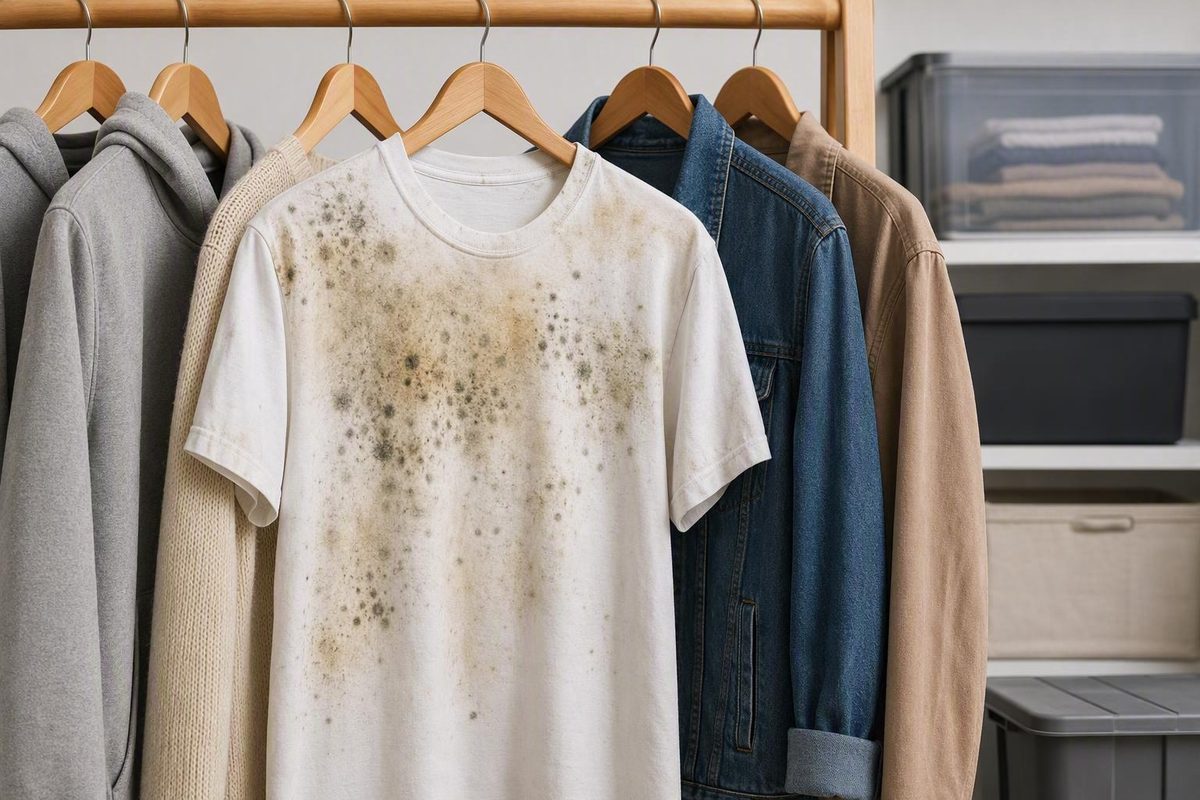
The quick answer: what mold on clothing can look like
Suspected mold on clothing commonly appears as irregular spots, grouped dots, or spreading patches, rather than smooth, uniform discoloration. It may look fuzzy, furry, raised, powdery, flaky, crusty, slimy, or occasionally stain-like. Common colors include white, gray, green, blue-green, brown, and black, although other colors are possible and growth may blend into the fabric.
A persistent musty, damp, or earthy odor is another clue. It can be especially useful when a mark is hidden inside a fold or lining, but odor alone does not prove that the garment contains mold. The smell may originate in a washer, hamper, suitcase, closet, storage bin, damp wall, or neighboring item.
The most useful assessment combines six factors:
- Moisture history: Was the garment wet, incompletely dried, exposed to condensation, or stored in a humid place?
- Pattern: Is the mark irregular, clustered, uneven, or apparently spreading?
- Texture: Does it look fuzzy, raised, powdery, flaky, crusty, or damp instead of merely discolored?
- Attachment: Does the material cling to or appear embedded in the fibers rather than resting loosely on top?
- Odor: Is there a persistent musty or earthy smell?
- Location: Is the mark concentrated in a fold, seam, pocket, lining, compressed area, or section that touched a damp surface?
Use this quick checklist:
- Was the garment damp or stored somewhere humid?
- Is the mark irregular rather than uniform?
- Does it sit above, cling to, or alter the texture of the fibers?
- Is there a musty smell?
- Is it concentrated in a fold, seam, pocket, cuff, lining, or storage-contact area?
The more clues that align, the more plausible mold becomes. Clothing-specific commercial guides describe these appearances, but they are practical indicators rather than validated diagnostic rules. Appearance cannot confirm a species, toxicity, severity, or health risk.
Start with texture and pattern, not color
Color attracts attention, but it is one of the least dependable identification clues. Ordinary stains, lint, dust, detergent, dirt, ink, fading, and dye transfer can all be white, gray, brown, greenish, or black. Different molds can also share similar colors.
Begin by asking whether the mark has changed the surface of the fabric.
A fuzzy or furry patch may appear to rise above the weave instead of merely changing the garment’s color. On a smooth shirt, the affected area might look softly raised or filament-like. This distinction is harder to make on wool, fleece, felt, suede, and brushed fabric because those materials already have textured surfaces.
Powdery or flaky material requires particular care because it can resemble loose dust, lint, chalk, flour, talcum powder, shed fibers, or dried laundry products. Mold becomes more plausible when the material forms an irregular patch, remains attached to the fibers, appears in a moisture-trapping location, and accompanies a musty odor.
Some mold-like areas may look damp, slick, or slimy. Treat that as one possible appearance—not as a universal stage of growth or evidence of a particular species. Oil, lotion, adhesive, food residue, and ordinary spills can also produce wet-looking marks.
Pattern supplies additional context:
- More suspicious: grouped dots, irregular speckling, uneven borders, nearby patches, or marks extending along a fold or seam.
- Less suspicious: one flat mark with a known cause, a symmetrical wear pattern, predictable underarm discoloration, or a clean streak that appeared immediately after washing.
Attachment also matters. Known lint and surface dust generally lift or roll away more readily than growth attached to the weave. However, do not use a bare hand, vigorous brushing, shaking, or close sniffing to test an uncertain patch. If the material may be mold and must be disturbed, use the protective precautions described later in this guide.
A mark that remains after cleaning is not automatically active mold. The EPA notes that mold can leave staining or cosmetic damage behind, so permanent-looking flat discoloration does not by itself establish continuing growth (EPA guidance on mold, moisture, and residual damage).
In short, an altered texture combined with an irregular pattern and credible moisture history is more informative than color alone. A completely flat mark may still deserve investigation, but it is also compatible with many ordinary stains.
What white, green, gray, brown, and black mold-like marks may resemble
Use color to describe what you see—not to name an organism. Mold can occur in many colors, and its appearance varies with conditions. Color alone cannot determine species, severity, toxicity, or health risk.
White: White growth may look powdery, chalky, dusty, flaky, fuzzy, or like small pale specks. It can be particularly noticeable inside folds or on dark clothing. Compare it with lint, dust, shed fabric fibers, and dried detergent. A pale patch is more suspicious when it has irregular edges, remains attached, smells musty, and follows damp storage.
Gray: Gray growth may appear dusty, mottled, patchy, flat, or slightly fuzzy. On faded black clothing, denim, heathered fabric, and workwear, it can be difficult to distinguish from grime, abrasion, or fading. Look beyond the shade to the texture and storage history.
Green or blue-green: These marks may appear fuzzy, spotty, or irregular. Although particular mold names are commonly associated with blue-green growth, a genus cannot be confirmed by sight. Paint, food, cosmetics, dye bleed, and color transfer can create similar hues.
Brown or tan: Brown marks may appear as scattered speckles, grouped dots, merged patches, or larger darkened areas. They can resemble dirt, rust, dried liquid, ink, dye transfer, or old staining. A brown patch following a damp seam or storage-contact area is more suspicious than predictable soil around a trouser hem.
Black-looking: Very dark growth may actually be black, brown-black, gray-black, or dark green. It may look spotty, uneven, fuzzy, crusty, damp, or almost stain-like when separate marks merge. These traits do not prove that it is Stachybotrys chartarum. Many molds may be described as “black mold,” and Cleveland Clinic notes that the term can refer to more than one kind of mold (medically reviewed explanation of black mold).
Orange, rust, pink, red, or yellow: These colors have multiple possible causes, including fungal growth, bacteria, cosmetics, food, body oils, metal-related staining, fabric degradation, and dye changes. Never classify them as mold from color alone.
The garment itself affects visibility:
- Pale growth may nearly disappear on cream, white, or gray fabric.
- Dark marks can blend into navy or black clothing.
- Printed, marled, mottled, and multicolored fabrics can conceal irregular dots.
- Wool, fleece, suede, felt, and other textured materials can hide raised growth among their normal fibers.
Use strong, indirect lighting and view the garment from several angles. The objective is not to name an organism. It is to decide whether enough supporting clues exist to justify cautious handling and inspection of the storage environment.
Mold or something else? A comparison of common look-alikes
No single home observation settles every case. The table below compares common possibilities while showing why each comparison has limits.
| Possibility | Typical appearance | Common location | Attachment or texture | Relevant history | What limits the comparison |
|---|---|---|---|---|---|
| Suspected mold | Uneven dots, fuzzy growth, irregular powdery areas, dark patches, or stain-like marks | Folds, seams, pockets, linings, compressed areas, and damp contact points | May rise above, cling to, or appear incorporated into the fibers | Incomplete drying, humid storage, condensation, leaks, flooding, or contact with damp material | Appearance varies and cannot establish species or danger |
| Lint | Fluff, pills, short fibers, or pale surface debris | Pockets and places that rub against other textiles | Generally dry and loosely deposited | Normal wear, drying, or contact with a shedding fabric | Textured garments can make loose fibers and attached growth hard to distinguish |
| Dust | Fine gray or pale coating, often broadly distributed | Shoulders, exposed shelves, box tops, and open closets | Usually dry and resting on the surface | Long uncovered storage | Dust can accumulate unevenly in folds and compressed areas |
| Detergent residue | Pale flecks, streaks, or chalky areas | Creases and areas where laundry product did not disperse | May feel stiff or chalky without forming fuzzy growth | First noticed directly after washing | Residue can resemble pale fungal material without context |
| Deodorant buildup | White, gray, or yellowish deposits | Underarms and adjacent side seams | May feel waxy, slick, chalky, or stiff | Repeated product contact in the same area | Damp storage can create a separate problem over old buildup |
| Sweat staining | Yellow, brown, or gray discoloration | Underarms, collars, cuffs, and waistbands | Usually flat, although the fabric may stiffen | Repeated wear and body contact | An old sweat stain and later mold can coexist |
| Dirt, ink, or dye transfer | Smudge, dot, streak, or flat dark patch | Hems, pockets, knees, spill sites, and rubbing points | Usually integrated into the fabric rather than raised | Known spill, work use, or contact with another colored item | An uncertain history may prevent a confident distinction |
| Fading or abrasion | Lightened color, thinning, or uneven wear | Knees, elbows, cuffs, shoulders, and exposed folds | No separate deposited material; the weave may be worn | Friction, sunlight, repeated washing, or age | Irregular fading can resemble pale staining |
| Residual staining | Flat discoloration that does not disappear after treatment | Site of earlier mold or another stain | No obvious raised, fuzzy, or spreading material | Persists after cleaning | The stain cannot show whether viable growth remains |
Laundry-information guidance supports using location, texture, washing history, and dampness together rather than relying on one mark. It also notes that detergent residue often follows washing, while sweat and deodorant marks tend to occur in predictable contact areas (Careonova’s clothing-mark comparison).
Consider two examples:
A pale patch inside a folded shirt: The shirt was packed before it dried completely, the bin smells musty, and the material is fuzzy and attached inside the fold. That combination is more suspicious than pale streaks noticed immediately after washing with no damp-storage history.
Dark dots on stored trousers: Several dots are clustered on the side that touched a damp closet wall, and nearby garments have similar marks. That pattern is more suspicious than one isolated, flat, ink-like dot on clothing that remained dry.
These observations change probability; they do not provide laboratory confirmation. If the evidence remains mixed, prioritize cautious handling and investigation of possible moisture rather than forcing a visual diagnosis.
Where to inspect a garment for hidden growth
Inspect the garment methodically under good lighting. Avoid unnecessary disturbance of any visibly suspicious material.
- Examine the outside. Check the front, back, sleeves, shoulders, and lower edges. Note whether marks follow a fold, compression line, or contact surface.
- Look at the reverse side. Carefully examine the back of the marked area for discoloration, altered texture, or additional spots.
- Open folds and compressed sections. Check beneath folded sleeves, trouser legs, pleats, lapels, and areas that were tightly packed.
- Follow the seams. Inspect side seams, shoulder seams, inseams, zipper areas, and stitched joins where layers may dry slowly.
- Check pockets and concealed panels. Look inside pockets and around pocket bags, flaps, fasteners, and reinforcements.
- Inspect cuffs, collars, waistbands, and hems. These layered sections may retain moisture longer than a single layer of fabric.
- Examine linings and undersides. Coats, skirts, dresses, and lined trousers may show little externally while concealing marks inside.
- Check underarm areas. These can retain moisture and residue, although predictable discoloration may instead be sweat or deodorant buildup.
- Review storage-contact points. Pay attention to any section that touched a closet wall, basement floor, wet cardboard, damp garment, or container with condensation.
For coats, bags, and layered clothing, inspect pocket interiors, removable liners, interior panels, insulation, straps, and areas beneath folded sleeves. A clean outer shell does not establish that the interior is unaffected.
Also consider the garment’s position in storage. Sections pressed against damp cardboard, a wet floor, or a wall with condensation deserve particular attention.
Dark and patterned clothing requires a closer look because marks can disappear into the design. Compare suspicious areas with unaffected fabric elsewhere on the same garment.
Finally, inspect neighboring garments and the storage environment. Check the container, shelving, closet wall, floor, suitcase lining, cardboard, and nearby fabrics.
Can clothes be moldy when no spots are visible?
Yes. Visible marks may be difficult to find when growth is early, hidden inside a lining or fold, or similar in color to the fabric. A persistent musty, damp, or earthy smell is a reason to investigate, but it is not proof that the garment itself contains mold.
Begin with concealed parts of the item:
- Seams and hems
- Pockets and pocket linings
- Areas beneath collars and cuffs
- Waistbands
- Undersides of folded sections
- Interior linings and removable panels
- The reverse side of any flat discoloration
Use good lighting and do not put the garment close to your face to test the smell. If no visible source appears, expand the inspection to the washer, dryer area, hamper, laundry basket, suitcase, closet, storage bin, nearby wall, floor, shelving, cardboard, and neighboring clothing.
Conversely, the same odor across several garments may point to condensation, leakage, persistently high humidity, poor airflow, a washer problem, or damp building material.
Appearance and odor are indicators, not definitive tests. The EPA says visible mold generally does not require sampling; the practical priority is addressing the growth and the associated moisture problem.
Mold versus mildew on fabric: a useful but imperfect distinction
People often use “mildew” for pale, powdery surface growth and “mold” for something darker, fuzzier, or more raised. That distinction can be descriptively useful, but it is not absolute.
The EPA explains that mildew refers to certain molds or fungi and that the word is commonly applied to mold with a flat growth habit. It also identifies clothing and leather as materials on which mold can thrive when moisture is present (EPA explanation of mold and mildew).
Typical tendencies include:
- Mildew: often described as flat, dry, powdery, and white, gray, or yellowish.
- Other mold-like growth: more often described as raised, irregular, fuzzy, darker, crusty, or occasionally slimy.
These are tendencies, not a reliable sight test. Powdery white growth may be called mildew in one fabric guide and white mold in another. On absorbent or textured clothing, even the distinction between surface material and embedded growth may be unclear.
Both labels are associated with excessive or prolonged moisture, and either may accompany a musty odor. Neither term establishes that an item is harmless, medically safe, or easy to restore.
For practical purposes, four questions matter more than the label:
- Is there suspicious attached material or persistent odor?
- Was the garment exposed to moisture?
- Is the storage environment still damp?
- Can the item be handled and cared for without unnecessary disturbance or fabric damage?
Focus on the damp material and underlying moisture source rather than trying to obtain a species-level label from appearance.
Why mold develops on stored or forgotten clothing
Moisture is the central condition. Suspected mold becomes more plausible when clothing was:
- Packed before drying completely
- Left wet in a washer, basket, or hamper
- Stored in a humid closet, basement, garage, dorm, or storage unit
- Exposed to a leak, flood, wet floor, or condensation
- Sealed in a bag, box, or bin while retaining moisture
- Stored with wet towels, shoes, bedding, or another damp garment
- Left where airflow was poor
The EPA’s moisture-control principle is straightforward: mold does not grow without water or moisture. It advises drying water-damaged areas and items within 24 to 48 hours to help prevent growth. That period is a prevention target, not proof that every item will or will not develop mold within a fixed time (EPA moisture-control guidance).
Moisture history changes how a mark should be interpreted. An irregular attached patch found after damp storage is more suspicious than the same color appearing as a flat mark on clothing that remained dry and has an obvious stain source.
Sealed storage is not automatically dry storage. If clothing retains moisture when packed, condensation can collect inside a plastic bag or container.
Fabric type affects susceptibility but does not provide immunity. Cotton, wool, linen, and leather can support mold when damp. Synthetic clothing may also develop growth when it remains wet or carries dirt, dust, body oils, food, or other organic residue. A commercial textile-restoration guide specifically notes that mold can occur on materials including nylon, rayon, and polyester under suitable conditions (Prism Specialties on fabrics and clothing mold).
Before storing clothing:
- Clean each garment as appropriate for its material.
- Let every layer dry completely.
- Check thick seams, cuffs, waistbands, linings, and padded sections.
- Do not pack damp laundry, towels, shoes, or bedding with dry clothes.
- Inspect the storage area for leaks, condensation, and damp walls or floors.
- Avoid arrangements that trap condensation around garments.
- Allow practical airflow where the setup permits it.
- Keep clothing away from wet cardboard and direct contact with damp surfaces.
Recurring spots or odors are an environmental warning. The underlying cause may involve the closet, washer, storage container, adjacent wall, floor, plumbing, ventilation, or wider storage space—not one garment alone.
What to do when a mark is suspicious or identification remains uncertain
If several clues align, treat the garment as potentially moldy without making assumptions about species or toxicity.
When handling or cleanup could disturb mold, the CDC recommends protective gloves, goggles that provide complete eye protection, and at least a NIOSH-approved N95 respirator. The CDC also advises people with allergies, immune suppression, underlying lung disease, asthma, or COPD not to participate in mold cleanup (CDC mold-cleanup precautions).
Next, make a fabric-specific decision:
- Read and follow the garment care label.
- Seek appropriate guidance for dry-clean-only items.
- Use particular care with wool, leather, silk, embellished fabrics, and structured garments.
- Consider textile-specific advice for valuable, sentimental, antique, or difficult-to-replace items.
- Do not assume bleach, vinegar, hot water, or high heat is appropriate for every material.
Cleaning instructions must be adjusted to the garment’s care requirements; even water temperature should remain within what the fabric can safely tolerate (fabric-specific care qualification).
Visible growth generally does not need species testing merely to establish that a moisture problem requires attention. Testing also cannot substitute for fixing a leak, condensation problem, or persistently damp storage area.
Appearance alone does not determine whether an item must be discarded or can be restored. The available evidence does not support a universal rule that every visibly affected garment must be thrown away. Nor does it support a promise that every garment can be saved by washing. The extent of the marks, the material, care requirements, item value, recurrence, and condition of the surrounding environment all matter.
Professional advice may be reasonable when marks are extensive, they repeatedly return, the building has a broader moisture problem, the textile is valuable or delicate, or occupants have elevated health risks. The type of professional should fit the problem—for example, garment care, textile conservation, building moisture, or health advice.
The core decision path is simple: treat the mark as more suspicious when several clues align; do not infer species or toxicity from color; handle the item cautiously; inspect the washer and storage environment; follow fabric-specific care guidance; and correct the moisture source.
Frequently asked questions
Is mold on clothes always black?
No. Mold-like growth on clothing may be white, gray, green, blue-green, brown, black, or another color. It may also blend into the garment and be difficult to see.
A dark mark is not proof of “toxic black mold.” Color cannot determine species, severity, toxicity, or health risk. Assess the pattern, texture, attachment, odor, location, and moisture history together.
How can I tell white mold from lint or detergent residue?
Known lint is generally loose, dry, and readily removable. Detergent residue commonly appears as pale chalky streaks or patches after washing. Suspected white mold is more likely to form an irregular fuzzy, powdery, or flaky patch that remains attached and occurs with a musty odor or damp-storage history.
There is no perfect visual test. Do not use a bare hand or aggressive brushing to determine whether an uncertain patch is lint. Instead, consider when it appeared, where it is located, and whether the garment or storage area was damp.
Does a musty smell mean clothing definitely has mold?
No. A persistent musty or earthy smell is a supporting clue, not proof. The odor may come from the garment, but it can also be absorbed from a damp washer, hamper, suitcase, closet, storage bin, wall, floor, or neighboring item.
Inspect concealed parts of the garment and the surrounding environment. If the odor repeatedly returns or affects several items, investigate unresolved humidity, condensation, leakage, poor airflow, or another moisture source.
Can synthetic clothes develop mold?
Yes. Synthetic fabric does not make a garment immune. Growth may occur when synthetic clothing remains damp or carries dirt, dust, body oils, food residue, or other organic material.
As with natural fibers, moisture history is more informative than the fiber label alone. Dry synthetic garments completely and avoid sealing them in containers while moisture remains.
Does a stain left after cleaning mean mold is still active?
Not necessarily. Mold can leave flat discoloration or cosmetic damage after cleanup, so a persistent stain does not by itself prove continuing growth.
Consider whether raised or attached material remains, the musty odor returns, new marks appear, or the source of moisture has not been corrected. A flat residual stain cannot establish whether active growth is present.
The diagnostic recap
Mold is more likely when several clues converge: an irregular attached patch, altered texture, musty odor, a moisture-trapping location, and a credible history of dampness. Color alone cannot confirm mold, identify a species, or establish danger.
If the garment remains suspicious, handle it cautiously, inspect the washer or storage environment, follow fabric-specific care guidance, and correct the moisture source so the problem does not recur.