
How to Recognize Suspicious Growth in Carpet—and What Appearance Can’t Tell You
Look for irregular discolored or fuzzy patches, then weigh musty odor and water history. A clean surface can conceal growth in the backing or padding.
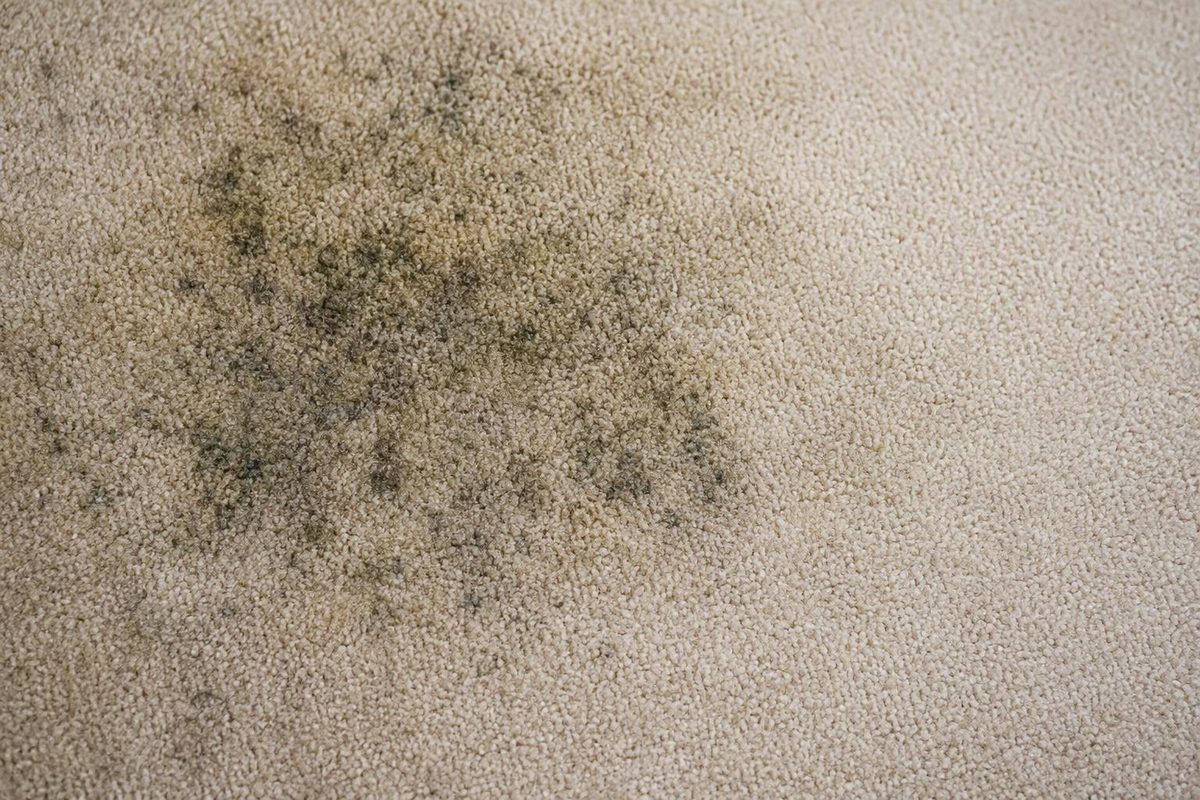
Possible carpet mold often appears as irregular spots, blotches, patches, or unexplained discoloration rather than a neat, uniform mark. It can be dark or pale, raised or flat, obvious on the surface, or concealed in the carpet backing and padding.
The most useful assessment combines appearance with odor, moisture history, location, current dampness, and whether the mark spreads or returns.
The short answer: what carpet mold can look like
Reported colors include black, dark green, white, gray, brown, and yellow. The Minnesota Department of Health describes mold generally as potentially white, gray, brown, black, green, or another color and notes that damage to carpet and other furnishings may appear simply as staining or discoloration. It also describes possible textures such as cottony, velvety, granular, or leathery. These are possibilities, not identification rules. See the Minnesota Department of Health’s mold and moisture guidance.
Carpet-specific reports also describe irregular discolored patches and growth that looks fuzzy or slimy, sometimes on the backing rather than the visible pile. Orange and rust-colored areas have also been reported, although those tones can reflect water staining or other damage rather than mold. No single color or texture is diagnostic.
| Pattern | Possible colors | Possible texture | Accompanying clues | Limitations |
|---|---|---|---|---|
| Irregular spots or scattered clusters | Black, green, brown, gray, white, yellow | Fuzzy, raised, granular, or flat | Musty odor, nearby leak, dampness | Dirt, spills, dye transfer, and old stains can form similar spots |
| Uneven blotches or spreading patches | Dark green, black, brown, orange, rust | Velvety, slimy, powdery, or matted | Patch changes over time or returns after cleaning | Spreading is concerning but does not identify the substance |
| Pale or white material | White, off-white, light gray | Cottony, fluffy, powdery, or crust-like | Found beneath a rug or near persistent moisture | Dust, adhesive residue, mineral deposits, and carpet powders may look similar |
| Brown, orange, or rust discoloration | Brown, tan, yellow, orange, rust | Usually flat; fibers may feel stiff or damaged | Water line, leak history, wet baseboard | May be a water stain without active mold |
| Darkened carpet edge | Black, dark green, gray, brown | Flat, fuzzy, or difficult to see among fibers | Exterior wall, baseboard, plumbing, condensation | Filtration dirt and ordinary soil can also create dark lines |
| No visible surface mark | None visible | Surface may feel normal | Persistent odor, wet padding, previous flood or leak | Hidden layers must be assessed; appearance from above is inconclusive |
Commercial carpet guidance similarly reports dark or discolored spots with irregular shapes, sometimes accompanied by fuzzy or slimy material on the carpet surface or backing. These observations reinforce the range of possible appearances, not the idea that appearance alone can establish what the material is. Review the carpet-specific descriptions from Capitol Carpet & Tile.
Carpet mold is often less conspicuous: growth may begin or remain concentrated on the underside, within the backing, in the padding, or on the material below. Consequently, a small surface mark may understate the affected area, while a clean-looking surface may conceal a moisture problem.
The safest recognition rule is not “black means mold” or “fuzzy means mold.” It is: an irregular mark becomes more suspicious when it occurs with persistent moisture, a musty odor, a known water event, or evidence that the material is changing.
Why a clean-looking carpet can still have mold underneath
Carpet is not a single surface. Wall-to-wall carpet usually has several layers, and each can show different evidence:
- Face fibers or pile: The visible and touchable surface.
- Primary and secondary backing: The structural underside holding the fibers together.
- Padding or underlay: The cushioning layer beneath the carpet.
- Subfloor: Wood, concrete, or another material supporting the flooring.
- Edges and transitions: Areas beside tack strips, baseboards, thresholds, and adjoining flooring.
Moisture does not move through or leave these layers at the same rate. The face may feel dry after evaporation while the backing or absorbent padding remains damp. Growth can therefore become established underneath before there is any visible change above.
InterNACHI’s carpet guidance notes that visible surface growth may be uncommon except in more severe cases and recommends considering both sides of a carpet when mold is suspected. Read InterNACHI’s explanation of hidden carpet mold.
A simplified cross-section shows why surface inspection alone is incomplete:
Room air
────────────────────────────────────
Carpet face fibers       ← visible spots may appear here
████████████████████████████████████
Carpet backing           ← concealed growth may occur here
════════════════════════════════════
Padding / underlay       ← can retain moisture after the face dries
▒▒▒▒▒▒▒▒▒▒▒▒▒▒▒▒▒▒▒▒▒▒▒▒▒▒▒▒▒▒▒▒
Subfloor                 ← staining, dampness, or growth may extend here
────────────────────────────────────
Possible surface clues to a hidden moisture problem include:
- Discoloration along carpet edges or baseboards
- Water lines or stains near a wall
- Buckling, rippling, or warping
- Curling around the edge of an area rug
- Soft spots, depressions, or unusual indentations
- A section that feels cooler, softer, stiffer, or otherwise different underfoot
- Baseboard swelling or staining near the affected carpet
- A persistent musty odor concentrated in one area
They do not independently prove mold.
Padding can retain moisture after the carpet surface appears dry. Practical guidance on concealed padding identifies edge discoloration, water staining, buckling, soft areas, and a changed feel underfoot as possible clues, while emphasizing that the visible surface can remain normal. See the overview of hidden moisture in carpet padding.
A persistent musty or earthy odor without a visible source deserves attention, particularly after a leak or flood. It can justify investigating the moisture history and accessible hidden layers or arranging a moisture-focused inspection. Odor is a clue, not proof: damp padding, old spills, pet contamination, and deteriorating materials can also smell unpleasant.
For a loose area rug, the underside and the floor beneath it may be accessible if the rug is manageable and the affected area is limited. Fixed carpet is different. Determining what is happening underneath may require careful edge lifting, moisture readings, and inspection of the padding or subfloor. Widespread or strongly suspected concealed growth is not an appropriate setting for casual exploratory disturbance.
Mold, dirt, mildew, water stains, or old damage?
A suspicious carpet mark rarely arrives with a label. Dirt, drink spills, pet accidents, rust transfer, degraded backing, cleaning residue, and old water damage can all resemble microbial growth.
The following comparison can help organize observations without pretending to provide a definitive home diagnosis:
| Possibility | Typical practical clues | Behavior over time | Odor and moisture context | What the clues cannot establish |
|---|---|---|---|---|
| Possible mold | Irregular spots, blotches, discoloration, or fuzzy, powdery, raised, slimy, or flat material | May spread, recur, or become more visible | More concerning with persistent mustiness, dampness, or known water damage | Appearance cannot establish species, toxicity, or even confirm that the material is mold |
| Ordinary dirt | Often surface-level, gritty, and concentrated in traffic lanes, near doors, or around edges | Does not independently grow; may accumulate gradually with use | Usually associated with foot traffic, dust, or airflow patterns rather than a leak | Embedded or oily soil can be difficult to remove, so a failed wipe does not prove mold |
| Water stain | Brown, tan, yellow, orange, or rust-colored line or blotch; may follow a spill boundary | Often remains stable after the area dries | Indicates past or present water movement | Can exist with or without mold and does not reveal the condition of the padding |
| Mildew-like surface growth | Commonly described as flatter, paler, and more powdery than deeper mold growth | May remain superficial or reappear if moisture continues | Associated with damp conditions | Carpet is too visually variable for a reliable mold-versus-mildew diagnosis |
| Residual discoloration after cleanup | Flat color change, faded fibers, permanent spotting, or a water line | Stable once cleanup and drying are complete | No continuing dampness or moldy odor | Staining can remain even after active growth has been removed |
Dirt is generally more likely to be surface-level, gritty, and comparatively easy to remove. It does not spread through biological growth. These are only practical clues, however. Oily soil can bind tightly to carpet fibers, while dark filtration lines along walls can look alarming even though they result from accumulated particles.
A water stain often forms an irregular brown, yellow, orange, or rust-colored boundary. It confirms that water or another liquid affected the carpet, not that mold is currently growing. Nevertheless, a water stain raises the priority of checking the moisture history and hidden layers because the visible pile may have dried faster than the padding.
“Mildew” is commonly used for flatter, paler, powdery surface growth, while mold is often described as darker, fuzzier, slimier, or more deeply embedded. General comparison guides use those distinctions, but carpet fibers distort texture and conceal depth. A neat visual separation is therefore unreliable on carpeting. SERVPRO’s comparison illustrates these commonly reported differences and their limitations.
Recurrence is more informative than a single glance. A patch that expands, returns after cleaning, or repeatedly appears in the same damp location is more concerning than a small, isolated mark that remains unchanged. Still, recurrence does not prove mold. Unresolved wicking, detergent residue, continuing soil deposition, or a repeated leak can also cause a stain to return.
The reverse is important too: discoloration can remain after successful mold cleanup. The U.S. Environmental Protection Agency notes that mold may leave staining or cosmetic damage even after remediation. A permanent color change therefore does not necessarily mean active growth remains. Consult the EPA’s residential mold and cleanup guidance.
No photograph, color chart, or visual comparison can conclusively identify carpet mold or determine its species. Photos are useful for documenting location, size, pattern, and change—not for proving what an unknown mark is.
Use smell, moisture history, and location to judge the clues
Appearance becomes more meaningful when placed in context. Ask four questions:
- What does the mark look like?
- Does the area smell persistently musty or earthy?
- Has the carpet or surrounding structure been wet?
- Is the location one where moisture could remain unnoticed?
A commonly reported mold-like odor is persistent and musty, earthy, damp, or reminiscent of wet soil or rotting wood. Such an odor can point toward hidden growth, especially when concentrated near one section of flooring. It is not conclusive by itself. Wet padding, old spills, pet contamination, stagnant moisture, and deteriorating materials can also produce odors.
A simple confidence framework can prevent overreaction to color while still recognizing serious combinations of evidence:
- Weak evidence: One isolated, stable area of discoloration with no odor, no dampness, and no known water history.
- More concerning: Irregular discoloration combined with a persistent musty odor, uncertain dampness, or a location beside plumbing or an exterior wall.
- Stronger evidence: Visible irregular growth together with continuing dampness, a known leak or flood, recurrence, or indications that the backing or padding is involved.
- Reason to consider professional assessment: Widespread visible growth, suspected concealed contamination, repeated water intrusion, deeply affected padding, or a source that cannot be located without disturbing fixed flooring.
This framework organizes clues; it does not assign a probability or confirm mold.
Relevant moisture events include:
- Plumbing or appliance leaks
- Roof, window, foundation, or exterior-wall leaks
- Flooding or standing water
- A large spill that soaked through to the padding
- Condensation on floors, pipes, walls, or windows
- Persistently high humidity
- Poor ventilation in a damp room
- Carpet cleaned or washed but left damp
- A rug rolled or stored before it was fully dry
Priority inspection locations include carpet near sinks, toilets, water heaters, washing machines, exterior doors, windows, and plumbing penetrations. Also check edges, baseboards, exterior walls, furniture-covered sections, basements, ground-level rooms, and any location that was previously wet. Carpet-specific inspection guidance reports that concealed problems may first become apparent at edges beside exterior walls, near water sources, beneath furniture, or in below-grade rooms. Review the location and appearance examples in this carpet inspection guide.
Mold growth depends on moisture, so finding and correcting the moisture source matters more than assigning a name based on color. A black patch is not automatically “black mold,” and a white patch is not automatically harmless or early-stage growth. Different substances—and different molds—can share the same visible color.
Do not use allergy-like symptoms as an identification test for carpet mold. Evaluate the property through observable moisture and material conditions, and address personal health concerns separately with an appropriate healthcare professional.
A cautious inspection checklist for carpet and rugs
Begin with observations that do not require pulling up fixed flooring or contacting suspicious material.
1. Document the mark
Take clear photographs in consistent lighting, including one wide view showing the location and one close view showing the pattern. Place a ruler beside—but not on—the area if a size reference is useful. Record the date so you can compare changes later.
2. Describe rather than diagnose
Note whether the material is flat, fuzzy, powdery, granular, crusted, matted, raised, or wet-looking. Record colors without turning them into a species label. “Irregular dark-green patch with a pale edge” is more useful than “toxic black mold.”
3. Check the immediate moisture context
Look for active drips, damp baseboards, wall staining, condensation, plumbing problems, or water lines. Recall recent storms, appliance failures, carpet cleaning, flooding, or spills. Do not assume the backing and padding are dry simply because the pile feels dry.
4. Record persistent odor
Note whether the odor is musty, earthy, damp, sour, or otherwise unusual, where it is strongest, and whether it persists after ordinary ventilation. Treat smell as a reason to investigate moisture, not as confirmation of mold.
5. Inspect surrounding surfaces first
Check carpet edges, baseboards, nearby walls, furniture contact points, the underside of accessible furniture, and visible water sources before considering hidden flooring layers. Pay particular attention to transitions where carpet meets tile, wood, or concrete.
6. Check a manageable area rug
If a rug is small enough to handle and there is no indication of widespread contamination, check its underside and the floor beneath it for staining, dampness, deterioration, or visible growth. This is not a universal instruction to move a large, heavily soaked, or extensively affected rug.
7. Treat fixed carpet as a layered investigation
When the source is concealed, an experienced flooring or indoor-environment professional may lift an edge, inspect the padding, take moisture readings, or determine whether targeted sampling would answer a specific unresolved question. The investigation should focus on finding the water pathway and affected layers, not simply naming a color.
8. Do not use photographs as species or toxicity tests
A photograph can preserve evidence of size, location, pattern, and change. It cannot reliably distinguish mold from every possible residue, identify “black mold,” or determine whether a substance produces toxins.
9. Avoid casual exploration of an extensive hidden problem
Widespread, concealed, or deeply embedded suspected growth calls for a planned assessment rather than unstructured lifting, cutting, scraping, or vacuuming. See the EPA’s guidance on hidden mold and cleanup.
Use this findings log:
| Field | What to record |
|---|---|
| Appearance | Colors, pattern, edges, and visible texture |
| Approximate size | Length and width, plus whether there are multiple areas |
| Location | Room, wall, corner, plumbing fixture, furniture, or exterior boundary |
| Odor | Type, persistence, and strongest location |
| Moisture history | Leak, flood, spill, cleaning, condensation, or prolonged humidity |
| Current dampness | Visible moisture, cool or soft area, damp baseboard, or no obvious dampness |
| Change over time | Stable, spreading, fading, or returning after cleaning |
| Hidden layers assessed? | Rug underside, carpet backing, padding, and subfloor—yes, no, or unknown |
| Actions taken | Water source stopped, area dried, inspection requested, or access restricted |
The log can help renters report a building problem, homeowners track recurrence, and movers evaluate a rug or carpet that became wet in storage.
What to do after carpet gets wet or mold is visible
The next step depends less on the color of the mark than on when the water event occurred, whether every affected layer dried, and whether growth is visible.
The EPA advises drying water-damaged areas and items within 24 to 48 hours to help prevent mold growth. Treat this as a prompt-drying target, not an exact diagnostic deadline. Mold does not automatically appear at hour 24 or 48, and missing that window does not prove that growth occurred.
Scenario 1: Recently wet carpet with no visible growth
- Stop or contain the water source.
- Determine how far the water traveled.
- Check whether the carpet face, backing, padding, edges, and subfloor are drying.
- Do not assume the assembly is dry because the pile feels dry.
- Continue monitoring for odor, discoloration, softness, or returning dampness.
- Consider further assessment if the water event was extensive, concealed, or impossible to dry completely.
The practical question is not merely “Can the top be dried?” It is “Can every affected layer be dried promptly, and can the moisture source be corrected?”
Scenario 2: An isolated, uncertain stain
Document the mark, investigate nearby moisture, and observe whether it changes. If it is stable, dry, odorless, and unrelated to a water event, it may be ordinary staining or soil. If it returns, spreads, develops texture, or appears with dampness or odor, further inspection is warranted.
Avoid assuming that repeated surface cleaning has resolved the problem. A changed appearance does not establish that the backing, padding, and subfloor are dry or unaffected.
Scenario 3: Musty odor with no visible source
Check accessible edges, nearby walls, plumbing, furniture contact points, and—for a manageable area rug—the underside and floor. If no source is visible but the odor persists, investigate moisture and consider a targeted inspection. Any testing should address a specific unresolved question rather than substitute for locating water or damp materials.
Scenario 4: Visible or widespread growth
Prioritize stopping the moisture source and determining how affected porous materials will be handled. When mold is already visible, routine sampling is generally unnecessary under EPA guidance. Testing should answer a particular unresolved question rather than delay moisture correction.
Carpet is porous, and growth can extend between fibers and into the backing or pad. Visibly moldy carpet may therefore have to be discarded rather than merely cleaned on the surface. The Minnesota Department of Health advises discarding carpet that is growing mold and emphasizes that testing should not replace visual inspection and moisture investigation. Read the department’s guidance on moldy porous materials.
No blanket recommendation for bleach, vinegar, deodorizer, carpet shampoo, or another household treatment can account for the carpet material, depth of growth, water source, affected area, padding, or subfloor. Surface cleaning may improve appearance while leaving concealed material or moisture unchanged. Do not assume established growth has been eliminated solely because the visible color fades.
Professional evaluation may be useful when growth is widespread, the padding or subfloor may be involved, the source is concealed, water intrusion keeps recurring, or examining the area would require extensive disturbance. This is a judgment based on the circumstances, not a universal threshold requiring professional service in every case.
Renters should document the condition and report leaks or building-related moisture promptly through the process required by their lease and applicable local rules.
Prevent the same pattern from returning
Prevention is primarily moisture control. Replacing stained or moldy carpet without fixing the leak, condensation, drainage, or ventilation problem can recreate the same conditions beneath the new material.
Focus on the following:
- Repair plumbing, roof, window, foundation, or appliance leaks.
- Address flooding and standing water promptly.
- Reduce recurring condensation and improve ventilation where moisture accumulates.
- Dry spills and water intrusion through all affected layers, not only the visible pile.
- Avoid covering, rolling, or storing a rug while it is still damp.
- Check whether furniture placement or coverings are trapping moisture.
- Reassess any location where a stain or odor returns.
After future water events, use the 24-to-48-hour guidance as a drying goal—not a guarantee that mold will or will not develop. The correct response depends on the amount and source of water, how far it traveled, and whether the face, backing, padding, and subfloor can all be dried.
Periodically inspect carpet edges, basement and ground-level rooms, exterior walls, plumbing-adjacent sections, and areas beneath furniture. These locations can conceal moisture because they receive little airflow or are rarely examined.
A successful response has three practical endpoints:
- The water or moisture source has been corrected.
- The carpet assembly and surrounding materials are dry.
- Visible mold and moldy odor are absent.
Cosmetic staining may remain even after those conditions are met. A stable stain alone does not establish continuing growth, just as a clean-looking carpet face does not rule out a problem underneath.
The compact recognition rule is this: a suspicious carpet mark becomes more concerning when irregular discoloration or growth appears alongside persistent mustiness, dampness, recurrence, or known water damage. Color and texture cannot confirm a species or toxicity, and a normal surface does not exclude growth in the backing or padding. Find and correct the moisture, assess hidden layers when warranted, and treat visibly moldy porous carpet as a potential removal problem—not merely a surface-cleaning task.
Frequently asked questions about carpet mold
Can mold on carpet be white, or is it always black or green?
Mold can be white. It may also appear black, green, gray, brown, yellow, or another color. White material might look fuzzy, cottony, powdery, granular, or flat—but dust, carpet powder, adhesive residue, and mineral deposits can resemble it. Color alone cannot confirm that the material is mold or identify its species.
Can carpet look clean on top but have mold in the padding?
Yes. The carpet face can appear normal while moisture or growth is present in the backing, padding, or subfloor. Padding may retain water after the visible fibers feel dry. A musty odor, previous leak, edge staining, buckling, softness, or changed feel underfoot can justify investigating hidden layers, but none of those signs proves mold by itself.
Can a photo or the color of a spot identify black mold?
No. A photo can document a mark’s location, pattern, size, and changes, but it cannot reliably identify a mold species or determine toxicity. “Black mold” should not be assigned merely because a spot is black or dark green; dirt, water damage, residue, and different kinds of growth can share similar colors.
Does a musty carpet smell mean there is mold?
Not necessarily. A persistent musty, earthy, or damp smell can indicate hidden growth and is more concerning after a leak, flood, or prolonged dampness. However, wet padding, old spills, pet contamination, stagnant moisture, or deteriorating materials can also produce odors. Investigate moisture and hidden layers rather than treating smell alone as proof.
Should visibly moldy carpet be tested, cleaned, or replaced?
Routine sampling is generally unnecessary when mold is already visible. The priorities are to stop the moisture source and determine how deeply the porous carpet assembly is affected. Targeted testing may be useful only when it addresses a specific unresolved question. Visibly moldy carpet—particularly when the backing or padding is involved—may need to be discarded because surface cleaning may not reach embedded growth.