
Choose a Latch That Works With the Way Your Gate Actually Moves
Two-sided thumb, ring and lever latches operate from both faces. Butterfly hardware lets a compatible chain-link gate swing either way. Locking is separate.
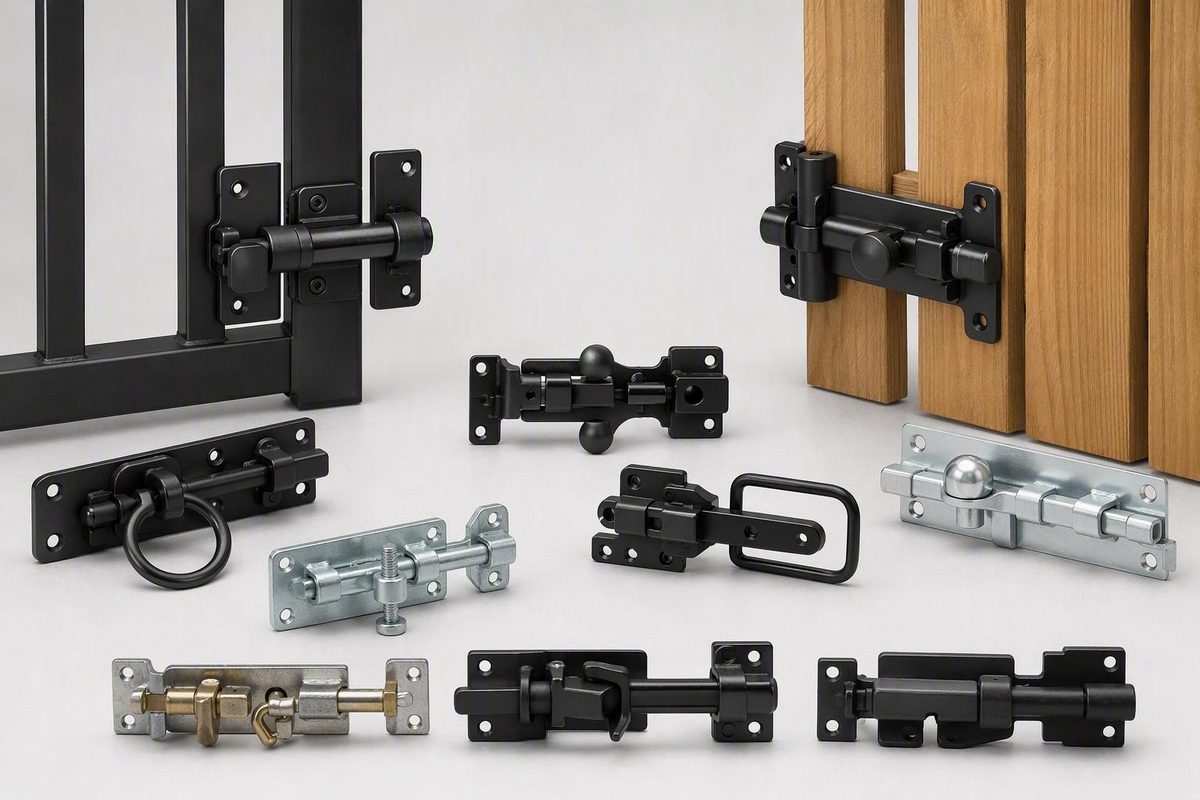
“Two-way” is one of the least precise labels in gate hardware. It may describe a latch that users can release from either side of a fence, a latch that accepts a gate swinging in either direction, or a product that does both. Those functions are not interchangeable.
Start by describing what the gate must actually do. Does it open inward, outward, or both ways? Who must release it, and from which side? Must it lock or unlock from both sides? Should it latch automatically after reaching the closed position, or must the gate also return to that position on its own?
Once those requirements are clear, compare latch form, operating mechanism, gate dimensions, locking workflow, hinges, stops, and other supporting hardware. The product label alone is not enough.
What “two-way” means in gate hardware
Terminology
- Two-sided release: The latch can be operated from either face of the gate.
- Bidirectional swing: The gate can pass through its closed position and open inward or outward, using latch and striker geometry that accepts it from either direction.
- Reversible handing: The hardware can be configured for a left- or right-handed installation. This does not necessarily provide two-sided release or bidirectional swing.
- Self-latching: The latch engages when the gate reaches the closed position.
- Self-closing: Hinges, a spring, or a closer return the open gate to the closed position.
A product may offer either meaning of “two-way,” or it may combine them. Market terminology is inconsistent: thumb, ring, and lever latches are often discussed as two-way because users can operate them from both faces, while a butterfly latch is called two-way because a compatible chain-link gate can swing through it in either direction. Angi’s latch taxonomy illustrates both uses of the term, describing two-sided controls for pedestrian-gate designs and bidirectional movement for butterfly hardware (see the gate-latch type descriptions).
Two-sided controls do not automatically permit two-way movement. A ring latch, for example, may let a person release the gate from either face, yet its latch arm and catch can still be arranged for only one opening direction. Conversely, a bidirectional livestock latch may accept the gate from either direction without providing equivalent release or locking controls on both faces.
Reversible handing is another separate question. A reversible model can be rearranged for hinges on the left or right. That specification says nothing by itself about whether the user can operate it from both faces or whether the gate can swing both ways.
The same separation applies to automatic action. A self-latching mechanism can catch the gate once it arrives at the closed position, but it does not necessarily pull an open gate back. Automatic return requires suitable self-closing hinges, a spring, or a gate closer.
Finally, “two-way” does not establish lockability. A latch may have a padlock eye, an integrated keyed cylinder, two-sided keyed controls, or no lock provision at all. Each feature must be confirmed separately.
Two examples make the distinction clear:
- A ring latch can release from both faces through interconnected rings while remaining arranged for a single swing direction.
- A butterfly latch uses geometry that allows a compatible chain-link gate to approach the latch post from either direction.
Comparison of the main two-way gate latch types
The main choices are best classified first by form—thumb, ring, lever, throwover, butterfly, or a specialized bidirectional design. Gravity, spring, and magnetic action describe how a mechanism engages; they are not equivalent product forms.
The table provides category-level guidance, not a substitute for a selected model’s drawings. Access, swing, lockability, and self-latching behavior can vary even among products with the same name.
| Latch form | Operation from both sides | Typical gate swing | Bidirectional-swing capability | Self-latching behavior | Possible lock options | Common application | Main compatibility check |
|---|---|---|---|---|---|---|---|
| Thumb | Commonly available in two-sided configurations; verify the model | Primarily inward-opening | Usually no | Often engages when the gate closes, depending on design | Some models lock; many conventional versions do not | Wood pedestrian gates; some double-leaf gates | Gate thickness, connector length, stile width, drop-bar space |
| Ring | Commonly available with a control on each face | Inward or outward, depending on latch-arm placement | Usually no | May be gravity- or spring-assisted | Padlock eyes or other locks on selected models | Wood, metal, or decorative pedestrian gates | Spindle length, arm side, catch alignment, lock location |
| Lever | Commonly available with handles on both faces | Inward or outward, depending on configuration | Usually no | May be gravity- or spring-assisted | Selected models offer padlock or integrated locking | Pedestrian and decorative gates | Handle clearance, spindle length, arm side, handing |
| Throwover | Model-specific; do not assume two-sided access | Usually used to hold the leaves of a double-leaf gate together | Depends entirely on arm and keeper geometry | Model-specific; do not assume automatic engagement | Model-specific; do not assume padlockability | Double wooden or metal gates | Leaf alignment, arm travel, gate thickness, keeper geometry, locking workflow |
| Butterfly | Release arrangement varies | Inward and outward | Yes, for compatible chain-link gates | Plates commonly drop back into their holding position | Model-specific; verify rather than assuming a lock can be added | Chain-link swing gates | Gate-frame and post diameter, plate alignment, clearance |
| Purpose-built bidirectional self-latching | Model-specific | Inward and outward | Yes | Designed to engage after approach from either direction | Some accept a padlock or integrated lock | Livestock, round-tube, double-action, or café-style gates | Gate profile, post gap, mounting orientation, hinge motion |
Thumb, ring, and lever latches are familiar candidates when the requirement is access from both sides. Conventional thumb hardware is primarily associated with inward-opening gates. Ring and lever latch arms can commonly be placed on the side toward which the gate opens, making those forms candidates for either inward- or outward-opening configurations. Gardenista’s illustrated guide makes the same distinction while emphasizing the need to match the latch to gate thickness and swing direction (review the illustrated configurations).
Throwover latches belong in the double-leaf-gate category. Abbey Hardware describes throwover hardware as a double-gate option, but its own category guidance also illustrates why individual locking and operating arrangements must be checked rather than inferred from the name (compare its latch descriptions).
Butterfly hardware is more purpose-specific. Its interlocking plates are associated with chain-link gates that must approach the closed position from either direction. Specialized livestock and double-action-gate latches form another group: their striker and catch geometry may combine bidirectional movement with automatic latching.
This is not a quality or security ranking. The supplied evidence does not provide independent comparative attack, load, corrosion, impact, or cycle-life testing for these categories. Compare selected models rather than treating an entire latch form as inherently stronger, safer, or more durable.
Thumb, ring, and lever latches for access from both sides
Thumb, ring, and lever latches solve a similar access problem through different controls.
A thumb latch normally has an exterior handle with a thumb-operated control. Pressing the control moves a connector through the gate and lifts the latch arm on the opposite face. The person on the latch-arm side can usually lift that arm directly, giving the assembly two-sided operation.
Conventional thumb-latch geometry is generally intended for an in-swinging gate. The gate opens toward the side carrying the latch arm and catch. Individual products can differ, so the installation drawing—not the decorative appearance—should decide suitability.
A through-gate connection also makes physical dimensions important. The spindle, bar, or connector must suit the gate thickness. The plates need enough mounting area, and the latch arm or drop bar needs room on the stile.
That last issue is especially relevant on narrow framed gates. In one documented double-thumb-latch installation, the vertical stile was too narrow to accommodate the drop bar, so the builder modified the gate. The retailer presenting the installation describes this as work for a qualified installer rather than an adjustment that should be assumed suitable for every gate (see the two-sided thumb-latch installation detail).
A ring latch generally places a ring or similar rotating control on each face. A spindle connects the controls through the gate. Turning either ring lifts or releases the latch arm so the gate can open.
A lever latch uses much the same arrangement but substitutes lever handles for rings. Moving either lever transfers motion through the gate to disengage the latch arm.
For ring and lever hardware, the latch arm is normally mounted on the side toward which the gate opens:
- On an inward-opening gate, the arm is generally on the inward side.
- On an outward-opening gate, the arm is generally on the outward side.
This changes where the catch, backplates, lock provision, and accessible fasteners are located. Confirm that the selected product supports the intended arrangement rather than assuming that a one-direction assembly can simply be rotated in the field.
The practical control differences are straightforward:
- A thumb latch uses a traditional thumb-operated through-gate action.
- A ring latch is released by turning or moving its ring.
- A lever latch is released through handle movement.
Grip, reach, clearance, and dexterity needs should be assessed for the intended users against the product’s dimensions. The available evidence does not support a general claim that one of these controls is more accessible, secure, or durable than the others.
The visible control also does not identify the engagement mechanism. Ring and lever forms may use gravity-assisted or spring-assisted action. When comparing similar-looking products, inspect the mechanism drawing and instructions rather than assuming they function alike.
Latches for gates that must swing in both directions
A handle on each face does not make a latch compatible with bidirectional swing. For that, the catch and striker must accept the gate approaching the closed position from either direction.
A butterfly latch is a purpose-specific example for chain-link gates. It uses two interlocking metal plates. As the gate frame meets the latch, the plates lift against the post and then drop into their holding position. This arrangement can let the gate swing inward or outward.
“For chain link” does not mean it fits every frame diameter or post arrangement.
Other gates may use purpose-built bidirectional self-latching hardware. Retailers offer products for double-action or café-style movement and for farm gates, but no single latch should be treated as universally required for every double-action hinge or gate construction.
For a concrete livestock example, Cashmans describes a round-tube latch that accepts a gate swinging either way, latches without manual resetting, and can be operated with one hand. The seller specifies 1-5/8-inch to 2-inch round tubing and a 2-inch to 2-3/4-inch gate-to-post gap (check the product-specific livestock latch specifications).
Those measurements belong only to that product. They are not templates for wood, vinyl, ornamental metal, square-tube, or other gate constructions.
Some specialized bidirectional designs accept a padlock. That means a compatible lock can be attached at the designated point; it does not establish a security rating or prove that users can lock and unlock the gate from both sides.
The latch must also be coordinated with the hinges. If the gate is intended to open in both directions, use hinges documented for that motion and verify the full operating sequence:
- The gate approaches the center position from the first direction.
- The striker enters or moves the catch without collision.
- The latch engages at the intended alignment.
- A user can release it from every required side.
- The gate can repeat the process from the opposite direction.
Where the mounting system allows, test the sequence before final tightening or irreversible drilling. Do not use this functional check as a substitute for the latch and hinge manufacturers’ installation instructions.
Gravity, spring-loaded, and magnetic are mechanisms—not guarantees
A latch’s form tells you what kind of control and hardware arrangement it has. Its mechanism tells you what force moves the catch, arm, bolt, or pin.
A gravity-assisted latch relies on gravity to drop an arm or catch into its secured position. As the closing gate contacts the keeper, the arm may rise and then fall into place.
A spring-loaded latch uses spring force to move a bolt, pin, arm, or catch into position.
Published guides characterize these mechanisms differently. Nationwide Industries describes gravity and spring-loaded mechanisms while also treating gate operation, side access, and lockability as separate selection questions. Other commercial guides describe particular gravity or spring-loaded configurations as two-sided. The difference reflects the variety of actual products rather than a universal rule for either mechanism (see the manufacturer’s latch-selection overview).
Do not infer any of the following merely from “gravity” or “spring-loaded”:
- operation from both faces;
- compatibility with inward, outward, or bidirectional swing;
- automatic gate return;
- padlock compatibility;
- integrated keyed locking;
- reversible handing.
Instead, inspect the selected product’s drawing for controls on each face, the path of the latch arm, the position of the striker, and the documented release method. Ring and lever latches may use either gravity- or spring-assisted engagement, so their visible handles do not settle the question.
Magnetic latches are another operating approach. Magnetic force may hold or help engage the gate, but the term alone does not establish side access, swing direction, locking, or self-closing behavior. Some magnetic products are marketed with two-sided keyed controls; others have different arrangements. The supplied evidence does not support treating magnetic latches as a single, uniform category.
Self-latching remains distinct from self-closing. A gravity, spring, or magnetic latch may engage automatically only after the user or closing hardware returns the gate to the correct position. If automatic return is required, the hinges, spring, or closer must provide it.
A conventional slide bolt offers a useful contrast. It normally requires someone to slide the bolt manually from the face where it is mounted. Unless a particular system adds a documented external release, it is a one-sided alternative rather than a two-way latch.
Lockability and security questions to resolve before buying
Gate-hardware listings often blur four distinct features:
- Latch release from both sides
- A padlock eye
- An integrated keyed lock
- The ability to lock and unlock from both sides
A model may provide one, several, or none of them.
Some ring latches include padlock eyes. Others do not. Even when a padlock can be fitted, it may sit on only one face, requiring access to that side to secure or remove it.
Conventional thumb latches are often described as non-lockable decorative hardware, but lockable versions exist. Check the exact model and determine whether “lockable” means an integrated cylinder, a padlock attachment, or compatibility with a separate gate lock. Lockability varies among ring, thumb, and throwover designs rather than following automatically from two-sided operation.
Some magnetic or handle-latch products are marketed with keyed control on both sides. Keyed deadbolts and keypad arrangements can also provide two-sided access in suitable installations. None is universally compatible with every gate thickness, material, swing direction, or required operating workflow.
Before buying, write down the intended workflow:
- From which face can a person release the unlocked gate?
- Where is the padlock, key cylinder, keypad, or deadbolt?
- Can the gate be locked from either face?
- Can it be unlocked from either face?
- What happens if a person without a key is on the enclosed side?
- Is an emergency-release arrangement required for the site?
- Does locking disable normal latch operation?
- Can someone reach over or through the gate to operate the control?
Padlock compatibility alone establishes neither a security rating nor two-sided lock operation. Likewise, no latch form in this comparison can be called the safest or most secure without appropriate attack, load, installation, and cycle testing.
A gate controlling a pool or another regulated area should not be selected from a general category description alone. Pool-gate rules can vary locally, and available editorial guidance specifically recommends checking applicable local ordinances and product instructions rather than assuming compliance from a latch label (see the pool-gate caution). For required exits, accessibility-sensitive installations, child-access controls, or other regulated uses, obtain project-specific direction from the relevant local authority and the hardware manufacturer.
Match the latch to the gate configuration
Begin with motion, not appearance:
- Sliding gate: Stop here. Sliding gates require different latch geometry, and the swing-gate types compared in this article should not be treated as direct substitutes.
- One-direction swing gate: Identify whether it opens inward or outward.
- Bidirectional swing gate: Look for hardware explicitly designed to accept the gate from both approaches.
Then match the gate configuration.
Wooden pedestrian gate, inward opening, release needed from both sides: Two-sided thumb, ring, and lever models are reasonable candidates. Confirm gate thickness, stile width, connector length, arm placement, and mounting area.
Outward-opening pedestrian gate: Ring or lever hardware is usually the clearer conventional candidate because the latch arm can be installed on the side toward which the gate opens. Verify that the chosen model explicitly supports the proposed orientation.
Chain-link gate swinging both ways: Evaluate a butterfly latch designed for chain-link construction. Confirm frame and post dimensions, release access, clearance, and any locking requirement.
Round-tube livestock gate: Consider a purpose-built bidirectional latch only after confirming tube diameter, gate-to-post gap, mounting orientation, release method, and included fasteners. Do not apply a farm-latch specification to a visually similar square-tube or ornamental gate.
Double wooden or metal gate: Identify one leaf as active and the other as fixed. The latch generally joins the active leaf to the fixed leaf, while a cane bolt or another vertical bolt holds the fixed leaf in position. A throwover latch is one option. A two-sided thumb arrangement may also work when the gate offers enough thickness, stile width, and drop-bar space.
A double gate commonly involves more than the latch:
- hinges suited to each leaf;
- a catch or keeper;
- a cane or vertical bolt for the fixed leaf;
- a gate stop selected for the gate’s construction and motion;
- optional locking hardware;
- an optional dummy handle.
The double-gate layout should be planned as a system. A specialist guide illustrates the usual relationship among the active leaf, fixed leaf, latch, cane bolt, hinges, and stop (review the double-gate hardware layout).
Material still matters, but it is not enough to choose by a “wood,” “vinyl,” or “metal” label. Check whether the mounting surface can accept the specified fasteners and whether reinforcement is required.
Also match the documented material and finish to the environment. Persistently wet or coastal exposure can make corrosion resistance an important selection factor. Do not infer a particular service life from appearance or material name alone; use model-specific finish, maintenance, and environmental guidance.
Pre-purchase measurements and installation checks
Measure the actual gate and post rather than relying on nominal lumber, tube, or panel sizes.
Measurement checklist
- Gate thickness: Determines whether a through-gate spindle, connector, or deadbolt is long enough.
- Spindle or connector length: Must span the gate while engaging both controls correctly.
- Stile width: Must accommodate backplates, latch arms, drop bars, and fastener spacing.
- Post dimensions: Affect the available catch area and suitable fastener length.
- Gate-to-post gap: Must fall within the selected latch’s engagement and adjustment range.
- Tube diameter or profile: Essential for round-tube clamps, chain-link frames, and purpose-built farm hardware.
- Latch travel: The arm, bolt, or catch must move fully without striking trim, pickets, or the post.
- Mounting area: Both gate and post need surfaces compatible with the hardware.
- Movement: Record whether the gate opens inward, outward, or in both directions.
- Handing: Confirm left- or right-handed installation and whether the model is reversible.
- Vertical alignment: Check whether sag or post movement prevents the latch and keeper from meeting.
- Handle clearance: Make sure rings, levers, keys, and padlocks can be operated without hitting the frame.
Gate thickness is especially important for controls mounted on both faces.
Stile width is equally important for thumb-latch and drop-bar arrangements. Do not assume that cutting, notching, or adding blocks is a routine fix.
For a double gate, mark all components before drilling:
- Active leaf
- Fixed leaf
- Latch body
- Catch or keeper
- Cane-bolt position
- Gate-stop position
- Lock or dummy-handle position, if used
A properly selected and positioned gate stop can receive closing and slamming forces that would otherwise act on the latch arm. Stop form and placement depend on the gate’s motion and construction, so follow the hardware and gate manufacturers’ instructions rather than copying a single layout to every installation.
Check the hardware package carefully. “Hardware included” may refer only to one side of the installation. For example, the round-tube livestock product cited earlier states that gate-mounting hardware is included but post-mounting hardware is not. That distinction affects fastener selection and installation planning.
Inspect the hinges before treating the latch as the source of poor engagement. Gate-hardware guidance recommends selecting hinges for the gate’s size and weight, and the hinges must also support its intended direction of movement (see the hinge-selection consideration).
Finally, compare every measurement with the selected manufacturer’s instructions, including allowable clearances and adjustment ranges. Seek qualified assistance for structural modifications, heavy gates, uncertain alignment, powered systems, or regulated safety applications.
Common mismatches and a final selection checklist
The most common purchasing error is solving the wrong meaning of “two-way.”
- Buying two-sided release when the gate must swing both ways: Handles on both faces do not make the striker bidirectional.
- Buying bidirectional-swing hardware without checking user access: A gate may move both ways while release or locking remains convenient from only one face.
- Assuming self-latching means self-closing: The latch cannot engage until the gate returns to the closed position.
- Treating “gravity” or “spring-loaded” as proof of two-sided access: Those terms describe the engagement mechanism, not the control layout.
- Assuming padlockable means keyed or rated: A padlock eye does not establish an integrated keyed function, a security rating, or two-sided locking.
- Selecting by material alone: “For wood” or “for metal” does not answer questions about thickness, stile width, post gap, tube diameter, travel, or mounting area.
- Reusing product-specific farm measurements: Dimensions for a round-tube livestock latch do not apply to unrelated gate constructions.
- Overlooking handing: Reversible left/right installation is a separate feature that must be confirmed.
- Expecting the latch to correct sag: Hinge, post, or frame alignment problems should be addressed first.
- Forgetting supporting hardware: Double gates may need a cane bolt and stop, while automatic closing requires suitable hinges, a spring, or a closer.
Conventional slide bolts, standard bolt latches, and hasp-and-staple arrangements are normally one-sided. They may be appropriate where access is deliberately restricted to one face, but they are not direct substitutes for a latch requiring normal operation from both sides.
Use this purchase sequence:
- Define movement: sliding, inward swing, outward swing, or bidirectional swing.
- Define side access: Identify every face from which users must release the latch.
- Identify gate form and dimensions: Record whether it is single or double, plus material, thickness, stile width, post gap, and tube profile.
- Choose the latch form: Thumb, ring, lever, throwover, butterfly, or specialized bidirectional hardware.
- Verify the mechanism: Gravity, spring, magnetic, or another documented action.
- Verify the locking workflow: Establish where the gate can be locked, unlocked, and released.
- Confirm supporting hardware: Check hinges, closer, stop, keeper, cane bolt, reinforcement, and fasteners.
- Check instructions and local requirements: Use the selected model’s drawings and applicable rules, not category assumptions.
Frequently asked questions
What is the difference between a two-sided gate latch and a latch for a gate that swings both ways?
A two-sided latch can be released from either face of the gate. A bidirectional-swing latch has catch and striker geometry that accepts the gate approaching from either direction. A product may provide one function or both.
For example, a ring latch may have controls on both faces while remaining arranged for one swing direction. A butterfly or purpose-built double-action latch can accept a gate moving inward or outward, but its release and locking controls still need separate verification.
Which two-way latch works on an outward-opening gate?
For two-sided access on a conventional outward-opening pedestrian gate, ring and lever latches are common candidates because the latch arm can be placed on the side toward which the gate opens. Confirm that the selected model supports outward-opening installation, has the correct spindle length, and provides the required lock access.
If “two-way” means the gate must swing both inward and outward, use hardware expressly designed for bidirectional movement, such as a compatible butterfly latch for chain link or another purpose-built double-action latch.
Can a two-way gate latch be locked from both sides?
Sometimes, but not automatically. Two-sided release, padlock compatibility, integrated keyed locking, and two-sided lock operation are separate specifications.
Choose a model explicitly documenting where it can be locked and unlocked. A padlock eye may be accessible from only one face, while certain keyed, keypad, magnetic, or handle-latch systems may provide controls on both faces. Confirm the intended normal and emergency operating workflow before installation.
What hardware is needed with a latch on a double gate?
A typical double-gate installation has hinges for both leaves, a latch joining the active leaf to the fixed leaf, and a cane or vertical bolt holding the fixed leaf. A gate stop may also be used to establish the intended closed position and receive closing forces, subject to the gate and hardware manufacturers’ instructions.
Depending on the application, the installation may include a lock, dummy handle, closer, reinforcement, or additional ground receiver. Lay out all component positions before drilling.
Does a self-latching two-way latch make the gate self-closing?
No. Self-latching means the mechanism engages after the gate reaches the closed position. It does not necessarily return an open gate to that position.
If automatic closing is required, use compatible self-closing hinges, a spring, or a gate closer. Verify from the manufacturers’ instructions that the closing hardware, gate motion, alignment, and latch engagement range are compatible.
The correct choice begins with a functional description rather than the phrase “two-way.” Specify how the gate moves, which faces need access, how locking must work, and whether the gate must close or merely latch automatically. Then confirm the latch form, every critical measurement, supporting hardware, manufacturer instructions, and any applicable local safety requirements.