
Measure Your Gate First, Then Choose the Locking System
Swing-gate fork latches are not sliding-gate receivers, even when tubing sizes look similar. Fit turns on frame and post size, gap, handing and access sides.
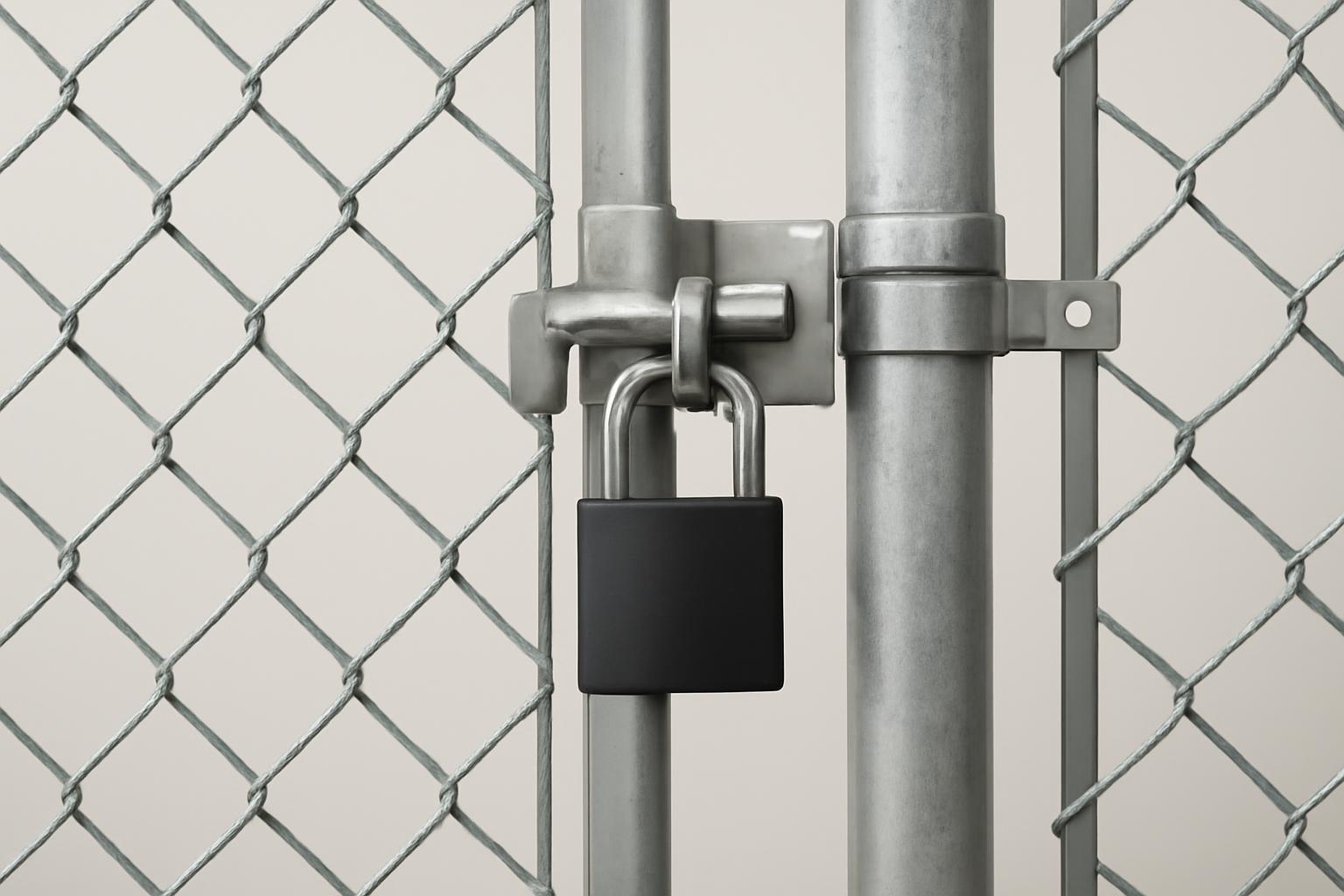
A chain link gate lock is not a universal part that can be chosen by appearance alone. Hardware that fits a round-frame pedestrian gate may not fit square tubing, a double driveway gate, or a rolling gate. Compatibility can depend on gate movement, leaf count, tubing shape and diameter, post size, latch gap, handing, alignment, mounting space, and the sides from which users need access.
Start with one essential distinction: a latch holds the gate closed; a lock restricts who can open it. Some latches accept a separate padlock. Other products combine the latch and locking mechanism in an integrated keyed, mechanical-code, or powered assembly.
This is a fit-and-function guide, not a security ranking. The available retailer, manufacturer, and contractor material does not provide comparable independent testing for forced entry, corrosion, operating cycles, or long-term durability. Product specifications and prices below are seller-reported snapshots, not independent performance findings.
Start Here: A Fast Decision Path for Your Gate
Use this sequence before comparing individual products.
1. Does the gate swing or slide?
A swing gate rotates on hinges. A sliding, rolling, or cantilever gate moves sideways along or across the fence line.
Treat these as separate hardware categories. Specialist catalogs distinguish slide gates from swing gates and also filter hardware by single or double configuration, post size, frame size, and locking method. A fork latch designed to rotate around a swing-gate post should not be treated as a sliding-gate receiver merely because its tubing dimensions look similar. Hoover Fence’s catalog shows these separate compatibility categories.
2. Is it a single gate or a double gate?
A single swing gate usually closes against a stationary latch post. Its latch or lock connects the moving gate frame to that post.
A conventional double-drive gate has two moving leaves that meet near the center. A common arrangement is:
- A drop rod or cane bolt secures one leaf to the ground.
- The active leaf latches to the immobilized leaf.
- A padlock or integrated lock prevents release.
Specialized double-gate latches are also sold for joining both leaves without a drop rod. That is a configuration option, not evidence of a particular forced-entry rating.
3. How should authorized users open it?
The principal access choices are:
- Separate padlock: Removable and easy to replace, but it must fit the latch geometry.
- Integrated keyed lock: Keeps the cylinder and operating hardware attached to the gate.
- Mechanical-code lock: Avoids distributing physical keys but requires code management and model-specific fit.
- Powered access control: May work with a keypad, card reader, touch pad, intercom, or facility controller.
Consider credential administration as well as convenience. Ask who receives keys or codes, how access will be revoked, and what happens when a key is lost or a code is shared.
4. Must it operate from one side or both?
“One-sided” and “two-sided” describe access operation, not product quality. A two-sided lock may require a key or code in both directions. Another system may restrict entry from outside while allowing free exit from inside.
Define the intended inside and outside before ordering. If unrestricted exit is required, determine whether the base product provides it or needs a separate handle, push device, or free-exit component. A double-sided lock is not automatically appropriate for an exit route.
5. Should the gate lock automatically?
Automatic locking and automatic closing are different functions:
- Automatic locking or self-latching means the mechanism engages after the gate reaches its closed position.
- Automatic closing means a spring, hinge, or closer physically returns the gate to that position.
A self-latching lock cannot engage if the gate remains open or stops short of its keeper. If automatic operation matters, verify both functions and confirm whether a closer is included.
Know What You Are Buying: Lock, Latch, or Supporting Part?
Retail collections often place complete locks, non-locking latches, brackets, keepers, mounting boxes, adapters, and drop rods on the same page. Category placement alone does not establish that an item can secure a gate by itself.
Use these definitions when reading listings:
- Ordinary latch: Holds the gate closed but does not independently restrict operation.
- Padlockable latch: Has aligned holes or another provision for a padlock. The padlock may be separate.
- Integrated keyed lock: Combines a locking cylinder with the gate’s latch, bolt, or operating hardware.
- Mechanical-code lock: Uses a code-operated mechanical mechanism rather than an electrical credential reader.
- Electromechanical lock: Uses electrical power or signaling to release or secure the gate.
- Keeper or receiver: The component that accepts a latch, fork, or bolt.
- Adapter: Connects hardware to a different frame shape, size, or mounting pattern.
- Mounting box or gate box: Provides a housing and mounting surface for a separate lock.
- Strike bracket: Positions the strike or receiver relative to the lock.
- Drop rod or cane bolt: Secures one gate leaf to the ground or a socket.
- Gate closer: Returns the gate to its closed position but does not necessarily lock it.
A padlock hole does not mean a padlock is included
If a listing says “hole for padlock,” read it literally. That describes a latch feature, not necessarily the package contents. Assume the padlock is separate unless the included-parts list explicitly names one.
Close the latch fully before measuring for a padlock. The shackle must pass through the intended holes without preventing full engagement, binding against the frame, or blocking key or combination access. Fit—not an unsupported universal rule about shackle length—should control the initial selection.
Example: the GB2900-LINX is not a keyless lock
The Lockey GB2900-LINX illustrates why product names and retailer categories require close reading. It is a stainless-steel mounting box listed for a 1-5/8-inch round post, with stated dimensions of 7-1/2 inches high by 2 inches wide by 1-3/4 inches deep. The compatible narrow-stile lock is purchased separately. The retailer lists Lockey 2900, 2930, 2950, and 2985 models as compatible, subject to model-specific installation requirements. GoKeyless identifies the box dimensions, post fit, compatible models, and separate-lock requirement.
A mounting box can adapt certain narrow-stile locks to tubular construction, but it does not make every lock compatible. Confirm the exact lock model, latch or bolt type, post dimensions, required opening, strike arrangement, and current instructions.
A typical double-gate bill of materials
A conventional double-drive gate may need:
- A drop rod, cane bolt, or other component to immobilize one leaf.
- A center latch or receiver joining the active leaf to the secured leaf.
- A padlock, integrated lock, or another mechanism that restricts release.
- A ground socket or stop.
- Size-specific adapters and fasteners.
- Hinge or alignment work if the leaves do not meet consistently.
A specialized center latch may eliminate the drop rod only when its documentation expressly supports that arrangement.
Included-versus-separate checklist
Mark each item as included, separate, not needed, or unknown:
- [ ] Lock body or padlock
- [ ] Latch bolt, fork, or deadbolt
- [ ] Keeper, receiver, or strike
- [ ] Gate-frame adapter
- [ ] Latch-post adapter
- [ ] Mounting box or gate box
- [ ] Strike bracket
- [ ] Correct fasteners
- [ ] Keys and stated number of keys
- [ ] Drilling or cutting template
- [ ] Current installation instructions
- [ ] Gate closer or self-closing hinges
- [ ] Drop rod or cane bolt
- [ ] Ground socket or stop
- [ ] Optional free-exit hardware
- [ ] Replacement parts or extra credentials
“Sold for chain-link gates” is not a substitute for this inventory.
Match the Hardware to the Gate Configuration
The correct arrangement begins with how the gate moves and where the two sides of the latch or lock can attach.
Single pedestrian swing gate
A single pedestrian gate commonly uses one of three arrangements:
- Padlockable fork latch plus separate padlock. The fork holds the frame against the post, while the padlock prevents release.
- Integrated keyed lock. The lock and latch or bolt remain mounted to the gate.
- Mechanical-code lock. Authorized users enter a code instead of carrying a key.
These represent different levels of integration and access convenience, not evidence-based security tiers. Use the measurement worksheet below to confirm frame shape and size, post size, gap, handing, mounting space, and access sides.
Sliding or rolling gate
Use a latch or lock expressly listed for sliding gates, together with its compatible receiver. Sliding hardware must accommodate lateral movement and the way the gate approaches, overlaps, or passes its closed position.
Do not repurpose a swing-gate fork latch unless the manufacturer documents that configuration. Similar tubing dimensions do not make the operating geometry equivalent.
Double-drive swing gate
The conventional arrangement secures one leaf with a drop rod or cane bolt and closes the active leaf against it.
JakeSales also lists a Strong Arm double-gate latch marketed as joining two leaves without a drop rod. Treat that as an alternative arrangement for a compatible gate—not as proof of resistance to cutting, spreading, lifting, or other forced entry. The retailer collection shows padlockable latches, drop rods, and the specialized double-gate option.
Round-frame swing gates
Round tubing requires hardware shaped or adapted to clamp around a curved surface. As one fitment example, Arch Iron Design lists Locinox keyed kits for 1-3/8-inch and 1-5/8-inch round gate frames. The listed configurations require 1-1/4-inch latch clearance and a latch post of at least 1-5/8 inches. Each kit is described as including the lock, keeper, round adapters, chain-link tension-bar adapter, three keys, drilling template, Allen wrench, and instructions. Arch Iron Design publishes those dimensions and package contents.
This example shows why frame diameter is only one specification. A gate can have the listed frame diameter yet still have an undersized latch post, insufficient clearance, an incompatible post shape, or unsuitable travel.
Round and square tubing are not interchangeable
Round adapters wrap around a curved surface. Even when one product family offers round and square variants, the required gap may differ.
Do not round an actual measurement to the nearest catalog choice. A nominal 1-3/8-inch frame, a 1-5/8-inch frame, and a 2-inch frame are separate configurations.
Specialized gates
Cantilever, kennel, and pool-gate products appear in dedicated retailer categories. Use the label only as a starting point. It does not prove fit or compliance with containment, pool, childcare, accessibility, fire, or emergency-egress requirements.
Configuration comparison table
| Gate type | Typical locking arrangement | Measurements to verify | Likely supporting components | Access questions |
|---|---|---|---|---|
| Single pedestrian swing gate | Padlockable latch, integrated keyed lock, or mechanical-code lock | Frame and post size, gap, clearance, swing direction | Keeper, adapters, padlock, closer | One or two sides? Free exit? Automatic relocking? |
| Double-drive swing gate | Drop rod on one leaf; active leaf latched and locked to it | Both frame sizes, center gap, alignment, ground clearance | Drop rod, socket, center receiver, padlock or lock | Which leaf is active? Must both open frequently? |
| Sliding or rolling gate | Sliding-gate-specific lock or latch and receiver | Frame size, receiver position, lateral travel, overlap | Receiver, stop, guide adjustment, adapters | Manual or controlled access? Which operating side? |
| Cantilever gate | Dedicated cantilever latch or access-control hardware | Closing geometry, frame profile, receiver location | Receiver, mounting plates, stop | Is manual release required? |
| Kennel gate | Configuration-specific latch or lock | Tube size, gap, opening direction, reach through mesh | Keeper, optional secondary retention | Is human access needed from both sides? |
| Pool-area gate | Locally appropriate closing and latching system | Product dimensions and locally required positioning | Closer, latch, keeper, release hardware | What do local rules require for entry and exit? |
The Measurement Worksheet to Complete Before Ordering
Measure the installed gate. Do not rely on a remembered fence size, an old invoice, or the dimensions of an adjacent post.
Printable gate worksheet
Gate identification
- Location or gate name: ______
- Primary purpose: _____
- Swing / sliding / rolling / cantilever: ___
- Single leaf / double leaf: ____
- Gate swings one way / both ways: ___
Tubing
- Gate-frame shape—round or square: _______
- Gate-frame outside diameter or width: _____
- Latch-post shape—round or square: ________
- Latch-post outside diameter or width: _____
- Receiving-leaf size, if a double gate: _____
Clearance and mounting position
- Gate-to-post or leaf-to-leaf resting gap: __
- Product-defined usable latch clearance: ___
- Available vertical mounting space: ________
- Available horizontal mounting space: _____
- Obstructions near mounting area: ____
- Padlock shackle must clear: _________
- Gap while gate is lifted gently: _____
- Gap while gate is pushed or pulled: _______
- Does the gap change through travel? _______
Operation
- Designated outside: __________
- Hinges are left / right when viewed from outside: ______
- Gate opens inward / outward / both ways: __
- Access needed from outside / inside / both: ______
- Free exit required: yes / no / uncertain
- Automatic locking required: yes / no
- Automatic closing required: yes / no
- Power available at the gate: yes / no
Condition
- Gate is plumb: yes / no / not checked
- Post is stable: yes / no / not checked
- Hinges are tight: yes / no / not checked
- Gate closes without lifting: yes / no
- Gate reaches the keeper freely: yes / no
- Existing corrosion or damage: _______
Do not transpose the frame and post measurements
The gate frame is the tubing that moves with the gate. The latch post is the stationary post against which a single swing gate closes.
On a double gate, both frames move. The active leaf may latch to hardware on the other leaf rather than to a stationary post. Record each part separately and label photographs by location.
Measure the actual tubing
Measure across the outside of the tubing at a straight, unobstructed section. For round tubing, record the outside diameter. For square tubing, record the outside width and note rounded corners or projecting seams that might affect a clamp.
Measure the gate frame and latch post independently.
Check the gap and available mounting space
The visible gate-to-post gap is not necessarily the same as the product’s required latch clearance. A lock body may need space beside the frame while its bolt must bridge a different distance to reach the keeper.
Check for chain-link tension bars, fabric, hinge bands, welded tabs, privacy slats, signs, and existing hardware. Any can obstruct an adapter, lock body, fastener, or drilling template.
Check padlock shackle clearance
Close the latch completely before checking the padlock position. The shackle must:
- Pass through every intended hole.
- Allow the latch to remain fully seated.
- Avoid binding against the post or frame.
- Leave room to insert and turn a key or enter a combination.
- Avoid interfering with gate movement.
The supplied evidence does not establish a universal shackle length, material, or hardness for every chain-link gate. Select from the actual fitted geometry and the site’s risk requirements.
Determine handing in plain language
Stand on the side the product instructions designate as “outside.” Record whether the hinges are on the left or right and whether the gate opens inward, outward, or both ways.
Manufacturers may define handing from this outside view. Compare your notes with the current manual or diagram rather than relying on a retailer photograph, which may show another configuration.
Test one-way and two-way travel
Some gates open only one way because of their hinges, stops, or surroundings. Others can swing both ways.
Move the gate through its complete travel. Confirm that the lock body, keeper, handle, adapter, and fasteners will not strike the post or block the intended arc.
Align the gate before finalizing dimensions
The gate should be stable and able to close freely. Gently lift the latch side, push and pull the gate, and move it through its full path. Record any change in the gap.
If the dimensions shift noticeably, correct the gate or post before choosing the lock. A measurement from a sagging gate describes only one unstable position. Correct frame diameter alone never proves compatibility; movement, shape, post size, gap, handing, mounting space, and model instructions still control.
Compare Padlock, Keyed, Code, and Automatic-Locking Access
Choose an access method by daily operation, credential management, fit, and installation needs—not by unsupported security rankings.
| Access method | Credential management | Main fit or use concern | Automatic relocking | Installation considerations |
|---|---|---|---|---|
| Chain and padlock | Distribute keys or a combination; replace the removable lock as needed | Chain and shackle must fit without obstructing closure | Usually no | Often straightforward, but chain and lock fit still matter |
| Padlockable latch | Manage a separate keyed or combination padlock | Shackle must fit fully aligned latch holes | Depends on latch | Latch must align before locking |
| Integrated keyed lock | Distribute and replace physical keys | Cylinder access and operation from each side | Model-dependent | Keeper and bolt alignment are critical |
| Mechanical-code lock | Share and change codes under the product’s process | One-sided versus double-sided operation | Model-dependent | May require adapters, a box, drilling, or cutting |
| Automatic keyed lock | Use keys for authorized release | Gate must consistently reach the keeper | Yes, if designed for it | A closer may still be separate |
| Electromechanical system | Administer codes, cards, or other credentials | Power, wiring, release logic, and egress | System-dependent | Professional integration may be appropriate |
Chain and padlock
A chain can join two gate leaves when there is enough clearance to pass through or around them, with a padlock securing the ends. This can be useful when a built-in latch position is unavailable or inconsistent.
The evidence does not establish which chain grade, link size, shackle material, or geometry is appropriate for higher-risk sites. Do not assume that an unspecified chain-and-padlock combination provides a known level of cut resistance.
Padlockable latch
A padlockable latch puts the padlock in a repeatable position and may be easier to operate than loose chain. It still requires a compatible padlock unless the listing expressly includes one.
Alignment remains essential. If the holes do not line up fully, forcing the shackle through them can leave the latch only partly engaged.
Integrated keyed access
Keyed gate locks can operate in materially different ways:
- A deadlock requires a key to lock and unlock the bolt.
- A latch deadlock can hold the gate shut with a handle-operated latch before the separate deadlock is engaged.
- A keylatch, in the manufacturer’s terminology, locks when the gate is pushed or pulled shut and then requires a key to reopen.
These differences affect user behavior. A deadlock may remain unlocked even when the gate looks closed. A keylatch may lock after closure, but only when the gate reaches the correct position. Gatemaster’s manufacturer guide explains these operating distinctions.
Mechanical-code access
A mechanical-code lock can reduce the need to distribute physical keys. That may help where authorized users change or carrying a key is inconvenient.
It does not, by itself, prove better manipulation resistance, outdoor reliability, or security. Before ordering, ask:
- How is the code changed?
- Must the unit be removed or opened to change it?
- Can different users receive different credentials?
- Does the same code operate both sides?
- What is the process for an exposed or forgotten code?
- What maintenance and environmental limits are documented?
One-sided versus double-sided operation
Treat operating sides as an independent specification. A double-sided lock may require a credential to leave. A one-sided model may control entry while allowing a separate interior release.
Where accessibility, free exit, emergency egress, or employee access is involved, define the required operation before selecting hardware. Do not assume optional free-exit components are included.
Automatic keyed lock example
Fence-Material lists a bolt-on keyed lock in round-frame variants for 1-3/8-inch, 1-5/8-inch, and 2-inch frames. The seller describes it as keyed on both sides, self-latching, and automatically locking, with four tubular keys included. A hinge-mounted spring closer is sold separately. The product page distinguishes the automatic lock from the separately purchased closer.
The distinction is important: the lock may engage automatically when the gate closes, but it does not necessarily cause the gate to close.
Electromechanical access
Electromechanical locks may integrate with keypads, card readers, or touch pads. That introduces system-level questions about power loss, wiring protection, controller compatibility, credential administration, manual override, and exit behavior.
Professional design or review is appropriate where electrical work, powered access, controlled egress, or facility-system integration is involved. A tubular-frame adapter does not answer those questions.
Installation Reality: Bolt-On Does Not Always Mean Simple
“Bolt-on” identifies an attachment method. It does not mean the gate already has the correct holes or that installation requires no measurement, drilling, or modification.
Installation-difficulty scale
Level 1: Clamp-on or simple bolt-on
- Uses clamps or existing mounting points.
- Still requires correct sizing and alignment.
Level 2: Bolt-on with drilling
- Requires accurate positioning of the lock and keeper.
- Requires following the hardware and tool manufacturers’ drilling instructions.
Level 3: Cutting or grinding
- Creates an opening for a bolt, latch, gate box, or mortised component.
- Requires compliance with the applicable product, tool, and workplace-safety instructions.
Level 4: Weld-in installation
- Permanently attaches a box, lock case, bracket, or receiver.
- Calls for a qualified person familiar with the gate material and structure.
Level 5: Powered access control
- Adds wiring, power supplies, controllers, readers, and release logic.
- May require electrical, access-control, and egress review.
Repair gate problems first
Before fitting the lock:
- Repair or tighten loose hinges.
- Stabilize moving posts.
- Correct sag.
- Remove travel obstructions.
- Confirm that the gate moves freely.
- Establish a repeatable closing gap.
A lock cannot compensate for a gate that misses its keeper. Do not use the lock body to pull an unstable or sagging gate into position.
Understand mounting terminology
- Surface-mounted: Attaches to the face of the gate or an adapter.
- Bolt-on: Uses bolts or machine fasteners.
- Weld-in: Uses a housing or case welded into or onto the frame.
- Mortised: Sits in a pocket cut into the frame.
Instructions written for a solid steel gate do not automatically apply to hollow round chain-link tubing. Tubular construction may require a gate box, backing plate, adapter, different fasteners, or another lock family.
The GB2900-LINX installation conflict
The GB2900-LINX retailer information demonstrates why buyers should not assume one universal installation method. The main description says no welding is needed and says an area must be ground out for the latch or bolt. An older seller response says the box may be welded or held while holes are drilled, depending on the setup.
Because those statements are not fully consistent, use current manufacturer documentation for the exact lock-and-box combination. Clarify missing steps with the manufacturer or a qualified installer before altering the gate.
Automatic locks may still need a closer
A self-latching mechanism works only after the gate reaches the keeper. If self-closing operation is required, the closer must move the gate through its full path and bring it into alignment.
Test the installed system under ordinary operating conditions rather than relying on one hand-guided closure.
Post-installation tests
After installation:
- Close the gate gently and confirm full engagement.
- Close it firmly without slamming and repeat the check.
- Test every key, code, handle, or release method.
- Operate the hardware from each intended side.
- Push and pull the gate while it is nominally locked.
- Verify that the latch or bolt is fully engaged, not merely touching the keeper.
- Inspect fasteners and mounting components for movement.
- Move the gate through its complete travel and retest.
- Test the closer, if present, from several opening angles.
- Repeat the inspection after an initial period of use.
Use qualified installation when the project involves welding, structural correction, electrical systems, controlled egress, or uncertain modification. No installation method should be assigned a security level without applicable test evidence.
Budget for the Complete System, Not Just the Lock
A low shelf price may cover only a latch. A more expensive listing may still exclude the adapter, gate box, strike, closer, free-exit hardware, tools, alignment work, and labor.
Price-check date for this guide: July 30, 2026. These are seller-reported examples captured for comparison, not current quotations or promises of availability. Prices can change by seller, date, size, finish, configuration, and stock.
Basic latch hardware
Hoover Fence’s captured catalog showed:
- Rolling-gate latch options at approximately $10.21 to $11.56.
- Malleable fork-latch assemblies at approximately $10.39 to $15.14.
- Butterfly latches at approximately $13.06 to $15.53.
The same catalog listed a Locinox swing-gate lock kit at $197.05 and a Locinox mechanical-code kit at approximately $763.84 to $780.92. These figures illustrate the catalog’s range, not comparable security or durability levels. Hoover Fence provides the captured basic-hardware and lock-kit prices.
Integrated keyed examples
Arch Iron Design listed specified round-frame Locinox kits at $213.20 in silver and $217.20 in black as of the price-check date. Those listings also described the included keeper, adapters, keys, template, Allen wrench, and instructions. The retailer supplies the keyed-kit prices and package details.
Differences between retailer prices may reflect the model, package contents, configuration, finish, or timing. Compare exact model numbers rather than assuming similarly named listings are identical.
Mechanical and keyless examples
Lockey Store’s captured collection listed:
- Single-sided mechanical models at approximately $232.84 to $269.29.
- Double-sided models at approximately $356.23 to $399.28.
- A surface-mounted SUMO GL2 starting at $601.92.
The same collection included a gate box, adapter, and strike bracket, showing why a category result may be an accessory rather than a complete lock. Lockey Store provides the captured model and accessory prices.
A higher price does not prove greater forced-entry resistance, outdoor life, or overall suitability. Similar inventories and prices appearing at multiple retailers may reflect shared manufacturer or catalog data, not independent validation.
Total installed cost worksheet
| Cost item | Needed? | Estimated cost | Confirmed supplier or installer |
|---|---|---|---|
| Base latch or integrated lock | |||
| Separate padlock | |||
| Chain | |||
| Keeper or receiver | |||
| Frame adapter | |||
| Post adapter | |||
| Gate box or mounting box | |||
| Strike bracket | |||
| Drop rod or cane bolt | |||
| Ground socket or stop | |||
| Gate closer | |||
| Free-exit component | |||
| Extra keys or credentials | |||
| Fasteners and required tools | |||
| Coating repair after modification | |||
| Hinge or gate realignment | |||
| Shipping and tax | |||
| Professional labor | |||
| Electrical or access-control work | |||
| Estimated total |
Compare complete, compatible systems—not isolated lock-body prices.
Outdoor Exposure, Maintenance, and Safety Limits
Outdoor gate hardware is exposed to weather, dirt, temperature changes, impacts, repeated movement, and changes in fence alignment.
Retail catalogs list aluminum, polymer, stainless-steel, and steel hardware in galvanized, black, silver, green, and other finishes. Those labels identify material or appearance; they do not establish a particular service life.
Treat marketing terms cautiously
The following descriptions are not substitutes for test evidence:
- Waterproof
- Rust-proof
- Marine grade
- Heavy duty
- Commercial grade
- High security
- Anti-theft
- Weatherproof
- Non-duplicable
Ask what standard, rating, test method, or certification supports the term. If none is supplied, treat it as marketing language rather than a measured performance level.
For each candidate, look for:
- Corrosion-test information
- Environmental or ingress rating
- Operating-temperature limits
- Warranty scope and exclusions
- Required maintenance
- Replacement-part support
- Forced-entry or cycle testing, where relevant
Many retailer pages in the supplied evidence do not publish these details. That absence does not prove poor performance, but it prevents reliable comparison.
Practical maintenance
Periodically inspect:
- Gate and keeper alignment
- Hinges
- Lock and latch fasteners
- Drop rods and ground sockets
- Closer attachment and adjustment
- Visible wear or corrosion
- Code buttons, cylinders, handles, and releases
Tighten loose fasteners and use only maintenance products suitable for the specific hardware. Brentwood Fence recommends annual dry-silicone lubrication, while All Around Fence and Decks recommends lubricating metal locks, latches, and hinges twice yearly. These are contractor recommendations rather than comparative test findings, so the applicable manufacturer instructions should control. All Around Fence and Decks provides the twice-yearly recommendation.
Perform an additional inspection after:
- Freezing weather or ice buildup
- Ground movement
- Strong winds or impact
- Heavy or unusual use
- Visible gate sag
- Fence, post, or hinge repairs
A small alignment change can prevent an automatic latch from engaging even when the lock itself still operates.
Separate the safety and security goals
A gate may serve several different purposes:
- Containment: Keeping a pet, vehicle, or normal yard traffic within a boundary.
- Access convenience: Giving authorized users a practical entry method.
- Burglary deterrence: Increasing the effort required for unauthorized access.
- Child or pool safety: Controlling access under specific operating and placement requirements.
- Emergency egress: Allowing occupants to leave as required.
Hardware suitable for one objective is not automatically sufficient for another. A simple latch may contain a pet but provide no credential control. A double-sided keyed lock may restrict entry but create an exit problem. A product placed in a retailer’s “pool gate” category is not automatically compliant at a particular property.
Verify the current local rules, product documentation, and installed configuration with the relevant authority or qualified professional. Contractor guidance likewise recommends confirming exact local pool-gate specifications instead of assuming one rule applies everywhere. All Around Fence and Decks emphasizes local verification for pool barriers.
Evidence checklist for comparing products
Before choosing between systems, check whether each seller or manufacturer supplies:
- [ ] Published gate-frame dimensions
- [ ] Published latch-post dimensions
- [ ] Required gate-to-keeper gap
- [ ] Round or square tubing compatibility
- [ ] Supported gate movement and leaf count
- [ ] Clear one-sided or two-sided operation
- [ ] Explicit free-exit behavior
- [ ] Complete bill of materials
- [ ] Current installation manual
- [ ] Applicable third-party test or certification
- [ ] Environmental rating or corrosion-test information
- [ ] Warranty terms and exclusions
- [ ] Replacement keys, parts, and credential support
- [ ] Maintenance instructions
- [ ] Clear closer requirements
- [ ] Model-specific adapters and strikes
Frequently Asked Questions
Does a padlockable chain-link gate latch include the padlock?
Not necessarily. “Padlockable” generally means the latch has holes or another provision for a padlock. Assume the padlock is sold separately unless the package contents expressly include one.
Close the latch fully before measuring. Confirm that the shackle can pass through the intended holes without preventing full engagement or interfering with the frame, post, gate movement, or credential access.
How do I lock a double chain-link driveway gate?
A common arrangement secures one leaf with a drop rod or cane bolt, then latches and locks the active leaf to it. The complete system may require a ground socket, center receiver, latch, and either a separate padlock or an integrated lock.
A chain and padlock can also join two leaves when there is enough clearance. Some specialized center latches are designed to join the leaves without a drop rod. In every case, check the center gap, leaf alignment, ground conditions, and how often both leaves must open.
Can one chain-link gate lock work on both round and square frames?
Only when the manufacturer expressly provides compatible variants or mounting hardware for both shapes. Round and square tubing require different contact surfaces, clamp geometry, and sometimes different clearances.
Matching nominal widths are not enough. Confirm the product variant, adapters, frame size, post size, required gap, and installation instructions.
Does an automatic-locking gate lock also make the gate self-closing?
No. Automatic locking means the mechanism engages after the gate reaches the closed position. Self-closing means a spring, hinge, or closer returns the open gate to that position.
Some automatic locks require a separately purchased closer. The gate must also remain aligned and unobstructed for the latch or bolt to engage reliably.
Can I install a keyless lock on a 1-5/8-inch round chain-link gate post?
Potentially. The GB2900-LINX mounting box is listed for a 1-5/8-inch round post and specified Lockey narrow-stile locks, but the box is not itself a lock and the compatible lock is sold separately. GoKeyless provides the fit and separate-lock specifications.
Post diameter alone does not establish compatibility. Confirm the exact lock model, gate geometry, strike or keeper, gap, access sides, and current instructions. The available retailer information indicates that installation may involve drilling, grinding, or other modification, so clarify the method before ordering.
Final Purchase Sequence
There is no universally best chain link gate lock. Use this order instead:
- Stabilize and align the gate.
- Identify whether it swings or slides and whether it has one or two leaves.
- Record the actual frame, post, gap, clearance, handing, and travel measurements.
- Choose the access method: padlock, integrated key, mechanical code, or powered control.
- Confirm one-sided, two-sided, automatic-locking, automatic-closing, and free-exit behavior separately.
- Verify every included and separately required component.
- Read the current installation manual for the exact model and configuration.
- Calculate the complete installed cost rather than comparing lock-body prices alone.
If the application involves powered access, welding, pool safety, controlled egress, or uncertain structural fit, obtain qualified installation and local-code guidance before buying.