
How to Choose Slatwall Hooks for Fit, Use, and System-Specific Load Ratings
Load position changes the comparison: 10 pounds at the end of a 12-inch hook creates the same 10 foot-pounds as 20 pounds at the end of a 6-inch hook.
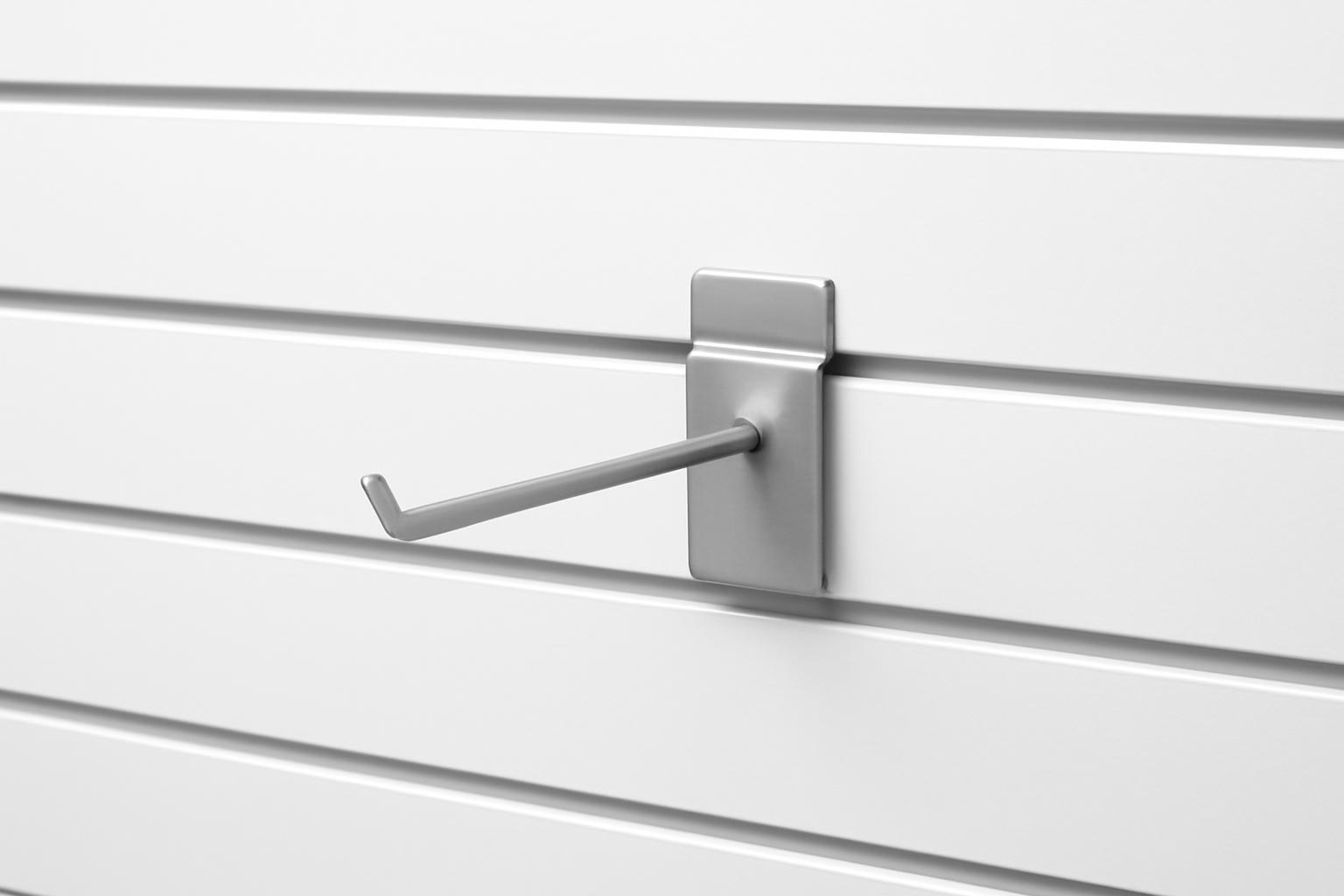
Overview
Choose slatwall hooks by starting with the item and setting, then verify that the hook-back fits the actual panel. Select a length and configuration that supports the item without unnecessary projection, and confirm the manufacturer’s working-load rating for the complete hook, panel, insert, and installation combination before comparing features or price.
There is no single slatwall hook that is right for every garage, workshop, stockroom, or retail display. Garage storage often calls for shapes designed around tools, bikes, brooms, or bulky equipment. Retail displays commonly use straight hooks that keep packaged products visible and easy to replenish. Suppliers offer numerous lengths and specialty forms, while locking mechanisms, protective coatings, upturned tips, and label holders solve different operational problems.
Compatibility and capacity require particular care. A hook described as compatible with “standard slatwall” may not fit every proprietary system in the same way. Likewise, two advertised weight ratings are not directly comparable unless the hook geometry, panel construction, inserts, installation method, load position, and test method are comparable. Treat the published rating as system-specific, not as a universal property of the hook.
Match the Hook to the Item and Use Case
Match the hook’s shape and contact points to the item before comparing finishes or pack prices. The useful question is not simply whether an item can hang from a hook, but whether it will remain stable, accessible, and adequately supported in normal use.
The following matrix uses documented catalog applications and features. It is a starting point for narrowing the category, not a universal compatibility or capacity chart.
| Item or use case | Configuration to consider | What to verify before buying |
|---|---|---|
| Smaller hand tools | Short single hook | StoreWALL uses a 2.5-inch single hook as its example for smaller tools. Check the tool’s hanging hole, handle shape, and panel fit. |
| Larger tools or equipment | Longer or wider single, double, J-, or U-style hook | StoreWALL identifies its 5-inch single hook as an option for larger items and advises choosing length or width according to what will be stored. Confirm support points and the system-specific load rating. |
| Brooms and lawn tools | Garage-oriented utility or specialty hook | Proslat describes its assortment as covering items “from bikes to brooms,” while StoreWALL identifies lawn tools as a supported use. Check whether the handle can slide, rotate, or lift free during removal. |
| Bicycles | Manufacturer-designated bike hook | Proslat lists bike applications, and retailer catalogs include pivoting bike hooks. Verify the intended bicycle position, contact surfaces, clearance, and rated hook-panel combination. |
| Fitness or sports gear | Wider, double, cradle, or manufacturer-designated specialty hook | StoreWALL names fitness equipment as a use case, but the correct form depends on the item. Verify where the load contacts the hook and whether padding is needed. |
| Small packaged retail goods | Straight display hook, often with an upturned tip | Fixture Zone describes deluxe display hooks for small packaged or lightweight goods and says a 45-degree upturn is intended to reduce products slipping off the end. Check package-hole fit, product depth, and restocking clearance. |
| Unusual specialty equipment | Manufacturer-designated accessory | Do not infer fit from appearance alone. Confirm the item use, hook-back profile, panel, installation, and working-load documentation with the system manufacturer. |
This approach prevents a common mismatch: buying a familiar-looking hook whose geometry does not suit the item. A short hook may provide compact storage but insufficient depth for several packages. A long straight hook may hold more product positions, yet it also projects farther from the panel and changes how the load acts on it. Specialty forms should earn their added complexity by providing a needed contact point, clearance, or retention function.
Garage Storage Hooks vs. Retail Display Hooks
Garage slatwall hooks and retail slatwall display hooks may attach to similar-looking grooves, but they are organized around different tasks. Garage storage prioritizes stable support for tools and bulky gear, convenient removal, protection at contact points, and the ability to reorganize a working space. Catalogs in this category emphasize single and double hooks, U-hooks, bike hooks, and accessories for items ranging from brooms to fitness equipment.
Retail hooks prioritize product presentation and replenishment. Grand + Benedict describes slatwall hooks as merchandising accessories that use vertical display space while keeping hanging products visible, organized, and easy to restock. Straight hooks suit packages with compatible hanging holes, while the product depth and quantity determine the useful hook length.
Merchandising-specific details can matter more than padding or a locking base. Fixture Zone describes a 45-degree upturn intended to keep merchandise from slipping off a display. It also lists a flip-scan paper label holder for slatwall, gridwall, and pegboard placement. These features support product retention, labeling, and inventory control. They do not establish that the same hook is suitable for a heavy garage item.
Choose according to the operating task. A retailer repeatedly loading identical packages may value consistent length, label placement, and bulk quantity. A garage owner storing a bicycle, tool, or irregular piece of equipment should focus on stable contact, clearance, protective surfaces, and a documented working load.
Verify Panel and Cross-Brand Compatibility
A nominal compatibility claim is a screening clue, not a guarantee of identical fit. Before buying, identify the panel system and confirm that the hook-back geometry is intended for that panel’s material, groove profile, spacing, and any inserts.
Use this verification sequence:
- Identify the panel manufacturer, product line, material, and installation method.
- Measure the groove spacing and inspect the groove or insert profile, rather than relying only on the term “slatwall.”
- Compare those details with the hook manufacturer’s fit documentation, including any proprietary mounting or locking mechanism.
- Confirm whether the capacity rating applies to your panel and installation, not merely to the accessory.
- Test the fit without loading the hook. It should seat as the manufacturer describes and should not require improvised bending or forcing.
For example, StoreWALL states that its accessories are designed around standard 3-inch on-center slatwall spacing and says many third-party accessories will work with its system. The wording “many” matters. It is not a declaration that every hook sold for slatwall will engage correctly or retain the same rated performance.
The supplied retailer evidence also flags Gladiator GearWall as requiring adapted items, illustrating why a proprietary system can be an exception to broad compatibility language. A compatible width or groove interval does not establish that the hook-back seats, locks, or carries load identically.
No independent chart in the evidence pack maps every hook profile across major panel brands, materials, and proprietary systems. As a result, visual similarity, marketplace compatibility lists, and customer reviews cannot replace product-specific documentation. If either manufacturer does not identify the combination, treat the fit and capacity as unresolved rather than assuming that “standard” means universal.
Choose Hook Length and Configuration
Choose length according to the item’s depth and required clearance, then choose the configuration according to how many contact points are needed for stability. A hook should be long enough to support the item or desired merchandise quantity, but extra projection is not automatically useful.
Retail suppliers demonstrate how broad the size range can be. Store Fixtures Direct lists slatwall hooks in 1-, 2-, 4-, 6-, 8-, 10-, and 12-inch sizes. KC Store Fixtures lists the same general span from 1 to 12 inches. These are availability examples, not a rule that every size fits every panel or use.
A short straight hook can reduce projection and suit a small tool or shallow package. A longer straight hook can accommodate a deeper item or more packages, but the item’s position along that hook affects stress on the panel. Do not choose a long hook solely because it offers more nominal capacity for merchandise.
Configuration addresses a different problem:
- A single hook provides one narrow support point.
- A double hook can provide additional lateral stability when the item or package geometry suits two prongs.
- J- and U-style hooks create a deeper or more contained support area for items that should rest within the hook rather than hang from a small hole.
- Cradle, bike, power-tool, and other specialty forms are designed around particular contact or clearance needs.
These descriptions do not create universal item-to-shape prescriptions. The dimensions of the stored object, its center of mass, the hanging opening, and the intended removal motion still matter. Measure the item’s width and depth, identify where it will contact the hook, and leave enough clearance to place and remove it without striking neighboring items.
Finally, consider how far the hook projects into an aisle, work area, or customer path. Choose the shortest configuration that provides the required support and usable capacity, then confirm the load rating for that exact length and system.
Understand Load Ratings Before Hanging Heavy Items
There is no responsible universal answer to how much weight a slatwall hook can hold. The safe working load depends on the hook design and length, where the load sits, how it is distributed, the panel material, groove inserts, fasteners, installation method, and the manufacturer’s test and safety assumptions.
Load position matters because weight farther from the panel creates a larger turning effect. A Panel Processing technical paper explains this relationship in foot-pounds and gives a concrete equivalence: 10 pounds at the end of a 12-inch hook creates the same 10 foot-pounds as 20 pounds at the end of a 6-inch hook.
The arithmetic is weight multiplied by distance from the panel: 10 pounds × 1 foot = 10 foot-pounds, while 20 pounds × 0.5 foot = 10 foot-pounds. This is why a pound rating without hook length and load position is incomplete.
Distribution changes the result as well. The same paper states that 20 pounds distributed uniformly over a 12-inch hook produces 10 foot-pounds using one-half × load × prong length. A concentrated 20-pound load at the 12-inch tip would produce 20 foot-pounds. Equal total weight does not necessarily mean equal stress.
You must also distinguish a breaking load from a working load. The Panel Processing tests reported panel failure results under defined conditions, including a 12-inch test hook positioned at the sample’s center and loaded at its end. The paper explicitly identifies its graphed figures as breaking loads and recommends limiting normal maximum working loads to 66% of those values to account for uncontrolled variables. That 66% recommendation belongs to that test program. It is not permission to take any seller’s maximum or failure number and multiply it by 0.66.
Installation can materially change a published accessory rating. StoreWALL says the capacities on its individual accessory pages assume its panels are hung using StoreWALL install strips. It states that those listed capacities are reduced by approximately 75% when panels are fastened through their faces into studs. This is a manufacturer-specific example, but it shows why the same accessory cannot be evaluated separately from panel installation.
Retail listings further illustrate why headline ratings are difficult to normalize. One Home Depot category snapshot lists a Proslat 10-inch single hook at 15 pounds and a 6-inch U-hook at 50 pounds. Those figures describe different products and geometries, so they do not prove that U-hooks generally carry more or that shorter hooks always have higher ratings.
For heavier items, find a manufacturer-rated working load that explicitly applies to the exact hook, panel construction, inserts, and installation. If the documentation instead reports a maximum, test, or breaking load without a working-load limit, do not treat those terms as interchangeable.
Space and Distribute Loads Safely
Place heavier loads according to the panel manufacturer’s instructions, because edge distances and hook spacing can be system-specific. The available guidance supports several practical actions:
- Keep heavy loads away from exposed panel or slat ends. Panel Processing reports that moving its test hook closer to the sample edge compromised load handling.
- For SlatWall MX specifically, Koffler Sales instructs users to keep heavy loads at least 3 inches from either panel end and separate heavy loads on the same slat by at least 6 inches.
- Distribute weight across the panels rather than concentrating it unnecessarily. Wind Mill Slatwall’s installation instructions explicitly call for equal weight distribution.
- Do not overload accessories, drop heavy objects onto them, or use them for climbing, hanging, or stepping. Wind Mill lists each of these as prohibited uses.
The 3-inch and 6-inch distances come from one named panel system and should not be generalized to every slatwall. For another system, use its specified edge clearances, fastener layout, groove limits, and distribution guidance. If those values are absent, the evidence does not support inventing a spacing rule.
Compare Standard, Locking, Padded, and Anti-Slip Features
Compare features by the problem they address. A standard wire hook may be sufficient when the item hangs securely, is handled gently, and does not cause the hook to lift or shift. Locking, padded, or anti-slip details become relevant when normal use introduces disengagement, surface contact, or sliding concerns.
Locking mechanisms are intended to retain the accessory at the panel. StoreWALL says its locking design prevents shifting, slipping, and accidental disengagement. Proslat describes a push-and-twist lock on its Classic line and a quick-click locking system on its Stealth line. These are manufacturer descriptions, not an independent comparison of retention strength, ease of use, or durability.
The evidence does not establish a threshold at which a locking hook becomes mandatory. A practical basis for considering one is repeated movement during loading and removal, especially if a conventional drop-in hook tends to lift with the item. Whether locking is required still depends on the panel system and manufacturer guidance.
Padding and coatings address contact rather than structural capacity. StoreWALL says its soft-touch covers and powder coating are intended to protect stored items from scratches and damage. That can be useful where a bicycle frame, finished tool, or other sensitive surface rests directly against the accessory. Padding should not be interpreted as proof of a higher working load.
An upturned tip addresses a different movement. Fixture Zone says the 45-degree upturn on its retail display hooks is designed to keep merchandise from slipping off. This can help retain hanging packages near the end of a hook, but it does not lock the hook to the panel.
“Heavy-duty” also needs documentation. The label alone does not identify a working load, panel compatibility, or test method. Compare the stated capacity only after confirming that it applies to the actual system. Pay for a locking base, protective cover, upturned end, or specialty cradle when that feature solves an observed handling or contact problem, not merely because it appears more substantial.
Choose Individual Hooks, an Assortment, or a Bulk Pack
Choose the purchase format according to how many hook functions repeat. Individual hooks suit defined specialty needs, assortments suit varied storage, and bulk packs suit repeated layouts using the same or a small number of sizes.
Buy individually when the item needs a specific form, such as a power-tool, bicycle, cradle, or wide U-hook. This makes it easier to match each accessory to a known item and working-load requirement, although the per-hook price may be higher than commodity wire hooks.
A mixed slatwall hook assortment is more useful when you are organizing tools and equipment with different dimensions. One Amazon bestseller listing describes a 60-pack containing 4-, 6-, and 8-inch hooks for garages, sheds, basements, and retail stores. The useful value of an assortment depends on how many included sizes you will actually use. A low package price is poor value if much of the assortment remains unused.
Bulk straight hooks fit repeated retail displays or standardized storage positions. An Amazon category snapshot listed 100 four-inch hooks for $25.99, displayed as $0.26 per hook. That illustrates the commodity bulk model, but it does not establish a stable market price or verify fit and capacity across systems.
Branded locking and specialty accessories use a different purchase model. A Home Depot listing showed a 20-piece Proslat Stealth bundle at $219.99, displayed as $11.00 per piece. The two listing snapshots should not be treated as equivalent products or as a controlled price comparison. The bundle’s usable value depends on its included configurations, locking system, panel compatibility, and how many pieces match the buyer’s actual needs.
Calculate value from usable hooks, not package count alone. List the items and required configurations first, remove any incompatible or unnecessary pieces from the comparison, and then divide the purchase price by the number of hooks you can use. Verify fit and working-load documentation before allowing a low unit price or large pack quantity to decide the purchase.