
How to Choose a Sliding Gate That Fits the Opening, Site, and Hardware
A listing may be a gate leaf, hardware kit or complete system. Verify support design, runback, wheel path, package contents and component capacities before buying.
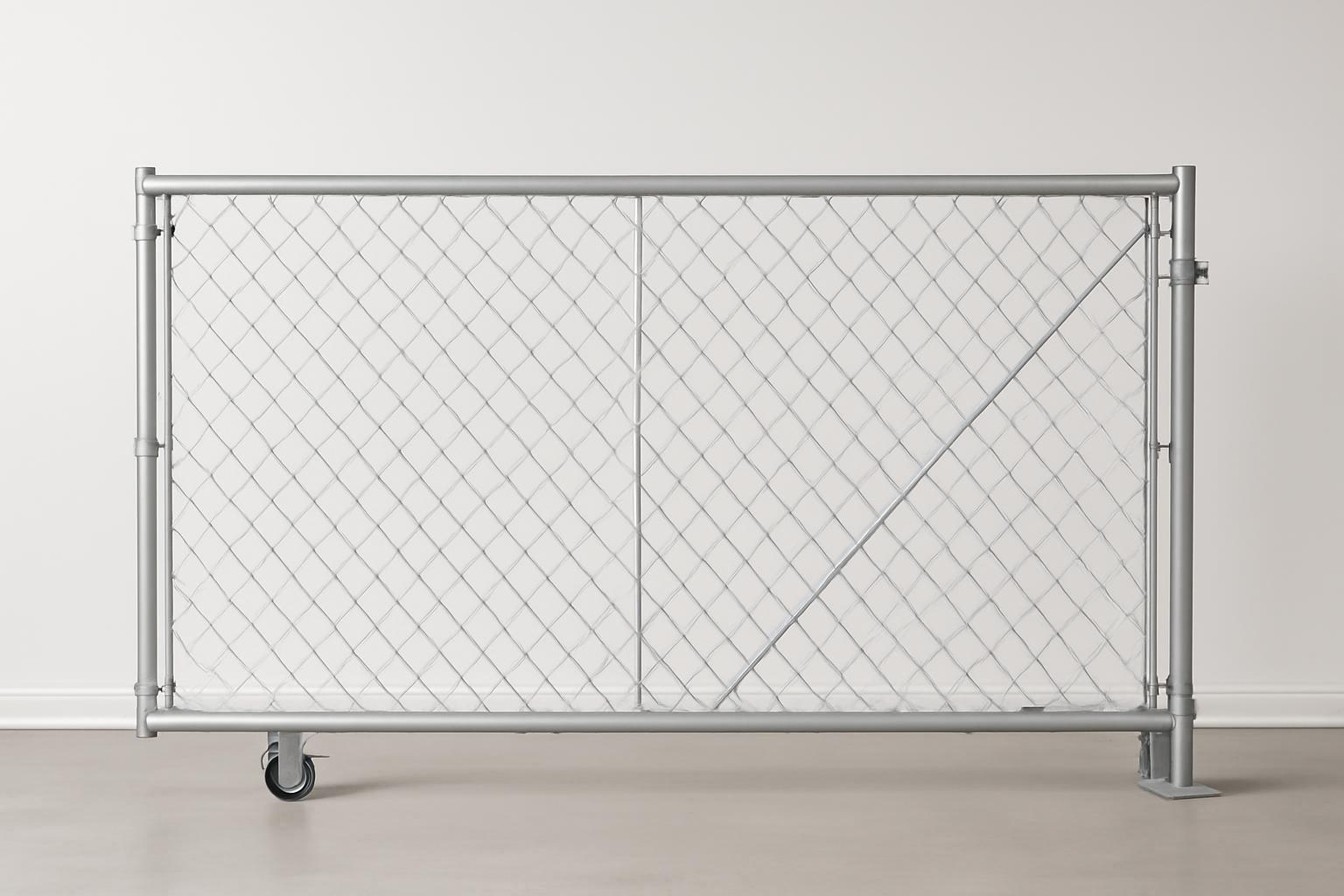
A rolling chain link fence gate can create a wide vehicle opening without consuming the sweep area of a hinged gate. It is not a universal solution, however. The gate still needs room to store beside the fence, and a ground-supported design needs a firm, reasonably smooth route for its front wheels.
The buying challenge is that sellers use “rolling,” “sliding,” and “cantilever” inconsistently. Listings may also represent three very different purchases: a gate leaf, an operating-hardware kit, or a complete system. Before ordering, identify how the gate is supported, measure both the opening and runback, inspect the wheel path, and obtain written confirmation of package contents and component capacities.
What a rolling chain-link fence gate is—and what it is not
A ground-supported rolling chain-link gate is a framed gate leaf that moves horizontally, parallel to the fence. It does not rotate through an arc like a swing gate. In one documented pipe-track arrangement, two rollers near the back of the gate travel on upper and lower tracks mounted along the fence, while a double-wheel carrier near the leading lower edge rolls on the ground. The installation manual shows the tracks, rear rollers, front carrier, guides, and latch arrangement.
A labeled system diagram should identify:
- The framed gate leaf and chain-link fabric
- Support or line posts along the runback
- The latch post at the closed end
- Upper and lower pipe tracks
- Track brackets attached to the support posts
- Upper and lower rear rollers
- The front double-wheel carrier
- Lower lift-prevention guides
- The latch and receiver
- A padlock provision, if supplied
- Fasteners, clamps, U-bolts, and post fittings
The rear rollers carry and guide the back of the leaf. Their guides must keep the gate engaged with the tracks without squeezing or misaligning the assembly enough to cause binding. The front carrier supports and steers the leading end as the gate crosses the driveway or yard.
A cantilever gate also slides parallel to the fence, but its leaf is suspended above the ground. Support rollers carry an extended frame that includes a counterbalance section behind the opening. There is no front ground wheel following the driveway surface. That distinction changes the required frame length, post and foundation arrangement, operating hardware, and site conditions.
A swing gate turns on hinges like a door. It does not need fence-line storage equal to the gate’s travel, but it needs clear space through its entire opening arc. Vehicles, snow piles, curbs, grade changes, and stored equipment cannot occupy that arc.
Do not buy from the product name alone. Some sellers call a suspended cantilever gate a rolling gate; others reserve “rolling” for a gate with a front wheel on the ground. Ask for a side-view drawing or installation manual and answer three questions:
- Does any wheel contact the ground?
- Does the gate run on fence-mounted pipe tracks?
- Does the frame include an extended counterbalance section?
Those answers identify the operating design more reliably than the listing title.
Rolling, cantilever, or swing: match the gate to the site
The right design depends on the site, not just the opening width. Compare lateral storage, surface condition, drainage, winter weather, traffic, manual effort, grade, and any future automation before comparing prices.
| Factor | Ground-rolling gate | Cantilever gate | Swing gate |
|---|---|---|---|
| Movement | Slides parallel to fence | Slides parallel to fence | Rotates on hinges |
| Ground contact | Front carrier rolls on the ground | Gate leaf is suspended | Leaf may clear the ground but travels through an arc |
| Storage or movement space | Needs unobstructed fence-line runback | Needs runback for the opening and counterbalance frame | Needs a clear swing arc |
| Surface needs | Firm, reasonably smooth wheel path | Ground below the leaf is not the rolling surface | Grade must not obstruct the arc |
| Debris and winter exposure | Wheel path can be affected by debris, mud, ice, or snow | Less dependent on the driveway surface | Snow and stored items can block the swing area |
| Typical frame length | Often near the opening width, subject to hardware and clearances | Common seller examples use about 1.5 times the opening | Leaf generally corresponds more closely to the opening |
| Manual use | Practical when aligned and supported by a sound wheel path | Practical when properly sized and balanced | Depends on leaf size, hinges, wind, and grade |
| Automation | Requires system-specific approval | Commonly considered for powered sliding systems | Requires a compatible swing operator and safety design |
A rolling gate eliminates the large clear arc required by a swing gate, but it does not eliminate spatial requirements. When open, the leaf must store somewhere. The adjoining fence line needs to remain clear of landscaping, bollards, parked equipment, curbs, utility cabinets, signs, and stored materials.
As a planning rule rather than a universal fabrication specification, a ground-rolling gate generally needs runback roughly corresponding to the clear opening. Cantilever leaves need additional length for their counterbalance; seller examples commonly use a leaf about 1.5 times the opening. Pacific Fence describes these general storage-space differences.
For an 8-foot opening, begin by checking for approximately 8 feet of unobstructed fence-line runback. Then account for the delivered frame, roller offsets, latch arrangement, open-position stop, brackets, and working clearance. Do not set posts from the 8-foot estimate alone.
Surface condition is one important limitation of a ground-wheel design. The carrier needs a firm, reasonably smooth travel path. Do not assume dependable operation in those conditions without supplier approval and a suitably prepared path.
Inspect drainage as well as visible smoothness.
Hoover Fence recommends rolling gates mainly where manual operation is planned and suggests cantilever or internal-track systems when automation is intended. That is retailer guidance, not a universal engineering rule, but it is a useful warning against assuming that any manually operated sliding gate can accept an opener. The retailer distinguishes among rolling, cantilever, and internal-track products here.
Consider a manufacturer-reviewed cantilever or internal-track system when rough terrain, recurring snow or ice, difficult drainage, demanding traffic, or planned automation makes a ground-wheel arrangement questionable. This does not mean cantilever gates are categorically better; it means a suspended leaf does not rely on the driveway as part of its rolling mechanism.
Measure the opening, runback, posts, and wheel path before ordering
Measure before requesting a quote, and measure the delivered components again before permanently locating posts. A nominal gate size does not necessarily equal the required post spacing, finished clear opening, or total storage length.
America’s Fence Store instructs buyers to measure the opening at both the top and bottom on a level plane, aiming for accuracy within plus or minus 1/8 inch and generally using the smaller dimension. For a rolling gate, its guide also calls for measurements between the gate posts and between the adjoining support posts that carry the open gate. See the retailer’s measurement method.
Printable measurement worksheet
| Measurement or site condition | Field entry |
|---|---|
| Required clear opening width | ____ |
| Opening width at top, inside to inside | ____ |
| Opening width at bottom, inside to inside | ____ |
| Opening height | ____ |
| Clear fence-line runback | ____ |
| Additional end or hardware clearance | ____ |
| Spacing between adjoining support posts | ____ |
| Existing post outside diameter | ____ |
| Proposed or supplied track diameter | ____ |
| Gate-frame member outside diameter | ____ |
| Latch and receiver clearance | ____ |
| Front wheel-path width | ____ |
| Longitudinal grade | ____ |
| Cross-slope | ____ |
| Surface material and condition | ____ |
| Drainage channels or low points | ____ |
| Curbs, bollards, landscaping, or equipment | ____ |
| Underground or overhead utility conflicts | ____ |
| Snow-storage area or winter obstruction | ____ |
| Seller-confirmed total gate length | ____ |
| Seller-confirmed finished post spacing | ____ |
Keep the tape level instead of following the ground. If the top and bottom measurements differ, determine whether the posts lean, the opening is out of square, or the grade is distorting the measurement. Do not average the figures without consulting the fabricator.
For a ground-rolling system, record:
- The inside-to-inside distance between the closed-position gate post and latch post
- The inside-to-inside spacing between adjoining line or support posts
- Total unobstructed runback beyond the opening
- Actual width and condition of the front-wheel path
- Clearance around tracks, brackets, guides, and the stored gate
Walk the full runback instead of inspecting it only from the opening. Look for shrubs, curbs, parked carts, waste enclosures, fire equipment, signs, utility boxes, drainage swales, stored materials, or grade transitions that may interfere only when the gate is nearly open.
Inspect every part of the front-wheel route. Mark broken pavement, soft shoulders, loose gravel, mud, depressions, drainage channels, raised joints, and areas where snow is stored during plowing. A short obstruction can stop an otherwise aligned gate.
Do not assume that an existing fence post is adequate merely because a bracket fits around it. Outside diameter answers only a hardware-fit question. Obtain written confirmation from the system supplier or have the support assessed by a qualified professional.
U.S. property owners should contact 811 before excavation so participating utilities can mark buried facilities. Hoover Fence’s pre-installation guide includes these property, permit, and utility checks.
Finally, measure the delivered gate and hardware before fixing post locations. Confirm total frame length, leading-edge position, roller offsets, latch reach, bracket dimensions, and track-joint locations. Hardware offsets can make nominal catalog dimensions an unsafe basis for permanent layout.
Build a complete parts list—not just a gate-leaf shopping cart
Rolling-gate listings generally fall into three purchase categories:
- Bare or minimally equipped gate leaf: Primarily the framed, fabric-covered gate.
- Hardware-only kit: Wheels, rollers, brackets, and a latch, but not necessarily the gate, posts, or tracks.
- Complete system: Represented as including the gate, posts, and operating hardware, although the buyer should still require an itemized packing list.
A working ground-rolling system may require:
- Framed chain-link gate leaf
- Chain-link fabric and attachment hardware
- Dedicated support posts where required
- Latch post
- Post caps
- Concrete foundations or an engineered alternative
- Upper and lower pipe tracks
- Track brackets and U-bolts
- Upper and lower rear rollers
- Rear-roller mounting brackets
- Front double-wheel carrier
- Wheels and axles
- Lift-prevention guides
- Padlockable latch and receiver
- Stops, fasteners, and adjustment hardware
- Surface preparation or a dedicated rolling strip
- Optional access-control equipment as part of an approved system
One Signet Fence hardware kit includes six universal track brackets, two rear rollers with brackets, a double-wheel carrier with two wheels, and a padlockable rollo latch. The listing covers operating hardware rather than a gate frame, chain-link fabric, posts, concrete, or track pipe. The seller itemizes the residential and commercial kits here.
The opposite problem appears in gate-leaf listings. A product page may explain that rear wheel assemblies and a front carrier are required while displaying those assemblies as separately priced related products. An operating description is not proof that the operating parts are included.
America’s Fence Store labels its rolling-gate selections “Includes Hardware,” but the available collection description does not itemize the package. That heading could mean complete operating hardware, selected fittings, or something narrower. Ask the retailer to identify every included component in writing rather than interpreting a category-page label.
Seller-verification checklist
Ask the seller to mark each item as included, excluded, or optional:
- Gate leaf and chain-link fabric
- Front carrier and both front wheels
- Rear rollers and roller brackets
- Upper and lower track pipe
- Track sleeves, brackets, and U-bolts
- Lift-prevention guides
- Latch and receiver
- Support posts and latch post
- Post caps
- Fasteners
- Concrete or foundation work
- Freight
- Lift-gate delivery or unloading
- Installation
- Surface preparation
- Taxes and permit costs
- Stops or open-position restraints
- Automation and safety equipment
On delivery, compare every package with the order and packing list. Check actual gate dimensions, frame specification, finish, fabric, visible welds, wheel diameter, bracket fit, track diameter, fasteners, and latch orientation. Resolve missing or incompatible parts before setting posts around assumptions that may be wrong.
Compare sizes, frame grades, wheel kits, finishes, and real package prices
Retail examples span a broad range, but availability does not establish suitability. Hoover Fence’s category filters cover widths from 6 to 40 feet and heights from 4 to 8 feet. The same page describes a residential rolling-gate frame as all 1-5/8-inch galvanized pipe with a 0.065-inch wall and a commercial version as an all-1-5/8-inch HF20 frame. These are seller specifications, not universal capacity ratings. See the listed size filters and frame descriptions.
Another commercial 8-by-8-foot listing identifies 1-5/8-inch framing and approximately 0.085-inch pipe. That specification can help distinguish products, but it does not establish capacity without the finished gate weight, bracing, wind exposure, support arrangement, and expected duty.
Hardware labels are similarly qualitative. Signet Fence’s residential kit uses 6-inch wheels and an approximately 6-inch-wide carrier, while its commercial kit uses 8-inch wheels and an approximately 12-inch-wide carrier. The seller directs lighter or shorter gates toward the residential kit and heavier or wider gates toward the commercial version, but it provides no numerical gate-weight or opening-width threshold. Wheel diameter alone is not a capacity rating. Review the two kit configurations and their stated selection guidance.
Listings support galvanized and black finishes, along with barbwire and no-barbwire configurations. Verify whether “black” applies to the frame, fabric, fittings, or every visible component. Confirm separately whether barbwire is permitted at the proposed height and location.
Use a normalized table when comparing quotes:
| Comparison field | Quote A | Quote B | Quote C |
|---|---|---|---|
| Clear opening size | |||
| Gate height | |||
| Total frame length | |||
| Frame outside diameter | |||
| Wall or frame grade | |||
| Bracing specification | |||
| Wheel diameter | |||
| Carrier width | |||
| Finish | |||
| Barbwire | |||
| Gate leaf included | |||
| Wheels and rear rollers included | |||
| Track and brackets included | |||
| Posts included | |||
| Required track diameter | |||
| Required post specification | |||
| Shipping and unloading | |||
| Advertised price | |||
| Estimated installed total |
The following 8-by-8-foot examples illustrate why sticker prices should not be compared without package details. Prices were checked on July 30, 2026 and may change.
| Listing example | Advertised price | What the available listing establishes | Important unknowns or additions |
|---|---|---|---|
| First Fence US, galvanized 8-by-8-foot gate | $247.91 | Gate listing; approximately 0.085-inch commercial pipe; rear and front wheel assemblies shown separately at $30.10 and $39.64 | Wheel inclusion is unclear; track and shipping are additional or not established |
| America’s Fence Store, 8-by-8 without barbwire | $686.70 | Collection says “Includes Hardware” | Exact hardware contents, shipping, posts, and installation are not itemized |
| America’s Fence Store, 8-by-8 with barbwire | $825.61 | Collection says “Includes Hardware” and identifies a barbwire configuration | Exact hardware contents, shipping, posts, installation, and local barbwire approval remain unresolved |
The lower-priced First Fence US page shows the gate at $247.91 and the related rear and double-wheel assemblies separately at $30.10 and $39.64, with shipping added at checkout. Review the listing, frame description, and separately displayed wheel assemblies.
America’s Fence Store listed the 8-by-8-foot configurations at $686.70 without barbwire and $825.61 with barbwire, but its collection-level “Includes Hardware” label did not itemize the package in the available material. See the two advertised configurations.
These figures are seller examples, not market averages or installed-cost estimates. The apparent price advantage can disappear after adding wheels, tracks, brackets, posts, concrete, freight, unloading, labor, permits, and surface work. A higher-priced package is not necessarily complete merely because a collection heading mentions hardware.
Before selecting a “residential” or “commercial” package, request written capacity and compatibility information addressing:
- Proposed opening and total gate length
- Finished gate weight
- Wheel and roller ratings
- Track and bracket compatibility
- Post and foundation requirements
- Wind exposure
- Expected operating frequency
- Manual or powered operation
- Barbwire or other added loads
If the seller cannot provide meaningful compatibility or capacity information, do not infer it from marketing labels.
Manual installation overview: posts, tracks, wheels, and latch
This is a planning overview, not a universal engineered specification. Local code, soil, frost depth, drainage, wind, gate dimensions, manufacturer instructions, and project-specific engineering take precedence.
A typical sequence is:
- Complete permit, property, and utility checks.
- Establish the opening, runback, wheel path, and post layout.
- Prepare drainage and the rolling surface as required.
- Set suitable support and latch posts.
- Align and brace the posts while foundations cure as required.
- Confirm the delivered gate dimensions and square the frame.
- Mount the upper and lower track brackets.
- Install straight, parallel pipe tracks with smooth joints.
- Attach the rear rollers to the gate.
- Mount the front double-wheel carrier.
- Place and secure the gate using adequate lifting support.
- Adjust roller engagement and lift-prevention guides.
- Install and align the latch.
- Test the complete travel repeatedly.
- Tighten all hardware and recheck engagement.
In one documented kit configuration, track-support posts are placed at approximately 8-foot centers and specified as at least 2-1/2-inch Schedule 40 posts. Brackets sit about 1 foot above the fence bottom and 1 foot below the top, and the upper and lower tracks use 1-5/8-inch Schedule 40 pipe cut to fit tightly between brackets. These are product-specific instructions, not universal post-sizing or structural rules. The kit manual provides the complete dimensional arrangement.
A loose, offset, or raised track joint can create a lip that catches a roller. Maintain consistent spacing between the upper and lower tracks for the entire run. If the distance narrows or widens, the rear rollers can bind even when each track looks straight by itself. Verify alignment against the actual gate and roller spacing, not only against the fence fabric.
In that documented arrangement, rear rollers mount on the outside face of the gate’s rear vertical support, approximately 1 foot from the top and bottom. The front double-wheel carrier mounts as far forward as practical on the lower horizontal member. Other frames and hardware systems may require different locations.
Lower guides should prevent the gate from being lifted off its tracks while retaining enough clearance for free travel. Guides set too tightly can bind. Excessive clearance can allow poor engagement. Follow the supplied adjustment method and check the gate at multiple positions because clearances may vary along the run.
Mount the rollo-style latch so it captures the naturally resting closed gate and accepts a padlock when that is part of the design. Do not lift or force the leading edge into the receiver during testing. If the latch misses, correct the gate alignment or approved latch adjustment rather than relying on downward pressure or momentum.
A large gate can be heavy and awkward even when it moves easily after installation. Handling may require multiple workers, safety straps, come-alongs, or lifting equipment. Secure the leaf against falling and uncontrolled movement whenever rollers, guides, or carriers are being installed or adjusted. A retailer installation guide specifically cautions that large gates may require several people or lifting support.
Diagnose binding, dragging, drifting, lift-off, and latch problems
Stop operating a gate that is derailing, leaning, or moving unpredictably. Retailer guidance identifies falling gates, moving parts, pinching, and crushing as installation and operating hazards, so troubleshooting should begin with secure support and observation rather than repeated force. America’s Fence Store identifies these hazards in its gate guide.
| Symptom | What to inspect | Appropriate response |
|---|---|---|
| Binds at one location | Track spacing, raised joints, loose sleeves, shifted brackets, debris | Clear the route and restore track or joint alignment before retesting |
| Drags or feels uneven | Front wheel path, carrier position, wheel condition, frame squareness, rear-roller contact | Correct the support or surface problem rather than forcing the leaf |
| Drifts toward or away from fence | Cross-slope, carrier alignment, axle adjustment where provided | Make restrained, approved adjustments and test the full travel |
| Gate can lift from track | Lower-guide clearance and rear-roller engagement | Stop use until the guides capture the track without binding |
| Jumps or derails | Track joints, brackets, post movement, wheel damage, guide engagement | Secure the area and inspect the complete support system |
| Latch misses receiver | Gate level, closed position, leading-edge alignment, post movement, receiver height | Correct gate alignment before relocating the latch |
| New sag or recurring misalignment | Frame damage, post lean, cracked foundations, settlement | Obtain professional assessment |
For binding at one location, compare the upper-to-lower track spacing before, at, and after the problem point. Inspect both tracks for joints that have loosened, rotated, or risen. Check whether a bracket has slipped and whether debris or surface damage is affecting the front wheels at the same location.
For dragging, determine whether the front carrier supports the leading edge correctly and whether both rear rollers bear as intended. Look for wheel damage, a twisted carrier, an out-of-square frame, depressions in the rolling path, or post movement.
Some documented double-wheel carriers include an axle trim bolt that adjusts travel direction. Where the supplied hardware provides that feature, make restrained adjustments according to its instructions and retest from fully closed to fully open. Do not use carrier steering to conceal a leaning post, damaged track, or unsuitable wheel path.
If the gate can lift off, inspect lower guides and roller engagement immediately. The guides should capture the track without clamping it. If the gate jumps, derails, or threatens to fall, remove it from service until the tracks, joints, brackets, wheels, guides, and posts have been checked.
A latch that previously aligned but now misses may indicate more than latch movement. Check whether the gate is level, whether its leading edge reaches the same closed position, and whether the latch post or foundation has shifted. New sagging, cracked concrete, leaning posts, a bent frame, or recurring derailment warrants professional assessment rather than repeated wheel adjustment.
Routine attention should remain limited to supported tasks: keep the travel route clear, check fasteners, inspect track alignment and guide engagement, look for visible wheel damage, and test the latch. Use only lubrication and servicing procedures specified for the supplied components; there is no universal product or maintenance interval established by the available evidence.
Permits, engineering, manual safety, and automation limits
Manual-gate precautions and powered-gate compliance are separate subjects. A padlockable latch, roller cover, or lift-prevention guide can be one component of a manual system, but none represents a complete automated-gate safety design.
For a manual installation:
- Support the gate securely while fitting or adjusting hardware.
- Keep hands away from wheel, roller, bracket, and latch pinch points.
- Keep people outside the gate’s possible fall path.
- Use suitable assistance for heavy or awkward lifting.
- Prevent uncontrolled movement on a slope.
- Install and verify lift-prevention guides throughout the full travel.
- Guard exposed pinch points where the design or local requirements call for it.
- Confirm that the latch reliably holds the closed gate.
- Do not permit use while posts, tracks, foundations, guides, or wheels are visibly compromised.
America’s Fence Store states that roller covers must be installed to protect others in accordance with ASTM 2200 and UL325 [Galvanized Steel Slide Gate
– America's Fence Store](https://americasfencestore.com/collections/galvanized-steel-slide-gate). This is a seller’s standards-related statement, not proof that a particular powered installation complies, and it does not describe all applicable requirements.
Automation cannot be assumed merely because a gate slides. Confirm compatibility with the gate manufacturer, operator manufacturer, and a qualified installer responsible for the complete safety system.
Professional fence, gate-system, or engineering input becomes especially important for:
- Very large or heavy gates
- Uncertain existing-post capacity
- Unknown or inadequate foundations
- Significant wind exposure
- Difficult soil, drainage, or frost conditions
- Unusual or changing grade
- High traffic or demanding duty
- Public, multifamily, or commercial access
- Any powered operation
- Projects for which the permitting authority requests calculations
As a bounded example, Engineering Express markets an engineer-sealed performance evaluation for an 8-foot-high by 25-foot-wide rolling chain-link gate, including track-bracket and wheel details for permit documentation under selected codes. That generic evaluation does not establish suitability for another gate size, replace site-specific engineering, or guarantee acceptance by a permitting authority. Review the provider’s stated scope and limitations.
Go/no-go checklist
Stop before purchase or installation if any answer is “no”:
- Can the seller identify whether the gate is ground-rolling or cantilevered?
- Is the clear opening confirmed at both top and bottom?
- Is the complete fence-line runback unobstructed?
- Is the ground-wheel path suitable throughout the travel?
- Is every included and excluded component documented?
- Are the frame, wheels, rollers, tracks, brackets, posts, and latch compatible?
- Has the supplier documented suitability for the proposed width and weight?
- Have wind exposure and expected operating frequency been considered?
- Are permits, property restrictions, and utility checks complete?
- Is the handling plan appropriate for the gate’s weight?
- If automation is intended, is the complete powered-gate system being designed and reviewed accordingly?
How much fence-line space does a rolling chain-link gate need?
A ground-rolling gate generally needs unobstructed runback roughly equal to its opening, plus clearance for the frame, brackets, rollers, stops, and access around the stored gate. For an 8-foot opening, use approximately 8 feet only as an initial planning figure, then rely on the delivered system’s dimensions for final layout.
A cantilever gate needs more room because its frame includes a counterbalance section. Seller examples commonly use a total leaf around 1.5 times the opening, sometimes with additional operating clearance. Neither estimate replaces the fabricator’s drawing.
Can a rolling chain-link fence gate work on gravel, a slope, snow, or uneven pavement?
Do not assume it will. A ground-supported rolling gate depends on a firm, reasonably smooth wheel path. Loose gravel, soft soil, mud, snow, ice, broken pavement, drainage channels, frost movement, and cross-slope can obstruct or redirect the front carrier.
Where difficult terrain or recurring winter obstruction cannot be controlled, compare a manufacturer-reviewed suspended cantilever or internal-track system.
Does a rolling-gate hardware kit include the gate, posts, and track?
Not necessarily. A documented hardware-only kit includes track brackets, rear rollers and brackets, a double-wheel carrier with wheels, and a padlockable latch while excluding the gate frame, fabric, posts, concrete, and track pipe.
Other listings sell a gate leaf with essential wheel assemblies shown separately, while some say “includes hardware” without itemizing it. Require a written packing list covering the leaf, wheels, rollers, tracks, brackets, guides, latch, posts, fasteners, freight, and unloading.
Can a manual rolling chain-link gate be automated later?
Only if the gate, operator, support structure, and required safety equipment are confirmed as compatible. Sliding movement by itself does not make a manual gate suitable for an opener.
If later automation is likely, disclose that before buying. A cantilever or internal-track package designed and documented for powered use may be a better starting point than retrofitting an unspecified ground-wheel gate. Operator selection and entrapment protection should follow manufacturer instructions and applicable requirements.
Why does a rolling chain-link gate bind or come off its track?
Guides set too tightly can cause binding; excessive clearance may fail to prevent lift-off. If the gate jumps, derails, leans, or repeatedly loses alignment, stop using it and inspect the complete support system rather than making isolated wheel adjustments.
Choose a rolling chain link fence gate only after confirming the operating design, usable opening, full runback, wheel-path condition, package contents, component compatibility, and documented capacity. A ground-rolling gate can be a practical manual solution on a smooth, well-drained site. Rough terrain, uncertain structural support, unusual loads, demanding traffic, or automation should trigger manufacturer review and qualified professional input rather than an improvised installation.