
A Preservation-First Method for Finding the Objects Worth a Closer Look
Preserve evidence, combine independent clues, compare only close completed sales, then escalate when photos and home research fall short.
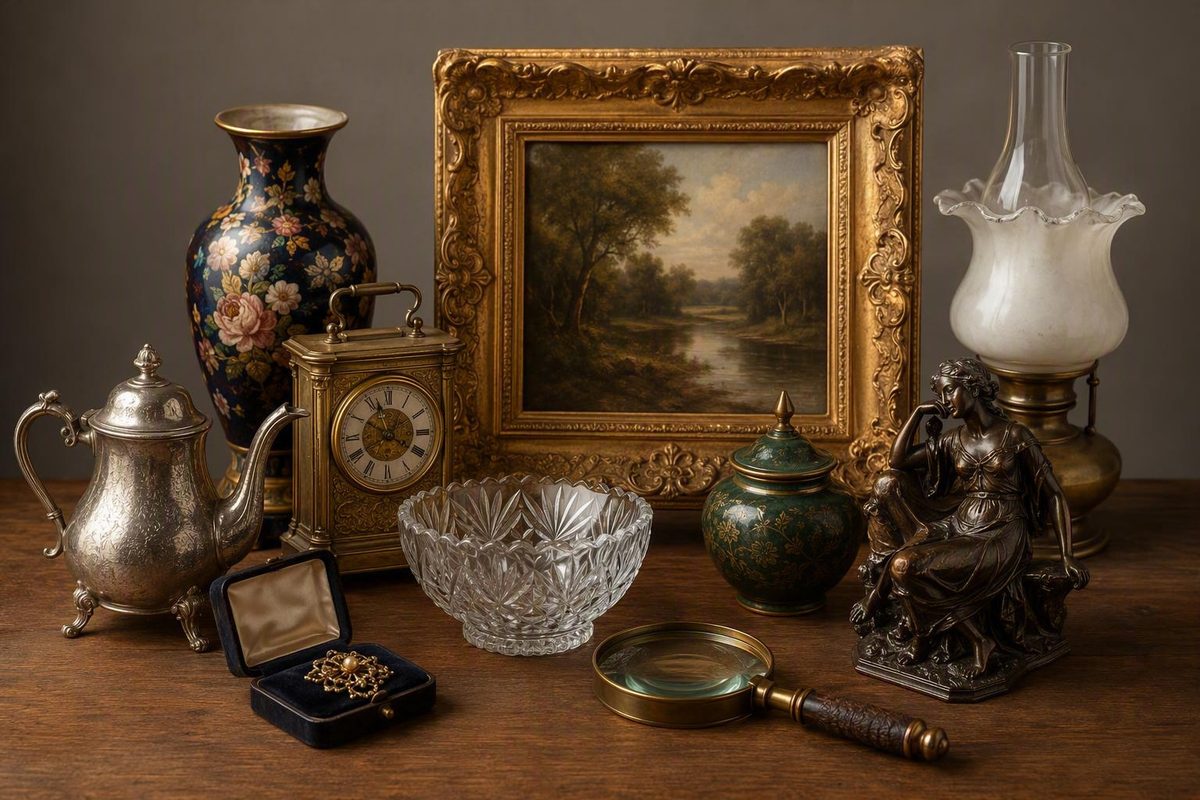
- A preservation-first method for finding the objects worth a closer look*
Learning how to identify valuable antiques at home is less about spotting one magical sign than building a case from several independent clues. A signature may be copied. A family story may be mistaken. Old hardware may be a later replacement, and an impressive asking price may never attract a buyer.
The safest sequence is straightforward: stop, secure, photograph, inventory, inspect, identify, verify, compare, and escalate. Here, “secure” means preventing unnecessary handling, restricting access, and keeping related components together—not wrapping, taping, moving, or altering the object unless safety requires it.
This process will not turn a beginner into an authenticator.
Start With the Right Question: Valuable, Old, or Merely Old-Looking?
An antique is commonly described as an object at least 100 years old. Younger objects may instead be called vintage or collectible, although definitions of “vintage” vary. More importantly, none of these labels establishes market value. Age must be considered alongside craftsmanship, rarity, condition, provenance, and buyer demand, as this overview of antique identification explains.
A common, mass-produced object can survive for a century without becoming desirable. Conversely, a younger piece of design, jewelry, studio pottery, advertising, fashion, or popular culture may attract committed collectors. Rarity also needs demand: an object can be scarce because few buyers ever wanted it.
Potential value comes from the interaction of several factors:
- Identity: Who made it, where, when, and for what purpose?
- Authenticity: Is it what it appears to be?
- Age: Does the proposed date fit the object’s materials, construction, style, and history?
- Materials: Is it made from the claimed material or merely imitating it?
- Craftsmanship: How was it constructed, decorated, cast, painted, or assembled?
- Originality: Are its finish, components, fittings, and decoration substantially original?
- Condition: Is it complete and stable, or damaged, altered, or deteriorating?
- Rarity: How many genuinely comparable examples seem to survive?
- Provenance: Can its ownership or history be documented?
- Aesthetics and significance: Is its form, design, subject, or association especially appealing?
- Buyer demand: Are people currently purchasing this maker, category, or form?
Separate your investigation into four questions:
- What is the object? Identify its category, maker or workshop, material, form, pattern, approximate period, and intended use.
- Is it genuine and substantially original? Test the proposed identity against its construction, materials, marks, wear, and repairs.
- Is there an active market for it? Look for close, recent completed sales and note unsuccessful offerings.
- What kind of value do you need? A resale estimate, auction estimate, fair-market value, insurance replacement value, and likely net sale proceeds answer different questions.
Spectacular discoveries do occur, but they are uncommon. The realistic goal is not to find a fortune in every attic or storage box. It is to recognize objects that deserve research before they are altered, separated, donated, or sold cheaply.
Myth versus reality
- Myth: “It is old, so it must be valuable.” Reality: Age is only one factor; common objects with weak demand may sell for little.
- Myth: “It is heavy, so it must be high quality.” Reality: Weight can reflect material or construction, but it does not prove age, quality, or precious-metal content.
- Myth: “It is handmade, so it must be valuable.” Reality: Handwork can support an identification, but quality, maker, condition, rarity, and demand still matter.
- Myth: “It is signed, so it is authentic.” Reality: Signatures and prestigious marks can be copied, added later, or misunderstood.
- Myth: “I cannot find another one, so it must be rare.” Reality: It may be misidentified, poorly indexed, assembled from several objects, or simply unwanted.
The First-Pass Home Triage: Stop, Document, and Prioritize
When you find a promising object, do not begin by making it look better. Avoid cleaning, polishing, repairing, refinishing, dismantling, replacing components, or throwing away detached parts.
When practical, photograph the object where you found it before moving it. It also creates an initial record before handling.
For a room-by-room survey:
- Work methodically. Complete one room, cabinet, box, or storage area before moving to the next.
- Assign an inventory number. Use a neutral code such as
DR-014for dining room object 14. Put the code on a separate card in photographs rather than attaching it to the object. - Record the original location. Note the room, shelf, drawer, box, or storage-unit area.
- Take initial photographs. Do this before extensive handling or repositioning.
- Keep associated material together. Preserve keys, lids, shades, stands, frames, chargers, fitted cases, tags, packaging, receipts, and detached fragments.
- Move only when necessary. Do not turn over large furniture, lift heavy stone, or remove a painting from its frame merely to satisfy curiosity.
- Create a “research first” area or list. Separate promising objects conceptually or physically without stacking fragile materials together.
A useful photographic record should show:
- The complete front and back
- Both sides
- The top
- The underside or base, if safely accessible
- A three-quarter view showing overall form
- Marks, signatures, labels, inscriptions, and numbers
- Joints, fasteners, hardware, and construction details
- Damage, staining, cracks, chips, losses, and repairs
- Replacement or mismatched components
- Every detached part or accessory
- A scale or ruler when size is otherwise difficult to judge
Photograph each mark twice: once in context, showing where it appears, and once close enough to read. Use even light, steady focus, and a plain background. Keep the original, unedited photographs even if you later make brighter or cropped copies for research.
Your written record should include:
- Inventory number and location found
- Height, width, depth, and relevant diameters
- Weight, if readily and safely measurable
- Apparent materials
- Colors, decoration, subject, and overall form
- An exact transcription of every visible mark
- Defects, missing components, and instability
- Known repairs, restoration, refinishing, or polishing
- Associated accessories and documents
- Family history, clearly labeled as recollection rather than verified fact
These details are also the kind of information online and in-person specialists use when reviewing an object; commercial appraisal guidance recommends supplying dimensions, materials, condition, known history, and photographs from multiple angles (Mearto).
Prioritize research when an object has:
- A legible maker, workshop, artist, or material identifier
- Unusual or notably skilled workmanship
- A potentially valuable material
- Documented ownership or acquisition history
- Original accessories, packaging, labels, or a fitted case
- A plausible connection to a known maker
- A complete set whose parts could be difficult to reunite
- Condition or construction that is difficult to interpret
This is triage, not authentication or appraisal. Its purpose is to preserve evidence and decide where to spend research time.
Brief safety stop
Stop handling an object if it is exceptionally heavy, structurally unstable, actively flaking, moldy, contaminated, electrically unsafe, sharply broken, or made from an unknown material that may present a hazard. Isolate access without attaching anything to the object and seek appropriate specialist help rather than experimenting at home.
Find and Decode Marks Without Treating Them as Proof
An identifying mark can be a maker’s mark, handwritten signature, stamp, hallmark, paper label, foundry mark, trademark, registration mark, patent detail, pattern number, mold number, workshop symbol, retailer’s label, or inventory notation.
Look in places chosen to be inconspicuous but accessible during manufacture or sale:
- Pottery, porcelain, and glass: Base, underside, foot ring, inner bottom, or near the lower edge
- Silver and metalware: Underside, rim, handle, foot, interior, or near a joint
- Jewelry: Inside ring bands, behind pendants, near clasps, inside brooch fittings, and on earring posts or backs
- Furniture: Backs, drawer interiors and bottoms, undersides, seat frames, hardware, locks, and unfinished surfaces
- Paintings: Painted front, canvas or panel back, stretcher, frame, labels, and old exhibition or shipping tags
These locations and the broad range of mark types are summarized in a guide to antique markings, although its publisher also promotes a commercial identification service. Use such guides to generate leads, not to settle authenticity.
Use good lighting and a loupe or magnifying glass. Do not rub chalk, graphite, polish, or cleaning solution into a faint stamp.
A mark may identify a maker, workshop, retailer, country, material standard, pattern, registration, or production period. It may not mean what it first appears to mean. A number could denote a mold, pattern, shape, size, batch, registration, or inventory entry rather than a date.
On silver-colored objects, STERLING, 925, and .925 are useful research leads associated with sterling silver, while EPNS denotes electroplated nickel silver rather than solid sterling. These markings guide further investigation; they do not independently authenticate the object or establish its value.
Use this verification process:
- Transcribe the mark exactly. Preserve capitalization, punctuation, spacing, symbols, orientation, and any surrounding shape.
- Record its placement. Note precisely where and how it appears.
- Search descriptive variations. Try the text, symbol, object category, material, and possible country together.
- Consult category-specific references. Prefer established mark directories, museum collections, manufacturer records, specialist books, catalogues raisonnés where relevant, and reputable auction archives.
- Check mark versions. Makers sometimes changed names, typefaces, symbols, partnerships, addresses, or country-of-origin wording.
- Compare application methods. Determine whether verified examples are impressed, engraved, painted, printed, cast, or applied as paper labels.
- Test the identification against the object. Material, form, quality, construction, and decoration should fit the attributed maker and period.
A prestigious name on poor workmanship is a warning, not a windfall. Marks and signatures can be copied, transferred, added later, partly erased, misread, or attached to reproductions. A genuine label can even remain on an altered or incorrectly assembled object.
The absence of a mark does not make an object worthless. Some furniture, folk art, glass, ceramics, textiles, and workshop production were never permanently marked; paper labels may also have disappeared. An unmarked piece should move to material and construction analysis rather than directly to the discard pile.
Inspect Materials and Construction, Especially in Hidden Areas
Decorative fronts are designed to persuade the eye. Backs, bases, drawer interiors, unfinished surfaces, joints, and hardware often reveal more about how an object was made.
Do not use one construction feature as a dating formula. Irregular dovetails, old-looking screws, oxidized metal, shrinkage, or tool marks can support a hypothesis, but repairs, regional practices, reused materials, and reproductions complicate interpretation. Auction-house guidance likewise recommends evaluating materials, tool marks, hardware, construction, condition, and provenance together rather than relying on one clue (Fontaine’s Auction Gallery).
Furniture
Determine whether apparently solid surfaces are solid wood, veneered, laminated, or assembled from several materials. Veneer is not automatically inferior; it may be an intentional element of fine furniture.
Examine:
- Dovetails for layout, variation, wear, and compatibility with the rest of the piece
- Mortise-and-tenon or other structural joints
- Drawer bottoms and how they are fitted
- Backs and undersides for tool marks and unfinished wood
- Grain direction, shrinkage, oxidation, and color differences
- Locks, hinges, pulls, escutcheons, casters, screws, nails, and evidence of former hardware
- Finish in protected areas compared with exposed surfaces
- Added blocks, replacement feet, cut-down legs, new screws, or reconstructed drawers
A useful question is not “Does this have old dovetails?” but “Do the joints, timber, hardware, finish, wear, and overall design tell the same story?”
Ceramics and porcelain
Record the body color and texture, apparent translucency, wall thickness, glaze, foot ring, kiln evidence, and decoration. Look closely at whether decoration appears hand-painted, printed, transferred, stenciled, or later applied.
Inspect impressed, painted, printed, or incised marks without assuming that a number is a production date. Compare both the mark and the physical object with verified examples from the proposed factory, workshop, or period.
Glass
Study the base and rim, pontil or mold evidence, seams, bubbles, weight, color variation, grinding, polish, and damage. These features can help narrow possible manufacturing methods, but bubbles, irregularity, weight, or a pontil-like base do not independently prove great age.
Paintings
Photograph the entire work before examining its support. Record whether it is on canvas, panel, board, paper, or another material. Inspect:
- Canvas weave or panel construction
- Stretcher design and fasteners
- Labels, inscriptions, and ownership markings
- Signature style and its relationship to the rest of the paint surface
- Varnish and cracking patterns
- Tears, patches, relining, fills, and overpainting
- Frame alterations and replaced fittings
Do not remove varnish, wet-clean a painting, detach the canvas, or remove it from its frame solely for home investigation.
Silver-colored objects and jewelry
Compare marks with weight, workmanship, wear, joins, clasps, settings, and overall construction. Look for plating loss or a contrasting underlying metal.
A magnet can help screen for some ferrous content, but a nonmagnetic result does not prove that an object is sterling silver or gold. Material identification may require appropriate specialist testing.
Lamps and assembled decorative objects
Check whether the shade, base, finial, burner, socket, mount, and decorative components appear compatible. Record drilled holes, altered fittings, repairs, and mixed finishes.
Do not plug in a lamp with visibly questionable old wiring merely to see whether it works. Lamp research should include both component compatibility and electrical condition, as specialist auction guidance notes.
| Category | What and where to inspect | What it may support | What it cannot establish alone |
|---|---|---|---|
| Furniture | Backs, drawers, joints, underside, hardware, finish | Construction method, alterations, material, possible period | Exact date, maker, authenticity, or value |
| Ceramics | Body, glaze, foot ring, decoration, base marks | Factory or workshop lead, technique, possible production range | Authenticity from a backstamp alone |
| Glass | Base, seams, pontil evidence, color, bubbles, wear | Manufacturing clues and possible category | Age from bubbles, weight, or one seam |
| Paintings | Front, support, stretcher, signature, labels, repairs | Technique, condition, and ownership leads | Artist attribution from a signature alone |
| Silver and jewelry | Marks, clasps, settings, weight, joins, wear | Material and maker leads | Precious-metal content from magnetism or appearance |
| Lamps and composites | Component fit, mounts, finishes, repairs | Whether parts may belong together | Original assembly from stylistic similarity alone |
Distinguish Supporting Signs of Age From Manufactured Effects
Genuine age is usually a pattern, not a theatrical clue. Materials, construction, hardware, surface, and wear should be mutually compatible.
Use-related wear generally appears where an object would naturally be touched, opened, rubbed, carried, rested, or exposed. A drawer pull may show handling; chair feet may show contact with floors; a box may wear at hinges and lid edges. Abrasion distributed similarly across protected recesses and exposed surfaces deserves closer examination.
Patina, oxidation, shrinkage, craquelure, rust, tool marks, and old-looking fasteners are preliminary evidence. None is a certificate of age. Patina can be altered or imitated, metal components can be transplanted, and an old board can be reused in a later object.
Watch for these inconsistencies:
- A prestigious mark paired with indifferent material or workmanship
- Wear in areas that normal use would not reach
- Repetitive scratches or distressing across unrelated surfaces
- Similar darkening in both protected and heavily exposed areas
- Hardware that does not fit existing holes or wear shadows
- Conflicting finishes on supposedly original components
- Modern-looking construction beneath an apparently aged surface
- A proposed date incompatible with the object’s material or assembly
- Components whose scale, style, wear, or mounting method do not match
Treat these as reasons to investigate, not as automatic proof of fakery.
Repairs create mixed evidence. A genuinely old chest may have replacement pulls and later feet. A lamp may combine an old base with a newer shade and electrical fittings. A painting may have a later frame, relining, patches, or overpainting. Describe these observations without prematurely declaring the entire object genuine or false.
Reproductions can imitate period styles, marks, surfaces, hardware, and apparent wear. A persuasive identification should therefore rest on several independent features: a plausible mark, compatible material, appropriate construction, consistent wear, credible provenance, and close comparison with verified examples.
What home tools can—and cannot—tell you
- Loupe: Reveals tiny marks, wear, joins, printing patterns, and surface detail. It does not authenticate the object.
- UV light: May reveal some repairs, fillers, coatings, or overpainting. Fluorescence requires category-specific interpretation and is not conclusive.
- Magnet: Screens for some ferrous material. Attraction may challenge a simple precious-metal assumption, but non-attraction does not prove gold or sterling silver.
- Scale and calipers: Record weight and dimensions for comparison. Measurements do not establish age or value by themselves.
- Visual search or image recognition: Suggests names, styles, and search terms. A visually similar result may differ in maker, scale, material, condition, or authenticity.
- AI identification: Can organize clues and generate hypotheses. It cannot independently inspect materials, hidden construction, restoration, or provenance.
Avoid rigid timelines based on one nail, screw, saw mark, rust color, fastener, or cracking pattern. Production changed unevenly across regions and workshops, while repairs and reused components can place evidence from several periods in one object.
Evaluate Condition, Originality, and Provenance Before Changing Anything
Condition is not simply “clean” versus “dirty.” Separate stable, age-consistent surfaces from active deterioration and structural failure.
Stable patina, softened edges, minor rubbing, or expected wear may be acceptable—or desirable—in some categories. Active flaking, loose joints, spreading cracks, severe corrosion, lifting veneer, tears, missing sections, unstable repairs, or detached decoration are different concerns.
Record condition neutrally:
- Chips and cracks
- Tears, holes, punctures, and losses
- Discoloration, staining, fading, and corrosion
- Missing lids, handles, feet, stones, drawers, fittings, or accessories
- Overpainting or later decoration
- Patches, fills, adhesive, solder, staples, and other repairs
- Refinishing, stripping, waxing, polishing, or replating
- Replacement hardware and components
- Warping, shrinkage, looseness, or instability
Do not assign a generic percentage reduction for a chip, repair, or refinishing. The effect depends on the category, maker, rarity, visibility, quality of treatment, and buyer expectations. A small defect can matter greatly in one collecting category, while an old repair may be tolerated on a rare object with few surviving examples.
Originality deserves separate attention. Collectors may prefer an age-consistent original surface over a glossy renewed one, even when the renewed surface looks cleaner. Original keys, fitted cases, packaging, shades, stands, mounts, and labels can also assist identification and affect desirability.
That is why assessment should come before cleaning, polishing, refinishing, repairing, or replacing parts. A commercial antiques-marketplace guide similarly advises owners not to repair or restore an object before proper assessment (The Hoarde). Professional conservation may eventually be appropriate, but treatment should follow category-specific examination rather than precede it.
Build a provenance worksheet
Ask relatives or previous owners:
- Who owned the object?
- Where did they live when they owned it?
- When and where was it acquired?
- Was it purchased, inherited, commissioned, awarded, or found?
- How was it used?
- Was it altered or repaired?
- Did it appear in a particular home, business, exhibition, or event?
- Are there receipts, inventories, catalogues, inscriptions, photographs, correspondence, insurance schedules, or ownership records?
- Do any boxes, labels, envelopes, or detached tags belong with it?
Photograph or scan both sides of relevant documents and record which object they accompanied. Before sharing images publicly, remove addresses and other private details from the copies while retaining unedited originals in your private record.
A family story is a research lead, not proof. “Grandfather brought it home after the war” may help establish where to look, but memory can compress dates, confuse relatives, or attach one object’s story to another. A period photograph showing the object in a documented location is stronger support; a continuous chain of ownership with receipts and inventories is stronger still.
Even extensive documentation must be checked for consistency and authenticity. Provenance research is most useful when the object, documents, dates, people, and locations agree. A named auction expert quoted in Country Living’s antiques guidance likewise describes ownership history as useful for narrowing an object’s period and function.
Estimate Market Value With Completed Sales, Not Wishful Asking Prices
An active listing shows what a seller hopes to receive. It does not show that a buyer accepted the price. Recent completed sales are generally stronger evidence of current demand, provided the sold objects are genuinely comparable. Prices also fluctuate, so an older result may no longer reflect the current market.
Start with the most reliable identification you have. Search using combinations of:
- Verified maker or likely workshop
- Object category and form
- Material
- Pattern, model, or variant
- Approximate period
- Dimensions
- Decoration or subject
- Distinguishing construction feature
- Relevant mark or label wording
Then filter for completed or sold results. Auction-house archives, specialist marketplaces with sale records, and general platforms can all help, but each result still needs scrutiny.
A strong comparable closely matches:
- Maker or attribution
- Material and construction
- Date or production period
- Size and proportions
- Pattern, model, form, or variant
- Condition
- Originality and completeness
- Provenance
- Sale venue and location
- Sale date
Online-research guidance recommends comparing exact variants, condition differences, recent timing, and groups of results rather than relying on a single visual match or asking price (Underpriced AI). That publisher promotes its own commercial tool, so its suggestions should be treated as a research workflow rather than an independent valuation.
A hypothetical comparison
Suppose you are researching a marked ceramic vase approximately 30 centimeters tall.
You find eight results:
- Two are by the same maker but are small bowls.
- One is a vase of similar height but a different material and later production line.
- One has the same form but extensive restoration.
- Three match the maker, material, form, size, and general production period.
- One appears nearly identical but sold for dramatically more than the rest.
Reject the bowls as form mismatches and the later line as a variant mismatch. Keep the restored vase as condition context, but do not treat it as equivalent to an intact example. Use the three close results to identify a provisional price cluster.
Now investigate the unusually high sale. Perhaps it had documented exhibition history, rare decoration, original packaging, superior condition, or unusually competitive bidding. If you cannot identify why it sold higher, treat it as an outlier rather than making it the center of your estimate.
Record each useful comparison in a worksheet:
| Field | Your object | Comparable sale |
|---|---|---|
| Maker or attribution | ||
| Form and material | ||
| Date or period | ||
| Dimensions | ||
| Pattern or variant | ||
| Condition | ||
| Original components | ||
| Provenance | ||
| Venue and location | ||
| Sale date | ||
| Recorded price type |
One record sale, an old price guide, or a superficially similar object is not a dependable estimate.
Repeated unsold offerings can also be informative. An unsold object does not reveal one definitive value, but it belongs in your assessment of demand.
Be precise about the number you record. A headline result is therefore not automatically the amount an owner would receive.
Visual-search services, AI tools, collector groups, and online communities are useful for generating identification leads and specialist vocabulary. Community members may recognize an obscure pattern or regional maker. These channels do not replace verified records, physical examination, or category expertise.
Know When to Escalate From Home Research to a Specialist
Different services answer different questions:
- Identification: What is the object likely to be?
- Authentication: Is the claimed maker, material, period, or origin genuine?
- Informal opinion: What does a specialist think based on limited information?
- Auction estimate: What price range might an auction house expect in a particular sale?
- Fair-market value: A purpose-specific estimate of what a buyer would pay an owner under the relevant market conditions.
- Replacement value: The cost associated with replacing the property in an appropriate retail market.
- Formal written appraisal: A documented opinion prepared for a defined purpose, effective date, scope, and type of value.
Fair-market value and replacement value should not be used interchangeably. Consumer Reports’ guide to antique appraisals distinguishes what a buyer would pay an owner from the retail cost of replacing the item and recommends confirming which value an appraisal reports.
Seek category-specific assistance when:
- The maker or material remains uncertain
- A prestigious mark or signature looks questionable
- The object appears composite, altered, or unusually complex
- Condition or restoration is disputed
- You cannot find credible comparable sales
- The object may be significant enough that a mistaken sale would matter
- Physical testing or in-person inspection is needed
An auction house may offer a useful preliminary opinion when an object appears suitable for consignment. That opinion is not necessarily independent because the business may benefit if you consign. Ask whether the opinion includes authentication, what assumptions it makes, what sale is contemplated, and which costs would affect proceeds.
A photograph-based online valuation may provide a practical preliminary estimate, but it may not authenticate the materials, maker, age, or genuineness.
A formal written appraisal may be justified for potentially significant property, insurance planning, estate-related work, or another purpose requiring a documented opinion. It may not be economical for every household object. The report’s purpose should be settled before the appraiser begins because different assignments can require different markets, methods, and definitions of value.
Appraiser-vetting checklist
Look for:
- Demonstrated specialty in the relevant object category
- Recognized professional credentials where appropriate
- Experience with the period, material, maker, or regional market
- A clearly stated purpose, effective date, value type, scope, and limitations
- Transparent flat or hourly fees rather than payment contingent on value
- A written explanation of methods and comparable evidence
- Disclosure of conflicts of interest
- No offer to buy the property being appraised
Consumer guidance recommends avoiding fees based on a percentage of appraised value and avoiding the conflict created when an appraiser offers to buy the property being assessed. The American Society of Appraisers, Appraisers Association of America, and International Society of Appraisers are possible directories, but membership alone does not make someone the right specialist. Verify the individual’s category expertise, report experience, and independence.
| Situation | Appropriate next step |
|---|---|
| Clear identity, modest stakes, close sales available | Continue careful home research |
| Identity unresolved or mark uncertain | Consult a category specialist |
| Object may suit a particular auction | Request an auction-house opinion and review the commercial terms |
| Surface, structure, or repair questions dominate | Consult a conservator in the relevant material |
| Insurance, estate, or other documented valuation need | Engage an independent qualified appraiser |
| Authentication requires testing or physical inspection | Seek an appropriate specialist rather than relying on photographs |
This article provides preliminary consumer research guidance. It is not authentication, a formal appraisal, legal advice, or a guarantee that an object has any particular value.
Frequently Asked Questions
Does an antique have to be 100 years old to be valuable?
No. The 100-year threshold is a common convention for calling an object an antique, not a rule of value. Younger vintage and collectible objects can be desirable, while older mass-produced objects may have little buyer demand.
Judge the object by identity, authenticity, material, craftsmanship, condition, originality, rarity, provenance, and current completed sales—not by age alone.
Can an unmarked antique still be valuable?
Yes. Some furniture, pottery, glass, textiles, folk art, and workshop-made objects were never permanently marked, while paper labels may have disappeared.
Investigate an unmarked object through its materials, form, construction, hardware, decoration, workmanship, wear, provenance, and comparison with verified examples.
The reverse is also important: a marked object is not automatically valuable or authentic. The mark must agree with the rest of the evidence.
Should I clean or polish an antique before photographing or valuing it?
Usually not. Photograph and document it first. Cleaning, polishing, refinishing, and repair can remove original surfaces, labels, residues, tool evidence, or signs of previous treatment. They may also change what collectors find desirable.
You can clear unrelated clutter from around the object if doing so does not disturb it. If the item is unstable, flaking, heavily corroded, moldy, contaminated, or otherwise vulnerable, stop handling it and seek material-specific advice before treatment.
Are online antique identification apps and photo valuations reliable?
They can be useful for producing possible names, categories, makers, and search terms. They are less reliable when an object is obscure, altered, one of a kind, poorly photographed, or strongly affected by condition.
A photo valuation may estimate a market range without confirming age, material, maker, restoration, or authenticity. Verify automated results against reputable references, close completed sales, and specialist knowledge. Never let an app’s confident wording substitute for evidence.
How do I choose an independent antique appraiser?
Choose someone whose specialty matches the property, not merely a generalist who appraises “antiques.” Ask what type of value the report will provide, what market will be researched, whether physical inspection is required, and what the finished report will contain.
Prefer transparent flat or hourly fees. Avoid compensation based on a percentage of the appraised value and avoid an appraiser who offers to buy the property being assessed, since either arrangement can create a conflict. Check professional directories, then independently verify the person’s relevant experience, credentials, methodology, and report scope.
The final decision rule is simple: preserve the evidence, identify the object from several independent clues, compare only close completed sales, and escalate when authenticity, condition, significance, or appraisal purpose exceeds what photographs and home research can establish.
The aim is not to declare an object valuable at first glance. It is to avoid discarding, altering, or underpricing something that deserves informed review.