
Understanding compare shipping bag
Cheaper packaging is not always cheaper shipping if a bag is oversized or treated as non-standard. Compare five bag types and a box by item fit and risk.
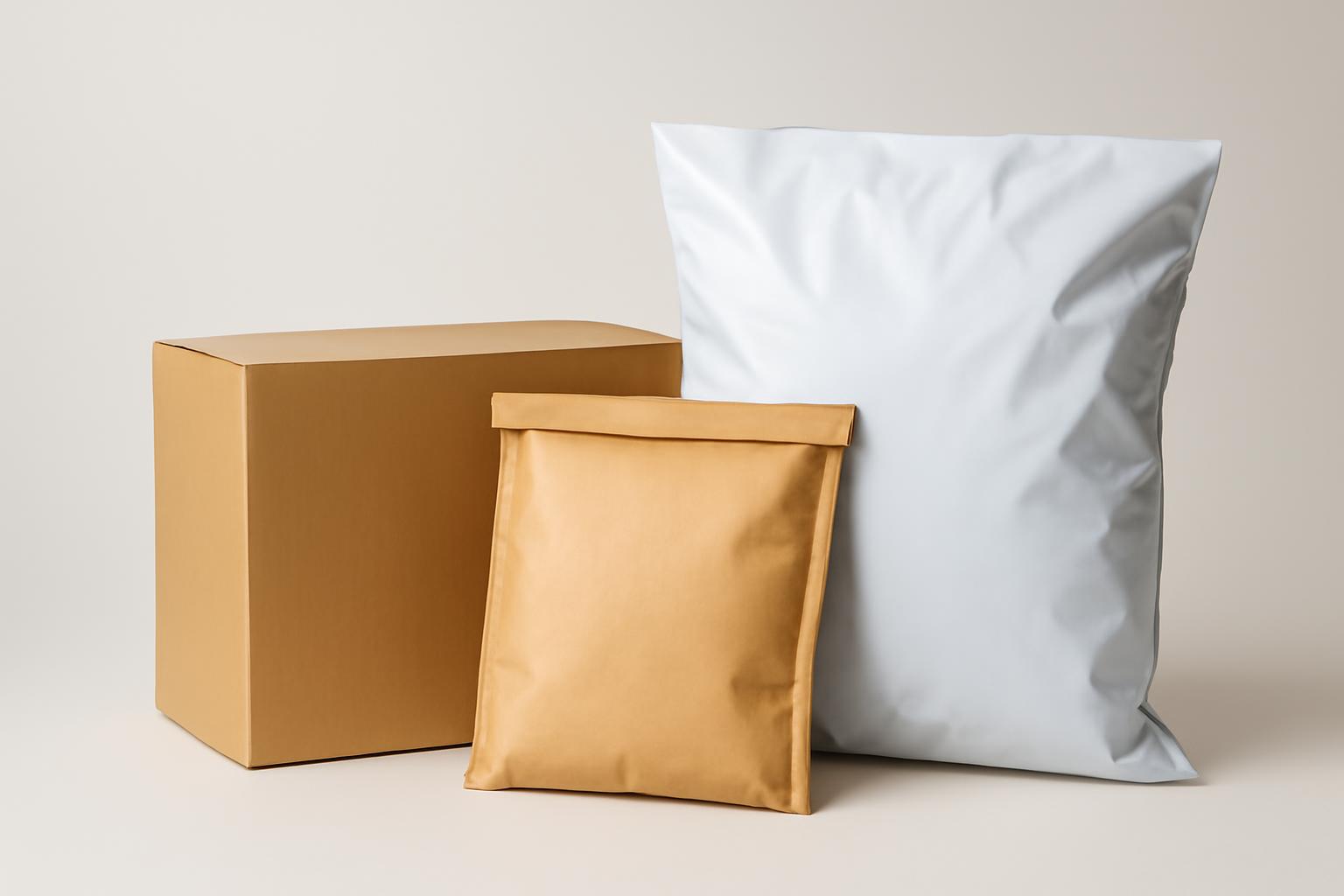
If you want to compare shipping bag options, the practical question is not just, “Which bag is cheapest?” It is, “Which package protects this item well enough, qualifies cleanly with my carrier, and keeps total shipping cost reasonable?”
That distinction matters because a shipping bag can mean several different things: a standard poly mailer, a bubble mailer, a paper mailer, a padded paper mailer, or, in some calculators, a broader “soft package.” Those choices affect more than supply cost. They can change dimensional weight, handling fees, moisture protection, fulfillment speed, customer presentation, and damage risk.
The evidence is fairly consistent on a few big points. Soft mailers are usually a strong fit for lightweight, non-fragile items such as apparel. Padded mailers can work for some small delicate items. Boxes remain the safer default for truly fragile, crushable, or leak-prone goods. And rate comparison is usually input-dependent: origin, destination, dimensions, weight, and package type all matter before a quote means much.
So the right way to compare a shipping bag is to evaluate it in context: what you are shipping, how it travels, how carriers classify it, and what happens if it arrives damaged.
What compare shipping bag means
In practical terms, compare shipping bag means evaluating different shipping-bag formats to decide which one makes the most sense for a specific shipment or product line.
That comparison usually happens on five levels:
- Item fit
- Protection level
- Carrier pricing
- Operational convenience
- Environmental and brand tradeoffs
A lot of confusion comes from treating “shipping bag” as one product. It is not. The most common options include:
- Poly mailers for soft, non-fragile items
- Bubble or padded mailers for small items that need some cushioning
- Paper mailers for brands that want a paper-based presentation
- Padded paper mailers for a paper-forward option with more protection
- Rigid mailers or document mailers for flat items that cannot bend easily
And in many real decisions, you also need to compare a shipping bag against a small box, because sometimes the best bag alternative is no bag at all.
A useful way to think about the topic is this:
- A bag-first comparison asks which mailer type is best.
- A rate-first comparison asks which carrier prices that mailer best.
- A risk-first comparison asks whether a bag should be used at all.
Those are different questions, but they overlap.
What usually matters most
For most readers, the core decision comes down to a short list of tradeoffs:
- Lower weight and lower package volume can reduce shipping cost.
- Less structure can increase damage or crushing risk.
- Better moisture resistance can protect contents in wet conditions.
- More eco-friendly messaging may come with weaker weather protection or higher supply cost.
- Faster packing may matter if you ship a lot of orders.
- Cheaper packaging is not always cheaper shipping if the bag is oversized or handled as a non-standard package.
The evidence also shows that bag selection is highly item-specific. A poly mailer that works well for a sweatshirt may be a poor choice for a candle, a jar, a framed print, or a liquid product.
Why the comparison is often harder than it looks
Shipping-bag comparison looks simple because the bag itself is cheap. But the bag affects everything around it:
- the final packed dimensions
- the billed weight or volumetric weight
- whether the package looks irregular
- whether the contents shift or bend
- whether you need added fill or a second protective layer
- whether the package survives rain, compression, and automated handling
That is why a good comparison does not stop at material type. It asks:
- What is inside?
- How fragile is it?
- Does it need moisture protection?
- Can it bend?
- Will it be overstuffed?
- Will the carrier classify it as a soft package, envelope, or custom parcel?
- Is the “cheapest” quote still acceptable if one damage claim wipes out the savings?
If you keep those questions in view, compare shipping bag becomes a practical packaging decision rather than a vague product search.
How compare shipping bag works
From start to finish, comparing a shipping bag usually follows a repeatable sequence. You define the item, shortlist suitable packaging types, measure the packed shipment, run carrier quotes, check restrictions and surcharge risks, then test whether the option actually performs well in transit.
Here is how that process works in practice.
1. Start with the item, not the bag
Before looking at prices, define the shipment:
- What is the product?
- Is it soft, rigid, fragile, liquid, sharp-edged, or crushable?
- Does it already have durable retail packaging?
- Can it tolerate bending or compression?
- Does presentation matter?
This first step narrows the field quickly.
For example:
- Clothing and other soft goods are commonly matched with standard poly mailers.
- Books, cosmetics, small electronics, and jewelry are more often paired with padded mailers if they need modest cushioning.
- Art prints or anything that must not bend usually push you toward rigid mailers.
- Glass, leak-prone goods, or fragile items often move the decision out of bags and into boxes.
Several commercial packaging guides agree on that broad logic, even though they vary in how aggressively they promote mailers.
2. Pick the packaging category the carrier will recognize
This matters more than many beginners expect.
Shipping calculators do not all use the same labels. Some explicitly support bag-like packaging under names such as:
- Poly mailer
- Soft package
- Envelope
- Custom package
For example, one real-time calculator includes a specific “Poly mailer” option defined as any soft, padded, or flat bag. Another comparison tool includes “Soft Package” for poly mailers, padded mailers, and bags. Other calculators are less bag-specific and treat the shipment more generically.
This means you should not assume every tool models a bag the same way. If the calculator gives you a package-type choice, use the option closest to the actual packaging you plan to ship.
3. Measure the fully packed shipment
This is where many comparisons go wrong.
You need the packed dimensions and weight, not the item’s raw dimensions. That means after the item is in the bag, sealed, and compressed as it would be in a real order.
Why it matters:
- Carriers price based on weight
- They may also price based on dimensional or volumetric weight
- Oversized or irregular soft packages may trigger additional handling
- An overstuffed mailer can become more expensive than it first appears
One shipping calculator explains volumetric weight with the formula:
length × width × height / 5000
It also notes that the divisor can vary by carrier, sometimes from 4000 to 6000. That alone is a good reason not to rely on guesswork.
A bag that looks “small enough” on the packing table may bill like a larger parcel if it puffs outward or becomes uneven.
4. Run quotes using the same shipment details
Now enter the same origin, destination, package type, weight, and dimensions across the options you want to compare.
At minimum, keep these constant:
- ship-from location
- destination
- service level you are willing to accept
- package contents
- package dimensions
- package weight
If you compare a poly mailer and a box, the only fair way is to measure both packed versions and quote both under the same route and service assumptions.
This is also where you need to be careful with “cheapest,” “fastest,” and “best value” labels. Some tools present those as platform judgments, not universal truths. They can still be useful, but they are not the same as a neutral shipping standard.
5. Treat example rates as examples, not promises
The evidence includes a few shipping-rate examples, but they are highly scenario-specific.
One domestic U.S. example for a 0.5 lb parcel showed:
- USPS Ground Advantage as the cheapest at $6.24
- UPS 2nd Day Air as “best value” at $13.77
- FedEx Priority Overnight as the fastest at $46.81
That example was not bag-specific and depended on the platform’s own setup.
Another bag-relevant example from a poly mailer guide cited:
- $5.97 for a 7.5 x 10.5 inch, 4 oz poly mailer via USPS Ground Advantage on a specific San Francisco-to-New York shipment
- $8.76 for a 14.5 x 19 inch, 1 lb shipment via UPS Ground Saver on a specific date and lane
Useful? Yes. Generalizable? Not much.
Those examples can help you understand the order of magnitude and the importance of size and service choice, but they should not be treated as your likely price unless your shipment is very similar.
6. Check handling rules, restrictions, and exceptions
After the quote, check whether the carrier or platform flags anything important.
Common issues include:
- oversized dimensions
- non-rigid packaging
- extra handling for unusual parcels
- vague or restricted contents descriptions
- protection exclusions
- service-specific packaging rules
One calculator warns that incorrect dimensions or weight can lead to added charges or interception in transit. Another notes that additional handling may apply for packages with long sides above certain thresholds, for shipments over 70 lb, or for non-cardboard packaging.
The exact thresholds and fees can change, and account-level rules may differ, so the main lesson is not to memorize one table. It is to verify soft-package treatment before you commit to a packaging standard.
7. Pack and test before standardizing
Rate comparison is necessary, but it is not enough.
A shipping bag choice only proves itself after you test it against the actual item and shipping conditions. That includes:
- whether the item shifts inside
- whether corners poke through
- whether the package bends too easily
- whether seams hold under stress
- whether labels stay attached
- whether the bag still looks presentable after handling
Some packaging guidance aimed at fragile shipping makes an important point: labeling a parcel “fragile” is less effective than packaging it well in the first place. That is a useful reality check. Protection should come from the packaging design, not from assuming handlers will treat a bag gently.
8. Review the true result, not just the quote
After a trial run, compare the real outcomes:
- shipping charge
- packaging supply cost
- time to pack
- damage or return rate
- customer complaints
- appearance on delivery
That final review is what turns a calculator exercise into a sound decision.
In short, compare shipping bag works best when you follow a full loop:
item -> packaging shortlist -> packed measurements -> carrier quotes -> rule check -> trial shipment -> final choice
The main approaches
A reader comparing shipping bags usually needs to compare both bag types and decision approaches. The packaging itself matters, but so does the lens you use.
The most useful way to do this is to compare the main options side by side.
| Option | Best fit | Main strengths | Main weaknesses | Usually not ideal for |
|---|---|---|---|---|
| Standard poly mailer | Apparel, textiles, soft goods, some non-fragile items | Lightweight, compact, moisture-resistant, usually low-cost | Limited structure, weak crush protection, can be overstuffed | Glass, brittle goods, items that cannot bend |
| Bubble or padded mailer | Small delicate items such as cosmetics, jewelry, some books, some electronics | Adds cushioning without going to a full box | Still limited crush protection; not enough for truly fragile items | Heavy, sharp-edged, very fragile, or bulky goods |
| Paper mailer | Apparel or soft items where paper presentation or paper-based branding matters | Stronger paper-forward sustainability story, recyclable/biodegradable positioning in many markets | Weaker moisture resistance, often less durable in wet handling | Wet routes, rough handling, items needing weather protection |
| Padded paper mailer | Small items needing more protection than a plain paper mailer | Paper-forward appearance with some added cushioning | May still underperform a box on impact and compression; exact recyclability varies | Truly fragile items, heavy items |
| Rigid mailer | Documents, photos, art prints, flat goods that must not bend | Better bend resistance than flexible bags | Less flexible, not suitable for bulky contents | Soft bulky goods or irregular items |
| Small box | Fragile, crushable, heavy, leak-prone, or high-value items | Best structure and protection; easiest to stabilize contents | Higher material volume, usually more storage space, often higher ship cost | Low-risk soft goods where a bag is sufficient |
Approach 1: Compare by item category first
For most readers, this is the most practical approach.
Instead of asking “poly or paper?” first, ask:
- Is the item soft or rigid?
- Is it fragile or not?
- Can it bend?
- Does it need weather protection?
- Is it already in sturdy retail packaging?
This approach typically leads to clearer decisions:
- Clothing and other soft goods: standard poly mailer is the usual starting point
- Small delicate goods: bubble or padded mailer is the usual comparison point
- Flat no-bend items: rigid mailer becomes the relevant option
- Truly fragile items: compare a padded mailer to a box, but expect the box to win on protection
This is also where some disagreement in the evidence matters. A few bag-focused sellers suggest that fragile items can still ship in bags if you add padding, double-bag, or pack carefully. That may be true for some limited cases, but other packaging guidance is more conservative and says fragile items should usually move to boxes. If damage would be expensive or unacceptable, the cautious reading is better.
Approach 2: Compare by protection level
Another useful method is to rank packaging by how much protection it provides.
A simple ladder looks like this:
- Standard poly mailer — lowest protection, best for durable soft goods
- Paper mailer — similar or slightly different risk profile depending on construction, but usually not stronger in wet conditions
- Bubble or padded mailer — moderate protection for lighter small items
- Rigid mailer — strong against bending, weaker against bulkier impact
- Box — highest all-around protection
This helps prevent a common mistake: comparing all bags as if they solve the same protection problem. They do not.
Approach 3: Compare by shipping economics
This is the cost-focused method, but it only works if you calculate carefully.
Mailers are often marketed as cheaper than boxes because they:
- weigh less
- use less material
- take up less storage space
- can reduce dimensional weight
That logic is often sound. But it is not automatic.
A bag can lose its cost advantage when:
- it is too large
- it bulges
- it becomes irregular
- it needs so much internal padding that it behaves like a poorly protected box substitute
- it triggers extra handling or non-standard treatment
So if you compare on cost, use total packed shipment cost, not just bag purchase price.
Approach 4: Compare by weather and handling conditions
On moisture resistance, the evidence is fairly consistent: commercial sources broadly describe poly mailers as better than paper mailers in wet or humid conditions.
That does not mean every poly mailer is excellent or every paper mailer is poor. It means the general material tradeoff is pretty stable:
- Poly: stronger on moisture resistance
- Paper: stronger on paper-based sustainability messaging
If your shipments may sit on wet porches, move through humid routes, or face rough last-mile handling, that tradeoff matters.
Approach 5: Compare by disposal reality, not eco claims alone
Environmental comparison is one of the least settled parts of this topic.
Some sellers frame poly mailers positively if they are recyclable, recycled-content, or branded as eco-friendly. Other guidance notes that standard LDPE mailers often are not curbside recyclable and may require store drop-off if clean. Compostable claims can also be less practical than they sound if industrial composting access is limited.
Paper mailers often present a cleaner sustainability story to consumers because paper recycling or biodegradability is easier to understand. But paper can also require more material or perform worse in wet conditions.
So the fair comparison is not “poly bad, paper good” or the reverse. It is:
- What disposal path does the customer realistically have?
- What weather protection do you need?
- Is the greener-looking option also the one that reduces product damage?
- Are you comparing marketing language or actual end-of-life behavior?
That is a more honest way to compare shipping bags.
A practical process
If you want a practical way to compare shipping bag options without overcomplicating the decision, use a short test process. This works whether you are shipping occasional orders or setting a standard package for a product line.
Step 1: Sort your items into packaging groups
Do not try to pick one bag for everything.
Start by grouping items into broad categories such as:
- soft and non-fragile
- small and somewhat delicate
- flat and bend-sensitive
- fragile or crush-sensitive
- liquid or leak-prone
This avoids forcing one solution across incompatible products.
A clothing item, a paperback book, a glass candle, and a framed print may all be “small shipments,” but they should not all enter the same comparison set.
Step 2: Pick two or three realistic candidates
For each group, choose only options that have a real chance of working.
Examples:
- T-shirt or hoodie: poly mailer vs paper mailer
- Cosmetic compact or small accessory: padded mailer vs small box
- Paperback book: bubble mailer vs rigid mailer
- Art print: rigid mailer vs tube or box
- Fragile ceramic item: small box vs better small box, not bag vs box
This keeps the test focused.
Step 3: Use a snug fit as your baseline
Multiple sources converge on this point: a snug-fitting mailer is usually better than an oversized one.
A snug fit can help by:
- reducing empty space
- reducing shifting
- avoiding a puffed-out shape
- limiting dimensional growth
- making the package easier to stack and handle
One poly mailer guide also points to about 2.5 mil as a common default thickness for apparel, with thicker mailers used for heavier or sharper-edged contents. That is useful as a starting point, not a rule.
If your item barely fits or creates pressure on the seams, the bag is too small. If the bag has a lot of dead space and balloons outward, it is probably too large.
Step 4: Pack real samples and record the packed size
Do not compare catalog specs alone.
For each candidate:
- pack the actual item
- seal it the way you would in production
- measure length, width, and height
- weigh it
- note whether the item shifts or bends
If the package needs extra fill, corner protection, or a secondary inner wrap, include that in the test. Otherwise you are undercounting cost and overestimating protection.
Step 5: Run like-for-like rate comparisons
Now quote those real packed samples through the same carrier tools or brokerage platform.
Be consistent about:
- origin and destination
- shipment date assumptions
- service level
- account type
- package type selection
If one tool has a poly mailer selector and another uses soft package, use the closest equivalent. If a tool does not model mailers clearly, treat the result as directional.
At this stage, note more than the headline price:
- transit speed
- whether the tool labels it cheapest, fastest, or best value
- pickup/drop-off assumptions
- tracking level
- any restrictions or warning messages
Step 6: Check for hidden penalties
A cheap-looking mailer can fail here.
Look for:
- additional handling rules
- non-rigid packaging cautions
- thresholds for long sides or unusual dimensions
- contents restrictions
- lack of protection coverage
- account-specific differences
This is especially important if the package is heavy, bulky, or oddly shaped. Some platforms explicitly warn that oversized or non-box items may face extra fees.
Step 7: Test protection realistically
The goal is not lab-grade packaging certification. It is to answer one practical question:
Will this package survive ordinary shipping without an unacceptable damage rate?
A simple test can include:
- gentle drop tests
- compression checks
- corner poke-through checks
- bend checks for flat items
- moisture exposure on the outer surface
- label adhesion check
You do not need to pretend a mailer is stronger than it is. If the item feels vulnerable in your hands before shipping, that is already useful evidence.
Step 8: Score the options on total value
A good comparison scorecard includes:
| Criterion | What to look for |
|---|---|
| Shipping cost | Actual quoted shipment cost |
| Packaging cost | Unit cost plus any added inserts, wrap, or tape |
| Protection | Likelihood of damage, crushing, bending, or moisture exposure |
| Fulfillment speed | Time and complexity to pack correctly |
| Customer experience | Presentation, ease of opening, perceived quality |
| Sustainability reality | Likely recycling or disposal path, not just marketing language |
| Carrier fit | Whether the package class matches carrier rules cleanly |
Notice what is not on the list: “bag looks cheapest in bulk.” That number matters, but it is only one part of the decision.
Step 9: Create a default and an exception rule
Once you choose an option, define when it applies and when it does not.
For example:
- Default: 10 x 13 poly mailer for standard folded apparel
- Exception: bubble mailer for items with rigid accessories
- Exception: box for decorated garments with hard embellishments
- Exception: paper mailer only for local or low-moisture shipments if brand presentation is a high priority
This step prevents backsliding into ad hoc packaging decisions.
Step 10: Review after a small live test
Run a short batch, then review:
- real billed shipping cost
- packaging defects
- customer complaints
- damage or return issues
- whether packers used the chosen option correctly
Then adjust.
That is the practical process in full: small enough to do, but detailed enough to avoid obvious packaging mistakes.
Common mistakes and tradeoffs
Shipping-bag comparisons often fail for predictable reasons. Most of them come from optimizing for one variable too early.
Mistake 1: Comparing bag price instead of shipment cost
A cheaper mailer does not necessarily create a cheaper shipment.
If the bag is too large, needs extra padding, or triggers non-standard handling, the savings can disappear. The correct comparison is:
shipping cost + packaging cost + damage risk + labor
Not just packaging cost.
Mistake 2: Using a bag for the wrong item
This is the biggest practical mistake.
Mailers are often ideal for soft goods and some small durable items. They are much less convincing for:
- glass
- ceramics
- leak-prone containers
- crushable foods
- heavy sharp-edged parts
- items with decorative elements that can snap or dent
Some seller-authored guides argue that fragile items can ship in bags with enough padding. Sometimes that is true. But if the item is truly vulnerable, a box is still the more dependable default.
Mistake 3: Choosing the wrong size
Oversized bags and overstuffed bags both create problems.
Oversized bag problems: - more movement inside - higher measured dimensions - worse presentation - greater chance of snagging or wrinkling
Overstuffed bag problems: - seam stress - corner punctures - bulging dimensions - more surcharge risk - harder label placement
A snug fit is usually the safer middle ground.
Mistake 4: Assuming all carriers treat soft packages the same way
They do not.
Different calculators and carrier programs define package types differently. Some explicitly support poly mailers or soft packages. Others are less clear. Some sources also note soft-package or non-rigid surcharges under certain conditions.
So if you standardize on a bag, verify the carrier treatment you actually expect to use.
Mistake 5: Believing promotional discount claims too literally
Big discount claims are common in shipping marketing.
Some platforms advertise deep savings versus retail, and some show dramatic customer examples. Those claims may reflect real negotiated rates in specific cases, but the evidence here is mostly example-based and platform-provided, not independently standardized across all accounts and shipment profiles.
Use those claims as signs that discounts exist, not proof of what you will get.
Mistake 6: Ignoring moisture and route conditions
If your package may encounter rain, damp porches, or humid transit, material choice matters.
Commercial sources consistently describe poly mailers as stronger on moisture resistance than paper mailers. If weather exposure is a meaningful risk, a paper bag may need extra protection or may simply be the wrong choice.
The reverse tradeoff is also real: if your brand values a paper-based presentation and the delivery environment is controlled, paper may be worth considering.
Mistake 7: Treating eco claims as interchangeable
“Eco-friendly” can mean very different things.
A mailer may be: - made with recycled content - recyclable only via store drop-off - curbside recyclable in some places but not others - compostable only in industrial facilities - paper-based but less weather-resistant
That is why disposal reality matters more than the headline claim.
Mistake 8: Forgetting the contents description and restrictions
Rate tools and carriers may care what is inside, not just the outer package.
Some calculators warn that vague contents descriptions can delay quoting or booking. Protection eligibility may also depend on the product type and declared value. If you are shipping restricted or fragile categories, that matters.
Mistake 9: Over-trusting “fragile” labels
Packaging guidance for fragile shipments often stresses that packaging design matters more than external warning labels. That rings true in practice. Automated networks do not reorganize themselves around a sticker.
If a shipment needs gentler treatment than normal parcel handling, the packaging should assume that reality.
Mistake 10: Not building an exception path
Even if one bag works for 80 percent of your shipments, the other 20 percent can create the losses.
You need an exception rule for: - heavier versions of the same item - bundles - gifts with added accessories - wet-weather sensitivity - international or longer-distance routes - high-value orders
The tradeoff here is simplicity versus precision. One packaging standard is easy. But too much simplicity can create preventable damage.
How to choose the next step
A sound decision starts with matching the package to the item and only then using rate tools to refine the choice.
If you are unsure what to do next, use this decision framework.
If you ship soft, non-fragile goods
Start with a standard poly mailer.
That is the most commonly supported recommendation for apparel and similar items because it is lightweight, compact, and typically better at resisting moisture than paper. If sustainability messaging is a major priority, compare it with a paper mailer on the same item and route.
Your test question is simple:
- Does the paper option still protect the item acceptably in your normal delivery conditions?
- If yes, compare cost and brand value.
- If no, keep poly as the default.
If you ship small items that need some cushioning
Start with a bubble or padded mailer, then compare it against a small box.
This is often the right comparison for: - jewelry - cosmetics - small accessories - some books - some electronics
If the padded mailer protects well enough and quotes materially lower, it may be the better fit. If the item is sensitive to crushing, corner impact, or bending, the box may still be the safer decision.
If the item cannot bend
Skip standard bags and compare rigid mailers or boxes instead.
A flexible bag is the wrong frame for bend-sensitive items.
If the item is truly fragile, leak-prone, or expensive
Move the decision to box-first comparison.
Even if a seller suggests a bag can work with extra padding, the more reliable next step is usually to compare box configurations, not bag materials. The possible postage savings are often too small to justify elevated breakage risk.
If your main concern is cost
Run a controlled quote test.
Pack the same item in: - one likely bag option - one slightly more protective option - one box if relevant
Then compare: - actual packed dimensions - quoted shipment cost - packaging cost - handling warnings - subjective protection confidence
That gives you a real decision instead of a guess.
If your main concern is sustainability
Separate material story from disposal reality.
Ask: - Will customers likely be able to recycle or dispose of this properly? - Does the greener-looking option increase product damage? - Is the packaging still appropriate for moisture and handling?
For some apparel brands, paper mailers may be worth testing. For wetter or rougher shipping conditions, poly may still be the more practical choice even if its end-of-life story is less straightforward.
If you are a beginner and want the safest starting point
Use this short rule set:
- Apparel / soft goods: try a snug poly mailer first
- Small delicate items: try a padded mailer first
- Flat no-bend items: use a rigid mailer
- Fragile / crushable / liquid items: use a box
Then quote and test from there.
The concrete next step
Pick one real item you ship or expect to ship. Pack it in two realistic packaging options. Measure the final dimensions and weight of both. Run the same origin, destination, and service quote for each. Then choose the cheapest option that still gives you acceptable protection and carrier compliance.
That is the most practical way to compare shipping bag options without getting lost in marketing claims or abstract packaging advice.
What should a beginner know about compare shipping bag?
A beginner should know three things first:
- A shipping bag is not one product category.
- Carrier quotes depend on dimensions, weight, route, and package type.
- The cheapest bag is not always the cheapest shipment.
In practice, most beginners should start by matching packaging to item type. Standard poly mailers are usually the first option for soft, non-fragile items such as clothing. Padded mailers are a common next step for smaller items that need some cushioning. Boxes remain the safer default for truly fragile goods.
A beginner should also expect shipping calculators to require real inputs. Many tools need origin, destination, weight, and dimensions before the comparison becomes useful.
What are the main risks of compare shipping bag?
The main risks are underprotection, bad fit, and misleading cost assumptions.
Underprotection happens when a bag is used for an item that really needs structure. Bad fit happens when the mailer is oversized or overstuffed, which can increase movement, puncture risk, or billed dimensions. Misleading cost assumptions happen when a bag looks cheaper in supply cost but leads to higher shipping charges, extra handling, or more damage.
There are also softer risks: - assuming all carriers treat soft packages the same way - trusting promotional savings examples too literally - overestimating recyclability or compostability claims - relying on “fragile” labels instead of packaging strength
How do you evaluate compare shipping bag options?
Evaluate them with a like-for-like test.
Choose one item and compare only realistic packaging candidates. Pack the item fully in each option. Measure the final size and weight. Run the same quote conditions for every option. Then compare:
- shipping price
- packaging price
- protection
- ease of packing
- moisture resistance
- carrier compatibility
- likely disposal path
If needed, do a small live shipment test before standardizing. The goal is not to find the universally best bag. It is to find the best bag for that item, route, and risk level.