
Why Storage Cannot Replace a Place to Sleep
Learn how storage leases and state law treat sleeping in a unit, what violations can mean for your belongings, and where to seek emergency housing help.
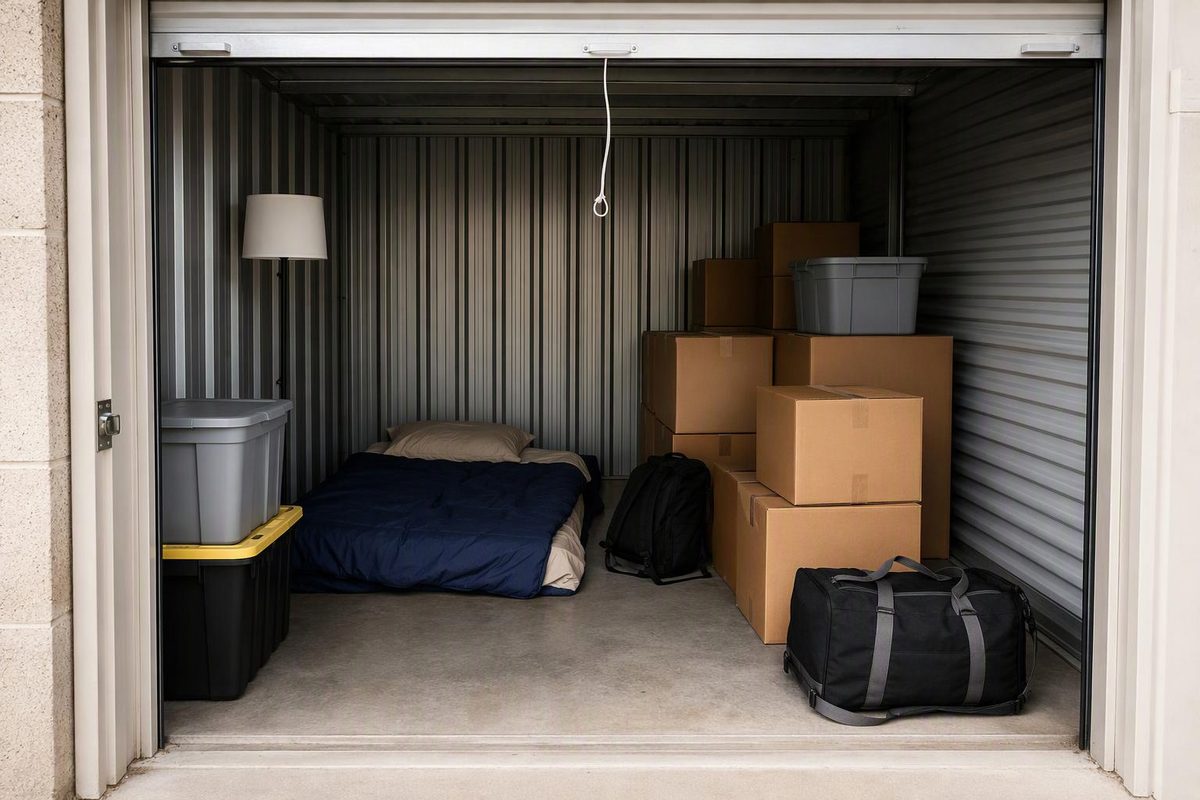
No—do not rent an ordinary self-storage unit as a place to live or sleep. It is space for belongings, not housing. Extra Space Storage expressly prohibits both living and sleeping in its units and says an overnight stay violates the rental agreement. Its prohibition on sleeping also covers a daytime nap, not just moving in permanently. Extra Space’s policy
If you need somewhere to sleep tonight, dial 211. In most U.S. areas, it connects you with local social services for emergency-housing referrals. A referral does not guarantee an available bed, but it is a better starting point than paying for space you cannot use as shelter. USAGov’s emergency-housing guide also lists help for veterans and young people. The legal examples and housing resources below are U.S.-specific.
Choose what you need the unit for; the result separates storage from shelter.
Match The Space To Your Need
U.S. guidance. Operator policies and state laws must be checked separately.
Seek Shelter, Not A Storage Unit
Extra Space prohibits overnight sleeping. Do not treat access hours or climate control as permission to sleep.
Dial 211 for local emergency-housing referrals in most U.S. areas. A referral does not guarantee an available bed.
Sources: Extra Space’s sleeping policy; USAGov housing help. These sources do not establish every operator’s terms or every state’s law.
Lease Restrictions And State Law Are Separate
“Against the lease” and “against the law” are not interchangeable. A facility can prohibit sleeping through its rental agreement. State law can independently prohibit residential use. You need to consider both; satisfying one does not establish that you have satisfied the other.
For a clear legal example, Florida’s 2026 statute says, “No individual storage space may be used for residential purposes.” It defines self-service storage as space rented for storing and removing personal property. That is a restriction on what the space may be used for, not a statement about whether you have paid the rent. Florida Statutes §83.803(5)
That Florida provision does not establish the exact law or penalty in another state. Likewise, Extra Space’s policy establishes that operator’s position; it is not a quotation from every storage company’s agreement. The sources here do not provide a nationwide penalty schedule, and there is no basis for promising a particular fine, removal deadline or other legal outcome wherever you are.
Read the current agreement’s permitted-use, prohibited-use and default provisions. A listing that describes a unit as spacious, private or accessible does not answer whether sleeping is allowed. Nor does the absence of a “no sleeping” sign override a restriction in the agreement or applicable law.
A manager’s permission is not a reliable shortcut around these questions. In Florida, permission would not remove the statutory prohibition on residential use. Elsewhere, the effect of permission depends on the applicable law and the agreement. A verbal assurance should not be treated as proof that a storage unit is approved housing.
A Nap And An Overnight Stay Can Both Breach The Agreement
Moving furniture into a unit and treating it as a home is not the only use that can be prohibited. Extra Space expressly includes sleeping in its restriction, so “I am only taking a nap” does not avoid that operator’s rule. A daytime visit can still involve a prohibited activity.
Other agreements need to be read on their own terms. The September 2021 Texas Self Storage Association sample lease published by Castle Road Storage restricts lodging, sleeping and cooking without prior written consent in paragraph 36. That wording differs from Extra Space’s outright prohibition. It is also a dated sample, not evidence that every Texas facility uses the same clause or will grant consent. Sample lease, paragraph 36
The distinction matters when asking a facility about use. Permission to enter, sort boxes or retrieve belongings is not necessarily permission to sleep. If the intended activity is sleeping, that is the activity the agreement must address; calling it resting or spending time with your possessions does not resolve the restriction.
For someone facing a housing gap, the practical answer remains the same: do not commit storage rent on the assumption that it buys a place to sleep. You could spend money needed for shelter and still have no permitted accommodation.
Access Hours And Amenities Do Not Authorize Living There
24-hour access does not mean permission to stay overnight. It describes when you may access the facility or your belongings, subject to the agreement. It does not, by itself, change what you may use the unit for.
The same distinction applies to climate control and an electrical outlet. Those features may affect how useful a unit is for storage, but neither establishes permission to live there. Before relying on an amenity, separate the feature being advertised from the use you intend.
| Feature Or Claim | What It Does Not Establish |
|---|---|
| 24-hour access | Permission to sleep overnight |
| Climate control | Residential conditions |
| Electrical outlet | Permission to cook or heat the space |
| Room for a bed | Approval for residential use |
A unit’s size is particularly easy to misread. A space large enough to fit a mattress is not necessarily a space where sleeping is permitted. Choosing a larger unit does not solve the lease or legal problem; it only changes the amount of storage space you are renting.
Ask about the written permitted-use terms before paying. If the response is only that you can enter at any hour or that the unit has power, your sleeping question remains unanswered.
Climate Control Is Not A Promise Of Residential Conditions
Temperature control is a storage feature, not a promise of residential conditions. The September 2021 Texas sample lease defines climate control in paragraph 15 as reasonable efforts to avoid temperature extremes. It warns that equipment can fail and makes no humidity-control representation. That is the wording of a particular dated sample, not a substitute for your current agreement. Sample lease, paragraph 15
Even a unit that feels comfortable during a visit does not answer basic shelter questions: safe emergency escape, sanitation, drinking water, and permission to use cooking or heating equipment. These are separate from whether stored furniture or boxes benefit from temperature control.
An outlet is not evidence that every appliance is authorized. Nor should you assume that you can supply whatever a unit lacks by bringing in cooking equipment. The sample lease’s separate restriction on cooking illustrates why an amenity and an allowed activity must be checked independently.
Never use a portable gas camp stove, charcoal grill or generator inside a storage unit. Fuel-burning equipment can produce carbon monoxide, an odorless, colorless gas that can kill. CDC specifically warns against indoor camp-stove and charcoal use, and against generators indoors even with doors and windows open. CDC carbon-monoxide guidance
Leaving the unit’s door open is therefore not an acceptable workaround for operating a generator inside. Climate control is not a reason to disregard that warning either. The carbon-monoxide danger is separate from whether management discovers the activity or whether the rental agreement prohibits it.
A Use Violation Can Put Your Storage Rental At Risk
Sleeping can put the storage rental itself at risk. The consequences come from your agreement and applicable law—not a universal eviction timetable. The sources here do not establish that every facility must follow the same process or give the same amount of notice.
The 2021 Texas sample illustrates the distinction. Paragraphs 23–24 treat rule violations as default and provide remedies that include restricted access and termination with written notice. Paragraph 36 addresses lodging, sleeping and cooking. Paying rent on time does not eliminate a separate use violation. Sample lease, paragraphs 23–24 and 36
That matters if you are relying on the unit for both shelter and possessions. A dispute over sleeping can also disrupt your storage arrangement. You should not assume that being current on payments prevents management from acting on a prohibited use.
A lease violation is not automatically an immediate auction. The same sample limits lien seizure and sale to unpaid sums. Terminating a rental for an unauthorized activity and enforcing a lien for unpaid charges are different matters. Do not collapse them into a claim that sleeping automatically causes an auction—or that paid-up rent protects you from every other remedy.
If management sends a notice, ask for the cited lease provision, the deadline and written arrangements for retrieving your property. Keep the notice and the response together. Do not ignore it because your rent is current, and do not infer a retrieval deadline from someone else’s experience at another facility.
If you have already been sleeping in a unit, seek a permitted place to stay and address the storage notice separately. Continuing to use the space for sleeping does not resolve the underlying violation, even while you are arranging somewhere else to go.
Keep The Housing Search Separate From The Storage Purchase
During a housing gap, there are two decisions: where you can stay and whether you can afford to store your belongings. A storage rental can serve the second purpose without serving the first. Its advertised rent should not be compared with housing costs as though the two purchases provide the same thing.
For an immediate housing need, start with 211 and the USAGov emergency-housing resources linked above. Ask about emergency-housing referrals for your situation. Because a referral does not guarantee a bed, keep the housing search active rather than treating a storage reservation as a fallback sleeping arrangement.
Keep identification, medication, your phone charger, financial records and clothes for the next few days with you. These should not depend on an access window or on the outcome of a dispute with the facility. Pack storage around what you can leave behind, not around what you need to get through tonight.
Price the actual load: furniture, luggage and boxes you need to keep. Use the storage size guide to choose space for those belongings rather than paying for an imagined living area. Extra floor space does not make residential use permissible.
Request the complete bill before committing. That means monthly rent, the administration fee, the lock, required insurance or a protection plan, taxes, promotion expiry and rate-change terms. The draft sources do not provide a representative total price, so there is no supported dollar figure to substitute for a facility’s quote. Compare the written charges with the storage cost checklist.
Finally, verify access hours, move-out notice requirements and whether the final month is prorated. Keep your contact information current so facility notices reach you. Budget for getting your belongings back out as well as keeping them stored. The workable arrangement is permitted shelter for you and an affordable, retrievable storage space for the possessions you cannot take along.