
What Proxy Data Reveals About Locker and Changing Room Build Costs in 2025
The NYC-metro proxy spans $50–$300+/sf and distinguishes dry from wet work. It is a planning range, not a 2025 national average.
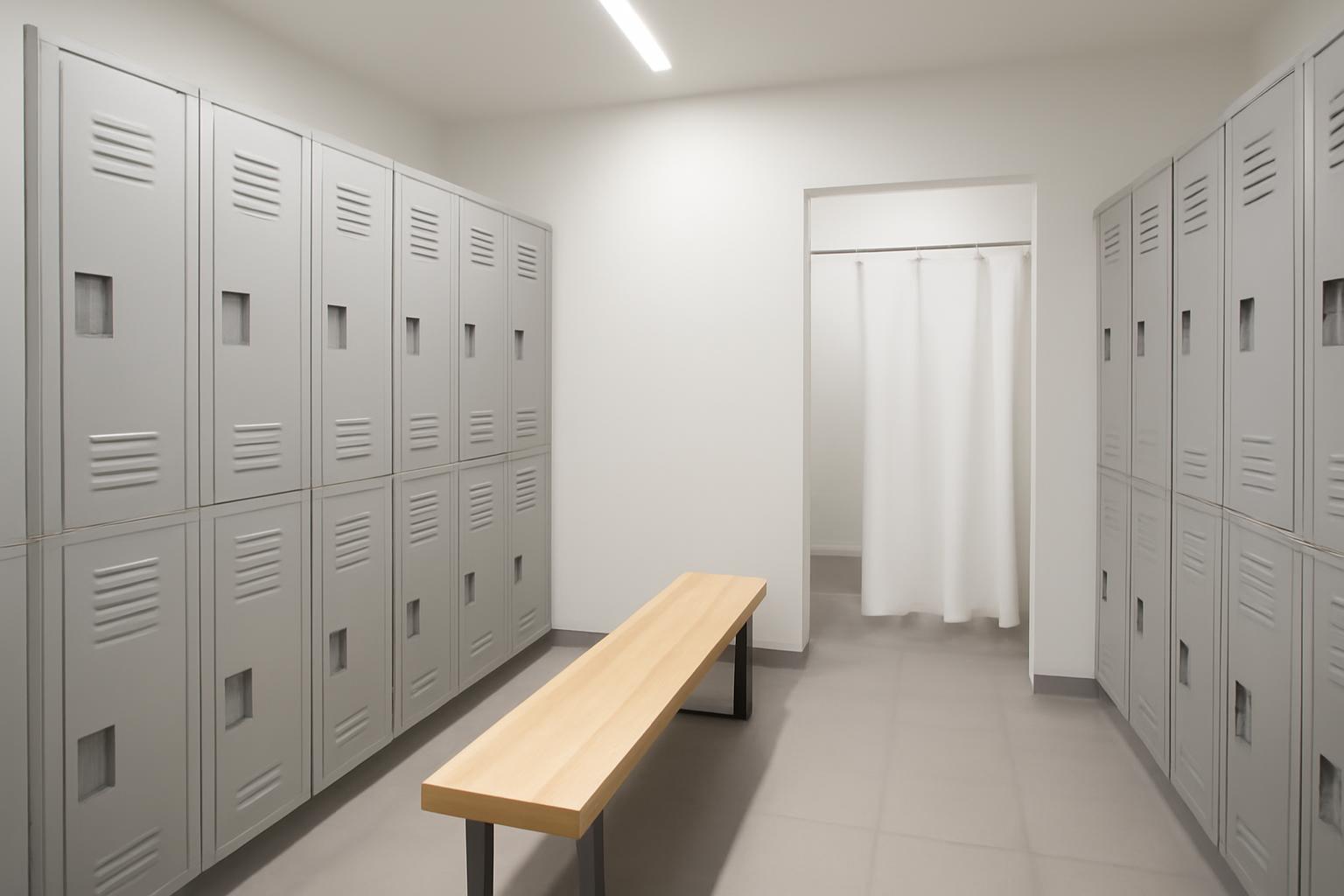
If you are searching for a 2025 locker room changing room construction cost per square foot benchmark, the most important finding is the one many articles skip: the available evidence does not provide a reliable locker-room-specific national 2025 average. What it does provide is a set of adjacent benchmarks that can be used honestly for early budgeting:
- a 2025 modular building buyer’s guide for dry enclosure and partition-type work1
- a 2026 NYC-metro changing-room fit-out guide that separates dry and wet scopes2
- a December 2023 athletic-facility opinion of cost with a locker-room/lounge build-out line item3
- 2025 whole-building recreation and interior build-out benchmarks, plus 2026 commercial hard-cost guidance for regional and budgeting context456
That means this page is best read as a proxy-based planning guide, not as a direct national price sheet.
Method note: Every benchmark below is labeled by source year and scope. The numbers are useful for screening, scoping, and feasibility, but they are not interchangeable and should not be compressed into a synthetic “national 2025 locker-room average.” The closest changing-room-specific fit-out ranges in the evidence are from an NYC-metro 2026 guide, used here as an adjacent proxy because a locker-room-specific 2025 national benchmark is not available.25
Quick answer
For early planning, the evidence supports three separate budgeting lanes rather than one blended locker-room number:
| Proxy lane | Reported range | Best use | Main caution |
|---|---|---|---|
| 2025 modular buyer’s guide1 | $50-$300/sf | Dry modular enclosure, partitions, simple changing areas | Not traditional site-built construction; excludes freight, installation, permitting |
| 2026 NYC-metro fit-out guide2 | $50-$300+/sf | Dry vs wet changing-room renovation and fit-out budgeting | NYC starts from a high-cost regional baseline; add soft costs and contingency |
| 2023 athletic-facility build-out example3 | $65/sf | Warm-shell locker-room/lounge build-out cross-check | One project, one year, opinion of cost, not a 2025 national average |
| 2025 recreation/gymnasium building data4 | $347-$683/sf, $403/sf average | Whole-building athletic-facility context | Not locker-room-specific; measures an entire facility, not a simple fit-out |
Which benchmark should you use?
| If your project is… | Start with this proxy | Why it fits | What to verify before using it |
|---|---|---|---|
| A mostly dry changing area made with modular partitions | 2025 modular guide1 | Best proxy for enclosure-type work | Freight, installation labor, permitting, and whether lockers/benches are included are not standardized |
| An existing dry locker/changing room refresh | 2026 NYC basic fit-out range: $50-$120/sf2 | Closest changing-room-specific dry benchmark in the evidence | Whether the estimate includes lockers, benches, lighting changes, or only finishes |
| A mid-level renovation with layout change, ventilation, electrical, and some plumbing | 2026 NYC mid-range fit-out: $100-$200/sf2 | Tracks the coordination jump that many “ordinary” locker-room projects trigger | Whether showers, drains, ADA rework, or premium finishes are creeping in |
| A wet locker room with showers, drains, waterproofing, and heavy MEP work | 2026 NYC wet fit-out: $200-$300+/sf2 | Best direct wet-scope proxy in the pack | Regional adjustment, soft costs, contingency, and hidden demolition risk |
| Locker rooms built out inside a larger new athletic shell | 2023 athletic build-out example: $65/sf plus 2025 interior build-out context36 | Useful only as a shell-context cross-check | The shell, shared systems, circulation, and common areas may already be paid elsewhere |
| An entire gym, recreation center, or athletic building | 2025 recreation/gymnasium whole-building data: $347-$683/sf4 | Useful for total facility budgeting | This is a building cost, not a locker-room cost |
Why Locker Room Costs Vary So Widely in 2025
Locker and changing room costs swing widely because the label sounds simple while the scopes are not. A “locker room” can mean a dry area with benches and lockers, or a wet suite with showers, drains, waterproofing, ventilation upgrades, accessibility work, and major mechanical, electrical, and plumbing coordination. The wider commercial benchmark sources consistently point to the same reasons ranges spread so far: structure type, MEP density, finish level, site conditions, and region.56
That is also why published square-foot numbers are easy to misuse. Some numbers reflect modular material or enclosure cost, some reflect interior fit-out, some reflect build-out inside an existing or warm-shell condition, and some reflect whole-building construction. Those are different cost families, not different opinions about the same job.1234
A useful way to separate them is:
- Simple enclosure or partition cost
- Interior fit-out from shell or existing space
- Build-out within a larger athletic-facility budget
- Whole-building gym or recreation-center cost
Once those categories are separated, the wide spread becomes easier to understand. The modular guide’s $50-$300/sf range is a rule of thumb for modular buildings and partition systems, not a turnkey wet locker-room benchmark.1 The NYC-metro guide’s $50-$300+/sf range is much closer to real changing-room scope because it distinguishes between dry and wet work.2 The South Carolina project’s $65/sf line item is a build-out inside a larger athletic facility, not a standalone building cost.3 And the recreation/gymnasium $347-$683/sf range is a whole-building proxy, not a locker-room-specific one.4
There is also a consistent hard-cost versus total-project-cost problem. In the available evidence:
- broader commercial benchmark guidance says soft costs can add about 15% to 25% beyond hard costs5
- the NYC changing-room guide says soft costs commonly run 10% to 20% of total project value2
- the same guide recommends 10% to 20% contingency, especially in existing buildings2
- the modular guide says freight is often around 10% of material cost and installation labor around 30% to 50% of material cost1
So a base square-foot number may be useful, but it is often not the number an owner ultimately experiences.
The evidence also supports caution about estimate accuracy at early stages. A 2026 commercial benchmark article describes feasibility numbers as broad tools that can be off by roughly 20% to 30%, while a 2025 commercial roundup notes that location can influence costs by up to 70% depending on market and conditions.54 For locker and changing rooms, that means third-party benchmarks are best treated as directional brackets, not final pricing.
Modular Construction Baselines for 2025 Locker Spaces
The clearest low-end proxy in the evidence comes from a 2025 modular building buyer’s guide, which gives a general rule of thumb of $50 to $300 per square foot for modular buildings.1 For locker-room planning, that range is useful mainly at the low end, where the scope is closest to a dry enclosure problem rather than a wet-room construction problem.
The same guide says:
- a basic partition wall system can cost around $50 per square foot or less1
- partition walls more broadly can run about $40 to $100 per square foot1
- modular offices often land around $100 to $200 per square foot once HVAC, raceways, and added features are involved1
- technically demanding spaces like modular cleanrooms can exceed $300 per square foot, with some reaching $1,000 or more, which is useful mainly as a reminder that systems density drives cost.1
For locker-related budgeting, the takeaway is narrow but important: a basic, mostly dry locker or changing area built with simple modular partitioning can plausibly start near the bottom of the spectrum. But that does not make $50/sf a valid stand-in for a shower-equipped locker room.
Includes / excludes for the modular proxy
What the modular numbers appear to cover: the modular building’s basic structure and necessary features as a rule of thumb.1
What the modular numbers explicitly exclude:
- freight, typically around 10% of material costs1
- installation labor, often 30% to 50% of material cost1
- permitting and inspections1
What is not clearly standardized in the evidence: whether a modular locker-area budget includes lockers, benches, accessories, plumbing fixtures, or owner-furnished equipment. The guide is about modular building systems generally, not locker-room FF&E specifically.1
That inclusion boundary matters. A dry changing area with partitions, doors, limited glazing, and little or no dedicated plumbing is fundamentally different from a locker room with showers, trench drains, exhaust, and waterproofing.
Scale can also affect the modular math. The guide notes that larger projects can see lower unit costs.1 That does not mean every larger locker room is cheap. It means repetition, manufacturing efficiency, and mobilization economics can improve the per-square-foot result compared with a tiny, customized one-off build.
In practical terms, the modular data answers one question well: How low can a simple locker/changing space start if it is mostly dry and relatively light on systems? It is a good floor-setting proxy. It is not a complete wet-room budget.
Changing Room Fit-Out Ranges from NYC Metro Data
The best changing-room-specific proxy in the evidence comes from a 2026 NYC-metro commercial changing-room fit-out guide. It is not a national benchmark, and it is not a 2025 source, but it is highly useful because it separates dry, mid-range, and wet scopes.2
Its published ranges are:
- Basic changing-room fit-out: $50 to $120 per square foot2
- Mid-range fit-out: $100 to $200 per square foot2
- Complex wet-area changing room: $200 to $300+ per square foot2
That tiering is more valuable than any single average because it mirrors actual scoping choices.
Basic dry fit-outs: $50 to $120/sf
The lower tier is the closest current proxy for a dry locker or changing room with limited infrastructure change. In that context, a project may involve some mix of:
- lockers and benches
- modest finish upgrades
- flooring changes
- lighting updates
- minor electrical work
- limited or no new shower infrastructure2
The guide is also explicit that scope varies from contractor to contractor. One proposal may include mostly paint, flooring, lockers, and minor lighting, while another may include a fuller package.2 So even within the $50-$120/sf band, bid comparison can be misleading if line items are not aligned.
Mid-range fit-outs: $100 to $200/sf
This middle range is where many “simple” locker-room projects stop being simple. The evidence ties this tier to projects with more underlying coordination, such as:
- stronger layout changes
- better ventilation
- additional or reworked electrical
- upgraded finish packages
- some plumbing complexity
- accessibility-driven modifications2
For owners and school administrators, this band is often the practical middle ground between a cosmetic refresh and a wet rebuild.
Complex wet areas: $200 to $300+/sf
The top tier is where showers, drains, waterproofing, accessibility, and heavy MEP work start dominating the budget. The guide specifically associates the upper range with:
- showers
- floor drains
- waterproofing
- ADA upgrades
- heavy mechanical, electrical, and plumbing work
- premium lockers and durable wet-area materials2
The most important lesson here is not only the absolute price. It is the jump from dry to wet. A wet locker room is not just a slightly nicer dry changing room. It is a different project category.
Includes / excludes for the NYC fit-out proxy
What the numbers appear to represent: changing-room fit-out cost per square foot, with scope varying by whether the room is dry, mid-range, or wet.2
Items the guide says may be included depending on scope: paint, flooring, lockers, benches, lighting, plumbing, drains, waterproofing, ventilation, accessibility work, electrical work, and closeout activities.2
Items the guide tells you to budget separately or on top:
- soft costs: roughly 10% to 20% of total project value2
- contingency: roughly 10% to 20%, especially in existing buildings2
What remains non-standard: whether all quotes include the same locker package, accessories, or filing/permitting effort. The guide repeatedly warns against comparing numbers without comparing scope.2
Finally, the guide states plainly that NYC metro pricing starts from a higher baseline than many markets.2 So this source is strongest as a scope map everywhere, and as a regional price reference mainly in the Tri-State area.
Real-World Athletic Facility Locker Room Example
Published ranges help, but many readers want at least one real project example. The evidence pack includes one: a December 2023 opinion of cost for an indoor athletic facility in Westminster, South Carolina.3
In that document:
- two locker rooms total 1,800 square feet3
- the line item is described as locker rooms/lounge areas build out3
- the build-out cost is $65 per square foot3
- the line-item total is $117,0003
At first glance, that sounds like a clean low-end benchmark. It is not that simple.
The same report shows that the locker rooms were part of a much larger indoor athletics program that included courts, fitness space, offices, lobby, concessions, training room, restrooms, circulation, and other shared facility components. The total indoor facility was listed at about 92,554 square feet and $26,717,675 in total construction cost, or roughly $288 per square foot overall.3
The document also separates a warm-shell hard structure component at about $170 per square foot for 85,681 square feet.3 That is the critical context. The $65/sf locker-room figure should be read as a build-out number inside a larger shell-and-facility budget, not as a turnkey rule saying “locker rooms cost $65/sf.”
Includes / excludes for the 2023 project example
What the line item covers: locker rooms/lounge areas build out totaling 1,800 square feet.3
What it does not prove: a national locker-room average, a 2025 price, or a standalone locker-room building cost.3
What the overall report notes:
- it is an opinion of cost, not a final bid3
- it is from 2023, not 20253
- land cost is excluded3
- the overall budget structure includes escalation, contingency, fees, FF&E, and equipment at the broader project level3
What is not clearly itemized in the evidence excerpt: whether the $65/sf line includes lockers, benches, or all specialty interior components within the locker rooms/lounge areas. The safest reading is to treat it as a build-out allowance within a larger athletic-facility program, not a fully portable template.3
Used that way, the example is still valuable. It shows that mid-double-digit build-out numbers are possible in a favorable shell context, and it reinforces how different build-out cost is from whole-facility cost.
Gym and Recreation Center Proxies for Locker Contexts
At the other end of the spectrum, the evidence includes 2025 whole-building recreation and gymnasium benchmarks derived from Cumming data. These numbers are not locker-room-specific, but they are useful when the question is about a larger school or athletic-facility budget.4
The reported figures are:
- Recreation/gymnasiums: $347 to $683 per square foot4
- Gymnasiums/recreational centers average: $403 per square foot4
For broader context, the same roundup lists other building-type proxies such as:
- single-story office: $289 to $437 per square foot4
- mid-rise office: $330 to $870 per square foot4
- schools: about $295 to $359 per square foot, with an average around $3274
These are explicitly described as rough averages subject to significant variation.4 That matters because whole-building recreation-center costs are doing something very different from locker-room fit-out numbers. A full athletic building may include:
- shell and structure
- roof and envelope
- corridors and common circulation
- common-area restrooms
- shared electrical distribution
- building-wide mechanical systems
- offices, lobbies, training areas, and other non-locker spaces
That is why the recreation-center numbers are so much higher than a dry fit-out or modular enclosure proxy. They are pricing an entire facility, not simply the locker-room program inside it.
Includes / excludes for the whole-building gym proxy
What the numbers represent: whole-building commercial construction averages by building type.4
What they are useful for: placing locker rooms inside the economics of a larger gym, school athletic wing, or recreation center.4
What they do not provide: locker-room-specific cost, dry-vs-wet differentiation, or fit-out-level detail.4
The same source also warns that location can influence costs by up to 70%.4 So even this whole-building context needs local adjustment before it becomes an actionable budget.
Key Cost Drivers: Wet vs Dry and MEP Intensity
If one issue dominates locker-room pricing, it is the shift from dry space to wet space.
The clearest evidence comes from the 2026 NYC-metro fit-out guide: basic dry changing-room fit-outs start around $50 to $120/sf, while complex wet changing rooms can reach $200 to $300+/sf.2 That means a wet project can roughly double or more than double the cost of a dry one, depending on scope and market.
Why does the jump happen? Because the expensive part is often hidden inside the systems package.
The biggest inflators
1. Plumbing and drainage Showers, floor drains, sloped floors, water supply, hot water delivery, and waste-line tie-ins add labor and coordination quickly. In existing buildings, the real budget stress may be below the finished floor rather than above it.2
2. Waterproofing Wet areas need moisture-tolerant assemblies and proper sequencing. Waterproofing is not just a finish choice; it changes prep work, inspections, and risk exposure.2
3. Ventilation and exhaust Wet locker rooms need stronger moisture management. The NYC guide specifically identifies ventilation and exhaust as major cost drivers, and the broader commercial sources reinforce that MEP intensity is a core driver of cost spread.256
4. Electrical and controls Lighting, controls, upgraded receptacles, dryers, equipment connections, and coordination with exhaust or mechanical systems can expand the electrical package far beyond a basic room refresh.2
5. Accessibility and code compliance ADA clearances, accessible showers, bench placement, fixture approach space, and door swings can reshape the room. Once the plan moves, framing, plumbing, and finishes often move with it.2
The broader 2025 interior build-out guide supports the same hierarchy of drivers. It identifies labor, finish level, and MEP complexity as the top cost drivers, says labor often accounts for 20% to 40% of build-out budgets, and places interior finishes at about 29.1%.6 That does not mean every locker room follows those percentages exactly. It does mean the evidence points to the same pattern: systems and labor pressure often outweigh purely cosmetic finish choices.
Existing infrastructure can change the budget
One of the most practical points in the changing-room evidence is that replacement work can be cheaper than first-generation work when usable drains, risers, exhaust paths, and electrical distribution already exist.2
That means two same-size locker-room projects can have very different budgets:
- one keeps showers and utilities roughly where they are
- the other relocates drains, changes ventilation, and reworks accessibility clearances
Both are “renovations,” but only one benefits from existing infrastructure.
For facility managers, that makes the early scoping exercise critical. Before chasing a per-square-foot number, figure out whether the job is primarily:
- a finish-and-fixtures refresh
- a moderate reconfiguration
- a systems-heavy wet rebuild
That classification usually matters more than the room’s square footage by itself.
Regional Adjustments and 2025-2026 Trends
Location does not just tweak locker-room budgets. It can redefine them.
A 2026 commercial hard-cost benchmark article says high-cost markets such as New York City and San Francisco often run about 25% to 45% above national norms, while moderate high-cost markets such as Chicago and Los Angeles may run about 5% to 15% above.5 That is generic commercial adjustment guidance, not locker-room-specific evidence, but it is useful as a regional heuristic.
The 2025 recreation-cost roundup adds a broader warning: location can influence costs by up to 70%.4 Again, that is not a locker-room-specific multiplier. It is a reminder that geography, labor market, zoning, and local conditions can overwhelm neat national ranges.
A separate 2025 interior build-out guide gives further regional context by listing average build-out levels around:
Those are interior build-out figures, not locker-room figures.6 But they reinforce the same point: region creates a different starting point before project-specific scope is layered in.
How to use the regional evidence correctly
The safest approach is to separate two questions:
- What does this kind of scope cost in proxy form?
- What does it cost in my labor, permit, and inspection market?
That is especially important here because the closest changing-room-specific fit-out source in the evidence is an NYC-metro 2026 guide.2 Its dry-vs-wet structure is useful almost everywhere. Its absolute numbers are most portable only after local adjustment.
The evidence also points to a more stable—but not flat—market in 2025-2026. The 2026 hard-cost benchmark article describes inflation as moderating to roughly 3% to 5% annually across 2025-2026.5 That does not justify converting a 2023 locker-room example into a precise 2025 figure. It does support a simpler conclusion: older examples should be treated as directional and not copied forward without caution.
Hidden Add-Ons: Freight, Soft Costs, and Contingencies
One reason square-foot numbers cause so much confusion is that they are often quoted as if they are complete. In this evidence set, they rarely are.
Freight
For modular projects, freight is typically separate and often runs around 10% of material costs.1 That matters when a planner uses low-end modular pricing as a proxy for a basic locker area. A $50/sf modular partition number is not the same as a delivered, installed, permitted project price.1
Installation labor
The same modular guide says installation labor is commonly charged separately and can add roughly 30% to 50% of material cost.1 That is large enough to change the apparent economics of modular solutions if it is omitted from the first budget pass.
Soft costs
Soft costs are where many early budgets go incomplete. Depending on the source:
- the NYC changing-room guide suggests 10% to 20% of total project value2
- broader commercial benchmark guidance suggests 15% to 25% beyond hard costs5
These soft costs can include design, engineering, filing, permit coordination, and similar non-field items, depending on the project and procurement approach.25
Contingency
For renovations, the changing-room fit-out evidence recommends 10% to 20% contingency, especially in existing buildings with hidden conditions.2 That is highly relevant for locker rooms, where demolition can expose drain issues, ventilation deficiencies, deteriorated waterproofing, or inaccessible utility paths.
Interior build-out cross-check
A 2025 commercial interior build-out guide gives a broad national range of $240 to $870 per square foot for interior build-outs from a finished shell.6 That is not a locker-room benchmark. It is useful as a reminder that interior work can become expensive fast once complexity, finishes, and full build-out scope are counted.
The safest way to use all of this
A better budgeting sequence is:
- choose the right cost family for the project
- confirm whether the number is modular material, fit-out, shell-context build-out, or whole-building construction
- add excluded items such as freight, installation, soft costs, and contingency
- treat the result as a screening budget, then replace it with project-specific estimating
The evidence supports three separate closing takeaways:
- Dry / simple proxy lane: very basic dry modular or fit-out conditions can start around $50/sf, and the 2023 shell-context example shows $65/sf build-out in one favorable athletic-facility case.123
- Wet / complex fit-out lane: once showers, drains, waterproofing, ADA work, and heavy MEP coordination appear, the best changing-room-specific proxy in the evidence rises to about $200 to $300+/sf in the NYC-metro guide.2
- Whole-facility lane: if the real question is an entire gymnasium or recreation center, the relevant proxy is $347 to $683/sf, with an average around $403/sf, because you are no longer pricing a locker room alone.4
That is why the most honest answer to the original query is not a single number. It is a scope decision.
Frequently asked questions
What is the lowest proxy cost per sq ft for basic locker room construction in 2025?
The lowest supported proxy in the evidence is about $50 per square foot, but only in very limited contexts. A 2025 modular guide says a basic partition wall system can be around $50/sf or less, and a 2026 NYC-metro changing-room guide says a basic dry fit-out can start at $50 to $120/sf.12
There is also a 2023 athletic-facility example showing locker rooms/lounge areas build out at $65/sf for 1,800 square feet.3
The key limitation is scope. The $50/sf figure is best read as a dry, limited-systems starting point, not as a shower-equipped locker-room benchmark. And the $65/sf example is a shell-context build-out, not a standalone 2025 national average.123
How do wet changing rooms differ in cost from dry locker areas?
The clearest proxy comes from the 2026 NYC-metro fit-out guide:
- basic dry fit-outs: $50 to $120/sf
- mid-range fit-outs: $100 to $200/sf
- complex wet rooms: $200 to $300+/sf2
So wet changing rooms can roughly double or more the cost of simpler dry locker areas. The main drivers are plumbing supply and waste lines, drains, waterproofing, ventilation, ADA requirements, and heavier MEP coordination.2
What regional premiums apply to high-cost areas like NYC?
A 2026 commercial benchmark article says high-cost markets such as NYC and San Francisco often run roughly 25% to 45% above national norms, while markets such as Chicago and Los Angeles may run roughly 5% to 15% above.5 Separately, a 2025 commercial roundup warns that location can affect costs by up to 70% depending on project type and local conditions.4
Those are generic commercial regional heuristics, not locker-room-specific factors. They do, however, support the NYC fit-out guide’s warning that its pricing starts from a higher local baseline.25
Are these costs hard costs only or total project?
They are a mix, which is exactly why they need careful handling.
- The modular numbers are rule-of-thumb system costs and explicitly exclude freight, installation, and permitting.1
- The broader commercial benchmark guidance says hard costs often exclude soft costs, which can add about 15% to 25%.5
- The NYC changing-room guide says owners should also budget soft costs of 10% to 20% and contingency of 10% to 20%.2
- The 2023 athletic-facility example sits inside a larger opinion-of-cost framework that includes escalation, contingency, fees, FF&E, and equipment at the broader project level.3
So before using any square-foot figure, ask what it includes: direct construction only, or also design, filing, permitting, freight, installation, and reserves for unknowns.
Why use gym or modular proxies for locker rooms?
Because the evidence does not provide a direct locker-room-specific national 2025 benchmark, and different proxies answer different budgeting questions.
- Modular proxies help estimate the low end of simple dry enclosure and partition work.1
- Changing-room fit-out proxies are the best available for dry vs wet locker-room renovation scope.2
- Gym and recreation proxies help place locker rooms inside the economics of whole athletic facilities.4
Used together—and kept in their proper lanes—they show the real pattern: dry, limited-systems work can start relatively low; wet, MEP-heavy work escalates quickly; and whole-building athletic facilities cost far more than a simple locker-room build-out.124
-
2025 modular buyer’s guide. Reported modular building costs of $50-$300/sf as a general rule of thumb; basic partition walls at about $50/sf or less and roughly $40-$100/sf more broadly; modular offices often $100-$200/sf; cleanrooms can exceed $300/sf and sometimes $1,000+. The guide says freight is often about 10% of material cost, installation labor about 30%-50% of material cost, permitting/inspections are excluded, and larger projects can reduce unit cost. ↩↩↩↩↩↩↩↩↩↩↩↩↩↩↩↩↩↩↩↩↩↩↩↩↩↩
-
2026 NYC-metro changing-room fit-out guide. Reported $50-$120/sf for basic changing-room fit-out, $100-$200/sf for mid-range work, and $200-$300+/sf for complex wet areas. The guide says soft costs commonly run 10%-20% of total project value and contingency another 10%-20%, warns that NYC starts from a higher baseline, and notes that replacement work can be cheaper where drains, risers, exhaust paths, and electrical distribution already exist. ↩↩↩↩↩↩↩↩↩↩↩↩↩↩↩↩↩↩↩↩↩↩↩↩↩↩↩↩↩↩↩↩↩↩↩↩↩↩↩↩↩↩↩↩↩
-
December 2023 athletic-facility opinion of cost, Westminster, SC. Two locker rooms totaled 1,800 sf; the line item for locker rooms/lounge areas build out was $65/sf, totaling $117,000. The same report listed the overall indoor facility at 92,554 sf and $26,717,675 total construction cost, with warm-shell hard structure around $170/sf. The document is an opinion of cost, not a final bid, and notes that land cost was excluded. ↩↩↩↩↩↩↩↩↩↩↩↩↩↩↩↩↩↩↩↩↩↩↩
-
2025 commercial construction roundup based on Cumming data. Reported recreation/gymnasiums at $347-$683/sf and gymnasiums/recreational centers averaging $403/sf; also listed single-story office at $289-$437/sf, mid-rise office at $330-$870/sf, and schools around $295-$359/sf with an average near $327. The article describes the figures as rough averages and says location can affect costs by up to 70%. ↩↩↩↩↩↩↩↩↩↩↩↩↩↩↩↩↩↩↩↩↩↩
-
2026 US hard-cost benchmark article. Says cost ranges vary by structure type, MEP density, finish level, site conditions, and regional labor markets; describes high-cost markets such as NYC and San Francisco as often 25%-45% above national norms and markets such as Chicago and Los Angeles as about 5%-15% above. It says hard costs exclude soft costs, which can add 15%-25%, that early feasibility estimates can be off by roughly 20%-30%, and that inflation moderated to around 3%-5% annually in 2025-2026. ↩↩↩↩↩↩↩↩↩↩↩↩↩
-
2025 interior build-out guide. Reported a national interior build-out range of $240-$870/sf from a finished shell; regional averages around $450/sf in the South and $580/sf in the East; identified labor, finish level, and MEP complexity as the top cost drivers; said labor often accounts for 20%-40% of build-out budgets and interior finishes about 29.1%. The guide is for interior build-out only, not ground-up or shell construction. ↩↩↩↩↩↩↩↩↩