
Choose a Storage-Unit Hasp Lock That Actually Fits
Measure a storage-unit latch before buying a hasp lock. Compare shackle diameter, width and reach, check clearance, and confirm facility rules.
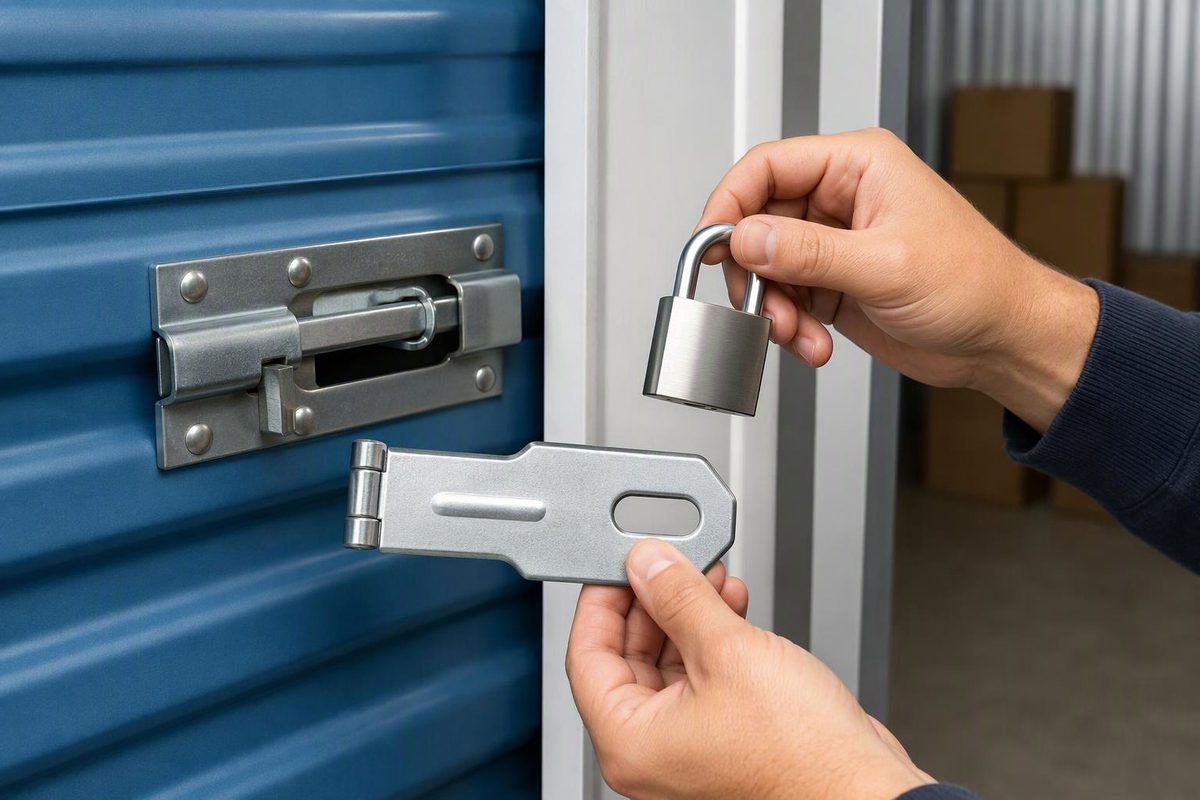
For a storage unit, buy a hasp lock only after the facility approves the lock style and you measure the closed latch. The shackle must pass through the latch holes, span the plates and reach far enough to close, while the lock body leaves room for the door, handle and key. Body width and a “heavy duty” label do not establish that a lock will fit.
Enter the closed-latch measurements; compare them with the cited disc lock or your own candidate.
Shackle Fit Checker
Use millimeters measured with the door shut and the latch in its locked position.
Your Lock’s Shackle Dimensions
Blank measurements remain unknown. The checker will not treat them as zero.
| 40DPF Shackle | Size |
|---|---|
| Diameter | 10 mm |
| Inside width | 19 mm |
| Inside length | 16 mm |
A dimensional fit does not confirm body clearance or facility approval. No measurement allowance is added.
Source: Master Lock 40DPF specifications; inch dimensions are also listed by the manufacturer.
“Hasp lock” is an informal label rather than one universal design. A traditional hasp is a hinged strap that closes over a staple. Many self-storage doors instead have a sliding latch whose holes align when the door closes. In either case, the padlock works only if its shackle fits the closed hardware.
Identify the Door Hardware First
A storage unit may use one of several arrangements:
- Sliding latch with aligned holes: Often paired with a disc lock, which leaves relatively little shackle exposed.
- Recessed cylinder receiver: This accepts a compatible cylinder rather than a padlock. Confirm the approved model with the facility because cylinder locks depend on latch fit.
- Hinged hasp and staple: A conventional short-shackle or shrouded-shackle padlock may fit.
- Purpose-built hidden-shackle hasp: The hasp and lock are designed to work together. Master Lock’s A801, for example, identifies four compatible hidden-shackle lock models and accepts shackle diameters up to 9/16 inch (14 mm), illustrating why compatibility is model-specific (Master Lock).
If the facility requires a particular lock or sells one specifically for that door, settle that requirement before comparing alternatives. A recessed cylinder receiver cannot be secured properly by substituting an ordinary padlock, and a lock accepted at one facility may not suit another facility’s hardware.
Measure With the Door Closed
Take a ruler or calipers to the actual unit if the facility permits it. A photograph can document the hardware, but perspective may conceal the few millimeters that determine whether the shackle fits.
Fully close the door and move the latch into its locked position before taking these measurements:
- Hole diameter: Measure the narrowest point in both aligned holes. The shackle must pass through without being forced.
- Required shackle width: Measure the span the inside of the shackle must bridge, including the latch plates and any gap between them.
- Required shackle reach: Measure the clearance needed from the inside top of the shackle to the lock body so the shackle can pass through and seat normally.
- Body and operating clearance: Check whether a disc body or shroud will hit the door corrugation, latch handle or frame. You also need room to insert and turn the key and remove the lock without trapping your fingers.
Public Storage’s disc-lock instructions show the operating sequence: shut the door firmly, slide the latch until its holes align, tug the door to confirm it is held, and then insert and close the lock. Its cylinder-lock process is different (Public Storage).
Compare the latch measurements with the manufacturer’s dimensional drawing or complete list of shackle dimensions. Product photographs are not reliable enough for this job. Even when the listed diameter, width and reach appear suitable, check the physical lock against the door if possible because published dimensions do not resolve body-clearance problems.
Prefer the Shortest Shackle That Fits
After confirming compatibility, minimize the amount of exposed shackle. Allegion’s padlock guidance says that, in principle, a shorter shackle is less vulnerable to attack and a closed-shackle design is preferable to a long-shackle padlock (Allegion).
For an external self-storage latch, that produces a practical order to test rather than a universal security ranking:
- Keyed disc lock, if the facility accepts it and the body and shackle clear the latch.
- Shrouded- or closed-shackle padlock, if a disc body will not fit.
- Conventional short-shackle padlock, if the latch geometry requires it.
- Long-shackle padlock, only when the hardware genuinely needs the additional reach.
Disc locks are not interchangeable merely because their bodies have the same advertised width. Master Lock’s current 40DPF, for example, has a 2¾-inch body but separately lists a 3/8-inch (10 mm) shackle diameter, 5/8-inch (16 mm) shackle length and 3/4-inch (19 mm) shackle width (Master Lock). Those shackle measurements—not body width alone—determine whether it can pass through and close around the latch.
The dimensional checker above uses that model only as a sourced reference, not as a recommendation for every door. A result showing that its three shackle dimensions fit still does not confirm facility approval, body clearance or adequate operating space.
For a broader comparison, see the best lock for a storage unit by door hardware.
Inspect the Hasp or Latch Itself
A padlock cannot compensate for a bent, loose or badly aligned latch. Before moving in, slide the hardware through its full travel and tug the closed door. Ask the facility to repair enlarged holes, loose fasteners, bent plates or a latch that closes only when forced.
Do not force a thick shackle through a tight or misaligned opening. Apart from making the lock difficult to operate, that can leave you unable to remove it normally. The shackle should pass through and close without using the lock to pull the latch plates into alignment.
On a shed or storage building you own, concealed fasteners reduce access to the mounting hardware. ABUS, for example, specifies a hardened bolt and hidden screws on its Series 300 outdoor sliding bolt (ABUS). On a rented unit, do not drill, replace or modify the latch without the operator’s written permission.
Confirm the Rule and Charge Before Buying
Ask the facility five specific questions before purchasing a lock:
- Does this unit require a disc lock, cylinder lock or named model?
- May I bring my own compatible lock?
- Is a lock included, or will it be added to the move-in bill?
- Can an unused facility-supplied lock be returned?
- What is the charge if lost keys require a lock cut or replacement?
Policies vary by operator and rental channel. Public Storage says customers renting online or by phone are charged for a lock, but may return it unused within 30 days for a full refund if they supply the correct type (Public Storage). That statement applies to the company and rental channels described on its help page; it does not establish every facility’s policy.
Treat a required lock charge as part of the move-in cost when comparing the full storage bill, fees and rate changes. The correct buying order is facility approval first, closed-latch measurements second and security features third. That prevents you from paying for a formidable-looking lock that cannot secure the actual door.