
Is That Wispy Growth Mold or Healthy Mushroom Mycelium?
In favorable conditions, 24-48-hour expansion is a warning, not proof. Compare several clues, isolate the suspect grow, and don't count on peroxide as a cure.
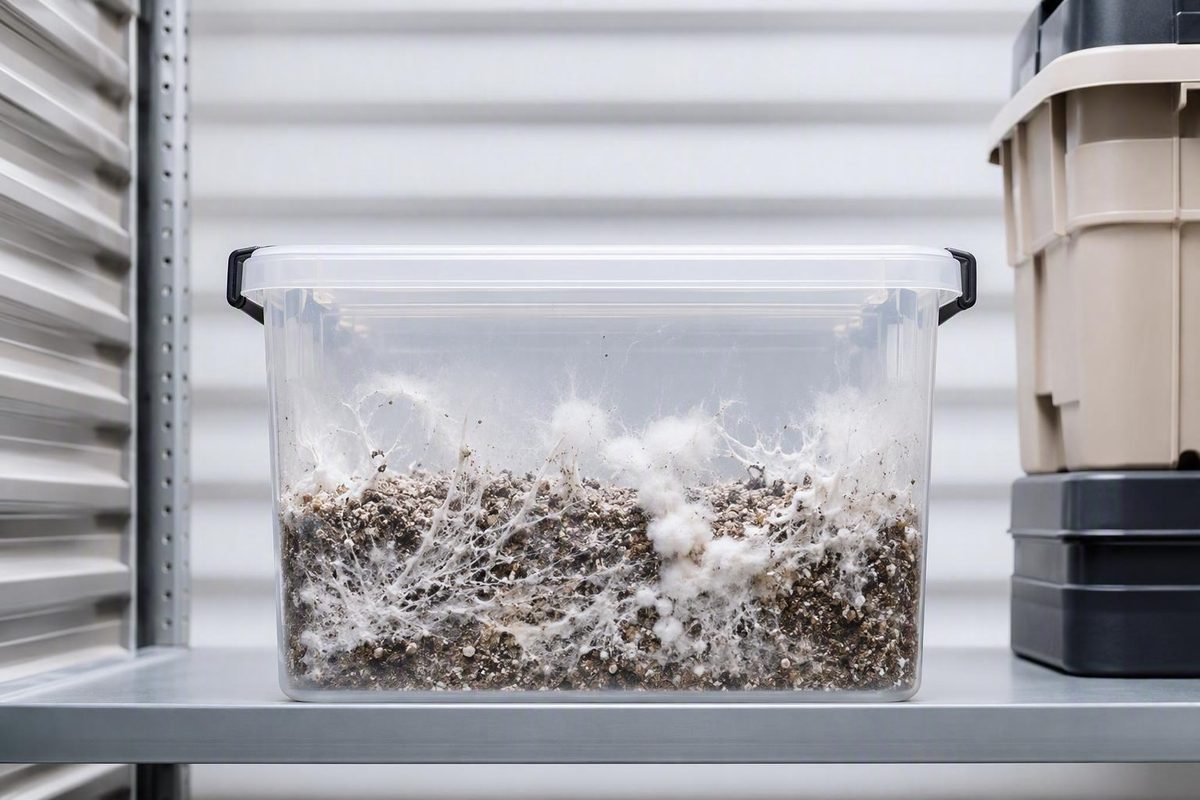
White fluff in a jar, bag, tray, casing layer, or monotub is not enough to diagnose cobweb mold. Healthy mushroom mycelium can be cottony, stringy, web-like, or raised above the substrate, and its appearance can change with growing conditions and developmental stage.
A more useful assessment combines several clues:
- color;
- strand thickness and structure;
- elevation above the surface;
- connection to the substrate;
- spread pattern and rate of change;
- cultivation stage and location;
- effects on pins or mushrooms; and
- odor noticed during ordinary handling, without deliberately sniffing.
When the evidence remains uncertain, follow a cautious sequence:
- Isolate the suspect grow.
- Observe it without unnecessary opening or disturbance.
- Decide whether closed monitoring or conservative disposal presents less risk.
This is a triage framework, not a laboratory diagnosis. The accessible cobweb-specific evidence comes largely from commercial cultivation publishers rather than independent controlled research. It can help growers recognize warning patterns, but it does not establish universal diagnostic, treatment, respiratory-safety, cleanup, or food-safety rules.
What growers mean by “cobweb mold”
This guide addresses cobweb disease and cobweb-like contamination in mushroom cultivation. It does not cover web-like mold on walls, furniture, clothing, stored goods, or building materials, which involve different organisms and remediation questions.
“Cobweb mold” is an informal cultivation label rather than a reliable species identification. The name has been applied to several related mushroom-parasitic fungi, including organisms in or historically associated with Hypomyces, Cladobotryum, and Dactylium. That does not mean every gray or wispy patch contains one of those organisms. A commercial mycology explainer describes the term as covering multiple related fungi and says definitive separation among them may require molecular testing (Zombie Myco).
Cultivation sources describe these fungi as parasites of mushroom mycelium and fruiting bodies. Reported crop effects include aborted pins, stalled fruiting, softness, and rot. Those symptoms still do not prove cobweb disease: waterlogging, environmental stress, bacteria, and other molds can also damage developing mushrooms.
Sources also disagree about prevalence. Some commercial publishers characterize true cobweb disease as uncommon and frequently misidentified, while another calls it a common mushroom pathogen. The supplied evidence contains no reliable prevalence data for home grows, so the true frequency is uncertain.
That uncertainty establishes an important diagnostic boundary:
- Field observations can guide containment and triage.
- A photograph cannot confirm the organism.
- No single color, texture, smell, location, or growth rate is conclusive.
- Definitive identification may require specialized analysis beyond ordinary home observation.
For most home growers, the immediate objective is not to prove which fungus is present. It is to decide whether the culture can remain safely contained for observation or whether continued handling threatens nearby grows.
Cobweb mold versus healthy mycelium: a multi-clue comparison
The central correction is simple: fluffy, cottony, or web-like white growth alone does not establish contamination.
Healthy mycelium can take more than one form:
- Tomentose mycelium is cottony, fluffy, and relatively unstructured.
- Rhizomorphic mycelium is root-like, rope-like, branching, or stringy.
Both can alarm an inexperienced grower. Tomentose growth may resemble white mold, while rhizomorphic growth can resemble a network of fine webs. Healthy aerial mycelium may also rise above the substrate, and dehydrated surfaces can develop pale or irregular-looking areas. Ryza’s comparison of these normal growth forms illustrates why “fluffy” and “web-like” are inadequate diagnoses by themselves (Ryza).
Use the following matrix for triage, not as a binary identification test.
| Clue | More consistent with healthy mycelium | More concerning for cobweb-like contamination | Diagnostic weight |
|---|---|---|---|
| Color | Commonly clean or bright white, although species, lighting, moisture, and substrate can alter appearance | Often described as white-gray, dull gray, darker gray, or occasionally nearly black | Supportive but strongly overlapping |
| Strand thickness | May be dense and cottony or form thicker ropes and branches | Often described as exceptionally fine, delicate, or wispy | Supportive, not definitive |
| Structure | Tomentose, rhizomorphic, branching, matted, or organized into defined zones | Loose, diffuse, cloud-like, or poorly organized | Supportive but subjective |
| Elevation | May remain close to the substrate or become aerial | Often reported as loosely elevated above the surface | Limited because aerial mycelium overlaps |
| Substrate integration | Appears to emerge from, bind, or colonize substrate particles | May appear lightly draped over the surface | Moderately useful when clearly visible |
| Spread pattern | Often advances from colonized areas in a coherent front or defined patches | May appear irregular, scattered, or discontinuous | Supportive, not exclusive |
| Rate of change | Can grow quickly but often follows an understandable colonization pattern | Dramatic expansion of fine gray growth raises concern | Useful for triage, not a diagnostic timer |
| Likely stage | Normal throughout grain, bulk colonization, casing, and fruiting | Frequently reported on casing layers and during fruiting or later flushes | Context only |
| Crop effects | Pins and mushrooms continue developing normally | Aborted pins, softness, rot, or stalled fruiting increase concern | Important but not organism-specific |
| Confidence from one clue | Low | Low | Combine multiple observations |
Color: compare rather than diagnose
Healthy mycelium is commonly described as brighter white. Suspected cobweb growth is often described as grayish, but commercial source descriptions range from white-gray to dark gray or black.
A bright-white patch is reassuring only when it agrees with other signs, such as substrate integration and organized development. A gray patch deserves closer observation, but grayness alone does not identify cobweb disease.
Texture and structure: examine how the growth is built
Tomentose mycelium may resemble cotton padding or dense fluff. Rhizomorphic growth can look like roots, veins, ropes, or strings. Both are recognized forms of healthy mycelium.
Cobweb-like contamination is more often described as a loose network of very fine strands suspended over the surface.
Instead of asking only whether a patch resembles a spiderweb, ask:
- Does it have organized branches or ropes?
- Does it arise from an established colonization front?
- Does it bind grains or substrate particles?
- Does it look like a loose cloud resting over the surface?
- Has its structure changed substantially since the previous photograph?
Elevation and substrate integration
Growth that appears lightly draped over a casing layer may be more concerning than growth visibly binding the substrate. Healthy aerial mycelium can also rise above the surface, however, so elevation remains an overlapping clue.
When possible, view the patch from the side through the container. Side lighting may show whether it is a thin surface haze, a raised cloud, or dense growth emerging from within the substrate. Do not open a sealed jar or bag merely to improve the viewing angle.
Other colors and textures may point elsewhere
Green, black, bright-yellow, orange, pink, or strongly discolored growth should broaden the possibilities rather than strengthen a cobweb diagnosis. Slimy, greasy, or excessively wet areas may indicate bacterial activity or another contamination problem. General cultivation guidance distinguishes gray wispy growth from green sporulation and wet, slimy patches, but these visible categories still do not provide laboratory confirmation (Fungi Academy).
Sometimes the most useful conclusion is not “This is cobweb mold.” It is simply: “This is not behaving like healthy mycelium, so it should remain isolated.”
Use growth over time and cultivation stage to improve the assessment
A single photograph freezes an ambiguous moment. A time series reveals direction, speed, pattern, and effects on surrounding growth.
Rapid expansion is not unique to cobweb-associated fungi. Nevertheless, a fine gray patch that changes dramatically between consistently framed photographs is more concerning than bright-white growth that remains integrated with the substrate and advances predictably.
Several commercial cultivation sources report that suspected cobweb growth can expand dramatically within 24–48 hours under favorable conditions. Treat that interval as a warning pattern, not a diagnostic stopwatch; healthy mycelium and other contaminants can also change rapidly (FloCube).
A suspect patch is not cleared merely because it fails to cover a container within two days. Conditions, organisms, substrates, and mushroom species vary.
A low-disturbance documentation protocol
If the container can remain safely closed, document it before deciding whether to continue monitoring:
- Leave the lid, filter, or bag seal undisturbed. Photograph through the container whenever visibility allows.
- Use consistent lighting. Avoid changing between strongly tinted artificial light and daylight.
- Keep the same camera angle and distance. This makes apparent changes easier to compare.
- Include scale. Place a ruler or coin outside the container, near the same visual plane as the patch.
- Record the date and time.
- Note the cultivation stage. Record whether the grow is in grain colonization, bulk colonization, casing, pinning, active fruiting, or a later flush.
- Describe instead of diagnosing. Write “pale gray, raised, approximately coin-sized” rather than “definitely cobweb.”
- Repeat after 12–24 hours. This is a practical comparison interval, not a biological diagnostic threshold; continue monitoring only while the grow remains contained and no stronger warning signs appear.
- Record crop effects. Note pin abortion, discoloration, softness, collapse, rot, or stalled development.
A useful log entry might read:
Day 18, 8:00 a.m.—pale patch on casing near rear wall; approximately 20 mm wide; fine raised strands; no visible fruit damage. Day 18, 8:00 p.m.—patch appears wider and less defined. Photographed from the same position. Container remains closed and isolated.
That record is more informative than “It looks fluffier today.”
Compare the spread pattern
Healthy colonization often grows outward from identifiable inoculation points or advances in relatively defined fronts. Separate colonies may initially be visible, but they commonly become denser and connect as colonization proceeds.
Suspect cobweb-like growth is often described as irregular or apparently discontinuous, as though it has appeared over separate surface areas rather than advancing as a coherent, substrate-bound front.
This clue also overlaps.
Let cultivation stage adjust suspicion—not decide it
Cobweb disease is reported more often on casing layers, during fruiting, and in later flushes than during early grain colonization.
The available sources conflict about grain spawn. Some mention cobweb-like contamination in jars or bags, while others say it is uncommon during early colonization and appears mainly after mushroom mycelium is established. One commercial explainer places the syndrome chiefly on casing layers and in later stages, but that account should not be treated as a universal exclusion rule (Zombie Myco).
Use stage as context:
- Early grain colonization: Healthy tomentose growth and other contaminants may be plausible; stage alone cannot rule cobweb-like contamination in or out.
- Bulk colonization: Look for connection to inoculation points and visible binding of the substrate.
- Casing and pinning: Raised gray wisps, irregular spread, and pin abortion warrant closer attention.
- Fruiting and later flushes: Document softness, rot, stalled development, and suspicious growth around damaged or persistently wet areas.
Do not open a suspicious grain jar or bag indoors simply to touch, smell, or inspect the growth more closely.
Immediate response: isolate, observe, then decide
The first response should be containment, not improvised chemical treatment.
1. Isolate the grow
Separate the suspect jar, bag, tray, or monotub from unaffected cultures and keep it closed when practical. Place it where people and pets will not disturb it and where a fan or other strong air current will not blow across it.
Do not shake a grain jar, squeeze a bag, fan an open surface, or carry an uncovered tray through the shared cultivation area. A commercial contamination guide similarly recommends isolating questionable cultures and minimizing disturbance before deciding what to do (Midwest Grow Kits).
Isolation does not mean ignoring the overall grow environment. Room-level air exchange may still need correction, but do not direct strong airflow across an open suspect culture.
2. Observe without unnecessary disturbance
Inspect through clear walls or lids and compare the same patch over time. Do not open the container merely to:
- obtain a clearer photograph;
- touch the growth;
- test whether it collapses;
- collect an informal sample;
- spray it “just in case”; or
- smell it.
Odor is only a supporting clue. Musty, mildew-like, sour, or otherwise strong off-odors can reinforce concern, but odor is subjective. Record an odor only if it is apparent during ordinary handling.
Do not place your nose near a filter, vent, lid gap, or open container. A commercial cultivation source warns that inhaling suspected mold spores may cause respiratory irritation or allergic reactions in some people and suggests wearing a mask during necessary handling, but the supplied evidence does not establish a complete protective-equipment standard (Fungi Academy).
Anyone with health concerns or a potentially significant exposure should seek guidance from an appropriately qualified medical or occupational-safety professional.
3. Decide according to the developing risk
Continued closed observation is more reasonable when the growth is:
- bright or clean white;
- visibly integrated with the substrate;
- organized into cottony, branching, or rope-like structures;
- stable or advancing in a coherent pattern;
- neither powdery nor slimy; and
- not associated with damaged pins or mushrooms.
Conservative disposal becomes more reasonable when the growth:
- changes unusually quickly;
- becomes increasingly gray, diffuse, or elevated;
- spreads in irregular surface patches;
- becomes powdery or appears readily airborne;
- develops slime or substantial discoloration;
- produces a strong off-odor apparent without sniffing; or
- coincides with aborted pins, softness, rot, or failed fruiting.
These are risk-management signals, not proof of a particular organism. Protecting nearby grows and minimizing exposure take priority over obtaining a species name at home.
Can a suspected grow be treated?
Environmental correction and eradication are not the same thing.
Correcting pooled water, excessive misting, stagnant air, or unsuitable temperature may make conditions more appropriate for the cultivated mushroom. It does not prove that an established contaminant has been eliminated.
Environmental adjustments
Low-disturbance corrections may include:
- stopping automatic misting when water is already pooling;
- addressing a persistently waterlogged surface;
- returning the environment toward the mushroom species’ requirements;
- improving general room-level fresh-air exchange; and
- reducing unnecessary container opening.
Do not defeat containment while making these changes. Avoid directing a fan at an open suspect tray or repeatedly opening an isolated container to make small adjustments.
Humidity should not be reduced indiscriminately. Mushrooms require species- and stage-appropriate moisture. The practical aim is to prevent standing water and persistent waterlogging without drying out the crop.
Hydrogen peroxide claims remain uncertain
Several commercial cultivation sources recommend hydrogen peroxide for small, early suspect patches, sometimes specifying pharmacy-strength 3% hydrogen peroxide. The supplied evidence does not include controlled, species-specific research demonstrating that this concentration reliably eliminates all fungi grouped under the cobweb label—or their spores—without harming cultivated mushroom mycelium.
Published commercial protocols also conflict over:
- the starting concentration;
- whether the product should be diluted;
- application method;
- treatment interval;
- number of applications; and
- criteria for success.
Because of those conflicts, there is no evidence-supported universal recipe here. FloCube, for example, gives a diluted protocol but does not clearly identify the peroxide product’s starting concentration, while other commercial advice recommends undiluted 3% peroxide (FloCube).
Possible outcomes of a rescue attempt include:
-
temporary suppression of visible growth;
-
an apparent improvement limited to the surface;
-
added exposure from opening and handling the culture.
The original visual diagnosis may also have been wrong, in which case treatment could damage healthy tomentose or aerial mycelium.
Salt is anecdotal, not validated
A commercial mycology source describes covering an early suspect area and applying refined salt. The supplied evidence does not establish a validated dose, species compatibility, eradication rate, or safe application method.
Do not use unsupported rules based on the percentage of surface visibly affected. Continued spread, recurrence, sporulation, crop damage, and the risk to neighboring cultures matter more than an arbitrary percentage.
When experimentation is least justified
A rescue attempt is particularly difficult to justify when contamination is:
- extensive;
- recurring after intervention;
- visibly sporulating;
- powdery or readily disturbed;
- associated with slime or strong off-odors;
- present in multiple areas; or
- damaging pins or mature mushrooms.
Do not apply general household or garden fungicides to a mushroom grow. One commercial source limits any fungicide suggestion to products specifically approved and labeled for mushroom cultivation, but the supplied evidence does not establish a particular product as safe or effective. Product labeling, cultivated species, intended food use, and applicable regulation would all matter.
For many home growers, preserving unaffected cultures is more valuable than repeatedly opening one suspect container for an uncertain rescue attempt.
When disposal is safer—and what not to eat
Disposal is the more conservative choice when suspicious growth keeps spreading rapidly, becomes powdery or readily airborne, involves much of the culture, returns after attempted containment, produces slime or strong off-odors, or causes mushrooms to soften and rot.
This is a practical risk decision rather than a cobweb-specific safety standard. Repeatedly opening, spraying, scraping, or inspecting a suspect culture can expose nearby containers without establishing what organism is present.
Keep disposal focused on containment
The supplied evidence does not establish a universal cobweb-specific disposal or remediation protocol. A bounded approach is to:
- Keep the suspect culture closed.
- Avoid shaking, scraping, or spraying it indoors.
- Keep it away from fans and strong air currents.
- Remove it from the cultivation area without reopening it when that can be done without spilling.
- Use waste guidance applicable to the materials and location involved.
- Clean contacted tools and surfaces according to product instructions and established cultivation sanitation practices.
These steps should not be interpreted as proof that a particular cleaning process eliminates every spore.
If a container cannot be moved without opening or spilling, the supplied evidence is insufficient to prescribe a complete handling, protective-equipment, or remediation procedure. Minimize access and seek guidance appropriate to the physical setup rather than improvising a high-disturbance cleanup.
Treat consumption as an uncertainty, not a reassurance
Do not eat mushrooms that are visibly moldy, soft, slimy, or rotting.
The supplied cobweb-specific sources do not establish authoritative safety criteria for apparently normal mushrooms harvested from the same contaminated culture. They do not provide confirmed organism identification, exposure limits, testing, or a formal food-safety framework. As a result, this article cannot assure that apparently unaffected mushrooms from that culture are safe.
Choosing not to consume the harvest is a conservative response to uncertainty, not proof that a particular cobweb-associated fungus has produced a known hazard. The visible growth may have been misidentified, other organisms may be present, and decomposing mushrooms can involve more than one problem.
Without authoritative evidence for the organism and circumstances involved, appearance and cooking alone cannot provide a safety guarantee.
Why cobweb-like contamination develops
The recurring pattern in commercial cultivation guidance is excessive surface moisture or high humidity combined with stagnant air or inadequate fresh-air exchange.
Humidity alone is neither a diagnosis nor a universal cause. Mushroom species and developmental stages have different environmental requirements. A humid environment with suitable air exchange and controlled surface moisture differs from a stagnant enclosure with persistent pooling.
Moisture and stagnation can interact
Practical contamination opportunities include:
- excessive misting;
- pooled water on the substrate or casing;
- persistently waterlogged substrate;
- condensation dripping repeatedly onto one area;
- inadequate fresh-air exchange;
- blocked or poorly functioning filters;
- continuously saturated surfaces; and
- warm, still pockets within a grow area.
A wet, stagnant environment can support multiple molds and bacteria, not only fungi associated with cobweb disease. Finding pooled water may explain an opportunity for contamination, but it does not identify the organism.
Handling creates additional opportunities
Repeatedly opening a container increases airborne exposure and the opportunity for handling errors. Commercial contamination guidance also identifies unclean handling, frequent tub opening, excessive moisture, open-air exposure, and movement between contaminated and clean cultures as practical risk factors.
Other possible weak points include:
- touching the culture or inner container surfaces;
- using unclean hands or tools;
- moving directly from a suspect culture to a clean one;
- reusing inadequately cleaned equipment;
- carrying uncovered trays through dusty or active spaces;
- improper substrate preparation;
- weak or contaminated spawn; and
- cross-contamination from nearby grows.
Growth first noticed during fruiting does not prove that the fruiting environment was the original source.
Temperature may affect speed without identifying the problem
Some commercial sources report faster cobweb-like development under warm conditions. The supplied evidence does not establish a universal temperature threshold for diagnosis, treatment, or prevention.
The relevant temperature depends on the cultivated species, organism present, substrate, moisture, air exchange, and developmental stage. Environmental correction should return the grow toward species-appropriate conditions rather than attempt to kill an unidentified contaminant by stressing the mushroom culture.
Casing layers and aging cultures deserve closer observation
Cobweb disease is frequently reported on casing layers and in later flushes.
Peat-based casing materials are also mentioned by commercial sources as a possible context for dormant contamination. That does not establish peat as the source of a particular outbreak or mean that peat automatically carries cobweb-associated fungi.
During later flushes, pay closer attention to places where:
- old mushroom tissue remains;
- water collects;
- the casing is compacted;
- mushrooms were damaged during harvesting; or
- one area stays wet while the surrounding surface dries.
These are risk contexts, not diagnostic findings. Poor sanitation, excess moisture, stagnant air, warm conditions, and an aging casing layer can raise concern without proving cobweb disease.
Preventing a repeat without drying out the grow
Prevention does not mean making the environment hostile to mushrooms. It means meeting the cultivated species’ requirements while reducing avoidable opportunities for contamination.
Preparation and inoculation checklist
Before starting another culture:
- Wash and dry your hands before handling clean materials.
- Clean work surfaces and tools using methods suitable for their materials.
- Use quality spawn from a reliable source.
- Prepare the substrate correctly for its composition and cultivation method.
- Use the appropriate pasteurization or sterilization process rather than treating those terms as interchangeable.
- Reduce airborne exposure during inoculation.
- Keep prepared materials covered until needed.
- Avoid opening clean materials near active suspect grows, waste, soil, or drafts.
- Label containers with the mushroom species, substrate, inoculation date, and batch.
- Separate suspect cultures promptly.
General mushroom-growing guidance likewise emphasizes clean handling, appropriate substrate preparation, quality spawn, reduced airborne exposure, and suitable air exchange as broad contamination controls (GroCycle).
Manage moisture for the mushroom
Use species- and stage-appropriate conditions rather than copying a universal humidity, temperature, or misting number from an unrelated grow.
The practical moisture goal is to:
- maintain the moisture required for colonization or fruiting;
- avoid standing water;
- prevent persistent waterlogging;
- respond to the actual surface rather than misting automatically;
- account for condensation and evaporation; and
- avoid repeated swings between saturation and excessive drying.
If the surface is already wet, additional misting is not automatically beneficial. If it dries too quickly, aiming stronger humidification directly at it may create uneven saturation elsewhere. Adjust the broader system rather than chasing one isolated reading.
Improve air exchange without blasting the culture
Fresh-air exchange and strong direct airflow are not the same thing.
Improve the overall environment by checking blocked air paths, reviewing filter condition, or adjusting room-level exchange in a way appropriate to the cultivated species. Do not place a fan directly across an open tray, especially one suspected of contamination.
The aim is suitable, gentle exchange—not a wind tunnel.
Build contamination barriers into routine operations
Useful operating habits include:
- limiting unnecessary tub opening;
- checking cultures through clear walls or lids;
- keeping clean and suspect grows physically separated;
- working with clean cultures before handling questionable ones;
- cleaning hands, tools, and contacted surfaces before returning to clean work;
- avoiding the use of the same unclean harvesting tools across containers;
- removing damaged mushroom tissue promptly;
- inspecting later flushes more closely;
- keeping waste away from inoculation and fruiting spaces; and
- correcting recurring leaks, drips, or pooling.
If several containers from the same batch develop similar problems, investigate their shared steps: spawn source, substrate preparation, inoculation session, tools, incubation area, misting routine, and air-exchange setup.
Keep a grow log
A basic log can reveal patterns that memory misses. Record:
- mushroom species and strain, if known;
- spawn source and batch;
- substrate ingredients;
- preparation method;
- inoculation date;
- colonization milestones;
- casing material and application date;
- environmental changes;
- misting frequency;
- fresh-air adjustments;
- container openings;
- harvest dates;
- photographs; and
- the location and timing of suspicious growth.
If problems repeatedly appear only in later flushes, after one environmental change, or in containers prepared during the same session, the log provides a practical starting point for investigation.
Home observations still have clear limits. Photographs, color comparisons, stage information, and time-series records can support a containment decision, but they cannot reliably identify a fungal species. Specialized analysis may be necessary for definitive identification.
Frequently asked questions
Is white fluffy growth cobweb mold?
Not necessarily. Healthy tomentose mycelium is naturally fluffy, cottony, and relatively unstructured. Rhizomorphic mycelium can be stringy or web-like, while aerial mycelium can rise above the substrate.
Assess color, structure, substrate integration, spread pattern, cultivation stage, rate of change, and crop effects together. Bright-white growth that remains connected to the substrate and develops coherently is more consistent with healthy mycelium. Gray, exceptionally fine, loosely elevated growth that changes unusually quickly is more concerning, but it is still not conclusive.
How fast does suspected cobweb mold grow?
Commercial cultivation sources report dramatic expansion within 24–48 hours under favorable conditions, but that interval is a warning sign rather than a diagnostic rule. Healthy mycelium and other contaminants can also grow quickly, while suspect growth may develop more slowly under different conditions.
Photograph the patch with consistent lighting, angle, and scale, then compare it after a documented interval. Focus on measurable change and spread pattern rather than whether it met a fixed deadline.
Should I open or smell a container to confirm cobweb mold?
No. Keep a suspicious container closed when practical and inspect it through the wall or lid. Do not open it indoors merely to take a better photograph, touch the growth, or smell it.
Musty or mildew-like odor is subjective and cannot confirm the organism. Commercial cultivation guidance also warns that deliberately inhaling suspected mold spores may cause respiratory irritation or allergic reactions in some people. If an off-odor is apparent during ordinary handling, record it without moving closer to investigate.
Will 3% hydrogen peroxide kill cobweb mold without harming mycelium?
That outcome is not established. Commercial cultivation sources recommend 3% hydrogen peroxide for some small, early suspect patches, but the supplied evidence does not demonstrate that it reliably kills all cobweb-associated fungi or spores while leaving every cultivated mushroom species unharmed (Fungi Academy).
Protocols conflict over dilution, timing, frequency, and application. Treatment may suppress visible surface growth, damage mushroom tissue, or create temporary improvement while contamination remains below the surface. Hydrogen peroxide should not be treated as a selective or guaranteed cure.
Can I eat mushrooms from a grow with suspected cobweb mold?
Do not eat mushrooms that are visibly moldy, soft, slimy, or rotting, and do not simply cut away the affected portion.
The supplied evidence does not establish authoritative safety criteria for apparently unaffected mushrooms from the same contaminated culture. Because the organism, extent of contamination, and possible presence of other organisms remain uncertain, this article cannot assure that those mushrooms are safe. Not consuming the harvest is a conservative risk-management choice under uncertainty, not a cobweb-specific finding that every mushroom from such a grow is necessarily hazardous.
Conclusion
Do not diagnose cobweb mold from fluffiness alone. Healthy mycelium can be cottony, rope-like, stringy, web-like, or aerial.
Isolate a suspect grow, keep it closed when practical, avoid direct airflow and unnecessary disturbance, and compare multiple traits over time. Stable, bright-white growth that remains integrated with the substrate may be normal mycelium. Rapidly expanding gray wisps, powdery or slimy growth, strong off-odors, sporulation, or mushroom damage make conservative disposal more reasonable than repeated rescue attempts.
Chemical treatments remain uncertain, visible improvement does not prove eradication, and visibly affected mushrooms should not be eaten. The practical goal is not to prove the organism at home—it is to protect nearby cultures while making the least disruptive decision supported by the grow’s changing behavior.